❌

普通视图

发现新文章,点击刷新页面。
昨天 — 2026年11月9日首页

Wearable sleep trackers are using your brainwaves to train AI models without explicit user consent

2026年11月9日 20:00

Your sleep data might be doing double duty. While wearable headbands promise to help users understand their sleeping patterns, some of the companies behind them are also turning the electrical signals collected from their customers' brains into training material for artificial intelligence models. Science recently conducted an investigation alongside Pulitzer Center's AI Accountability Network and found that the customer neurology companies have accumulated tens of millions of hours of electroencephalography (EEG) recordings — a rather technical way of saying brain-wave data. As per the findings, several are using those recordings to develop so-called brain foundation models, despite initially failing to spell out that use in their privacy policies.

Interaxon, the Canadian firm behind the Muse sleep and meditation headband, is one of them. Its devices monitor electrical activity in the brain, alongside other physiological measurements, while users sleep. The recordings are processed into reports that help customers track their rest and identify changes in their sleeping patterns. But there is another use for that information. Interaxon has already trained an AI model using about 50,000 hours of EEG recording and says it removes identifying information, including names, email, and addresses, before using the data. “We aim to use as much of that eligible corpus as possible,” Nadia Kumentas, its Chief Marketing Officer, said.

That was not made particularly clear to customers, though. Prior to talking to Seince, Interaxon's privacy policy did not explicitly disclose that users' brain recordings could be used to train foundation models. The company has, however, updated the same with Kumentas acknowledging, "We agree users should be explicitly informed." For customers whose recordings had already been used, the classification came late, which likely exposes the company to potential lawsuits. Privacy, it seems, remains a major issue. As per Science, more than two-thirds of the companies studied explicitly allowed corporate transfers of data without user consent. That could be significant if a small neurotechnology firm is acquired, potentially putting its accumulated recordings in the hands of a new owner. Colorado and California, however, have amended their consumer privacy laws to cover neural data, although other states lag behind.

Interaxon isn’t the only company pushing this idea. Emotiv, another wearable EEG maker, is training its Large Brain model partly on recordings from customers using its high-end devices. It also updated its privacy policy following questions by Science, disclosing the use of de-identified neural data for model training subject to opt-in consent.

Notably, the idea behind these systems is particularly different from training a large language model. Instead of feeding AI an enormous amount of text, developers supply it with recordings of electrical activity in the brain. The model then learns recurring patterns that can be adapted to recognize different brain states or assist with specific research tasks. And there are already some interesting results. AI startup Piramidal has trained its model on more than 4 million hours of EEG data in partnership with Cleveland Clinic. The company developed a seizure-detection system that correctly identified nine out of 10 seizures in a pilot study after being fine-tuned on the clinic's recordings. That, however, doesn’t mean consumer headbands can suddenly read people's thoughts. Most wearable EEG devices use just one to six electrodes, considerably fewer than 19 to 25 typically found in clinical EEG systems. Also, their recordings are generally less comprehensive.

That said, the privacy implications of wearable brain technology aren't entirely new. In February, an engineer discovered he could access other people's brainwave recordings through a smart sleep mask he had purchased. He reportedly investigated the device after running into connection problems. By examining its Android application, he discovered hardcoded credentials that appeared to be shared across devices, which he later found were EEG readings belonging to other users.

The industry has also been gathering neural recordings on a considerable scale. Last December, we covered Coundit’s effort to collect 10,000 hours of neural data from thousands of patients. The San Francisco startup built its own headset system to capture brain activity alongside speech and text, with the aim of developing AI capable of translating signals into language. Meta has also been working on BrainQwerty, a non-invasive brain-computer interface that translates brain activity into keyboard inputs. Its second-generation system improved average word accuracy to 61% from 40% in the earlier version, although the technology remains a far cry from practical everyday use.

AMD admits GPU driver bug is writing data continuously, wearing out SSDs

2026年11月9日 19:46

An SSD can spend most of its day doing very little, particularly when a PC is sitting idle. That may not be the case for some AMD Radeon systems, however, with reports suggesting that AMD’s External Events Utility (EEU), which is installed alongside Radeon drivers, may be writing data to the system driver continuously, even when the computer is barely being used. The issue drew attention again on November 8, when Reddit user ‘darklinkpower’ highlighted reports of the unusual drive activity.

One Radeon owner claimed the problem had been quietly eating into their drive's reported health for more than a year, writing: "I just found out that the driver eats up 1% of my SSD health every month for 16 months." Another user reported sustained writes of approximately 5MB/s while their PC was idle. Another one claimed their SSD health had dropped by about 1% every month for 16 months. AMD has acknowledged the problem. In an October 21 response on its community forum, a company representative confirmed that they were investigating. “Yes. We're looking into it with the aim to resolve it in a future driver release." He said. Another representative, AMAD Vik, subsequently offered a more encouraging update on Reddit, apologizing and saying, “This is hopefully fixed in the next one."

PSA: As of the latest AMD Adrenaline update, a bug may be causing silent, constant writes to your SSD, unnecessarily killing its lifespan.
 from r/pcmasterrace

Notably, the EEU is not an entirely unfamiliar culprit. Last November, a similar issue involving AMD chipset drivers arose, with a Redditor claiming he had discovered that the software repeatedly updated a log file whenever on-screen elements were moved or resized. That incident also prompted questions about whether stopping the service would affect FreeSync. The latest reports are a different proposition, though, with some users now seeing writes that barely let up, even when their PCs are doing nothing.

The numbers are worth looking at. At 5 MB/s, an SSD would receive about 18GB of host writes per hour. Over a full day, that's 432GB, and a month of uninterrupted activity could push the figures close to 13TB. That, however, does not necessarily mean being written to the NAND flash itself. SSD controllers use caching and wear-leveling, and other techniques, to manage incoming data. How much of that reported activity thus translates into actual flash wear is still unknown. The user's claim of losing 1% of drive health each month also hasn't been independently confirmed.

Moreover, there doesn't appear to be clear patterns across Radeon driver versions. Reports include systems running Adrenalin 26.19.2, as well as older releases, suggesting the problem may not be limited to the latest update. AMD's October 30 release notes for Adrenalin 26.20.2 don't mention the issue either. For now, it's difficult to say which driver versions, hardware combinations, or system configurations are responsible.

That said, there are two reported workarounds. The first involves opening the Windows Services application by pressing Win + R, entering services.msc, and locating AMD EEU. Users can then stop the service or change its startup type to Disabled. That appears to stop excessive writeups, but isn’t necessarily a clean solution. The second workaround involves disabling Resizable Bar (ReBAR), which another user reported had stopped the disk activity without disabling the EEU. This, however, isn’t ideal either, as ReBAR can improve gaming performance by allowing the PC to access the GPU’S memory more efficiently.

For now, checking whether the problem actually exists on your PC is probably the most sensible first step. Open Windows Resource Monitor by pressing Win + R, typing resmon, and selecting the Disk tab. Sort by write activity and look for sustained writes from atieclxx.exe or atiesrxx.exe. AMD has indicated that a fix is in the works, but hasn’t published a confirmed release date. Until then, Radeon owners may want to monitor their storage activity rather than immediately disabling driver services or changing BIOS settings.

Ukraine builds combat robots to hunt Russian troops in underground gas pipelines

2026年11月8日 22:36

Ukraine is developing a new class of combat robots designed to operate inside underground gas pipelines, where Russian troops have repeatedly attempted to bypass frontline defenses, United24Media reports. The project, disclosed by Ukraine's 2nd National Guard Corps, Khartiia, involves modifying unmanned ground vehicles (UGVs) to perform reconnaissance and combat missions in spaces too narrow for conventional military machinery. Notably, the work is being carried out by specialists from the corps’ Lava Unmanned Systems Regiment, following Operation Veles — an underground assault that saw Ukrainian soldiers advance more than 15 kilometers through pipeline infrastructure near Kupiansk. Khartiia says the operation killed more than 100 enemy soldiers and resulted in over 30 captured, although those battlefield figures have not been independently verified.

The commander of Lavas ground robotic system battalion, identified by the callsign ‘Matematyk’, said the project addresses a category of warfare that requires a different approach from conventional battlefield robotics. “There is a very long list of tasks that need to be accomplished to fight underground and counter the enemy underground. This is a new class of technologies and challenges that we will have to confront,” he said.

The machines are being adapted from existing groundrobots,rather than developed as conventional surface vehicles. They must be compact enough to navigate narrow pipelines while retaining the ability to carry out military assignments . Most commercially available underground machinery, meanwhile, is designed for construction, drilling, and tunneling — not combat.

As of now, Khartiia is already developing several robotic systems to address those limitations, with the broader objective of sending machines into dangerous underground environments where soldiers would otherwise have to conduct reconnaissance, confront enemy positions, clear positions, or clear out themselves. “War is already underground, and it will expand. The question is how we adapt to this war,” Matematyk said.

The project follows unusual battlefield developments near Kupiansk, where Ukrainian forces used the same underground infrastructure that Russian troops have previously exploited to infiltrate behind Ukrainian defensive positions. During Operation Vels, Ukrainian soldiers moved through a gas pipeline measuring approximately 1.2 meters in diameter, according to a report by Ikrainska Pravda. The confined passage made movement and close-range firefights particularly,with Ukrainian troops having little-to-no room to maneuver.

Russia had previously used the pipeline network beneath the Oskil River to move soldiers toward Ukrainian-held territory. The Ukrainian battlefield monitoring group ‘Deepstate' reported an earlier Russian infiltration attempt in September 2025. Last month, President Volodymyr Zelenskyy said that Ukrainian forces had eliminated more than 100 Russian troops and captured over 30 during the operation. The experience also exposed the limitation of sending soldiers into such environments. Underground operations restrict visibility,complicate communications , and leave little room for maneuvering equipment.

That said, Ukraine has increased its reliance on unmanned military systems as battlefield terrain proves complicated to navigate. In July 2024, we reported on Ukrainian forces deploying AI-controlled drones capable of independently identifying and attaching targets. The country has also been experimenting with unmanned systems that operate beyond conventional aerial platforms. In August, the US Army tested an autonomous Ford F-250 breaching vehicle, which builds on the Lancer unmanned ground vehicle program and uses a counter-drone turret to protect military operations from aerial attacks.

However, autonomous ground systems still face considerable technical challenges. Russia's Shturm uncrewed assault tanks , for instance , repeatedly lost their command connection during the Tsentr-2026 military exercise. The vehicle eventually became stuck in mud, even after organizers switched to manual driving. Russia has also tested an AI powered Shahed variant using Nvidia's Jetson Orin computing platform. The system was reportedly capable of identifying targets without relying on externally supplied coordinates.

昨天以前首页

Enthusiast abandons self-hosted Microsoft Exchange after 27 years, moving mailboxes to Microsoft 365

2026年11月7日 20:30

Running your own email server is one thing. Keeping it alive for nearly three decades is quite another. One homelab enthusiast has finally decided to call time on his Microsoft Exchange installation after maintaining it since 1999, replacing the last remaining server with Postfix on Ubuntu Server LTS. The user, posting as Meta4X on Reddit’s r/homelab on November 5, said they had already moved their mailboxes and email delivery to Microsoft 365 a couple of years ago. Exchange was still hanging around, however, serving as a relay for alerts generated by hardware and software on their local network. With that final job now being handed to Postfix, the 27-year run is coming to an end.

Pour One Out For My Homies - 27 Years of Exchange at Home
 from r/homelab

Meta4X’s installation began with Exchange 5.5 running on Windows NT 4. Since then, they have upgraded through Exchange 2000, 2003, 2007, 2010, 2013, 2016 and finally Exchange 2019. They said access to Microsoft’s software through MSDN, TechNet and the Microsoft Action Pack had allowed them to keep the setup running over the years. The end of support for Exchange 2019 last year was one reason to consider keeping the server around. Microsoft has since moved its on-premises Exchange platform to Exchange Server Subscription Edition (SE), which comes with ongoing licensing requirements. That said, the transition is not quite as straightforward as the original post suggests.

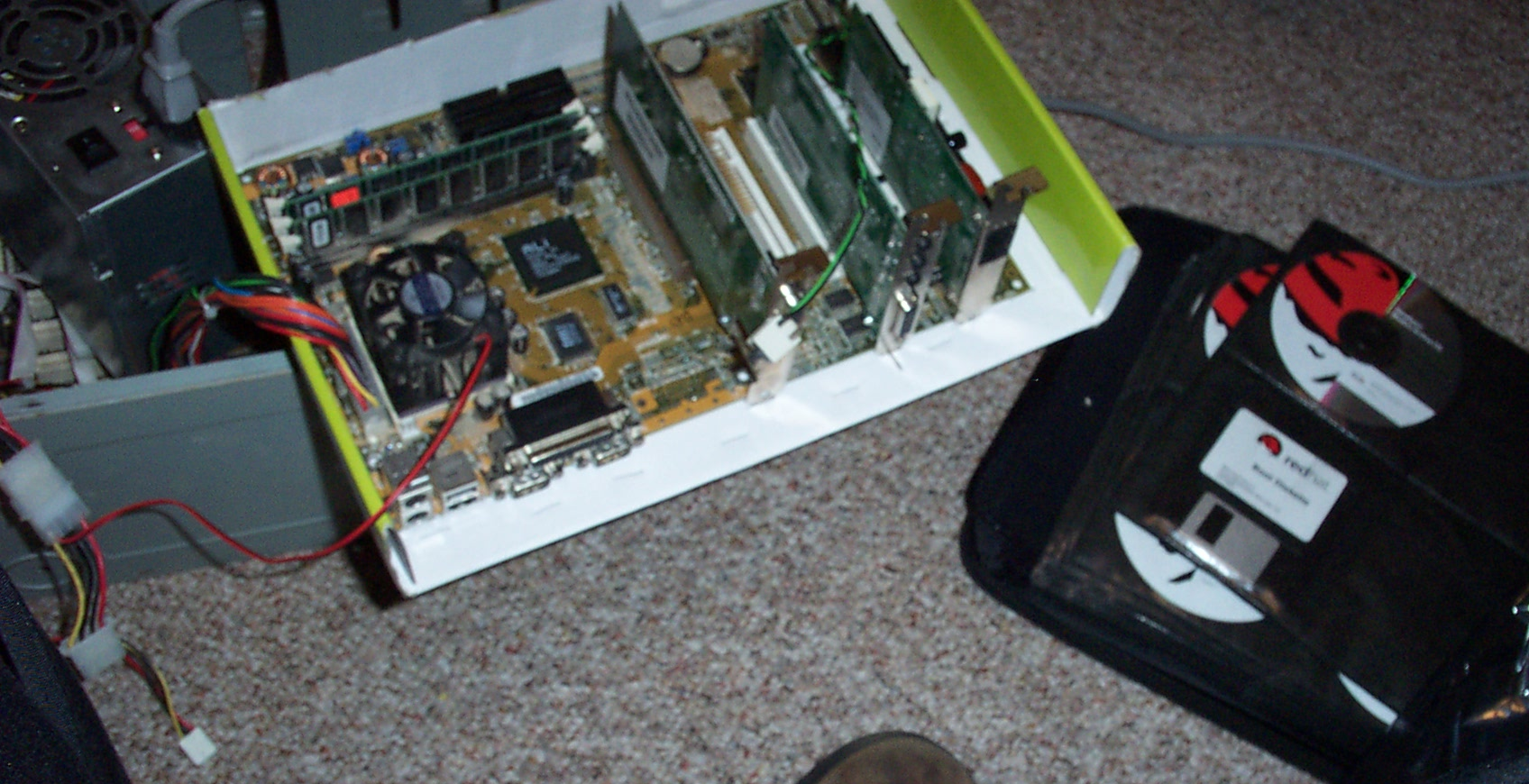
In the post, the Redditor shared a photo from 2003, when they upgraded from Exchange 2000 to Exchange 2003. The server did not have a conventional PC case, and its motherboard was strapped to the cardboard box it came with using zip ties.

Windows Server With Open Case

(Image credit: Reddit)

One commenter pointed out that existing Exchange 2019 licenses can be used with Exchange SE under qualifying licensing arrangements. Meta4X admitted that they did not know that, adding that they were probably better off not knowing. “I did not know that, thank you! In hindsight, I'm glad I wasn't aware because I probably would have put off killing Exchange,” they wrote. In other words, the server was not necessarily being retired because there was no way to keep it licensed. The move gave its owner an opportunity to finally get rid of a system that had outlived its original purpose.

For context, the replacement is Postfix, an open-source mail transfer agent that will run on Ubuntu Server LTS. The enthusiast is also using the migration to address several pieces of technical debt that have accumulated during the server’s long life. “Moving to Postfix is a good opportunity to implement STARTTLS, move to Let's Encrypt certificates, implement boot encryption, and eliminate a bunch of other technical debt that has accumulated over the past 20+ years,” Meta4X explained.

STARTTLS upgrades an ordinary SMTP connection to an encrypted TLS connection, while Let’s Encrypt provides publicly trusted certificates that can be renewed automatically. Boot encryption adds another layer of protection by securing data on the system drive. These are planned improvements, though — the Reddit post does not establish that the new configuration is already fully deployed. Meanwhile, Postfix is hardly the only destination for Exchange refugees. Several commentators said they had moved Mailcow, while another recommended Grommunio as an alternative for people who still want to keep their mail infrastructure on-premises. Others were more than happy to leave email hosting to Microsoft and other cloud providers.

That said, the move to Postfix does not necessarily make email security a solved problem. Postfix’s own documentation explains that enabling TLS can encrypt SMTP sessions, but administrators still need to configure certificate handling and decide how connections should behave when a remote server does not support encryption. We have previously reported on a vulnerability in Exim that exposed millions of email servers, showing how flaws in mail transfers can put systems at risk. Ransomware has particularly been a headache, exploiting vulnerabilities in Microsoft Exchange. A more recent report highlights how Outlook silently falls back to unencrypted email connections

US FAA to eliminate floppy disks from air traffic control by 2028

2026年11月7日 19:00

The US federal Aviation Administration (FAA) is finally moving to retire floppy disks from its air traffic control infrastructure, with plans to replace four decades-old information systems across 435 facilities by the end of 2028. The agency announced the rollout on November 5, introducing a centralized platform that will give controllers faster access to weather reports, flight alerts and other operational information. “We’re moving away from outdated, manual processes and replacing technology that once relied on floppy disks with a modern system that allows controllers to instantly share critical flight alerts, restricted airspace schedules and pilot reports,” FAA administrator Bryan Bedford said, adding the agency wants to make critical information available more quickly across its networks.

Notably, the new Enterprise Information Display System (E-IDS) is designed to replace four legacy systems dating back to the 1980s. Rather than relying on separate information displays and manual processes, controllers will get a centralized view of operational updates, equipment problems, weather disruptions, and aviation advisories. The first five locations receiving E-IDS include Atlantic City International Airport, Nashville International Airport, Greater Rochester International Airport, and FAA data processing hubs in Atlanta and Salt Lake City, although the system could be extended to 453 sites by the end of 2028.

Floppy disks from the 1980s: OUT 🤯 21st century tech: IN 🛫The new Enterprise Information Display System, or E-IDS, is a streamlined way for air traffic controllers to get REAL-TIME weather, equipment, and traffic info, all in ONE place and on ONE display!5 sites now. More than 400 @FAANews facilities by 2028. Safer skies for you.November 5, 2026

The upgrade comes amid mounting pressure on the FAA to modernize infrastructure that has become increasingly difficult to maintain. Last year, Congress approved $12.5 billion for air traffic control improvements, while Transportation Secretary Sean Duffy is seeking another $30 billion for additional upgrades. The agency problems extend well beyond removable storage. The FAA still relies on decades-old Company computers and replacement parts sourced from eBay. Its facilities also operate with separate systems that make information sharing more difficult, with Bedford previously saying “every facility is a silo.”

Communication failures have also exposed weaknesses in the infrastructure. Last month, the FAA sent a memo to airports warning about several recent outages caused by fiber optic cable cuts, which can trigger flight delays, diversions and, in worst cases, cancellations. One incident occurred in mid-October when a construction-related cable cut outside George Bush Intercontinental Airport disrupted data services between FAA facilities, forcing a ground stop. September also saw thousands of flights delayed or canceled across the Northeast after a circuit failure at a Philadelphia air traffic facility and in New Jersey.

That said, mission-critical infrastructure struggling to abandon obsolete systems is not entirely new. In June 2025, we covered the FAA's earlier modernization plans, which also targeted paper flight trips and computers reportedly running Windows 95. The agency has been gradually introducing electronic flight trips since the Biden era, with the transition expected to reach 49 major airports by at least 2028. So far, only 27 have made the switch. San Francisco has faced a similar challenge with its Muni Metro light rail network, with the city awarding Hitachi Rail a $212 million contract to replace its floppy-disk-based control system in 2024.

The German Navy has also been looking to replace 8-inch floppy drives used aboard its Brandenburg-class frigates. These disks are part of a data acquisition system connected to basic ship functions, including propulsion and power generation. Japan, meanwhile, finally moved the remaining government regulations requiring floppy disk submissions in June 2024, eliminating 1,034 such rules.

Nvidia tightens tracking of AI GPUs in Southeast Asia as Chinese chip smuggling draws scrutiny, report claims

2026年11月6日 21:49

Southeast Asia computing providers are now reportedly required to register with Nvidia's Fleet Intelligence tracking system if they want to become official Nvidia Cloud Partners (NCPs). The move, according to Bloomberg, is aimed at giving the chipmaker another way to monitor where its AI accelerators are deployed, as Washington grows increasingly frustrated with restricted hardware finding its way into China through regional smuggling networks. Nvidia was not immediately available for comment.

The NCP designation is worth pursuing as it gives cloud providers Nvidia's public endorsement and preferred access to its sought-after AI chips, putting the company in a position to use those benefits as leverage. Customers seeking the status must now enroll in Fleet Intelligence, according to people familiar with the new requirements. Fleet Management was introduced last December primarily as a data centre management tool. It gathers information about NVIDIA hardware deployed across participating companies' infrastructure, including the locations of individual accelerators. That information could give Nvidia a better picture of whether its chips are operating after they leave the supply chain.

The system is, however, a universal tracking mandate. Participation has remained voluntary outside the NCP requirement, and Nvidia does not automatically receive location data from every customer using the software. The company has also not clarified whether existing Cloud Partners will have to enroll to retain their designation or whether the requirement will eventually extend beyond Southeast Asia.

Notably, Nvidia has been developing a way to locate AI for some time now. Last December, we reported that the company had developed software-based GPU tracking, using GPU telemetry and network latency measurements to estimate where processors are operating. Nvidia described the software as a customer-installed agent for monitoring hardware health, integrity and inventory.

The technology has an obvious use beyond data maintenance. The U.S. restricts Chinese companies from purchasing advanced AI accelerators without a license, yet authorities believe billions of dollars worth of the hardware have reached Chinese buyers through third-party networks, with Southeast Asia becoming an important transit point for those transactions.

A C4ADS investigation has previously identified several routes used to move restricted processors into China, including purchases through research initiatives, shell companies and shipments routed through other Southeast Asian countries. The nonprofit examined transactions between 2022 and 2025 and identified $13.4 million worth of Nvidia A100, H100, and AD102-series GPUs moving through regional trade routes. Its report also linked $4.6 billion in hardware purchases to Singapore-based Megaspeed International.

Megaspeed has become a particularly awkward case for Nvidia, with the company being under U.S. and Singaporean investigation for more than a year over suspected chip diversion. Last week, Nvidia CEO Jensen Huang defended his dealings with the firm, describing them as “completely normal,” adding, “we’ve studied all their deployments of our GPUs and counted every one.” Megaspeed denied any wrongdoing. In April, Megaspeed’s Malysisan data centre landlord terminated its contract, reallocating 68.4 megawatts of capacity to another cloud provider

Moreover, Megaspeed is not the only example of how difficult it can be to police the movement of AI hardware. Earlier this year, U.S. prosecutors accused people associated with Super Micro of helping divert around $2.5 billion worth of Nvidia-powered servers to China through Southeast Asian intermediaries. The alleged scheme involved falsified paperwork and dummy server shells, with genuine hardware shipped onward after inspections. More recently, the company has faced additional scrutiny over its export compliance after inspections. Nvidia has also reportedly removed half of the Asian companies on its pre-approved buyer list and told cloud providers to keep at least 51% of their computing services with customers outside China.

Nintendo’s latest Zelda remake already circulating online as a Switch 2 ROM

2026年11月6日 19:00

Nintendo’s remake of The Legend of Zelda: Ocarina of Time has reportedly been dumped the same day it launched on the Switch 2. The game launched today, but ONE jailbreak says copies of the original 1.0.0 release and its 1.1.1 update are already circulating outside Nintendo's official distribution channels. The update reportedly weighs 23 GB.

The leak is not entirely surprising. Physical copies had already started turning up at buyers' homes several days before the release date. Footage of the game was already appearing online by Nov. 1. Those early cartridges gave hackers access to the remake before most players could get their hands on it, with some gamers sharing videos of themselves playing the game on social media.

However, the game still remains far from playable on PC, with emulators struggling to render its graphics correctly. Some users encountered washed-out visuals or black screens, while others saw terrain bleeding through objects or could not get past the title screen.

🚨 BIZARRO! ZELDA: OCARINA OF TIME RODANDO NO PC!O jogo já teve seu dump realizado e está sendo executado no PC através de emulação. Sim, estamos falando de um game que ainda não lançou oficialmente rodando fora do hardware original da Nintendo! https://t.co/giO956ssnINovember 5, 2026

Notably, the game is identified by title ID 0400486024DEC000, with its report naming two tools involved in extracting the files: ‘ns2jb and OunceCake’. The first is a software jailbreak developed by security researcher Sammy ‘pepsipu’ Hajhamid.

Last month, Hajhamid explained how he managed to get code running on Nintendo's latest console without installing a modchip, and also described what the exploit does: "This lets us run homebrew, reverse engineer and mod Switch 2 games, back up save files off the Switch, and access most of the Switch 2’s peripherals through MMIO. To my knowledge, it’s the first such exploit for the Switch 2."

That opens up several possibilities for homebrew developers and researchers as well as pirates, but ns2jb has limitations. It is a tethered jailbreak, meaning it has to be activated again after the console restarts. The exploit also does not provide unrestricted kernel access. The same extraction method has reportedly been used with two other games: Deltarune Chapters 1-4 and Mario Kart World.

This is not the first time hackers have found a way into Nintendo's hardware. Just a day after Switch 2 went on sale in June 2025, an exploit that allowed hackers to run custom code on the system popped up, although it did not provide root access or a full jailbreak. Cartridge-based backups have also caused headaches. In August this year, we reported that Nintendo had targeted more than 400 GitHub repositories, with 401 repos removed following seven Digital Millennium Copyright Act (DMCA) notices. Several Yuzu forks were among the affected projects.

Nintendo has not publicly commented on the Ocarina of Time dump or the nsj2b exploit yet. However, SmileBASIC 4, the application used to launch the jailbreak, has disappeared from the Nintendo eShop following the exploit’s disclosure.

India targets creating homegrown GPUs within 2 years and plans to commercialize indigenous SHAKTI and VEGA processors

2026年11月6日 02:00

India wants to develop its own graphics processing unit (GPU) within the next two years as the country steps up efforts to build a domestic semiconductor industry and reduce its dependence on foreign chip suppliers, reports ETGovernment. The target was outlined by S.Krishnan, secretary of India's Ministry of Electronics and Information Technology (MeitY), in a November 4 interview. "Under India Semiconductor Mission 2.0, we intend to target the development of an indigenous GPU chip. We should have a GPU chip of our own. This will not happen overnight. It is a project that will require approximately 24 months, and we intend to work towards that objective," Krishnan said.

The proposed GPU is part of a wider plan to establish an Indian hardware and software ecosystem, with Krishnan describing five layers needed to support AI development. These include: energy, accelerator chips, computing infrastructure and servers, AI models and applications. Indian companies such as VVDN, Kaynes and Avalon are already manufacturing servers, while the Centre for Development of Advanced Computing (C-DAC) has developed its Rudra server range, whose systems are designed to support AI workloads, after which the government transfers the technology to local manufacturers. Krishnan also sees AI as a potential repeat of the opportunity India's IT industry experienced during the Y2K (the year 2000 bug) transition. "AI could create a similar opportunity, although the nature of the work will be different," he said.

The comparison is big for a country whose IT-enabled service sector employs about 6 million people. A NITI Aayog paper estimates that roughly two million existing jobs could become redundant as AI adoption changes the industry, but around 4 million more jobs could emerge. Krishnan argues that Indian companies could benefit from helping businesses worldwide integrate into their AI operations, just as they benefited from the demand for software services around the turn of the century.

The country has already attracted major interest with ASML, partnering with Tata Electronics to equip India's first commercial semiconductor fabrication facility in Dholera, Gujarat. The planned facility is expected to use 300mm wafers and eventually reach a capacity of 50,000 wafers per month. Intel also announced a strategic partnership with Tata Group covering semiconductor manufacturing and packaging for the Indian market. However, the proposed GPU remains an early-stage target. Krishnan did not identify a manufacturer, chip supplier, or builder for the project. India is also looking to bring its own homegrown SHAKTI and VEGA processors to commercial markets. Both are based on the open-source RISC-V architecture, allowing local developers to build processors without relying on proprietary CPU designs. Notably, these are CPU designs, separate from the GPUs now being targeted by MeitY.

That said, it is not the first time India has attempted to build its own GPU production unit. In 2019, India's IT Madras released a software development kit that allowed developers to begin building applications before the processors were commercialized. The project included several processor classes aimed at different markets, from embedded devices and micro-controllers to workstations and server workloads. The effort has continued since then, with the Aries 3.0 development board, which uses the C-DAC’s VEGA ET301 processor, being introduced in 2024. The 32-bit chip runs up to 100MHz and includes 26KB of SRAM and is intended for relatively simple applications such as sensors, wearables, and Internet of Things devices, rather than desktop PCs or graphics-intensive workloads.

However, there are signs that the SHAKTI and VEGA platforms are nodding beyond development boards and into practical applications. At the September 26 SEMICOM India event, the government highlighted projects using the processors, including an autonomous water-cleaning robot around SHAKTI and a digital telescope using VEGA. Another VEGA-based project was designed to monitor forest environments. The government's Design -linked Incentive (DLI) program is already supporting more of that work. MeiyT says 24 companies received assistance under the scheme, and subsequently raised venture capital or other private investment. Their projects include microcontrollers, drone flight controllers, smart meter chips and CCTV cameras.

India's semiconductor market is currently valued at just about $50billion and is expected to approach 100 billion by 2030, according to a report by the India Electronics and Semiconductor Association (IESA). The government wants local companies to capture more of that growth domestically rather than remain dependent on imported components.

Binance heist began with fake job interviews and a malicious Homebrew download

2026年11月4日 21:00

Binance has revealed how North Korean hackers spent months preparing to steal approximately $6.34 billion in cryptocurrency last week. According to a November 3 security report by the exchange, the attackers used a malicious Homebrew installation to compromise one engineer and a fake recruitment process to trick another into installing malware disguised as a coding assistant. "Our current investigation indicates that this was a sophisticated, multi-stage campaign. It was not a single isolated breach or a simple phishing incident," the exchange said.

Binance says the first known compromise occurred in June, when an engineer in Binance’s Wallet DevOps team searched online for a popular AI coding tool and downloaded an adulterated Homebrew installation. Homebrew is a package manager, used by developers to install and manage various software tools on macOS.

Binance says it detected the unusual activity, replaced the engineer’s device, and rotated their associated credentials. However, those moves proved to be too little, too late, as the attackers had already learned about the employee’s role and identified colleagues working on the exchange's wallet infrastructure

https://t.co/sU9dUqLQDHNovember 3, 2026

The incident follows the compromise of another Binance software engineer who was contacted in September through a legitimate job hunting platform by a malicious actor posing as a project director. The fake recruiter arranged two interviews. One involved a purported HR representative who conducted a live video call and shared a social media account containing personal photos and videos to establish credibility, while the second involved someone posing as a CEO of a fictitious company.

Near the end of the interview, the engineer was asked to download a coding assignment containing a malicious software repository onto his work computer—a popular social engineering scheme. That malicious code executed during the setup process. At the time, Binance said the malware replaced a legitimate component of the Python version-management tool "pvenv" with a malicious version capable of executing commands and communicating with an attacker-controlled server. The exchange's endpoint security tools did not detect the malware at the time.

Those compromises began bearing fruit on October 20, as the attackers used the compromised computers associated with the fake interview and an internal AI tool to gain control over two wallet engineers' devices. They also discovered a container deployment permission token stored on the computer of the engineer initially targeted in June.

Later, on October 29, the attackers used stolen credentials to access another engineer's computer, deploy a container, and execute a malicious script. This gave them access to Binance's internal wallet signing service, allowing transactions from five hot wallets outside the exchange's normal withdrawal process.

The U.S. FBI directly attributed the theft to North Korea on November 1. ”The FBI is releasing information advising the Democratic People's Republic of Korea (North Korea) was responsible for the theft of more than $6 billion USD in virtual assets from cryptocurrency exchange, Binance, on or about October 29, 2026. The FBI refers to this specific North Korean malicious cyber activity as "TraderTraitor," the agency tweeted. Pyongyang has distanced itself from the hack, describing the U.S. claims as "preposterous nonsense.”

Binance said it had since frozen or intercepted approximately $2.85 billion in compromised assets, while 98% of the affected funds have been replenished.

The tactics resemble previous North Korean-linked campaigns. WaterPlum attackers previously used fake job postings and coding tests to infect more than 30,000 devices across 100 countries, compromising over 7,000 crypto wallets in September. A 2024 campaign that targeted Python developers with fake job offers and malware hidden in code was attributed to the Lazarus group, which was also linked to the $1.5 billion Bybit hack in 2025. Attackers posed as potential employers and sent coding tests containing Base64 obfuscated malware. Running the tests could infect developers' computers, giving attackers remote access.

Apple faces unprecedented memory cost increases as RAM prices continue to surge, manufacturing bill climbs by $33 billion

2026年11月3日 22:28

Apple is about to feel the squeeze from rising memory prices, with the cost of RAM climbing just as the company heads into its busiest shopping season. According to Reuters, Apple expects to pay more for memory in the December quarter, with the CEO, John Ternus, describing the current price increases as “unprecedented. The company has so far managed to soften the blow by using memory bought at lower prices, cutting costs elsewhere and raising prices on some products. However, it is reported that its manufacturing bill has climbed by $33 billion in just a few months.

But that cushion is getting thinner, and Apple expects memory purchases to become even more expensive into 2027. “What we're seeing with memory pricing right now is unprecedented. And as we said earlier in the September quarter, we did see higher memory costs as compared to the June quarter, which were partly offset by the benefit of carrying inventory and lower costs on certain non-memory components. Now for the December quarter, we expect even higher memory costs, partly offset by a few factors. So as you know, we changed the price on many of our products, including Mac and iPad at the end of June and iPhone in September, and these price increases provided some offset.” Ternus said during Apple’s November 2 earnings call.

Memory is used across Apple's hardware lineup, so sustained price increases could affect manufacturing cost for several product categories—although Apple has not announced another round of price increases. Absorbing higher components could, however, indefinitely become difficult. Dave Nicholson, Chief Research Officer at the Futurum Group, also identified memory prices as a growing pressure point for Apple's margins and hardware pricing through the holiday season and into 2027. According to him, Apple is in a different position from companies pouring hundreds of billions of dollars into AI data center infrastructure. The impact of higher component costs is easier to quantify than the eventual returns on massive AI capital expenditure, he said.

The next pressure point for @Apple may not be AI CapEx, but the rising cost of memory across its hardware portfolio.@TheFuturumGroup Chief Research Officer @DaveN007 explained that higher memory prices could put more pressure on Apple’s margins and pricing through the holiday season and into 2027. Even with demand holding up, the question is how much of those higher costs consumers will absorb.Dave also sees Apple in a stronger position than companies committing hundreds of billions to data center infrastructure, because the impact of higher component costs is easier to quantify than the long-term returns on massive AI CapEx.▶️ Watch Dave’s analysis of Apple’s margin outlook, memory costs, and why its AI infrastructure strategy could give the company more flexibility.#Apple #AI #Semiconductors #FuturumNovember 3, 2026

And the warnings from Apple's suppliers suggest that the cost pressure is unlikely to ease quickly. Last month, Samsung, a major supplier of RAM(DRAM), NAND flash storage and OLED displays for Apple, said that memory demand would far exceed supply as AI infrastructure continues to expand. Its memory division also reported a quarter-on-quarter increase in DRAM average prices during the third quarter, while NAND prices rose by high-teen percentages. Senior executive vice president of its memory business warned the supply crunch could extend to 2028 and beyond. Elsewhere, SK Hynix delivered a similar warning, saying it had secured long-term agreements covering more than Half of its production capacity for2027 and 2028. Micron, the third major supplier for Apple aside from Samsung and SK Hynix, is also benefiting from the surging demand for memory. Its latest published outlook warns that supply shortages in memory and storage could take “considerable time” to improve.

We have previously reported several signs of the pressure now confronting Apple. In January, the company was already scrambling to secure memory supplies amid strong demand, with then CEO Tim Cook warning that rising prices could have a greater impact on earnings. By June, rising component expenses had translated into higher retail prices. Apple increased prices across several Mac and iPad models, including a $400 increase to the starting price of the MacBook Pro, due to the RAM crisis. In July, Cook described the memory market as a “hundred-year-flood” and said Apple expected to pay more for memory in the September quarter. The company had also increased its inventory to $11.09 billion as it built a buffer against supply and price pressures.

OpenAI considers rebranding data centers to 'AI compute campuses" as data center backlash intensifies

2026年11月3日 03:15

OpenAI is reportedly preparing a major public relations campaign to influence how Americans view artificial intelligence, including a proposal to rename its data centers as “AI Compute Campuses,” Axios reports. The initiative comes ahead of the November 3 U.S. midterm elections and forms a broader effort to influence the debate around AI before the 2028 presidential race. Chris Lehane, OpenAI’s chief global affairs officer, noted that the midterms would be “a bit of a movie trailer for what you’re going to see in 2028.” He expects AI to be a major issue for presidential candidates as the technology raises concerns over its impact on jobs, the economy, and the environment.

The proposed terminology change by OpenAI has been ongoing since August as the company focuses on promoting safeguards for the powerful technology, which Lehane described as “speed limits.” The proposed AI compute campuses is particularly interesting as it comes as opposition to large data centers accelerates across the U.S. Data centers require enormous amounts of electricity and water, with nearby communities raising concerns about noise, air pollution, rising utility bills and limited public consultation. OpenAI hopes to address these concerns through community agreements and a different way of presenting the infrastructure. “Compute campuses better describe the role of the infrastructure we are rebuilding for AI," a company spokesperson separately stated. He added that these projects represent long term investments in computing, energy infrastructure, and skilled jobs.

The latest proposal follows similar efforts by other technology companies to improve their relationship with communities hosting their infrastructure. In January, Microsoft announced a community-first approach, promising to cover electricity cost increases associated with its data centers, and invest in local infrastructure and jobs. However, while changing the name may be easier, changing public opinion may bring some headaches. A Redfin report in May found that 47% of Americans surveyed are opposed to having a new data center built in their community. Another report in August detailed how negotiations between developers and local authorities frequently take place behind non-disclosure agreements, leaving residents without access to important project information.

The resistance has also affected actual construction plans. At least 19 Michigan municipalities have already moved to restrict new data center developments after OpenAI and Oracle’s $16 billion Stargate project went ahead with their project in Sanile township despite local opposition. Meanwhile, Amazon abandoned plans for four data centers in northern Virginia last month following community pushback.

OpenAI is not alone in trying to reshape the language surrounding AI. President Donald Trump has previously pushed for terminology change, directing Federal agencies and urging AI companies to replace artificial intelligence with ‘super intelligence.’ Trump announced the change in late September arguing that the word "artificial" made the technology sound "fake." His administration subsequently instructed state department employees to use super intelligence or SI in official directives, websites, reports and policy documents.

Some technology executives have also embraced the terminology. Nvidia CEO Huang has previously referred to data centers as "superintelligence factories" while Elon musk announced plans to rename his AI company SpaceXAI to SpacexSI last month. Meta, meanwhile, established Meta superintelligence labs in 2025, and Microsoft has also assembled a team focused on developing superintelligence. OpenAI’s proposed terminology will now face a more difficult test than simply finding a name as communities will still want answers about the raised issues. Lehane, however, acknowledged that public scrutiny is part of the process saying, “Communities should hold companies responsible and accountable so they really and truly get a transformative benefit from these projects.”

Nvidia Brev security breach may have exposed SSH keys used to access customer VMs

2026年11月2日 22:00

Hackers have struck Nvidia again, this time targeting its BREV cloud development platform, with users reporting unauthorized activity between October 4 and October 20. According to a notification sent to affected customers, some accounts may have been exposed. The company said it had investigated the incident and identified unidentified activity on the platform, adding that information stored on the platform may have been exposed to malicious actors. The said information included the SHH key set up by Brev.

The company has already replaced the affected SHH keys and updated customer machines with new ones but says they found no evidence of improper use. “We are writing to inform you that Nvidia Corporation has experienced a security incident that may have affected the security of your data," the notification reads. “Our analysis determined that your information from our Brev network may have been affected. This SSH key has since been rotated, and your instances have been updated with the replacement key.”

However, the company fell short of explaining how the attackers gained access, or whether anyone attempted to use the compromised data. Moreover, it has not disclosed whether customer data or workloads were accessed. SSH is a protocol used to establish a secure connection between ‘virtual machines’ or remote computers working together. Developers or system administrators can use it to manage remote servers, transfer files, and execute commands without needing physical access to the machine—much like AnyDesk or TeamViewer, but now for developers. Brev uses SSH keys to help customers access these services in the cloud, meaning if attackers access these keys, they could potentially take control of a virtual machine, depending on its specific permissions and other security controls.

And now @NVIDIAAI Brev also got a security breach. At this point in time, every major tech company is going through some sort of security issues - CVEs, stolen keys/API, credentials of users 🥲 https://t.co/3VgUZriQ7lOctober 30, 2026

The incident comes as several firms hosting AI development services and cloud infrastructure grapple with mounting security incidents involving customer credentials. On October 30, cybersecurity firm Wiz released a blog dubbed ‘Black October’ for AI developer platforms. The firm identified at least nine platforms that have had security incidents during the month, including Zeabur, Fireworks AI, Lightning AI, Opencode, Warp, Northflank, among others. As per the firm, the incidents were recurrent, with researchers noting that “all public reports highlight targeted exploitation, explicitly hunting stored environment variables, with a focus on those granted AI access.” Wiz further shared two cases involving compromised Amazon Bedrock credentials where, in one, attackers generated about 800,000 API calls over 30 hours while another key was used to make roughly 1.7 million calls over 13 hours. The combined usage came to a staggering $100,000 at list prices.

Such incidents are not just restricted to Nvidia, with major US banks including JP Morgan, Morgan Stanley and Bank of America restricting Agents from accessing customer accounts earlier this month. Their primary concern is that automated assistants could veer off set instructions and initiate unauthorized approvals. Similarly, the CyberCartel hacking group has previously used Anthropic’s AI tool Claude and Grok’s XAI to conduct attacks on more than 400 Latin American institutions, mostly targeting banks and mobile payments services after attackers obtained customer login credentials. China-linked attackers have also been accused of using AI agents in a ConnectWise supply chain attack that left about 2,250 Microsoft 365 tenants exposed, with some attacks reportedly reaching privileged access in under three hours.

Though updating compromised software may not be enough to eliminate an attacker’s access, Bradford Regeski, a threat intelligence analyst at RH-ISAC, has recommended extensive checks for customers in SHH-related incidents, asking users to “Isolate hosts that installed the compromised extension during the exposure window,” remove unauthorized SSH keys and persistence mechanisms, and rotate credentials and sessions.

Google data center wins approval in Minnesota after protests delay council vote twice

2026年11月2日 21:00

Google has secured approval for a proposed data center in Hermantown, Minnesota, following a unanimous vote by the city council, MPR News reports. The decision, reached on Friday, October 30, clears a major hurdle for the company following at least two postponed meetings and hours of public opposition, though the project still faces lawsuits and a separate inquiry into its electricity supply. The proposed development could cover just over 200 acres in a rural residential area outside Duluth with three data center buildings spanning approximately 1.66 million square feet.

The council approved a development agreement, a special use permit, and provisions for decommissioning the site if construction is abandoned or the facility eventually closes. The meeting, which was capped at 85 people and offered a livestream, ended shortly before midnight, with some criticizing the attendance restriction. Council member John Geisler, however, clarified the move, noting that the decision concerned local land use application rather than the wide debate over artificial intelligence or big technology companies.

“What we've done tonight is not about AI. It's not about big tech. It's not about software. It's about a project here in Hermantown, a land use application, and agreements that are associated with that,” Geissler said.

The approval comes at a hefty price for Google, with the company being forced to make several changes during the approval process. The company changed its initial plan of putting up four buildings to three, capped their height at 33 feet, and agreed to monitor nearby private wells —but each building would still be larger than six football fields. Google also agreed to withdraw an earlier request for up to $80 million in property tax breaks. The revised arrangement is now expected to generate about $3 million in annual property tax for the city, with a separate decommissioning agreement valued at $210 million in place.

Supporters point to those provisions as evidence that Google had responded to local concerns. Opponents, however, argue that the changes did not address the important questions of whether such a colossal development belongs in the area. The dispute echoes other data center battles within local communities, with Alabama residents being unable to halt a 50MW Bitcoin mining facility in August, despite local moratoriums, exposing gaps in the state's zoning rules. In September, a proposal for a 1,300-acre data center in Pennsylvania by NorthPoint Development also faced resistance despite its developer offering $10,000 to thousands of nearby households. Key issues raised mostly by residents in both cases have been about noise and water consumption by such facilities and property values.

It’s important to note, however, that Hermantown’s vote does not mean Google can immediately begin construction. Three lawsuits filed by The Minnesota Center for Environmental Advocacy and Stop the Hermantown Data Center challenge the city’s zoning process and ownership of the land, and are also demanding the project’s environmental review. The project’s environmental needs are also another pain point, given it requires about 500 megawatts, comparable to the combined demands of homes in Minneapolis, St. Paul, Duluth, and Rochester, as per the Citizens Utility Board of Minnesota. Google still needs approval from the Minnesota Public Utilities Commission on power consumption, despite its agreement with Minnesota Power.

The scale of demand is a recurring point of friction in data center proposals. Last year, the OpenAI Stargate facility in Michigan received approval for a 1.4-gigawatt power supply — construction, however, started in June 2026 despite objections from local residents. Google is also pursuing a separate data center project near Pine Island, close to Rochester. That proposal is now subject to a more extensive environmental review following a legal settlement.

SpaceX loses bid to dismiss lawsuit over xAI data center pollution

2026年11月2日 20:00

SpaceX has suffered a setback after losing in a lawsuit aimed at stopping the Clean Air Act requirements on the turbines powering xAI’s Colossus 2 data center in Southaven, Mississippi. According to a report by CNBC, a judge rejected the company’s motion to dismiss the case on Friday, October 30, allowing the National Association for the Advancement of Colored People (NAACP) to proceed, rejecting xAI’s argument that its turbines fall under the ‘mobile sources’ category that exempts it from air permitting requirements.

The case, brought in April 2026 by the NAACP and represented by the Southern Environmental Law Center (SELC) alongside Earthjustice, targets xAI’s operation of a gas-fired power plant to supply electricity to its facility in the Greater Memphis area. SpaceX owns and operates xAI, implicating Elon Musk's wider aerospace and technology company.

According to court documents, NACCP accuses xAI and its subsidiary, MZX Tech, of installing 27 gas turbines in Southaven last year without obtaining the required permits. The applicants also argued that the company’s equipment has been polluting the environment through nitrogen oxide emissions and fine particulate matter, which can contribute to breath-related hazards to residents. The SELC particularly says the plant could emit over 5,00 tons of nitrogen oxides, 400 tons of fine particulate matter, and 47 tons of formaldehyde — a cancer-causing chemical — annually.

The judge also rejected xAI’s attempted classification of the turbines as mobile equipment, holding that the company did not qualify for exemptions under applicable regulations and that the turbines were not exempt from Clean Air Act permitting requirements. Just two weeks earlier, SpaceX suffered another setback after the same court rejected a separate Department of Justice lawsuit that argued against the case proceeding.

“This decision is another important victory in our effort to hold xAI accountable. The courts have repeatedly rejected attempts by xAI and the DOJ to dismiss the NAACP’s Clean Air Act case, affirming our right to pursue justice for communities impacted by pollution. Our position has been clear: xAI cannot operate gas turbines without the required permits. Now that the motion to dismiss has been denied, we look forward to continuing to defend our position in court,” Abre’ Conner, NAACP Director of Environmental and Climate Justice, said. SpaceX is yet to comment on the ruling.

Colossus 2 installed 59 natural gas turbines in July, immediately sparking concerns from residents about emissions and the impact on nearby communities. The Memphis facility plans for about 860,000 Nvidia GB300 GPUs across four Colossus buildings —but it could be more — with Musk stating, “There will be a total of around 1.2M Blackwells at Colossus 2 by end of year”

Elon Musk just gave a massive update on Colossus 2 in Memphis, and the scale of what's being built is absolutely insaneTwo buildings already packed with GB300s, two more are coming online within weeks, and it is heading toward roughly 860,000 NVIDIA GB300sHere's the breakdown:• Macroharder: 220,000 GB300s, 800-gig NICs, configured for training• Minihard: 220,000 GB300s, same training configuration• Gun Range: 220,000 GB300s, tracking to be operational by the END OF NOVEMBER• Spam: ~200,000 GB300s, configured for inference, targeting DECEMBERThat's roughly 860,000 GB300s across these four buildingsSpam is designed for inference, which needs much simpler networking and less than HALF the fiber of the training buildings. And yes, the building once housed Hormel productsElon personally walked the entire Colossus 2 site around midnight and again the next morning to check progressBuilding by building, SpaceXSI is assembling SI compute at a speed no one else on Earth can matchOctober 31, 2026

In August, the company stated that it would remove its unpermitted turbine generators and replace them with a larger permitted power plant — but that could take at least a year. The latest setback adds to a string of lawsuits surrounding the gas-powered infrastructure used to power xAI’s data centers. In June, the DOJ had asked the court to dismiss the NACCP’s lawsuit, arguing that Colossus 2 supports crucial national security operations. That request was, however, rejected. More recently, SpaceX started manufacturing turbine blades in-house to fast-track generator production for its xAI data centers.

Sony's final 4K Blu-ray player listed as out of stock in Japan, firm may be preparing to abandon standalone players

2026年11月2日 19:30

Sony may be preparing to abandon the standalone 4K Blu-ray players, and the signs are becoming harder to ignore. According to a report by Forbes, its last remaining model in Japan, the UBP-X700K, was marked as unavailable on October 22, with local retailers reportedly told not to expect another shipment— a development that has raised questions about the future of Sony’s dedicated followers. Sony's U.S. website has also listed the player as ‘out of stock’.

So, is Sony really done making 4K Blu-ray players? That isn't clear. The company is yet to announce a worldwide withdrawal, and its responses to questions about the reports leave that possibility open. When asked by Forbes whether Sony is leaving the market, its UK operation replied: “This information has not been publicly announced by Sony. We are aware of the recent media reports, but prefer to refrain from commenting on speculation.”

There is an important difference between what is happening in Japan and what buyers can still find elsewhere. The UBP-X700K remains listed on Sony’s U.S. website, with Best Buy offering it for $329.99 at press time, which means Sony 4K buyers haven’t missed their chance yet. However, Amazon is no longer selling the player directly as a new product. Finding one could be harder if the company decides not to restock.

This is not the first time Sony has stepped away from physical media. In January 2025, the company stopped producing blank recordable Blu-ray discs, later announcing in February that it would also end its production in Japan. In July 2026, Sony announced it would stop producing physical PlayStation game discs from 2028— although it remains unclear if the next PlayStation console will have a disc drive. Notably, the PS5 Pro launched without a built-in disc drive, but customers who want to play physical games can purchase the optional drive separately.

However, if Sony ultimately leaves the market, buyers will still have alternatives. Panasonic remains the biggest name in dedicated 4K Blu-ray players, although its products are not that cheap. Currently, the Panasonic UB154 lists on Amazon for $289.99, while the UB820 goes for $649.99, a steep climb from its original $499 launch price. The higher-end UN9000 is retailing at $1,299.99 on Walmart. Buyers could also consider gaming consoles such as a disc-equipped PS5, which is listed at $649.99, or the Xbox Series X, priced at $799.99. Both can play 4K Blu-ray movies, but neither supports Dolby Vision when playing discs.

Sony’s move, if true, would add it to a growing list of manufacturers that have dropped the Blu-ray hardware. In 2018, Oppo stopped producing players while Samsung ended plans for new U.S. Blu-ray players a year later. Other companies include LG, which dropped the business in 2024, with French company Reavon halting production in 2025.

But it's important to note that 4K Blu-ray demand has not collapsed in the same way as the wider physical disc market. Figures laid out by the Digital Entertainment Group show that overall U.S. disc sales declined by roughly 9% in 2025. Spending on 4K discs, however, climbed by 12% over the same period, before climbing another 18% in the second quarter of 2026. That said, for existing Sony owners, there is no reason to panic just yet. A player that works today will continue playing the discs already in a collector’s library — and there is no evidence that Sony plans to push an update that would stop existing players from reading movies.

Sam Altman meets with Samsung leadership to secure more RAM for data centers amid crushing shortages

2026年11月1日 22:21

OpenAI CEO Sam Altman has met with about 50 senior Samsung executives in South Korea, as the company seeks to expand its Artificial Intelligence and memory capacity, Bloomberg reports. Altman’s visit to South Korea follows his recent comments about how the world's limited memory supply should be allocated. In an interview on the Chick Pink podcast this week, the OpenAI chief argued that DRAM sitting inside personal computers is often underused, describing it as “quite terrible”. He suggested that data centers could make more intensive use of memory by sharing computer resources across AI workloads. The argument has drawn widespread criticism given OpenAI’s own services like ChatGPT rely heavily on centralized computing infrastructure.

The meeting, which took place at Samsung’s Resources Development Center in Yongin on Saturday, October 30, brought together chiefs from the company’s financial, electronics, and biotechnology businesses. Confirming the meeting, Samsung Korea said the discussion revolved around strengthening existing relationships between the two companies, particularly a letter of Intent signed in October 20225 to cooperate on global AI infrastructure, including supplying memory semiconductors for OpenAI’s Stargate project. “The Samsung executives and CEO Sam Altman discussed the direction of AI technology development and its potential applications, as well as new markets and business opportunities that will emerge from it,” Samsung stated.

Samsung, however, emphasized more on AI transformation and future business opportunities, rather than announcing a new memory supply agreement. Reportedly, Altman also presented Samsung’s AI Center head with a Codex Micro Keyboard, a device designed for use with OpenAI’s coding agent. The latest meeting comes as demand from AI centers continues to soar, with AMD forecasting DRAM revenue will jump 177% in 2026 to about $416 billion. Trendforce also estimates DRAM supply will fall 1% to 2% short of demand this year, with the imbalance expected to worsen in 2027. New manufacturing capacity may take time to come, which means the shortage could persist into 2028, as per a recent warning by Micron.

For now, demand for data centers is facing major competition, especially from PCs, smartphones, and other electronics, for limited memory supplies (and may be nowhere close to peaking). High-bandwidth memory (HBM), a specialized form of DRAM used in AI devices, has become particularly important as companies deploy increasingly powerful computing systems.

Samsung and SK Hynix are among the world's leading memory manufacturers, giving South Korea a central role in supplying the hardware behind the AI expansion. According to Counterpoint Research, both companies controlled about 63% of global DRAM revenues in the second quarter of 2026. Their influence is greater in HBM, where the two South Korean manufacturers accounted for roughly 83% of global revenue. This has prompted other technology executives to approach the country, with AMD CEO Lisa Su visiting earlier this month to discuss securing additional HBM supplies from SAMSUNG, saying, "It is important to plan three to five years ahead with our partners."

Meanwhile, Samsung and SK Hynix have been upgrading Chinese factories to meet the surging demand for AI-related memory and storage products. However, those particular upgrades concern NAND flash production, rather than DRAM — but they show just how manufacturers are adjusting capacity as demand shifts towards data center hardware.

French lawmakers add $11.2 billion internet tax based on traffic usage to budget, costs $0.06 per gigabyte of content accessed

2026年11月1日 00:11

Edit 11/1/2026 4:25am PT: Clarified title to state the bill still has to pass the Senate after being added to the budget.

France has approved a proposed tax that aims to tax the amount of internet data per gigabyte sent to French users in the country, with major companies like Google, Netflix, TikTok, and Meta now in the crosshairs. According to minutes released by the National Assembly, members voted 11-10 in support of the motion on October 30 — which now means the new law has been added to the country’s next budget, despite major opposition from the government side and the finance committee rapporteur. The law still has to pass through the Senate for final approval. The latest amendment, introduced by socialist lawmaker Laurent Lhardit, could see content providers pay €0.055 (roughly $0.06) to the government for every gigabyte of content distributed to French users.

With approximately 154 million users and counting in France, the proposal’s authors say such a tax could generate around €10 billion ($11.2 billion) in annual revenue for the government. “This amendment proposes a tax on digital data flows emitted by content providers, to be borne by the providers themselves. Its revenue is estimated at €10 billion.” Said Laurent Lhardit. The said proposal, though yet to be passed as it must survive further parliamentary scrutiny, aims at companies that generate substantial internet traffic as opposed to taxing their advertising revenue, profits and subscriptions. Its explanatory notes particularly mention Google, Meta, Netflix, Amazon, and content delivery network Akamai as major potential contributors. Notably, TikTok and other similar platforms could fall under this broader scope depending on how these rules are applied.

Internet service providers, including Orange Free and Liad, would be required to measure the volume of data and identify the companies responsible for sending it to French users. The Data will then be collected and submitted quarterly to France’s tax administration under the supervision of telecommunications watchdog Arcep. Aside from the €0.055 per gigabyte levy, the proposal also includes a cap of 15% of a company’s French revenue or 2% of its worldwide revenue. It also accounts for content delivery networks (CDNs), which store copies of online content closer to users to reduce loading times and network congestion.

Approximately 200 billion GB of data pass through French internet providers annually, with about five major companies identified in the amendment accounting for about half of that traffic. Lhardit argued that tax would primarily affect global technology companies because they generate most of the data traffic reaching French subscribers. He also disputed that those platforms would merely push additional costs to users, using Facebook, Instagram, and TikTok, which provide free access, as examples. “The rapporteur keeps arguing that the taxes will be passed on to consumers. However, I fail to see how a tax can be passed on to users of Facebook, Instagram, or TikTok since these services are free,” He stated.

How much money are you willing to spend during the Black Friday sales?

Lawmakers opposed to the proposal, however, argue that it is likely to endanger user privacy. Government Minister David Amiel questioned whether the internet traffic could be measured and attributed to content providers without introducing complicated monitoring requirements. Those concerns extend to potential consequences for French business. Lhardit, however, noted that businesses would pay relatively modest costs, citing TF1 as an example, which requires broadcasters to contribute between €200,000 and €300,000.

Several European countries already impose digital service taxes, generally based on revenue from Ads, marketplaces and other digital activities. In March, Meta announced it would introduce location-based fees of between 2% and 55 for advertisers to offset digital services taxes and other government levies in several countries, including France, Italy, and Spain, from July 1, 2026 . Previously, the European Commission has rolled out major enforcement actions against major technology companies, including a €5 billion fine against Google over Android antitrust violations, Facebook’s €100 million fine for misleading European regulators, and the EU’s investigation into Facebook’s ability to link WhatsApp accounts.

Last year, Apple and Meta were also fined €500 million and €200 million, respectively, a move that strained the relationship between Brussels and Washington, with the U.S. calling the penalties ‘a novel form of economic extortion’ that it will not tolerate. That said, the amendments' adoption in parliament is only the first step. If it can clear the remaining stages of France’s 2027 budget process, it can become law, with parliament scheduled to vote on the budget’s first section in early November.

South Korea clamps down on Tesla drivers for unlocking restricted full self-driving feature, $15,000 fines and prison possible sentences

2026年10月30日 18:20

South Korean authorities have identified 80 Tesla drivers who allegedly forced Full Self-Driving (FSD) onto cars that were never cleared for it, Electrek reports. The Seoul Metropolitan Police Agency says it confiscated 21 of the devices used to switch the feature on. The unlock modules reportedly connect to the car’s CAN bus (the internal network that links its electronic control units) and get around the regional software lock that keeps FSD disabled. That works because Tesla builds the same computer into every car, whether or not the feature is approved locally.

Some suspects bought ready-made units from Europe and China, and one reportedly plugged a European-made module into his own Tesla. Others skipped the shopping. One suspect, an IT worker, built his device using information he found on GitHub, which suggests the barrier to entry for this kind of modification is lower than it sounds. The group also traded tips online, including how to stop the car from keeping any record that FSD had been activated. Concealing the activation history is likely an attempt to avoid detection by Tesla, which has been looking for these devices itself.

Then there is the legal risk, where prosecutors are using the Motor Vehicle Management Act, which bans unauthorized software changes that could affect vehicle safety. In Korea, the maximum penalty is two years in prison or a fine of up to 20 million won, or roughly $15,000, a steep price for a driver-assistance feature that many of these owners had already paid for.

South Korea’s transport ministry first flagged suspicious activations to police in April. “Safety risks were confirmed, including the possibility that FSD may fail to properly recognize driving conditions or operate differently from the driver’s intentions,” a police official said then.

Notably, the root of the problem is a certification gap. Tesla began offering FSD (Supervised) in South Korea in late 2025, but only on US-built Model S, Model X, and Cybertruck units, which skip local safety certification under the Korea-US free trade agreement. The Model 3 and Model Y arrive from Giga Shanghai and have yet to pass. Nobody agrees on how many Korean Teslas are eligible, although Carisyou Data Lab figures cited by MK last month indicate 47,458 of 229,311 cars (20.7%).

The South Korean investigation follows Tesla’s own efforts to stop unauthorized activation. In April, the company began remotely detecting unlock devices and disabling FSD access on affected vehicles. It has also warned owners that unauthorized modifications could void warranty coverage and leave them liable for crashes. Moreover, the restrictions are not the first time Tesla’s software protections have come under scrutiny. In August 2023, researchers exploited a hardware security flaw in the AMD processor powering Tesla’s media control unit to unlock certain paid features. The exploit targeted the car’s AMD-based system-on-chip, although researchers did not confirm that every premium feature could be unlocked.

Tesla has also faced regulatory scrutiny over software restrictions. In December 2021, the US National Highway Traffic Safety Administration investigated the company after an over-the-air update allowed drivers to play certain games while their vehicles were moving. The case highlighted how software changes can raise safety concerns when features are accessible under conditions regulators consider unsafe. Hardware reliability is another challenge for Tesla. Last year, the company detailed how it identifies defective processor cores in its Dojo AI supercomputers, where a single faulty component can compromise lengthy training runs.

Amazon tells engineers to stop ‘tokenmaxxing’ to look productive

2026年10月28日 23:13

Amazon wants its engineers to quit chasing token counts, warning that heavy AI usage does not automatically mean better work. In updated engineering guidelines published on October 27, the company laid out how developers and managers should gauge AI’s real impact — and the takeaway is blunt: consuming more tokens is not the same as delivering more value. Amazon is not backing away from the technology, though. “We are certain that whatever future best practices are, AI will be at the center of software engineering practice,” the company wrote.

The guidance targets ‘tokenmaxxing,’ a practice where employees deliberately inflate their AI usage to look productive on internal dashboards. According to the memo, metrics such as AI adoption rates, token consumption, code changes, and code reviews become ‘deeply flawed’ when they are disconnected from actual results. Turning them into targets, Amazon says, encourages wasteful behavior that clashes with its emphasis on ‘frugality and simplicity’ and can raise both compute bills and software complexity.

The company’s preferred yardstick is long-term results. “We believe that it is best to measure, and be measured by, long-term outcomes,” Amazon wrote. That does not mean managers should ignore usage data altogether, as input metrics remain useful when examined ‘with care and judgment’ alongside other indicators. Amazon suggests looking at both the teams using AI the least and those using it the most to determine whether adoption is translating into better delivery.

The push comes as Amazon, under CEO Andy Jassy, has been weaving AI deeply into its sprawling operations. Jassy said earlier this year that the technology will ‘change the scope and speed’ of everyday work, and he has suggested that automation could shrink the company’s corporate workforce over the next few years — though he also expects it to create ‘other jobs.’

The memo also pushes back on the idea that every task needs an AI tool. If current tooling does not benefit someone’s work, Amazon says, that is ‘a finding, not a failing.’ Engineers who can explain where today’s tools fall short are demonstrating judgment rather than reluctance to adopt AI.

In May, it emerged that Amazon employees were using AI unnecessarily to boost internal usage scores, amid pressure to use the company's tools. Workers reportedly used MeshClaw, an internal AI agent capable of handling tasks such as deploying code and interacting with Slack, to inflate their token counts.

Notably, Amazon is not the only company rethinking how it spends on AI. Uber president and COO Andrew Macdonald said in May that higher token usage has yet to translate into useful consumer features. “That link is not there yet,” he said. The remark stands out because Uber’s CTO previously revealed that the company had burned through its entire 2026 Claude Code budget by April.

Accenture appears to also be wrestling with the same problem on behalf of its clients. Leaked audio obtained by 404 Media in June captures executives acknowledging that token spending is climbing fast as companies move from simple chatbots to agentic workflows, and that nobody can reliably predict what a given task will cost or whether it was worth the money. Accenture’s agentic AI strategy lead described it as ‘not a niche problem,’ and the firm is reportedly building an advisory tool called ‘Token IQ’ to help customers manage the bill. OpenAI CEO Sam Altman has previously acknowledged that AI token costs had become 'a huge issue', as companies faced mounting bills from heavy AI use.

Amazon, however, says it has not imposed token caps on its employees. According to CNBC, however, it shut down an internal leaderboard in May after workers were found gaming it to climb the rankings — an early example of the behavior the new guidelines are meant to discourage.

Israeli ad tech firm tied to suspected Starlink tracking effort, report claims

2026年10月28日 01:37

Discover-Tech, an Israeli advertising technology company, has reportedly been linked to a suspected surveillance effort aimed at Starlink users, according to Reuters. The report, which cites six people familiar with the matter, claims the firm was the top bidder for ad space tied to Starlink traffic in more than 100 countries. Researchers suspect the aggressive bidding was meant to reveal where users are located or to enable further monitoring — though the findings do not show that anyone was actually tracked.

The data comes from TrendAI, the research arm of Trend Micro. Its October 15 report referred to the activity as ‘Shadow-Earth-79’ without naming a company, but the report claims the codename belongs to Discover-Tech. TrendAI says its attribution process is designed to avoid ‘hype-driven labels’ that could mislead security teams. “Our approach reduces the risk of misattribution, hype-driven labels, and unstable actor names that can mislead defenders, distort risk prioritization, and trigger inappropriate response actions.” The report says.

The method exploits how online ads are sold with advertisers bidding in real-time auctions for space on websites and in apps, and each bid request can carry details about the person on the other end. Collected over time and combined with other data, that information could be used to identify people, follow their activity across the web, or select targets for spyware.

The geography is what raised eyebrows. Shadow-Earth-79 was reportedly the largest ad buyer in Syria, Libya, Yemen, and South Sudan, and the second largest in Afghanistan, while also claiming unusually large shares of bids in Hungary, Israel, Egypt, Azerbaijan, and Venezuela. TrendAI says the pattern points to ‘targeting and tracking infrastructure rather than a commercial advertising operation.’ That is plausible, given how little legitimate Western advertising demand exists in sanctioned or war-torn markets.

Notably, Discover-Tech was already under scrutiny. On the same day as TrendAI’s report, Citizen Lab and ad security firm Confiant separately named the company, alleging that it used ad auctions to collect data on users across sensitive networks, including those tied to media organizations, governments, and tech firms. “The malicious advertisements were purchased by Discover-Tech, an Israeli company that presents itself as a legitimate advertising company, but which we found operates as a facilitator for multiple mercenary spyware partners.” Citizen Lab wrote.

Google and Comcast have since said they removed Discover-Tech from their advertising platforms, while the report says that a major U.S. technology company and an international organization have opened internal inquiries into whether the firm’s ads targeted their employees.

For Starlink, the stakes are obvious — the service works outside conventional telecom networks, which makes it a lifeline where governments restrict internet access, and makes its users an attractive target for those same governments. In April, Iran’s nationwide internet blackout passed 1,000 hours, with authorities reportedly going after Starlink terminals and imposing severe penalties for possessing one. Earlier this month, SpaceX also limited Starlink service for Ukraine’s high-speed military drones, which Ukrainian officials say complicates logistics and operations.

Advertising and consumer tech have been abused for tracking before. A backdoor was previously found in a popular iOS ad library that could collect device-location data and capture screenshots, while Chrysaor, Android spyware linked to the Pegasus family, was discovered by Lookout and Citizen Lab on a small number of devices. More recently, a researcher claimed to have found extensive data collection, including ad-related telemetry, inside a Samsung smart TV’s Tizen operating system, though those findings are still being investigated.

That said, it is still unclear if Discover-Tech actually used Starlink-related data to single out specific subscribers remains unverified, and neither the company nor SpaceX has commented.

❌
❌