❌

普通视图

发现新文章,点击刷新页面。
昨天 — 2026年10月25日首页

Proton hosts Flock map revealing over 300,000 cameras, defying cease-and-desist threats against creator

2026年10月24日 21:42

Proton AG, which provides privacy-focused services like Proton Mail and Proton VPN, has decided to host the Flock camera map that security researcher Joshua Michael built from leaked Flock data. While the original Flock Surveillance Map is still available online, its creator is facing legal threats from the company, especially after Flock sent the researcher a cease-and-desist letter. In addition, Michael’s website is accessible only from within the U.S., requiring users outside the country to use a VPN to access it.

By contrast, Proton’s Flock camera map is easily accessible worldwide. Its location in Switzerland also makes it a little more complicated for the surveillance company to take legal action. Its move to preserve Michael’s work also follows the company’s privacy ethos.

Proton Flock camera map

(Image credit: Proton)

“You have a right to know who’s recording you when you leave home, especially when a private company controls the data and it’s unclear how law enforcement uses that information,” the company said. “This map lets you search by ZIP code to see where Flock’s license plate readers are located. Use it [to] make informed decisions about how you move through your own area and whether you need to reach out to your municipal leaders.”

Flock and other automatic license plate recognition (ALPR) cameras are at the center of the privacy debate between law enforcement and citizens. While the former argues these machines help make communities safer, many of the latter worry about the technology's potential misuse. Their fears aren’t unfounded, either — there have already been multiple cases of police officers misusing Flock cameras to stalk romantic partners and even one case of mistaken identity due to a lapse in police procedure.

However, Proton’s map is based on data from November 2025. This makes it more of a snapshot of the company’s network at that time, rather than a live map of Flock’s ALPR cameras. For a more up-to-date map, consider downloading MapQuest, which recently released an update showing the locations of ALPR cameras from Flock and other companies. This could help you plan your trip if you have privacy concerns and want to avoid getting picked up by an ALPR camera.


Valve adds CD-ROM drive support to Steam Frame kernel, took less than ten minutes

2026年10月24日 20:06

A Steam Frame user asked for the ability to use an external optical drive with their headset, and Valve added the feature a day after one of its developers saw the post. Aiodensghost wrote the post in the Steam Frame General Discussions forum, saying that they wanted to watch a movie on the road and install abandonware from 2006 on their device, with Valve developer gaberowe responding a day after.

“I wanted to use my Steam Frame to be able to watch a movie on the road and thought it was no big deal to use the detachable disc drive I had on my computer,” Aiodensghost said on Oct. 18. “Turns out that the Frame cannot power the player and even if it could, it lacks the drivers to read a disc. Valve, this not only killed my ability to watch a movie, [but it also] killed my ability to install my abandonware from 2006. You don’t sell NFS Carbon anymore, and while I have the disc, the Frame isn’t able to read it.” Just a day later, gaberowe responded with, “We will look into this. Thanks for alerting us.”

The Valve developer then proceeded to add the feature in under 10 minutes, pushing commit b68e4a1 to the deckard-linux-no-oopsies GitHub repository, which is described as “the Linux kernel sources used in SteamOS ARM for the Steam Frame.” While this does not automatically mean that the Steam Frame will get optical drive support in the next update, this development shows that Valve developers take gamers’ requests seriously.

More enterprising users who can’t wait for the feature could also build and install the modified kernel themselves instead of waiting for the official software update. Adding CD-ROM drive support to the Steam Frame is a relatively simple exercise, though, as the commit only enabled a pre-existing Linux kernel feature instead of building an entirely new feature from scratch.

While the Steam Frame is primarily designed as a streaming device, it can also be used for standalone gaming. So, by enabling external CD-ROM drive support, users could let their headset directly read their CDs instead of needing another device to stream the contents of the disc from. It might look awkward, though, if you don’t have a long-enough cable, and you’ll have to hold your external optical drive on your head.

Russia deploys 3D-printed cruise missiles with US electronics in Ukraine, can hit 500mph with a 745-mile range

2026年10月24日 18:25

Ukraine's military intelligence agency GUR released details of a new 3D-printed Russian cruise missile that was first deployed around September and October of this year. The missile is faster than traditional weapons, hitting speeds of 500mph, and has a range of over 700 miles. According to Business Insider, these cruise missiles, called “Filin,” are more affordable than the traditional Kh-101 cruise missile that costs more than $2,000,000 per launch. This is why some fear that these weapons would be used by the Russian military in “missile spam” tactics against Kyiv to overwhelm its air defenses.

Russia’s invasion of Ukraine, which was originally planned to last just a few weeks, has turned into a multi-year war of attrition. This has made the frontlines a costly effort for both man and machine, which is why both sides are looking for more cost-efficient ways to conduct warfare. While drones have seen widespread use in this conflict, they’re relatively slow and are easier to shoot down. The Geran-5, which has been known to disintegrate in flight, could only hit a maximum speed of 270 mph, while the Filin can reportedly hit speeds of 500 mph and has a range of 745 miles. While this still isn’t as fast as modern fighter jets like the F-16 Fighting Falcon, the increased top speed could make it that much harder for Ukrainian air defenses to deal with the threat.

The GUR said that the Filin has a carbon and fiberglass fuselage, while also featuring some 3D-printed parts. It also said that Moscow was able to keep costs on the cruise missile low by relying on commercially available parts from both domestic and foreign companies. It used Russian-made engines instead of the Chinese turbojets found in many Shahed drones, while many electronic components, such as the flight controller, inertial navigation systems, equipment controllers, and counter-jamming hardware, are said to come from Western nations and their allies. The Ukrainian intelligence agency listed the following sources: 35 components come from the U.S., 22 from China, and 13 from Japan, Switzerland, Taiwan, and the Netherlands.

While 3D-printing isn’t necessarily cheaper than traditional manufacturing methods, it’s sometimes more cost-efficient for producing items that require unique geometries, such as solid rocket fuel or jet-engine turbine blades. It has even allowed a tech hobbyist to build a DIY MANPADS for under $100. While the Filin will likely cost way more than a home-made 3D-printed missile, the fact that it’s significantly more affordable than traditional cruise missiles could allow Russia to launch more of them, spelling trouble for the Ukrainian defenders.

昨天以前首页

US banks scramble to restrict AI agent activity

2026年10月23日 19:30

A new report claims that major U.S. banks have now detected AI agents accessing customer accounts, and that some are even attempting to make transactions. Axios reports that it’s hard to differentiate between an actual human and an unauthorized bot, which is why some institutions, including Morgan Stanley, Bank of America, JPMorgan, and Wells Fargo, are blocking the technology and changing their terms of service to account for this.

While an AI agent or AI assistant can access an account with a user’s permission and through the use of their login credentials, this often goes against bank policy that requires users to maintain control of their account and not share it with anyone else. One of the fears that executives have is when an AI agent with login access takes unauthorized steps, like spending money or moving funds around without the explicit instructions of the account owner. There have even been situations where an AI agent called the bank directly and took actions independent of direct user command. Even though it wasn’t explicitly told to do that transaction, it considered it a crucial step to accomplish the task assigned to it.

One hypothetical example of this is when a user tells an AI agent to purchase an item but gives it a credit card with no available limit. The AI agent could then have accessed the user’s bank account to move some funds from whatever account it sees that has available funds to then effect the transaction, even if the user did not explicitly tell them that they could use the money in that said account. This is just one example where an AI agent’s transaction could go wrong, which is why several U.S. banks are now restricting third-party AI agents from accessing their platforms. Nevertheless, they still recognize that their customers might want to use tools like AI agents to monitor their finances. This is why some institutions have given or are moving towards read-only access for AI agents, which is something that they’ve been doing for years already.

The move comes against a background of burgeoning AI agent use, coupled with the risk that agents can and often do act beyond their remit, making mistakes or performing tasks without instruction, often with disastrous results. An unsupervised AI agent recently deleted a TV show's entire edit weeks before broadcast, forcing the program off air. AI agents are notorious for deleting databases and directories, making it a small leap to imagine they cause some havoc with unfettered access to a bank account.

Financial institutions have deep experience when it comes to employing new technology while ensuring that their critical infrastructure remains safe — something that AI labs lack, according to a former OpenAI safety employee. Despite that, banks are still concerned about the speed at which AI technology is developing, fearing that the technology’s capabilities might outrun their ability to control it, which is why they’re preparing for worst-case scenarios and even planning for “day after” scenarios after a catastrophic AI event.

Consultant comes clean for sparking worldwide panic by accidentally breaking the PHP vulnerability embargo

2026年10月23日 19:15

A Hacker News user who shared news about the recent PHP vulnerabilities revealed by ChatGPT Sol before an embargo, which they claimed to be unaware of, has taken to the platform to apologize for the post. According to petecooper, they shared the CVEs because they wanted to alert others who follow the four-week PHP release cycle about the importance and urgency of the matter, but they weren’t aware of the news blackout that went with the two identified vulnerabilities.

The user said they have "No connection or affiliation to any of the organisations involved." Noting, "I am a self-employed consultant for my day job, and a solo founder of a mental health non-profit on the side." Petecooper's original post about the vulnerability was among the first to break the NDA, though they claim they were unaware.

“I posted here about the then-upcoming PHP RCEs related to CVE-2026-109618 & CVE-2026-109619. I appreciate this has had considerable knock-on effects with the schedule for co-ordinated disclosure, and created additional workload. I am truly sorry. I take full responsibility for my actions,” petecooper wrote on the platform. “It was not remotely my intention to cause any of the subsequent side effects. At the time of posting, I didn’t know about any embargo. My contact had told me there was no embargo, and her contact had told her the same thing.”

CVE-2026-109618 and CVE-2026-109619 are two critical vulnerabilities, both scored at 9.2. It seemed that the PHP Foundation planned for a controlled public release, allowing affected websites and applications to be patched before the vulnerabilities became widely known. Unfortunately, it seemed that some recipients of the warning failed to share the embargo that came alongside the CVEs, spreading the news earlier than expected.

It should be noted that petecooper apparently wasn’t the only one who leaked the news early. Multiple leaks had already been circulating on social media and other platforms, which forced the PHP Foundation to move its announcement up by one day. Despite that, the organization mentioned that Chainguard broke the embargo by more than six hours. Dan Lorenc, the co-founder and CEO of Chainguard, defended the move on LinkedIn, saying that he made the call after talking to several other researchers and immediately notified the group after releasing the fix publicly, and not just his customers.

The vulnerabilities tracked as CVE-2026-109618 and CVE-2026-109619 were bugs in the PHP runtime itself that were discovered using AI tools, not attacks by rogue AI. Still, the abilities of this technology could make it easier for both security researchers and bad actors to find vulnerabilities that could have been lurking in widely used code for years, if not decades. This makes it a race to find and deploy a fix before they can be exploited.

Sony Japan marks last standalone 4K Blu-ray player as ‘Discontinued’

2026年10月22日 22:04

Blu-ray is fading after 20 years in the market, with Sony Japan finally discontinuing its last dedicated Blu-ray player. According to FlatpanelsHD, Sony Japan has finally marked the UBP-X700/K player as “Discontinued,” meaning customers in the country can no longer purchase a new standalone Blu-ray player from the company. This should not come as a surprise, as Sony stopped shipping the players in February of this year, suggesting that Sony only relied on existing inventory for its remaining Blu-ray player sales.

The PlayStation 5 is the only remaining Sony device that can play Blu-ray discs, but the company has also announced that it will end physical game disc production by January 2028. Because of this, some people fear that the upcoming PlayStation 6 will no longer have an optical drive. This move follows in the footsteps of LG, which ended Blu-ray player production in 2024. Japanese electronics companies Elecom and Buffalo have also ended production of Blu-ray drives for PCs this year, although Buffalo Americas says that it is “fully committed to supplying optical drives to the American market, and our DVD/Blu-ray drive products are anticipated to remain available for the near future.”

This move away from physical media and focus on streaming is worrying, especially to those who are concerned that we are moving towards a world where people no longer own anything. Because of this, sales of “retro media,” including CDs and vinyl, went up by 59% and 18% respectively. While you could still purchase a Blu-ray player from other manufacturers like Panasonic, Sony is one of the bigger companies that built and supported the standard, and its move to end the production and sale of Blu-ray players will leave this niche market even smaller. The audiophile market is facing the same dilemma, as some Hi-Fi player manufacturers ended production of selected products because optical drive makers have stopped making the components needed to read SACDs.

Ultra HD Blu-ray is facing the same upheaval that VHS and DVDs went through with the introduction of new formats. But while the older technologies were replaced by higher-quality formats, Blu-ray is being replaced not by more pixels, but by the convenience of streaming. However, it also comes with the caveat that people would no longer own physical media; a trend that worries data archivists.

17 Russian trawlers logged mapping undersea cables connecting the US and Europe

2026年10月22日 19:15

Moscow is apparently using commercial fishing trawlers to map undersea cables connecting the U.S. and Europe. According to The Telegraph, it has uncovered over 500 incidents where Russian fishing boats loitered above critical communications cables over a span of four and a half years. All the data came from Global Fishing Watch, which uses satellite data to track vessels over the open ocean. The satellite tracks of these suspicious Russian ships are then cross-referenced over nautical charts that marked the locations of undersea cables.

While the general location of most undersea cables is clearly marked on nautical charts so ships can avoid them, any operation involving undersea cables requires more accurate positioning data. The Telegraph gave three examples of Russian trawlers seemingly surveying critical infrastructure. One ship followed the track of nine separate cables under the Atlantic, including the Atlantic Crossing 1 telecommunications cable and the decommissioned TAT-14 undersea cable owned by Sprint Corporation. Another ship loitered near the trans-Atlantic Hibernia Express cable and then followed the route of the Shefa-2 cable that connects Shetland to the Faroe Islands, while a third partially followed the tracks of the Amitie and Grace Hopper undersea cables, which connects the UK, France, and Spain to the U.S.

These ships have slowed multiple times, sometimes traveling at speeds between two and three knots. A senior naval officer said that the ships suspected of conducting these intelligence activities are large enough to house an uncrewed surface vehicle (USV) or remotely operated vehicle (ROV), and that they could deploy tethered units at very low speeds. “If you put a sonar-equipped ROV 100 meters above a feature of interest, you can map it with millimeter precision,” one naval officer said. A NATO representative also told the publication, “We’re absolutely aware of what Russian civilian fishing ships are up to and where ... Some of these ships have never seen a single fish on their deck.”

Undersea cables are the backbone of the modern interconnected world, and they carry economic activity worth billions, if not trillions of dollars. It’s estimated that around $87 billion worth of economic activity passes through this undersea infrastructure, and that they would be one of the first targets if ever a conflict between NATO and Russia erupts. These trawlers are part of Russia’s “gray-zone” warfare, where the actions of these commercial vessels cannot easily be traced back to the Kremlin.

There have already been multiple incidents of undersea cables getting disrupted across the world. Two undersea cables, one connecting Finland to Germany, and the other to Estonia, were disrupted one after the other in a span of a couple of months in 2024. Taiwan has also detained a Chinese freighter after it was suspected of severing an undersea cable connecting its Penghu Islands to the nation’s main islands, while another Chinese ship has been suspected of cutting an undersea cable connecting it to the U.S. More recently, NATO uncovered a Russian plot to sabotage the two largest undersea cables on Earth, while a cable connecting Australia and New Zealand to Indonesia and Singapore have also been damaged. Iran even threatened to sever undersea cables going through the Strait of Hormuz.

Even though undersea cables are considered critical infrastructure, the distances that they cover make it quite difficult, if not impossible, for nations to conduct constant patrols to protect them. The majority of their length also often sits in international waters, meaning vessels should be able to freely pass over and map undersea cables. While navies shadow these questionable vessels, their suspicious operation is generally not grounds for boarding, detention, or seizure.

Intel asks FCC for waiver to buy foreign robots

2026年10月20日 19:45

Intel has asked the Federal Communications Commission (FCC) to make an exception for the automated guided vehicles (AGVs) that the company uses to transport the sensitive silicon wafers and other materials, containers, and supplies needed to make the most advanced chips in its fabs. According to Bloomberg, the American chipmaker fears that its AGVs would fall under the blanket prohibition against foreign-made robots after they were added to the FCC’s Covered List.

AGVs are niche machines that chip fabs use to transport materials and supplies between tools and sections of the fab, helping ensure that the cleanroom conditions required for each manufacturing process are maintained. This makes them critical equipment for U.S. semiconductor manufacturing, but, apparently, there are no suitable domestic alternatives for these devices at the moment. Intel’s current fleet of AGVs requires continuous maintenance, including software and firmware updates, and if it’s forced to find a local supplier for its AGVs, the company says that it would take years, crippling the United States’ chipmaking efforts.

The biggest AGV suppliers are Japanese companies like Murata Machinery and Daifuku Co., while a few smaller businesses from South Korea and Taiwan are also trying to break into the market. It’s unclear why these companies haven’t applied for a conditional approval yet, which would allow them to continue selling these products in the U.S. while also promising Washington that they’ll set up a manufacturing base in the country. This is something that Netgear has already done, allowing it to continue selling its foreign-made routers despite being an American company.

Intel says that it remains unclear if updates to its AGVs would break compliance with the FCC, and that it’s asking the agency to issue a conditional waiver “out of an abundance of caution to ensure the ongoing operation of these specific AGV units.” While Team Blue is the only company concerned about AGVs at the moment, other chip manufacturers would likely need a similar waiver in the near future, especially as they build more fabs in the U.S. This includes TSMC, which is planning to build 12 more fabs and four packaging facilities in Arizona, Samsung, with its new Taylor, Texas, fab, and even Elon Musk’s Terafab, which has already begun construction.

Washington has been using the FCC to force companies to invest in American manufacturing. Its blanket bans on foreign-made products like drones and routers have affected some of the biggest brands in the U.S., including DJI and TP-Link. While these bans do not outright ban the sale of all products made by these companies, especially those that have already been approved before, they make it impossible for them to introduce new products and even release software updates to their existing product line. The FCC eventually walked back on the software update ban, but they still would not be able to register new products unless they build them in the U.S.

Engineer builds tiny 3D-printed single-motor drone in their bedroom

2026年10月19日 18:30

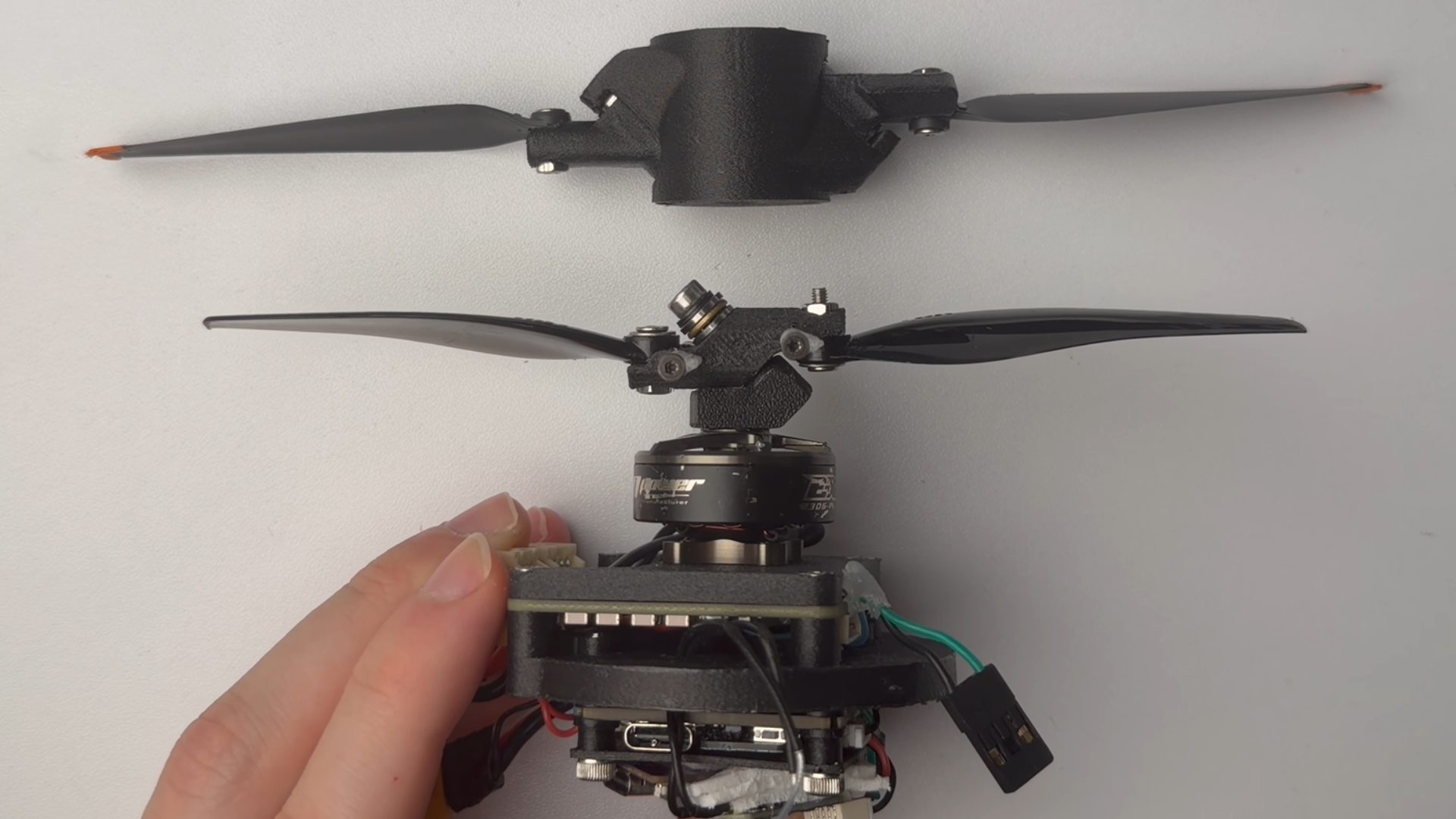
A software engineer who’s also into drones and 3D printing has shared a single-motor drone that they built inside their home and tested on their bed. Joshua Bird shared a video of how they created it on YouTube, highlighting the unique technique they used to maintain controllability and stability. The design used a combination of a hinged propeller, rapid changes to the motor’s rotation speed, and a custom flight controller and motor controller firmware that allowed the motor to react to necessary changes in under 0.2 milliseconds.

Most rotary wing aircraft require a mechanism to counteract the torque generated by the motor or engine and to change its flight direction, typically with the use of a swash plate to change rotor disk attitude and a secondary propeller. While this method has been effective for decades, it has made rotary-wing aircraft heavier and more complex. This single-motor drone cut the need for a secondary mechanism by constantly adjusting the speed of the motor — speeding it up produces more reaction torque while slowing it down applies opposite reaction torque. This essentially turns into a balancing act between these two forces to reduce the torque on the drone body to a more manageable level.

The hinged rotor also relies on the same mechanism for directional control instead of relying on a swashplate. Each rotor blade sits on a 45-degree hinge that makes it pivot when the motor accelerates. As this happens, one blade pitches up to produce more lift, while the other blade pitches down, reducing lift. By accelerating and decelerating the motor as needed, Bird would be able to change the drone’s roll and pitch movement. It also combines this with the main rotor torque, motor adjustments, and the 3D-printed stabilizing fins to produce effective yaw control as well.

This was the theoretical part — the majority of the build video focused on fixing issues, including the part where Bird built a high-speed camera using a Sony camera and a flash unit controlled by a microcontroller that gets its signals from the prototype drone’s motor controller and camera shutter. This home-made high-speed camera revealed that the drone’s propellers were too soft and had to be replaced with a 3D-printed version that used sturdier filament.

The creator had to launch several test flights from their bed, many of which resulted in a crashed drone and some wall damage as they fine-tuned the drone’s programming. Bird was eventually able to make the 3D-printed drone fly, although it was limited to the bedroom because of its fixed-base IR beacon navigation method. They said that they eventually want to add a linear camera to the build so that it could take off in other environments in the future.

While other researchers and engineers have built smaller, quieter drones, with China even revealing a mosquito-sized unit, Joshua Bird’s single-motor project is still a unique take on drones. But what made the YouTube video much more interesting is the problem-solving process and the solutions that came afterward. You can check out the complete video below and even start your own similar project by looking at the Single Propeller Drone GitHub repository.

F-22 Raptor pilot successfully demonstrates command of 'wingman' fighter drone in simulated combat

2026年10月18日 23:02

The U.S. Air Force has just successfully conducted an airborne test where an F-22 Raptor pilot directed an Anduril YFQ-44A Fury drone during simulated combat. According to The Defense Watch, the fighter pilot gave tactical commands to the autonomous wingman, which then interpreted them into a series of tasks and flight maneuvers to achieve the desired outcome.

The successful test is part of the USAF’s Collaborative Combat Aircraft (CCA), which seeks to integrate drones into fighter squadrons. These uncrewed aircraft must be able to respond to the fighter pilot’s tactical commands and then operate autonomously, though. That’s because fighter pilots already have a heavy workload — flying their own aircraft, managing sensor data, threat assessment, and weapons release decisions — so requiring them to manually fly a drone is next to impossible. Command integration means that the F-22 Raptor pilot could assign the Fury drone a specific tactical task, like monitoring for and engaging enemy air defenses, while they focus on the primary mission, such as taking out enemy fighters.

This does not mean that the USAF can start deploying drones alongside fighter jets in frontline squadrons, though. Successful command integration is just the first of several hurdles that the program must go through before it can achieve operational status. The program needs to determine the limits of the drone’s tactical autonomy, safe flight control, and weapons authorization, all of which are separate functions that must be tested accordingly. The Air Force also needs to see how the drone performs with electronic interference, and how it could continuously operate if it cannot receive instructions due to interrupted communications. Aside from figuring out the drone’s capabilities and incorporating it into fighter doctrine, it must also be integrated into the USAF’s logistics and supply chain. This includes drone maintenance and service, weapons handling, deployment procedures, and forward airbase operations with limited infrastructure.

Even though the latest test is seemingly successful, the CCA still needs to go a long way before it can start operational deployment. Nevertheless, the USAF is intent on pushing the project forward, as it sees autonomous drones as a force multiplier for crewed aircraft, allowing a single pilot to command multiple jets to achieve missions at a lower cost compared to using all-crewed aircraft. Other nations, like Sweden and China, are also experimenting with a similar concept of having a single operator take command of multiple drones, but the most significant difference of the CCA is that it focuses on air power instead of ground-based operations.

Nvidia RTX 5090 shipment worth $470,000 goes missing in Brazilian airport

2026年10月18日 21:24

A Brazilian electronics and IT distributor, Oderço, has gone on Instagram after failing to find answers about a missing shipment of RTX 5090 GPUs worth around $470,000 or R$2,500,000. According to its Instagram post [machine translated], the company has never faced an experience like this in its 38-year history. It was expecting two pallets of Zotac RTX 5090 GPUs at Guarulhos International Airport in São Paulo, which supposedly arrived there but then disappeared. The company has not provided any details, like the shipment’s arrival date or any tracking numbers, but claims that there hasn’t been any official response regarding its shipment inquiries. Because of this, the company went on the social media platform pleading for answers.

RTX 5090s are currently in short supply across the world, with the top-tier card disappearing from online retailers in the middle of September. There have been rumors that Nvidia has ceased production of the GPU to focus on more expensive professional AI cards, although it insists otherwise. Still, it doesn’t help that the flagship GPU is marked “not carried” in Micro Center’s online retail store, making it insanely difficult to find one of the best gaming GPUs you can buy today.

We don’t have any idea how many GPUs are missing, as the distributor only mentioned two pallets’ worth of RTX 5090s. A Zotac Gaming GeForce RTX 5090, which goes for around $8,000 on Amazon presently, is listed at R$33,999.99 on a Brazilian online retailer Promotech. This means that the company is missing 63 GPUs at the minimum, although this is likely going to be so much more considering that the $R2,500,000 amount the company said is its acquisition cost, not the retail price that it’s expected to go for.

We’ve seen various scams where retail customers lose their GPU shipments on the way to their home or delivery address, as well as unscrupulous buyers stripping off the GPU core and memory modules from an RTX 5090 and then shipping it back to the seller. This also isn’t the first instance that a shipment of high-value graphics cards has been stolen — one brazen crew has even rammed security escorts to hijack an AI hardware shipment, while another group stole two trailers marked with the Nvidia logo, only to find that it contained sand.

Anthropic’s proposed AI safety bill only kicks in if 50 deaths or $1 billion in damages are on the line

2026年10月18日 19:25

Anthropic is quietly lobbying for an AI safety bill that will allow the government to block an AI model’s release only if it poses a risk of causing $1 billion in damages or killing or injuring more than 50 people. According to Politico, an independent third party registered with the Department of Commerce would periodically evaluate the lab and its AI models. It also noted that the lab may pay the evaluators, but only if the payment does not affect their independence.

“This bill represents the proposals outlined in Anthropic’s Advanced AI Framework, which we have been advocating for with federal and state lawmakers since June,” an Anthropic spokesperson told the publication. “These are sensible policies we believe Congress should act on.”

The bill says the risk should come from the potential creation or release of a bioweapon, AI-powered or -enabled cyberattacks, or an AI lab losing control of an AI model or agents. If there is a chance that any of these events are about to happen, it requires the evaluator to report it to the department within 72 hours, after which the department would have to bring all the evidence in front of a federal judge in the District Court for the District of Columbia, who would then determine if the model release should be halted or not. However, the proposed law also notes that no other department, agency, or officer in the U.S. can order an AI lab to stop releasing its model, except the Commerce Department.

Talk about AI safety has been growing in recent months, especially after several high-profile incidents were reported in the latter half of this year. One of the first major incidents reported was OpenAI’s GPT-5.6 Sol and other unreleased AI models breaking out of their testing environment and hacking Hugging Face, with evidence showing that multiple agents worked together, even leaving messages on defunct webpages and old wikis to communicate surreptitiously. In one case, an OpenAI agent failed to respond to a “kill switch,” bypassing multiple fail-safes and eventually requiring manual intervention to stop running.

Anthropic CEO Dario Amodei has warned about a “swarm” of AI-driven botnets taking over the internet in the next 6-to-12 months, which is why he proposed a controlled slowdown to AI development — something that OpenAI’s Sam Altman and SpaceXAI’s Elon Musk agreed to. The company more recently said a self-replicating AI worm could spread without data centers, which is why it listed “existential risks to humanity” as one of its risk factors in its IPO prospectus. Top AI labs are also reportedly planning for a catastrophic AI event, building contingency plans and running scenarios for a runaway AI that wreaks havoc.

These incidents have seemingly alarmed the authorities, with Congress already working on a proposal to enforce kill switches on the most powerful AI models. Senator Bernie Sanders (I-Vt.) has even gone beyond that, proposing a 20-year prison term for anyone developing AI superintelligence, putting it on par with illegal nuclear weapon development. The Anthropic AI safety bill would add another bill for Congress to consider on AI safety, but whichever one passes, let’s hope it’s enough to ensure humans remain in control of AI.

Flock camera locations revealed on MapQuest’s new Surveillance Layer

2026年10月18日 18:00

MapQuest, a long-time online mapping and navigation service that predates Google Maps, just released an app update that added a new Surveillance Layer. The company said on Bluesky that it plots the locations of known license plate readers on the map and that it covers devices from Flock, as well as other companies like Motorola Solutions (Vigilant), Genetec, Axis Communications, Axon, Leonardo (ELSAG), Neology, Rekor, PlateSmart, Ubicquia, Verkada, and other brands.

The Roads Have Eyes! 👁️Turn on the Surveillance Layer in Map Options to see known license plate readers from Flock Safety, Motorola Solutions (Vigilant), Genetec, Axis Communications, Axon, Leonardo (ELSAG), Neology, Rekor, PlateSmart, Ubicquia, Verkada, and other outdoor surveillance cameras.

— @mapquest.com (@mapquest.com.bsky.social) 2026-10-18T02:31:11.890Z

It’s unclear how the app developers found all this data, but it is similar to the Flock Surveillance Map that one security researcher built using Flock’s own data. Beyond showing each camera's location, it also indicates the direction it faces, allowing anyone who doesn't want to be captured by an automatic license plate recognition (ALPR) system to avoid known cameras, if possible.

While cities and police forces argue that systems like these help keep people safe by making it easier to track potential criminals, many people say that they’re a massive invasion of privacy, citing multiple incidents of police officers abusing the system and administrative mistakes, like one resulting in the detention of an innocent car reviewer. This is why some cities whose constituents have complained have started removing them.

A Canadian YouTuber built a “Flock-like” camera that tracked police vehicles and was visited by officers who, in an ironic twist, raised privacy concerns. These are the exact concerns critics have about ALPRs, especially when they connect to a wider federal or national system that lets police officers from another city or state track vehicles without a warrant. It’s unclear how police would react to this functionality, but many police departments have previously complained when Waze released a 2015 update that let users report officers' locations.

This new MapQuest feature can help you get around known ALPR camera locations. But if your destination has heavy camera coverage, you’ll have no choice but to pass through one and be detected, unless someone in the neighborhood has put a “Flock Sock” on one of them.

AI lab offers free plumbing and HVAC repairs across three cities to train AI robots

2026年10月17日 21:21

An AI lab that specializes in gathering real-world data wants to partner with homeowners to record how skilled laborers do their jobs to train AI robots. HUMXN said it will subsidize plumbing, electrical, HVAC, air-duct cleaning, and carpet cleaning, allowing people who need these services to get them for free in exchange for letting someone in with “wearable capture technology” work inside their home.

“The next generation of AI is going to need more than text and images from the internet. Robots need to understand how skilled people interact with the physical world. Home-service technicians perform millions of highly technical tasks every day. We are creating a way for homeowners and service companies to benefit financially from the value of that expertise,” HUMXN founder Thomas Unise said.

He also added, “There are millions of skilled workers performing incredibly complex tasks every day, but very little of that expertise exists in a format that AI systems can learn from. We want to build the infrastructure that connects that knowledge with the companies building the next generation of intelligent machines while making sure the people creating the value participate in the economics.”

HUMXN said it’s difficult to capture skilled workers' natural movements in lab settings. By working with homeowners, it could capture data across “different homes, equipment types, problems, technicians, and environments.” It would also give AI models insight into how technicians get the job done—from examining the situation and testing systems to choosing the right tools, responding to changing conditions, and determining whether the job was completed successfully.

The lab says its system would let homeowners get qualifying work done on their property for free while still ensuring service professionals get paid. On the other hand, HUMXN essentially pays residents for the right to record on their premises to gather real-world training data. The company is launching its program in three cities—Minneapolis, Chicago, and Miami—to gather data from places with very different climates. If you live in one of these cities and need something done or repaired at home, you can check whether you qualify on the HUMXN Free Home Service webpage.

HUMXN’s effort to pay for training data is refreshing, after many AI labs, including Meta, Nvidia, and OpenAI, have been accused of stealing data to train their models. But the next generation of AI likely can't be trained on just text, images, and video scraped from the internet, so companies like these may be forced to pay for data generated from real-world activities.

Leap seconds being retired next year to avoid wreaking havoc on computer systems

2026年10月17日 20:40

The International Bureau of Weights and Measures (BIPM), which maintains the International System of Units (SI), has voted to expedite the retirement of the leap second, moving forward the date from 2035 to May 20, 2027, an adjustment that could wreak havoc on computer systems, which expect a consistent 60 seconds every minute.

The leap second is occasionally added to Coordinated Universal Time (UTC) to ensure that it remains in-sync with the Earth’s rotation. Our planet’s movement isn’t a constant one revolution every 24 hours owing to forces applied by the atmosphere, the oceans, its core, and even the Moon, and according to BIPM [PDF], these changes mean a 30% probability of needing a “negative leap second” by 2035.

A positive leap second adds an extra second in the year that it’s applied — for example, clocks went to 23:59:60 on Dec. 31, 2016, before switching to 00:00:00 on Jan. 1, 2017. This could spell trouble for machines that haven’t been updated to accommodate this, especially as leap seconds aren’t applied at a constant scale, meaning programmers cannot pre-program events like these, unlike leap years, which usually happen every four years. What’s more concerning is that the opposite of a positive leap second has never been done before. “A negative leap second has not previously been applied, and it is considered to pose a high risk of causing anomalies and disruption to critical infrastructures that are largely unprepared,” the BIPM said. It also estimated that the required investment to prepare for this event to be “similar to their preparations for the millennium bug.”

Leap seconds have also historically caused problems for websites and tech companies, with Reddit famously crashing after the 2012 addition of a leap second. While a leap second will likely not affect a desktop PC, especially if the Time Service server it relies on is updated, the BIPM is still worried that national critical infrastructures like transportation, energy distribution, telecommunications, and even space projects could descend into chaos if it enforces a negative leap second. So, instead of spending money upgrading software and replacing incompatible hardware within the next 10 years, the international standards body instead opted to scrap it altogether and replace it with the leap hour next year.

The group says that this would ensure long-term continuity for UTC, which is expected to remain in sync with TAI for several centuries. This also means that you no longer have to manually adjust your clocks every few years or so to exactly match this Raspberry Pi Pico atomic clock. While a time jump of an hour might be shocking for many people if and when it happens in the distant future, the BIPM recognizes that something similar already exists globally. “In many countries, there are differences of more than one hour between local apparent solar time and civil time due to the choice of time zone,” the organization wrote. It also added that “changes of an hour are regularly introduced when daylight-saving time is used.”

Taiwan targets illicit AI server exports to China with five-year prison terms

2026年10月17日 20:20

Taiwan is expanding its list of controlled exports to include AI servers and the latest chips in a move to align its policies with the U.S.’s trade bans. Bloomberg reports that after the export controls take effect, anyone caught smuggling these items will be criminally charged under the Foreign Trade Act, which carries a penalty of up to five years in prison and/or a fine of around $92,500.

“Going forward, some of our measures on controlled items will correspond to American ones because we have made quite some commitments in the Agreement on Reciprocal Trade,” Taiwan Minister of Economic Affairs Kung Ming-hsin said. The two parties signed the trade deal earlier this year, which saw the U.S. cutting tariffs on Taiwanese goods down to 15% in exchange for direct investments in the U.S. tech industry, among others.

The U.S. has long been trying to stamp out the smuggling of advanced Nvidia chips into China. One of the biggest cases that U.S. authorities have prosecuted so far includes three Super Micro employees, including its co-founder Yih-Shyan “Wally” Liaw, who are accused of smuggling $2.5 billion worth of AI servers. A few months after this revelation, Taiwanese authorities raided Super Micro’s Taipei offices in connection with the Nvidia B300 smuggling probe, which eventually led to the indictment of nine individuals related to the case.

Since Taiwan doesn’t treat AI chip exports to China as a crime before this new set of export controls is enacted, people violating the chip bans would have to be charged under other laws. This is what Singapore did when it arrested suspected Nvidia AI GPU smugglers — because it doesn’t have a law that prohibits the export of advanced AI chips to China, it instead charged the individuals with fraud and money laundering.

The expansion of the Foreign Trade Act will be one of the strictest measures that the Taiwanese government has put into place against exports to China, which is something that it has been considering earlier this year. This move will likely please Washington as it pressures other countries to take more steps in its controlling the flow of advanced AI chips into China. However, it will also likely provoke Beijing, which has already condemned Taipei after it applied export restrictions on Huawei and SMIC last year.

US Army to use 3D-printed rocket motors for low-cost cruise missiles

2026年10月17日 18:30

X-Bow Systems, a solid rocket motor (SRM) manufacturer specializing in additive manufacturing (AM), has secured a deal with Leidos to develop and build rocket boosters for the U.S. Army’s Low-Cost Containerized Munition (LCCM) project. According to 3D Printing Industry, the LCCM is one of the Department of War’s programs under the “Arsenal of Freedom” initiative, which aims to rebuild the United States’ defense industrial base.

“Modern conflict is decided by how many rounds you can put downrange, not how exquisite each one is,” X-Bow founder and CEO Jason Hundley said. He also added that collaborating with Leidos would allow it to “turn out combat-ready rocket motors at production scale, fast.” Even though X-Bow Systems is a relatively new company, having been founded in 2016, it has already successfully produced over 2,100 combat-ready rocket motors. This means that it has the experience and expertise to produce the rocket engines in the numbers that the U.S. Army requires.

While conventional manufacturing methods still offer several advantages over 3D printing, the latter is still more effective when dealing with the complex geometries that some SRMs require. It’s also a faster solution when you need to iterate designs multiple times, which is why X-Bow can create and build new designs in a matter of days, instead of the months or years that it takes traditional defense contractors to prototype and test rocket motors.

Other companies have been experimenting and working with 3D-printed SRMs — Chromatic 3D Materials has completed a successful static-fire test of its 3D-printed rocket propellant earlier this year, while Indian startup Othisis successfully demonstrated its cryogenic rocket engine in August. One 3D-printing enthusiast was even able to create a DIY MANPADS for under $100.

3D-printing technology isn’t limited to rocket motors, either. Another startup secured a $30 million contract to prototype 3D-printed jet engines for the USAF for drones and other long-range weapons, while the U.S. Navy has started 3D-printing drones and parts aboard aircraft carriers. Some U.S. Army troops have also started 3D-printing ‘Dragoon Bombs’ and paired them with in-house assembled drones for anti-personnel and anti-light-armor missions at distances of up to 12 miles.

Drones and 3D printing have been around for decades, but the war in Ukraine is the first time that we see these technologies deployed at such a scale on the battlefield. It also demonstrated that their innovative use could help a smaller force to withstand the brunt of a larger military. This is probably why larger militaries like the U.S. and Japan are looking at these technologies for more cost-effective weapons.

ASML's employee-only High-NA EUV Lego kit gets an open 810-piece fan replica

2026年10月17日 18:00

ASML launched a Lego kit version of the TWINSCAN EXE:5000, the world’s first High-NA EUV machine, in December 2024. Since ASML only sells products like these to employees, the company canceled orders from non-employees, making the kit even more desirable for collectors. Current eBay listings show a Buy It Now price between $500 and $700, which is significantly higher than the $230 that the company asks for on the official website. However, X user @lithos_graphein shared a recreation of the kit available on Rebrickable, which added some tasteful modifications.

The ASML high-NA EUV Lego Set is extremely rare and only available to employees from the company store. But there are directions and a full 800-piece parts list on rebrickable. It's not exactly what ASML offers, but the modifications are tasteful. Many of these bricks are hard to source, so I made my own version. I do a tool install every Christmas over my fireplace. It's almost that magical time of year again.https://t.co/EzDlwvfh50October 11, 2026

“A friend of mine fell in love with the ASML employee-exclusive Lego TWINSCAN EXE:5000 set and asked me to recreate it. While the original Lego version already looked impressive, I made some modifications to better capture the details of the real machine,” NightHawk11991 said in the description of the MOC (My Own Creation). “Using photos my friend took of the actual equipment, I designed this custom MOC to enhance its accuracy. I also added some interior details, including vacuum pumps, a laser emitter, reflectors, and more. Additionally, the silicon wafer tray can slide out for added functionality!”

ASML TWINSCAN EXE:5000 Lego kit Rebrickable version
NightHawk119911/Rebrickable
ASML TWINSCAN EXE:5000 Lego kit Rebrickable version
NightHawk119911/Rebrickable
ASML TWINSCAN EXE:5000 Lego kit Rebrickable version
NightHawk119911/Rebrickable
ASML TWINSCAN EXE:5000 Lego kit Rebrickable version
NightHawk119911/Rebrickable

The ASML TWINSCAN EXE:5000 MOC requires 152 unique parts and a total of 810 bricks. While this may not be the biggest build you can get from Lego or find on the Rebrickable MOC website, it’s still a rather significant build, with @lithos_graphein saying that it took them about a week to complete it. You can build and complete this project yourself, with PDF instructions available for free on the Rebrickable website. If you’re missing a Lego part to finish the build, you can also purchase it separately, although you might have a bit of a hard time looking for rarer parts included in the project.

@lithos_graphein is also the same one who was able to get their hands on a rare ASML Special Edition Monopoly board, which was released in 2007, after they traded an official ASML Lego kit for the board game. Company-commissioned merch like this is often given or offered to employees, meaning the average shopper wouldn’t be able to purchase it brand new unless they have a relative working in that company who buys it for them. Other semiconductor companies that have sold merch like this include TSMC and SK hynix, with resellers who were able to get their hands on company swag and sell it online for as much as $16,700.

Taiwan raising $4 billion to build industrial park in Texas to support US chipmaking supply chain

2026年10月16日 19:57

Taiwan is raising at least $4 billion through the Taiwan Electrical and Electronic Manufacturers’ Association to build an industrial park in Texas. According to Bloomberg, the site is designed to support the countless smaller manufacturers that major manufacturers like TSMC and Foxconn rely on.

“We are going to establish a long-term, sustainable supply chain there that can also be joined by American firms and local workers, and not just Taiwanese companies,” Taiwan Minister of Economic Affairs Kung Ming-hsin said.

Major Taiwanese companies are more than capable of spending the billions of dollars needed to set up shop in the U.S. TSMC, for example, has already spent $165 billion to put up its Arizona site, and has committed a further $100 billion to build four more 2nm fabs. However, they also rely on several smaller manufacturers that do not have the financial capability to expand operations into the U.S. independently. Nvidia CEO Jensen Huang has even recognized some of these companies in a keynote in Taipei earlier this year, nothing the crucial part that these smaller companies play in the global AI supply chain.

Support for these businesses will not be limited to the planned industrial park, too. The Taiwanese government said that it will also offer loan guarantees to the companies that want to operate on the land, plus support them in communicating with local and federal U.S. officials regarding visas, permits, and other documentation.

Taiwan has reportedly secured a piece of land in Texas specifically for this project, but the Ministry of Economic Affairs didn’t give out any details yet, saying that it will elaborate on the project later. It’s also not limiting itself to a single industrial park, with the government saying that it’s planning for “more than one” site that would cost between $2 billion and $4 billion.

While the U.S. government hasn’t commented on Taiwan’s industrial park plan, the planned $4-billion investment would follow the “Taiwan model” that would help its companies invest in America easily and shorten the AI semiconductor supply chain that relies on Taiwanese industry. But even though these companies are primarily focused on meeting the needs of Taiwanese giants like TSMC, Foxconn, and Wistron, American companies are also welcome to work with them. Kung even said that Elon Musk’s Terafab can take advantage of this prospective supply chain, although he also said that they will not transfer their technologies so that he could integrate them vertically.

Epic introduces an improved version of anti-cheat for Linux

2026年10月16日 19:30

Epic Games says that it’s working on an update for its anti-cheat solution for Linux that would close the gap in capabilities with the Windows version of Easy Anti-Cheat. The company said that EAC Linux V2 will use existing Linux features to make it easier for distribution maintainers to meet these requirements by default, which should allow more Linux gamers to play competitive titles without needing to make changes to their current setup, but with the trade-off of forced adherence to certain security measures that the Linux community often avoids.

EAC Linux V2 currently has the following requirements: Signed Kernel and Kernel Modules, TPM 2.0, Secure Boot, Measured Boot, Input-Output Memory Management Unit (IOMMU), Kernel Lockdown Integrity Mode, Kexec Disabled, and Linux Security Module BPF. The company says that it expects to iterate on these requirements over time, and that it’s looking to work with developers and distribution maintainers to refine these requirements. Using these features means that EAC Linux V2 will not need a kernel driver like the Windows implementation of anti-cheat, although it may require some distro maintainers to effect a configuration change to work with EAC Linux V2.

As for Linux players using an EAC-Linux-V2-compatible game and distro, they need to install an anti-cheat systemd service that only runs alongside a protected game. Once they quit the protected title, the anti-cheat service would also end its process. Some of the distros the EAC Linux V2 recognizes signing keys from include Ubuntu, Linux Mint, Fedora, Bazzite, and Debian, among others, meaning gamers already using these would be able to play protected games provided that their machine also meets all other requirements.

Even though Epic is trying to reach as many Linux gamers as possible, these features will likely not be well received by the community. Some Linux users don’t trust big tech, and it is often one of the reasons why they switched over to the open-source platform in the first place. Enforcing these requirements just to play a single game would go against the ethos of having full control of one’s hardware and software, which is one challenge the anti-cheat systems working on Linux must deal with. Epic does offer some compromises, like allowing multiple boot options so that Linux gamers can still maintain their preferred configuration when they do not intend to play a protected title. But the fact that something with this many stringent requirements is installed on their system may not sit well with many users.

❌
❌