阅读视图

发现新文章,点击刷新页面。
✇Tomshardware

Nvidia app update fails to block unofficial DLSS multi-frame generation mod on RTX 40 series gaming GPUs — modders restore support across multiple games within hours

作者 Zak Killian

When NVIDIA launched the GeForce RTX 50 series, a major part of the hype surrounding the new GPU family was its support for DLSS Multi-Frame Generation. This feature was officially locked to the new RTX 50 "Blackwell" GPUs, but modders have been working on unlocking it for RTX 40-series cards for a while now. NVIDIA is clearly aware of these efforts, as it recently pushed an over-the-air update via the NVIDIA App that seemed targeted at blocking them due to its odd changes. Yet, as pointed out by Sebastian Castellanos on X, enterprising hackers had already found a workaround just hours later.

At the launch of Blackwell, NVIDIA explained that bringing Multi-Frame Generation to previous-generation RTX 40-series cards wasn't possible because those GPUs relied on a hardware optical flow generator incapable of producing multiple interpolated frames per rendered frame. Instead, Blackwell introduced a software-based optical flow method executed directly on the GPU shader cores without requiring the hardware unit. To tech-savvy gamers, the obvious question arose: why not use that same software method on Ada Lovelace GPUs and bypass their hardware optical flow units? NVIDIA showed no interest in enabling this, leading many to assume it was technically impossible.

I uploaded a video on how to enable DLSS Multi-Frame Generation on my RTX 4060 GPU.I tested RE9 and Forza Horizon 6. To be honest apart from the oblivious latency increase, it works extremely well!Thanks to @Sebasti66855537 for notifying me about this mod!Video linked below pic.twitter.com/Tldr9JZIxJSeptember 4, 2026

Put simply, it's possible. There are apparently various roadblocks within NVIDIA's software, but the strength of the PC platform lies in its openness; users can freely modify software running on their own hardware. And so, at least three distinct mods have emerged to unlock DLSS Multi-Frame Generation across multiple titles. It began with a Cyberpunk 2077 mod by creator "dashdogy" that relied on game-specific modding frameworks, but the technique has since been adapted into a broader ReShade plugin applicable to almost any game, and that's just one of at least three different multi-game unlock mods I found.

It's obviously in the company's best interest to protect its marketing narrative, and the narrative is that Multi-Frame Generation doesn't work on GeForce RTX 40 series graphics cards. However, user reports across X and Reddit tell a different story. Users report that the mods not only work, but also deliver surprisingly smooth frame pacing. NVIDIA had previously warned that Blackwell's specialized hardware flip metering was mandatory for proper frame pacing with multi-frame generation, but dashdogy noted that his mod backports "Blackwell-specific frame timing instructions to allow Ada to place the frames in the correct positions," suggesting that MFG's purported hardware dependency was greatly exaggerated.

A screenshot of the MFGAdaUnlock-RenoDx GitHub project showing the patch notes for Release 0.4.

There are already two more updates after this, both fixing major bugs. (Image credit: Future)

Earlier attempts to enable multi-frame generation on Ada Lovelace relied on GPU spoofing or hybrid solutions, like combining standard 2x DLSS Frame Generation with AMD's FSR 3 or Lossless Scaling's software frame generation. Those workarounds were significantly clunkier than native game mods that utilize NVIDIA's own DLSS-G framework. While I couldn't get this latest mod working in the limited time before publication, community developers have not only bypassed the latest roadblocks thrown up by Mean Green, but in fact, they've released at least two more updates for the mod in the last ten hours since Castellanos' X post.

All of this coincides rather neatly with the contentious rollout of DLSS 5 "Neural Rendering," which is another technology originally pitched as an RTX 50-series exclusive before NVIDIA made a last-minute reversal to promise it for RTX 40-series cards as well. That shift may well have been driven by hackers porting DLSS 5 Neural Rendering not just to older NVIDIA architectures, but even to AMD Radeon GPUs. Once it became common knowledge that DLSS 5 runs on non-Blackwell hardware, continuing to claim hardware exclusivity risked a major loss of consumer trust. It'll be fascinating to see if NVIDIA will pivot on DLSS Multi-Frame Generation in the same way. While it would be a nice bone to throw the company's loyal previous-generation customers, we wouldn't bet on it.

✇Tomshardware

RPCS3 emulator devs slam Nvidia DLSS 5 as 'AI-slop generator' — says industry pushing 'more upscalers and frame generation to hallucinate games and hide their lack of optimisation'

Developers at RPCS3, the open-source PlayStation 3 emulator, have criticized Nvidia’s DLSS 5 technology, calling it an “AI-slop generator.” A number of modders managed to port DLSS 5 to various games last week after the latest neural-rendering tech leaked before the official launch. A few people also went ahead and apparently tested the leaked DLSS 5 DLL on the RPCS3 renderer. According to a post by the official RPCS3 account on X, “Whilst the gaming industry pushes more upscalers and frame generation to hallucinate games and hide their lack of optimisation, we do not ship any of that slop.”

The post has drawn criticism from certain users, with one calling RPCS3’s response “possibly the dumbest” they could have expected. They argued that DLSS and FSR frame generation can complement game-engine optimizations rather than simply mask poor performance, while Nvidia’s Reflex can help mitigate the latency penalty associated with frame generation.

DLSS 5 on RPCS3?A few people are testing a leaked DLSS 5 DLL on our renderer. We have seen the slop it generates.Whilst the gaming industry pushes more upscalers and frame generation to hallucinate games and hide their lack of optimisation, we do not ship any of that slop. pic.twitter.com/S2GciNbCTKSeptember 1, 2026

In its response, RPCS3 said that emulators have never-ending goals, and they do not simply target high-end hardware to achieve playable status. The developers also added that modern temporal upscalers are difficult to implement because PS3-era games do not expose the motion-vector data they require. At the same time, RPCS3’s low-level RSX emulation makes reconstructing that data impractical. As a result, the emulator currently relies on spatial upscalers such as FSR 1, bilinear, and nearest-neighbor scaling.

DLSS 5 is expected to officially roll out starting today, with NBA2K27 being the first game to support the latest tech. Focusing on 3D-guided neural rendering, DLSS 5 aims to deliver movie-grade visual realism and photorealistic lighting in games. The AI model is trained to deduce how complex features of game scenes like characters, skin, hair, and environmental lighting should look in the real world given certain inputs from the game engine, like color buffer and motion vectors, in combination with an input frame.

According to Nvidia, DLSS 5 will also provide different AI models and controls, allowing artists to decide what gets enhanced, where the effect appears, and how strongly it is applied. For players, however, Nvidia wants to keep things simple as DLSS 5 essentially becomes an on/off graphics option, while the detailed decisions about how the AI-generated visual effects are used are handled by the game developer.

Since DLSS 5 is resource-intensive, gamers should expect a noticeable drop in frame rates, especially with the initial release. Nvidia has also confirmed that DLSS 5 will only be compatible with RTX 50-series desktop and mobile GPUs, as well as GeForce Now. Notably, the recently leaked DLL has allowed some modders to successfully port DLSS 5 to older RTX 40-series cards.

✇Tomshardware

Nexus Mods acquires SteamDB after 13 years of solo dev work — promises no ads, no paywalls, and smarter mod-update tracking

It may come as a surprise to many readers (and me) to realize that the venerable SteamDB, used and beloved by a good chunk of PC gamers, was actually a one-man effort. The hero in question is Pavel Djundik (aka xPaw), who's been single-handedly developing, designing, managing, and doing systems administration for most of the site's 13 years of existence. He's earned his figurative retirement and now handed over the reins to well-known modding site Nexus Mods.

In a public statement and subsequent FAQ, Nexus Mods (NM) clarifies the acquisition situation. To immediately assuage fears, NM says that SteamDB will remain ad-free and won't have any paywalls placed on existing content. Users won't be required to use a NM account to browse the site, nor will there be any forced integration between both properties. The FAQ clearly states that NM "[is] not interested in changing SteamDB into something it isn't."

The new owners also explain in detail how meshing together both NM and SteamDB has the potential to be extremely beneficial for the modding community, at least at face value and our own experiences with game modding, they appear to have an excellent point. Installing and maintaining a set of mods for a game in this day and age is relatively easy, but anyone who's ever done it knows it's all sunshine and rainbows until a game update drops and breaks your careful curation.

SteamDB keeps track of game versioning down to individual deployments, complete with release dates, and changed files (a rough analog to a GitHub commits) — here's the info for Stalker 2 as an example. Nexus Mods can leverage this information to warn you there's a pending update, execute version pinning (keeping the game locked at a version that's compatible with the mod list), and also know if a mod install or uninstall broke the game installation, since it'll know what the unmodified files are meant to look like. This ought to allow for far better troubleshooting, too.

As far as the future of SteamDB goes, NM says straight up states the site "needs to make money," as it's relied on donations to Djundik and his daily work for a long while. Despite the monetization intentions, NM says "[it wants] to be smart about it," isn't looking to put ads on SteamDB, sell personal data, or put up paywalls or login walls. The NM folks mention partnerships, integrations, and affiliate links with publishers as ways to keep the numbers in the black, particularly as they intend for SteamDB to have an actual team running it.

For his part, Pavel Djundik tells a sadly familiar story: SteamDB was one of his passion projects, but as the site grew, the "self-inflicted workload [took] its toll." According to Djunidk, the radical change of the internet after COVID and the rise of AI sapped his passion further, and working as the sole man in the operation was unsustainable. He'd wanted to hand over the reins for years, but it wasn't until now he found "a worthy partner," particularly one that wouldn't riddle the site with ads. A hearty salute for your service, sir.

✇Tomshardware

Massive 12TB Steam leak reveals decades of unreleased games — archived files include unseen Half-Life 2: Episode 3 builds and assets

Valve might've just suffered its biggest data leak in history, but it wasn't a hack or a security breach. Instead, the company left an endpoint to its legacy infrastructure accessible to the public, from where archivists extracted 12-13TB of old game content. The files are still being explored, but we know they include both Valve's internal projects and third-party releases, with an early weapon asset from Half-Life 2 Episode 3 being the key discovery, along with scrapped Portal 2 concepts.

The archive consists of old Steam content-server data from 2003 to 2013, overlapping with the timeline of the platform's upgrade from the old Steam2 system to SteamPipe. Valve used to distribute games via proprietary NCF (No-Cache File) and GCF (Grid Cache File) formats during the Steam2 era before it transitioned to a standard HTTP file-tree system around March 2013. Therefore, this dump basically acts like a preserved time capsule.

During this period, Valve was a much more active game developer, so we get a rare insight into their projects. First up is Left 4 Dead, and the files include an entire early build of the game from June 2008. It has a different HUD, different voice lines cut from the retail release, altered sections of the map, and many unfinished early assets that Valve was recycling from the Terror Strike mod (for Counter-Strike: Condition Zero).

left 4 dead 2 beta dead center map #2the exterior outside of the hotel leads you across the street instead of right, directly to the gunstore.this is like whiplash nothing is the same, its like a dream sequence of what im used to pic.twitter.com/AIcvykRe80August 30, 2026

Then, there's Portal 2, which is actually said to have been hit the hardest, and modders have similarly reconstructed a playable build from the files. It's a beta dating back to July 2009 when the game was still in its Core Hub era before that concept was scrapped in favor of a more direct sequel. We also get to see early assets from the F-Stop prequel that was in development the year prior, featuring camera mechanics for gameplay.

An intro sequence shows the player falling down one of the labs. The beta features a completely different GLaDOS, with a more passive role, different voice lines, and new animations. Some of the scenes in this build are so unfinished that they use assets from Team Fortress and Half-Life as placeholders. But perhaps the most exciting discovery here was a 3D weapon model for "Weaponizer."

Prehub GlaDOS Wakeup Sequence https://t.co/Inkid1U9q7 pic.twitter.com/kF5Vf4ssXCAugust 29, 2026

Weaponizer is supposedly a concept weapon from the canceled third episode of Half-Life 2. It's been leaked for years and officially shown off by Valve, too, but never in a build form. It's used to turn objects into ammo, but Valve was using it as a placeholder for a handheld Paint Gun before switching to gel drops. Still, the fact that it exists in this early build of Portal 2 just goes to show how close we were to getting Episode 3.

We got the Weaponizer Model (repost bc other one didnt preview the pics)
 from r/HalfLife

Finally, we got a decent look at CS:GO as well, which looked much more like Source in its early development days, with a more stylized UI and alpha versions of maps. There was an MP5-Active weapon found in the files, suggesting it was part of the original launch roster at some point, along with a bunch of early knife models, cut grenade mechanics, and a Riot Shield brought back from Counter-Strike 1.6.

counter strike 15 is just the weird source port to console.has the escort gamemode visually updated mapshas women playermodelsother than that its just source but for xbox pic.twitter.com/QwmROqH5XmAugust 30, 2026

The archive also includes builds from 2011 that run on Source physics and movement but feature early Left 4 Dead 2 engine code and prototype CS:GO UI elements. This was right around the time CS: GO was born as a whole because, up until then, Valve was simply trying to port Source to home consoles. The extensive upgrades made by Hidden Path Entertainment convinced the company to release a new Counter-Strike game entirely.

hey guysguess what i just foundSonic 4 Episode 2, Beta 2 for PC pic.twitter.com/Bda8O3OSTHAugust 29, 2026

Those are just a few tidbits from the giant dump that's sure to dish out more information over the coming days. Someone found an early beta build of Sonic 4 Episode 2 in the files, so expect to see more from third-party games as well. Valve has not acknowledged the leak so far, but given that even the latest "leak" in this archive is over 13 years old, it's probably not a major internal concern. Besides, all this data was only discovered because of a mistake on Valve's part, not a breach.

✇Tomshardware

At least three exhibitors got robbed at Gamescom 2026 — laptops and handhelds with unfinished game builds stolen from locked cabinets

Several developers and game publishers at Gamescom 2026 in Cologne, Germany, have reported equipment theft at the exhibition. According to Video Games Chronicle (VGC), Mimic developer Ryan Laley, game publisher iam8bit, and Tessera Studios were all hit during the week.

Laley reportedly lost all his laptops from his booth, while iam8bit said in its X post that it’s missing two laptops as well. Meanwhile, Tessera Studios had two laptops and a Steam Deck taken from its cabinet. Laley’s and iam8bit’s booths are located together in Hall 4.1, next to the west entrance gate, meaning they’re both easy targets for thieves looking for a quick score. However, Tessera Studios is in Hall 10.2, putting it quite far from the other two targets.

My #gamescom cut short. Our equipment was stolen last night from the booth.Police reports have been filed.At a loss for words to describe the feeling. Just defeated. Gonna do my best with what's left of the week. But a huge blow financially and mentally pic.twitter.com/dKpp3Of6dfAugust 28, 2026

The cost of the stolen equipment will certainly be a huge setback for these developers and publishers, especially for smaller indie creators. However, the bigger loss would be the data on the machines, which often includes unreleased builds of the games they’re demoing at the expo. While they may have backup copies of their work stored in some of the best external SSDs, the fact that a copy of the games they’re working on is out in the wild and could potentially be leaked would chill the blood of any developer and could be “heartbreaking” for the team working on it.

“Today at gamescom we arrived at our station in the business area hall to discover that our two laptops had been stolen overnight, despite the presence of Koelnmesse security,” iam8bit said in their X post. “These were machines we were using to demo iam8bit Presents titles Petal Runner and Escape Academy 2 to media and content creators during the show. On top of obviously disrupting our very busy appointment schedule, this theft has potentially put unfinished builds of these games at risk of being leaked.”

We were robbed at Gamescom.On Wednesday, we arrived at our booth in the Indie Area to find our cabinet forced open. Two laptops and a Steam Deck were gone.The devices contained not only our Gamescom demo, but also personal, company, and critical information.Here’s our story pic.twitter.com/ZghaSx9RJBAugust 28, 2026

“On Wednesday, we arrived at our booth in the Indie Area to find our cabinet forced open. Two laptops and a Steam Deck were gone,” Tessera Studios posted on X. “The devices contained not only our Gamescom demo, but also personal, company, and critical information.”

Gamescom organizers responded to the issues, saying that although they have arranged for uniformed guards to provide general security, individual booth security must be booked separately. They’ve also advised exhibitors to have insurance against theft, and said these warnings are noted in the terms and conditions for participants, as well as in the event’s technical guidelines.

“All cases have been reported to us and to the police, and investigations are already underway,” the organizers’ statement read. They also said that security is one of their priorities at the event, but also added, “At an event of this size, however, there will always be individuals attempting to take advantage of the situation.”

✇Tomshardware

Valve was founded 30 years ago today — changed PC gaming forever with Half-Life, then Steam

Today marks Valve’s 30th birthday. The company was founded on August 24, 1996, by Gabe Newell and Mike Harrington, both Microsoft veterans. It didn’t take long for the PC gaming world to feel Valve’s influence after it rewrote the FPS genre with Half Life (1998) and pioneered an internet-connected games retail model with Steam (2003).

Valve didn’t come from nowhere, and it doesn’t have a bedroom coder story like many of the game publishers of the 8- and 16-bit eras. Both Newell and Harrington were time-served Microsoft employees, with experience spanning 13 years and 9 years at the massive software corporation, respectively. Their in-depth knowledge of OS engineering, large-scale software projects, game porting and programming, and technical ambition were a great foundation for what they would achieve with Valve.

Only two years after its formation, Valve released Half Life. This title changed FPS gaming forever with its scripted sequences, smart enemy ‘AI,’ storytelling, seamless level design, and application of physics. It broke the Doom-a-like mold that many devs had settled into, and Half Life’s influence is still felt in modern-day FPS games.

Steam is probably Valve’s greatest achievement, though, and powerful rivals are still trying and failing to replicate its success. This online games retail platform got better and better with features like automatic patching, cloud saves, communities, achievements, indie publishing, and - importantly - mod distribution.

Valve was quick to 'industrialize' its game engine and modding to appeal to gamers. The firm’s Source Engine was used by a host of successful games, and its Steam Workshop modding wasn’t just casual fun, with billion-dollar franchises beginning as Valve-supported mods. Valve’s embrace of the above helped it fight off rival online distribution platforms made by powerful and wealthy rivals, and that it prevented deep fragmentation was probably good for the PC platform as a whole.

We remember the first wave of Steam Machines, so Valve isn’t immune to strategic missteps. However, it seems to have found much greater success in the hardware realm with the introduction of the Steam Deck handheld. It clearly wants to rekindle the Steam Machine desktop dream, but the PC industry is having something of a moment right now, with the AI-pocalypse making so many key components of PCs (and consoles, and smart devices) unaffordable. However, the software support for the new hardware thrust, things like SteamOS and Proton, seems to be improving at an enviable pace, clearly worrying Microsoft's Windows and Xbox divisions. If and when we get past this difficult hardware pricing cycle, perhaps other console makers should be worried too.

✇Tomshardware

Prolific Team Fortress 2 collector is selling his in-game case arsenal for an estimated $100,000 — 1.7 million items collected over 10 years are enough to fund a house purchase

Team Fortress 2 cases are worth pocket change. There are a few select cases that scale up to a few dollars, and even fewer with a market price in the double digits, but the vast majority of cases are worth a few pennies, no more than a Steam Trading Card. But one player, Vincent Stech, started collecting cases nearly a decade ago, racking up over 1.7 million cases across several Steam accounts. And now, he’s selling the whole collection, with an estimated value of $100,000.

Stech started collecting cases around Team Fortress 2’s last major update, in late 2017, outside of annual Halloween events that persisted through 2022. In order to accumulate so many cases, Stech largely automated the process, noting that he was careful not to upset the string-pullers at Valve as he amassed a stash of seemingly innocuous digital assets.

“That’s always been one of my biggest fears over the past decade, is one day they wake up like ‘hey, we don’t like what this guy’s doing,’” Stech told Tom's Hardware. “Because I know people with accounts with like 50,000 items that won’t load, and Valve won’t delete the items off their account, so they just can’t access Team Fortress 2 inventory ever again on their main account.”

Before understanding Stech’s process, however, we have to start with how Team Fortress 2’s in-game economy works. Like other Valve titles, you’re able to list items you earn in-game on the Steam Community Marketplace, selling them for real dollars or spending real dollars of your own to buy other items. That’s the normal way of doing things, but this in-game economy has grown beyond the bounds of Steam. A lot of transactions happen off the platform.

Backpack

(Image credit: Backpack)

Websites like backpack.tf and stntrading.eu take trading off of Steam, allowing you to use in-game crafting materials (along with keys) to buy and sell items. There are several reasons for these third-party marketplaces to exist, not the least of which is bot automation, which is against Steam’s Terms of Service. This exchange of in-game currency for items happens through trades on Steam, creating a separate marketplace where real money doesn’t change hands.

That’s not where Stech started. “Team Fortress 2 cases, they weren’t worth anything. They were… people were just giving them away because they take inventory spots,” Stech said. “People were deleting things, and so I decided to scoop them up.”

The problem Stech quickly ran into was inventory space. You can only have a few thousand items in your inventory (Stech told me 4,000 for Team Fortress 2, others say it’s around 2,000). Regardless of the number, it’s far too low a limit to amass nearly 2 million items, even with dozens of alternative accounts. Stech bypassed this issue by using the community marketplace. He listed the cases at very high prices where they were unlikely to sell. That’s because you can have tens of thousands of items on the market “before Steam gets really angry at you.” It effectively multiplies inventory space.

Team fortress 2 inventory

(Image credit: Vincent Stech)

As his inventory began to grow, Stech started automating the process of taking inventory and accepting trades, the latter of which was handled through a simple batch file. At first, Stech was just buying cases in bulk at relatively low prices, but the inventory escalated once he started digging into Steam’s local pricing in different regions.

“In Venezuela and, like, Russian [Rubles]... they are very weak currencies compared to the U.S. dollar,” Stech said. “What I found out is the lowest you can sell an item on Steam for us is three cents. For them, it’s a 10th of a penny. So I found this one guy in Venezuela… he would buy almost every case off the Steam Community Market for their extremely low price, and then he would sell it to me, and I would just give him, like, keys. And he was actually a doctor in Venezuela, and they don’t make much at all by comparison to, like, what $50 would be in USD. So a large majority of his income was case money.”

For context, $50 is equivalent to just over 37,000 bolívares (the official currency of Venezuela).

Stech’s first cash-out from Steam was $50 when he was around 16 years old. A few years later, he cashed out $2,500 to buy his first car. Stech stopped collecting cases about three years ago, and now, he’s looking to sell off the entire collection, which he estimates is worth around $100,000.

Selling this collection is no easy feat, however. For starters, Steam can break when trades get too large, necessitating hundreds of trades across dozens of different accounts. Further, Stech controls quite a large portion of known cases. “At one point, I calculated I had, like, 17% of all TF2 cases that are publicly known… I would have an extremely hard time selling it off because I am a large [portion] of the market. It’s like, you know, Elon Musk couldn’t dump a lot of his stock.”

Stech has, apparently, found a buyer that wants the whole collection, however, and the selling process is already underway. “The transaction has kind of started… he has admin privileges on the trade offers he sends to my accounts, so my accounts just automatically accept any trade from him,” Stech said. “An option was for him to just buy the accounts, but we know that is very bannable, so we haven’t done that.”

Stech says he expects to have the process complete around October. Just as he used case money to buy his first car, he says he plans to use the money from the sale as a down payment on a house.

✇Tomshardware

Ambitious gamer turns fanless Subway menu PCs into gaming rigs — passive Intel Core i3 units manage just 15 fps in GTA V and 25 fps in Minecraft

An intrepid TechTuber has tested a trio of passive mini PCs from the Subway sandwich chain to check if they can be repurposed for gaming fun. In a recent video, Garkus indicates that the three Intel Skylake-powered mini PCs that had been displaying sandwich menus above the serving counters for a decade but were saved from scrap/landfill, alongside a matching set of LG digital signage TVs. Spoiler: they are too puny for mainstream AAA gaming in 2026, even after doubling the RAM installed.

Before getting on with the digital signage-to-gaming conversion, Garkus investigated the hardware in hand. Labeling indicated that the three slim mini PCs were all Advantech DS-081 models (official PDF link). Pondering over that data sheet, we see that the variant with the Intel Core i3 6100U, as these were, carries the full designation of DS-081GB-U21A1E.

The processor is now both long in the tooth and low powered, so immediately we know this 2C/4T @ 2.3 GHz CPU, configured to suck between 7.5W and 15W, won’t be ideal for modern AAA titles. Moreover, the iGPU is the Intel HD Graphics 520 with 24 EUs and clocks up to just 1.00 GHz, sharing the DDR4 system RAM.

A DS-081GB-U2A1E is quite expandable for such a small, low-powered set-it-and-forget-it unit. It has twin HDMI 1.4, twin Ethernet, four USB 3, audio in/out, and an RS-232 serial port accessible from the outside. Inside, users can configure the machine via twin DDR4-2133 SODIMM slots (up to 32GB total), a SATA III HDD/SSD, and an mSATA port that looked like it was an M.2 2242 slot in the video. This passive machine is designed to run signage 24/7 in environments with 0 ~ 40° C (32 ~ 104 ° F) ambient temperatures.

Advantech DS-081 passive mini PC for digital signage

(Image credit: Advantech DS-081)

Setup and gaming

These systems were found to actually come with just 4GB of RAM (one slot used) and with a 64GB SATA SSD installed. They booted to Windows and went straight to kiosk mode, displaying the Subway sandwich menu. We saw an extra 4GB DDR4 stick added to bring the test system(s) up to 8GB RAM in total.

After a bit of OS wrangling, Garkus decided to set up the salvaged trio of passive mini PCs as follows. One kept Windows 10, another got Bazzite Linux (because SteamOS balked at the SATA-only storage), then another went Hackintosh with macOS Monterey installed.

Gaming tests began with a very light test. The system ran Peggle, and this 2D puzzler posed no problems. After this modest victory, Garkus ambitiously leapt straight to GTA V. This legendary but now older title could only reach a frame rate of about 15 fps. But it was found to have defaulted to high settings, took ages to get ready to run on Bazzite, then crashed on exit.

Probably not following best benchmarking practice, the tech tinkerer appears to have decided to test Mario Kart Wii emulation performance while GTA V was still compiling shaders… Later, a test run in Minecraft delivered a wildly inconsistent but roughly 25 fps performance. As is now established as the Garkus testing MO, resolution, quality settings, and so on weren’t shared.

To conclude the gaming part of the video, the TechTuber suggests that these ex-kiosk machines are probably best suited to emulating older consoles up to the PS2 and original Xbox era. We think that for PS2 emulation, you will still need to restrict yourself to lighter titles and reduced settings for smooth action.

✇Tomshardware

Gamers compress 80TB map of Minecraft's oldest anarchy server down to a 15TB download — custom .zvcr compression format and 28 bots map 1 million blocks on infamous 2b2t server

Despite the storage shortages, a brave team of Minecraft players has successfully mapped the entirety of 2b2t, arguably Minecraft’s oldest and most notorious server, and have now shared it as a 15TB download of highly compressed data that can be unpacked to the full 80TB archive. The team had to create its own custom compression format to pull off the feat.

The 2b2tplace preservation project started in 2024 and finally concluded in April of 2026 after an intensive 22 months of hard work. The team employed 28 bot accounts that tirelessly flew across the vast 2b2t world to map every single block with precision. The sheer scale of 2b2t is staggering because it encompasses well over one million blocks and includes the three primary Minecraft dimensions: the Overworld, the Nether, and the End.

The 2b2t server has a data footprint that exceeds 80 TB. Even if the team began their efforts before the recent storage shortage, it would still require an immense amount of storage capacity. Storing the entire 2b2t server would demand at least eight 8TB M.2 SSDs or, as an alternative, five 16TB SATA SSDs. Even with traditional storage, you still need three massive 36TB hard drives. We estimate the team has likely spent several thousand dollars on storage equipment, not to mention priority queue purchases and server rental costs, which totaled over $3,000 alone, according to the GitHub page.

If you are not a big Minecraft fan, 2b2t, short for 2builders2tools, is a Minecraft server characterized by its anarchic nature that launched in 2010. Unlike typical Minecraft servers, 2b2t operates with absolutely no rules, no staff moderation, and no map resets, so players have complete freedom to do whatever they want. Over the years, countless updates have dramatically reshaped the landscape, which has fueled several enthusiasts, including crayne, Fuch, mahan, Steve3, and others, to preserve the original state of 2b2t before it loses all of its essence for good.

Storing or sharing 80TB of data is insane, especially given the limited availability and overpriced storage solutions today - something on the scale of 2b2t can rapidly cause file sizes to spike to impractical levels. The archival team originally promised back in April to make the archive available in a compressed format, but that obviously created issues. As such, the team engineered a custom file compression format specifically for this project, named .zvcr (Zstd-compressed Version Controlled Regions). Common Minecraft servers use the .mca (Minecraft Anvil) file format, which is fine for single-player worlds or even small servers.

Unlike the .mca file format, which normally uses Zlib or Gzip compression, .zvcr uses the Zstd (Zstandard) algorithm that yields higher compression ratios. Zstd is superior in every way to Zlib or Gzip, whether it be compression and decompression speed or final file size. As a result, the team was able to compress the entire project to 15TB, saving up to 81.25% of space. So, now instead of needing eight 8TB M.2 or five 16TB SATA SSDs, you only need two or one to store the compressed archive, respectively. Unpacking the archive, on the other hand, is a different story.

The 2b2t server remains online so that Minecraft players can join in for their daily dose of chaos. Nevertheless, many longtime gamers argue the server has strayed from its anarchic roots. The eventual shift is the main motivation behind the 2b2tplace preservation initiative.

✇Tomshardware

Minecraft system requirements raised for the first time in 17 years — Microsoft now recommends 16GB of RAM and a 2020s or newer CPU to run the Java Edition

Microsoft announced that it’s increasing Minecraft’s minimum and recommended system requirements for the first time in 17 years. According to the company’s blog post, Minecraft: Java Edition will get a spec bump to ensure that the game runs smoothly today and in the future. While it’s understandable that the game’s developers would want to increase the performance of the hardware that the title runs on to implement more advanced features, the new requirements are significantly higher than the previous minimum specification. This could negatively affect players on older hardware that barely hits the minimum requirements, who would have no choice but to upgrade their PCs at a time when RAM prices are at a record high.

Java Edition Minimum (Old)

Java Edition Minimum (New)

Bedrock Edition Minimum

Java Edition Recommended (Old)

Java Edition Recommended (New)

Bedrock Edition Recommended

OS

Windows 7, macOS 10.14.5 Mojave, or later

Windows 10 64-Bit, Windows on ARM, macOS 12+, or Linux 64-bit

Windows 10 19041.0 or higher

Windows 10, macOS 10.14.5 Mojave, or later

Windows 11 64-bit, macOS 14+, or Linux 64-bit

Windows 10 19041.0 or higher

CPU

Intel Core i3-3210 / AMD A8-8600 / Apple M1

Intel Core i3-10100 / AMD Ryzen 3 3100 / Qualcomm Snapdragon X / Apple M1

Intel Celeron J4105 / AMD FX-4100

Intel Core i5-4690 / AMD A10-7800 / Apple M1

Intel Core i5-12400 / AMD Ryzen 5 5600 / Apple M2 Pro

Intel i7-6500U / AMD A8-6800K

GPU

Intel HD Graphics 4000 / AMD Radeon R5

Nvidia GeForce GTX 950 / AMD Radeon RX 460 / Intel Arc A310 / Intel i5-6400 (iGPU)

Intel HD Graphics 4000 / AMD Radeon R5

Nvidia GeForce 700 series / AMD Radeon RX 200 series

Nvidia GeForce RTX 2060 / AMD Radeon RX 5600 XT / Intel Arc A580

Nvidia GeForce 940M / Radeon HD 8570D

Memory

2GB

8GB (discrete GPU) / 12GB (iGPU)

4GB

4GB

16GB

8GB

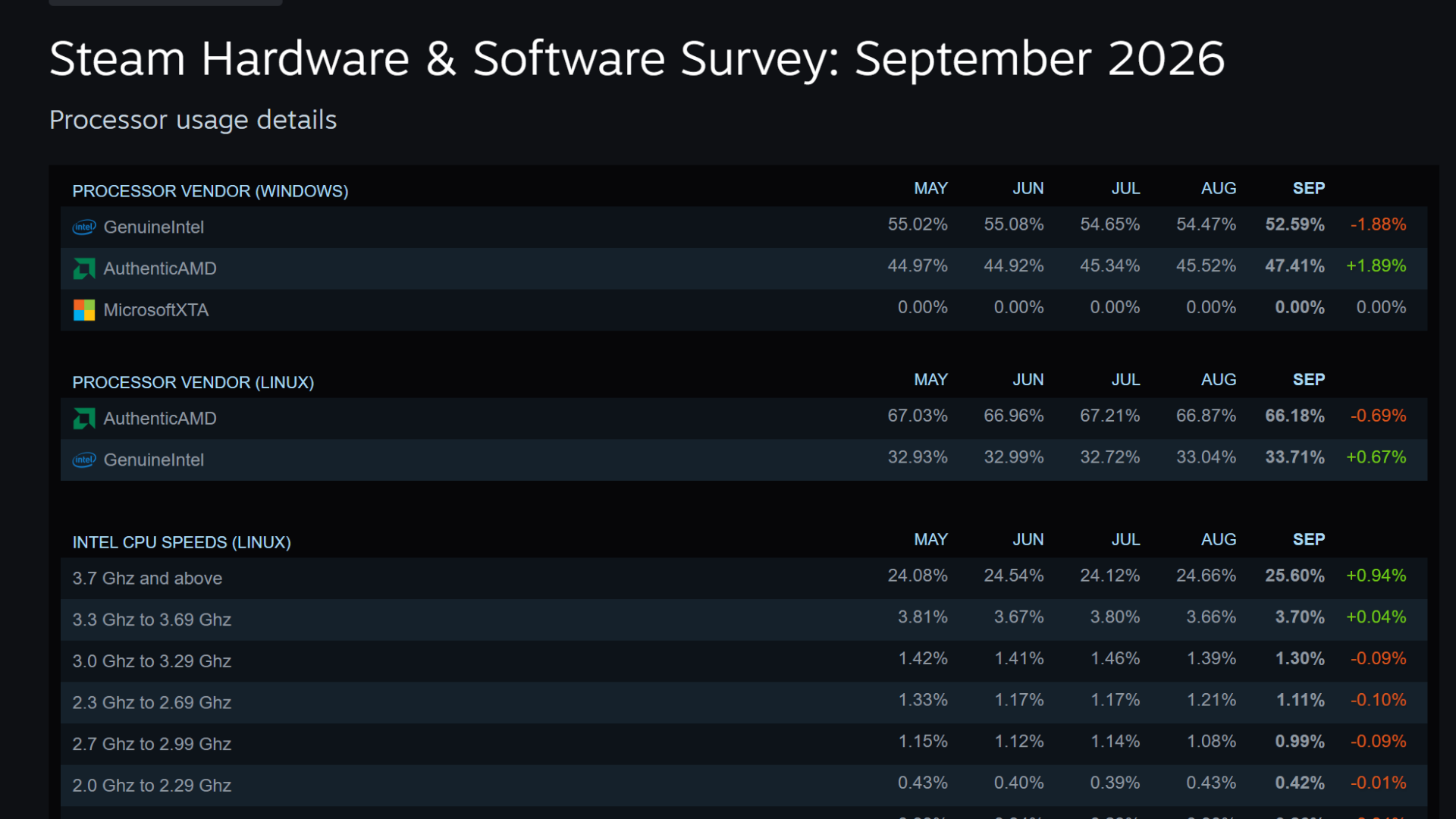
The new minimum specifications are quite reasonable, with the recommended specs falling squarely within the performance of the most common hardware in June’s Steam Hardware Survey (which also indicates that AMD now has more than 45% market share compared to Intel). If your system used to be at or higher than Minecraft: Java Edition’s previously recommended specifications, but no longer hits the current minimum requirements, you can switch over to the Bedrock Edition to continue gaming, although you might have to forgo some of your favorite mods.

If you’re running the bare minimum hardware to play Minecraft, Microsoft said that you could still possibly launch the game, although it warned that you might run into some issues. “These updated recommended system requirements won’t stop you from playing Minecraft: Java Edition today. If your computer falls below the new minimum requirements, Java Edition should still launch,” the company said in the Minecraft blog. “However, its performance and visual quality are no longer guaranteed on below-spec hardware, and it may struggle or fail to launch Java Edition in the future – especially as we transition away from OpenGL and towards Vulkan. We will keep players informed of these changes, especially changes that will sunset hardware that previously supported Minecraft: Java Edition.”

This means that you’ll have to spend some money to upgrade your system to just to continue playing your favorite game. You don’t have to spend thousands of dollars to get a new PC or join a giveaway to be able to play, though. If you know what you’re looking for, you can plausibly buy a used gaming laptop or desktop PC for around $350 to $500 — that should give you about a decade or more to enjoy the game if Microsoft keeps its spec upgrade cadence of 17 years for future versions of Minecraft.

✇Tomshardware

Grand Theft Auto Multiverse with real-time portals created by ambitious modder — San Andreas, Vice City and GTA III all run simultaneously, with cross-game interactions

The Grand Theft Auto franchise has a rich history when it comes to modding and tinkering, but we're pretty confident the community has never seen anything like this. Created by Dryxio, this new mod combines GTA Vice City, GTA San Andreas, and GTA III into one multiversal entity interconnected through real-time, fully functional portals that let you travel between the three different games as if it were just a regular window.

The video above showcases just how insane this mod really is. It starts with CJ on Grove Street in San Andreas shooting at NPCs in different parts of the game (The Strip). Then, he moves toward the pink portal, shoots at NPCs once again, and just casually goes through it to end up in GTA Vice City as Tommy Vercetti. He wreaks havoc, walks back to the portal, and crosses through to Vice City as CJ, only to go to GTA III and repeat the same thing there.

The craziest part is how these portals genuinely act as windows to another world where you can stand in one game and shoot inside the other one. It's unclear whether there's a limit to the level of interaction, like if you can't drive cars through them, but it's impressive, nonetheless. The video also shows how you can place these portals anywhere in the world in any of the three games yourself.

All of this begs the question: how? The modder explains that all three games are running simultaneously inside one process, sharing one Direct3D device. Each portal is a live GPU texture; there's no video capture to fake the realism, and the transition to each game happens in real-time via an engine swap. When you walk through a portal, it simply switches to that game's engine while the others keep running in the background.

Shooting at GTA Vice City from inside GTA San Andreas
Dryxio on YouTube
Shooting at GTA Vice City from inside GTA San Andreas
Dryxio on YouTube

Each game and its world retain full native functionality such as its own AI, traffic, physics, saves, missions, and even settings. There's no loading screen when you use the portals either; you enter the world on the other side instantly, just the way you saw it before going through. This is largely possible because the source code of each game has been reverse-engineered and recompiled using an open-source engine.

Dryxio modified re3 and reVC — community projects that decompile the original source code of GTA III and Vice City into clean, readable C++ code — and used plugin-sdk to interface with San Andreas. Since these games used the proprietary RenderWare engine that can't render multiple spatial scenes together, an open-source reimplementation of it called librw was used to compile all three games into a single unified process.

The mod isn't publicly available at the moment, but you can bet everyone in the community now has their eyes on it. It's by far the most technically complex GTA mod ever, one that doesn't even require any understanding of software to grasp its ambition. There's also the elephant in the room known as Rockstar Games that could see this as copyright infringement and order it to be taken down, but for now, it lives as proof of human ingenuity (and vibe-coding).

✇Tomshardware

Microsoft announces Xbox Backward Compatibility for PC — will let gamers play classic console games on PCs and handhelds

Xbox has announced a new Xbox Backward Compatibility for PC program, which will let gamers play a selection of classic Xbox titles on PCs and handhelds, a move the company says marks the beginning of a bigger push into Xbox game preservation. The announcement begins with four titles that can now be played on PCs and handhelds, including the ROG Xbox Ally and Ally X.

"This marks the beginning of a broader effort to preserve XBOX games from the past and bring them to PC over time," the company said in a blog post authored by Xbox "VP next generation" Jason Ronald. Alongside backward compatibility, the company says games will also include new features. The four titles in the announcement are:

You can now buy all of these games on PC, and they're also included in all Xbox Game Pass plans. Anyone who already owns these titles digitally on console can also now play them on PC or handheld, with support for Xbox Play Anywhere and Xbox Cloud Gaming. Crucially, this appears to be a digital-only preservation effort, so it won't help anyone who only owns physical copies of these games. Xbox has reportedly been testing a way to digitize physical games as far back as Xbox One, but that hasn't yet materialized yet.

Alongside the preserved original gameplay, Xbox claims these games will let users customize graphics settings, with up to 4x resolution scaling, VSync support, Fullscreen and Windowed modes, anisotropic filtering, and enhanced anti-aliasing, with more features to come in the future. Notably, Xbox will add achievements to select original Xbox games on console and PC.

Users who want to play these titles will need to meet the following system requirements:

Spec:

Minimum requirements

Recommended specs

GPU

Nvidia GTX 950 or AMD Radeon RX 550 or Intel UHD 770 or Intel Arc A310  

Radeon RX 68005 or Nvidia GTX 1070 Ti or Intel Arc A770 

CPU

Min 4 Cores Intel Core i3-8100 or AMD Ryzen 3 1200 or AMD Ryzen Z2 A Processor  

6 cores and 12 threads Intel Core i5-10400 or AMD Ryzen 5 3600 or AMD Ryzen AI Z2 Extreme 

RAM

8GB

8GB

DirectX

N/A

DirectX12 API, Hardware Feature Level 11 

OS

Windows 11   

Windows 11

Drivers

Latest Version as of January 2026 

Latest Version as of January 2026 

Microsoft's emphasis on preserving older games is particularly noteworthy given recent backlash against Sony over its decision to end physical games with its next console generation, and the shuttering of some of its online stores. While Xbox's digital emphasis on game preservation still can't match the solidarity of physical media preservation, the timing of this announcement seems like more than just a coincidence.

✇Tomshardware

GTA 3 and Vice City are now playable inside San Andreas — a mod lets you revisit Liberty City and Vice City without leaving San Andreas

A Grand Theft Auto (GTA) modder has developed a mod that lets you run Grand Theft Auto III (GTA 3) and Grand Theft Auto: Vice City (GTA VC) as mini games right inside Grand Theft Auto: San Andreas (GTA SA). The modder, DryxioGTA, demonstrated the feat in a video posted on YouTube on Thursday, running the game on a Windows virtual machine on macOS.

In the video, GTA SA’s main character, CJ, can be seen stepping up to a TV, apparently inserted into the game by the mod. Once in front of the TV, the option to start either GTA VC or GTA 3 appears. The selected mini-game immediately starts running on the TV.

Gamers can switch between controlling the main GTA SA game or the mini game, using the F10 key. When controlling the mini-game — say, GTA 3, as in the video — players can play it as normal while the rest of the outer SA game continues to run, with characters roaming about. Similarly, switching control back to the outer SA game leaves the mini-game running on the TV.

Just a few hours after uploading a brief gameplay video, the modder released another video demonstrating an even more mind-blowing mod, this time running GTA Vice City inside GTA 3, inside GTA San Andreas!

As shown in the clip, the game starts with GTA SA, where players can walk up to a large screen to activate and start running GTA 3. Within GTA 3 — now running on the large screen inside San Andreas — gamers can drive to another specific screen and launch GTA VC. So you can be playing GTA SA, switch to a fully functional GTA 3 within SA, and then switch again to play Vice City right inside the GTA 3 sandbox, all while the other games are simultaneously running.

The remarkable mods are just one of thousands that developers have created since the game was first released on PC over 20 years ago in 2005. There are also several Mods for other GTA titles. Older GTA games have seen renewed interest as anticipation builds for GTA 6, which is scheduled to be released on consoles on November 19 after several postponements.

✇Tomshardware

PC gamer turns Steam games into cartridges with ingenious 2.5-inch SSD system — games are stored on 128GB drives alongside a script to auto-start the title once plugged in

A PC gamer has created and demonstrated a handy Steam Game Cartridge system. Over on PCMR, Jibril-sama introduced the system, which blends the old-school console convenience of cartridges with Steam’s awesome and agreeably flexible games library. Ingeniously, it upcycles a bundle of old SATA SSDs into Steam-ready game cartridges using a disk mount detect and execute script on the software side and a SATA dock on the hardware side. Icing on this already tasty cake is provided by Jibril-sama’s colorfully encased and custom-labeled Steam Game Cartridges. Nice.

Steam Game Cartridges from r/pcmasterrace

“Got a couple of used 2.5" SSDs for cheap so I decided to make a Game Cartridge system,” the Redditor casually informs the PCMR masses in the post embedded above. “Games are actually on those SSDs with a script to auto-navigate Steam to the game's page. Auto-starting the game right away is also possible.”

Further comments by the OP explain that all the drives bought for this project were 128GB in capacity, and €7 a piece ($8). That’s not bad in the current RAM and NAND crunch, and keeps these files off your built-in primary storage. As many readers will know, PC game libraries can easily grow to hog a lot of storage.

We reached out to Jibril-sama for some more background info about how the Steam Game Cartridge system is designed to work with as little user friction as possible. They informed us that the system in the video runs Linux and Valve’s Steam URL Protocol is leveraged to navigate to the game's page or launch the game.

“All it needs is a systemd template to check for a script on the SSD and launch it. And a udev rule to trigger the system,” Jibril-sama told Tom’s Hardware. “So basically: Plug in SSD -> udev rule sees the event -> triggers the systemd daemon -> systemd daemon looks into the SSD and finds the script -> execute the script.”

Steam Cartridge Games system
PrincessMidori
Steam Cartridge Games system
cakehonolulu
Steam Cartridge Games system
cakehonolulu
Steam Cartridge Games system
cakehonolulu

Commenters on PCMR have overwhelmingly welcomed the Steam Game Cartridge future teased by this system. Some want to see the system extended to include GOG game libraries. Others query how the system handles the inevitable hefty multi-gigabyte updates that are pushed (even to older games) from time to time. Jibril-sama told Tom’s Hardware that they didn’t plan to deal with updates often, as they didn’t use cartridges for ‘live service’ titles, and they are mostly used for the “games that I want to replay once in a while.” If and when updates have been flagged, “I just let Steam handle the updates and wait a bit before I can play,” they added.

I’ve had repeated firsthand experience with Steam Games libraries being fussy when moving across different PCs, so stretching the library system this way could reveal cracks and wrinkles as more games are tested. We shall see.

Hopefully, fuller implementation guides, scripts, and resources to help others purchase or 3D print their own Steam Game Cartridge shells will be shared in due course.

✇Tomshardware

Nvidia and Sega team up to deliver RTX Spark support for future games — partnership kicks off next year with upcoming Virtua Fighter Crossroads

Nvidia's RTX Spark platform arrives later this year, and the company is hard at work building the partner ecosystem around the GB10 Superchip to ensure that Windows and applications are ready for its agentic AI PC vision. As part of that groundwork, the two companies announced today that Sega will support the RTX Spark platform with its upcoming Virtua Fighter Crossroads, coming in 2027.

The two companies also committed to RTX Spark support for "future Sega titles,” meaning that we might see official support for other evergreen franchises like the Yakuza series, the Persona games, and the upcoming Alien: Isolation 2 and Total War: Warhammer.

Although the companies didn’t go into detail about exactly what full support for the RTX Spark means for Sega games, one would expect that the developer’s titles will be natively compiled for Windows on Arm instead of relying on the Prism x86 emulator for compatibility.

It also seems safe to expect that future Sega titles will incorporate DLSS technologies like upscaling and Multi Frame Generation in order to deliver the best possible experience on RTX Spark systems. Despite having GPU compute capabilities similar to those of a desktop RTX 5070 on paper, the unified memory architecture and relatively limited memory bandwidth of the GB10 Superchip behind the RTX Spark platform present challenges for gaming performance that are likely to make the incorporation of DLSS tech important for the best experience.

The relationship between Nvidia and Sega spans over 30 years, tracing its roots to the ultimately abandoned development of the GPU for the Dreamcast console. Despite its eventual decision to use an NEC-produced PowerVR GPU for that system, Sega offered Nvidia a $5 million lifeline that gave the company the runway that it needed to develop and deliver the Riva 128, its first DirectX-compatible GPU.

That investment proved to be historic, as Nvidia now has a market cap of over $5 trillion and is in the process of shifting the very foundations of computing through its Grace Blackwell and upcoming Vera Rubin AI platforms for the data center.

Whether the RTX Spark platform reshapes the PC when it arrives in the fall of this year remains to be seen. But if you’re a fan of Sega’s IP, this partnership means that you can at least look forward to a first-class experience with its games on RTX Spark systems.

✇Tomshardware

Steam sales reportedly topped $11 billion during H1 2026 due to shifting trends — staggering growth driven by influx of Chinese players and booming legacy catalogues

According to new research published by Alinea Analytics, Valve has grossed an estimated 11.1 billion dollars throughout the first half of 2026. If correct, the estimates would make it Valve's most profitable half-year on record, as digital storefronts become the norm throughout the games industry. Earlier this month, Sony announced that it would stop making new physical PlayStation discs by 2028, instead turning its efforts digital.

According to a Substack post from research firm Alinea Analytics, games sold on the platform accumulated $11.1 billion in revenue in the first six months of this year, which is a 14.5% jump compared to the first six months of 2025. Even more impressively, though, Steam's H1 2026 has posted 8% higher numbers than H2 2025, which includes the lucrative holiday season where most of the biggest sales happen. The store generated "only" $10.3 billion in revenue during the latter half of 2025.

Steam has been on a consistent incline for 10 years, boasting record revenue numbers almost every successive year. Even if it hits a slump, the data shows Valve has never had two bad years in a row; a recession is always followed by a boom. Alinea says five main factors contribute to the storefront's growth: a surge in Chinese players, higher prices, viral co-op hits, and smarter back-catalogue categories from big publishers.

The last one is rather ironic, as it involves third-party publishers quietly returning to Steam after their own launchers faltered. Some companies like Activision still inject their proprietary launchers between Steam and the game itself for titles like Call of Duty, but the situation has generally improved.

What display resolution do you use on your primary monitor?

Almost 10 years ago, in the first half of 2017, the platform made a little less than $2.5 billion, which means the H1 2026 revenue is 4.7 times higher, almost quintupling in a decade. Moreover, it's remarkable to believe that Steam also made more in the first six months of this year than it did in the entirety of 2020, when most of us were confined to our homes, free from responsibilities, and with a lot of time on our hands.

Alinea lists Forza Horizon 6, Resident Evil Requiem, and Crimson Desert as the top three games for Steam's explosive H1 2026 numbers — all of them made almost $200 million. Games from prior years also played a bigger role this time since 2026 releases only accounted for 21% of the $11.1 billion, while 27% of H1 2025's revenue came from 2025 launches; 29% of H1 2024's revenue was accumulated from 2024 releases.

Amidst all the data, a clear trend is forming. People are looking back in their libraries and appreciating older games more than ever before, while new releases still make an impact if they're universally acclaimed. With the highly anticipated GTA VI coming soon (with no current PC release date), it'll be interesting to see how these numbers change. Now, if only Valve could make more Steam Machines to play all those older games everyone seems to be playing.

✇Tomshardware

Cracked version of Assassin’s Creed Black Flag Resynced leaked days prior to official release despite Denuvo DRM protection — Denuvo unable to stop crackers, with some finding ways to completely remove it from other titles

Game anti-tamper app Denuvo has been completely bypassed in pre-release versions of Assassin’s Creed Black Flag Resynced, allowing pirates to distribute copies of the game days before its official release. A cracked version of the remake has been circulating since June 7 — more than a month before its July 9, 2026, release date. While the game is a remake of the original Assassin’s Creed Black Flag, which launched way back in 2013, it’s still expected to offer new content and enhanced graphics brought by newer, more capable hardware.

This isn’t the first major title to be hit by a leak before its official release day this year. Forza Horizon 6 leaked four days before early access and more than a week before its general launch date of May 19. LEGO Batman: Legacy of the Dark Knight and Subnautica 2 also suffered similar leaks, with playable versions of the games circulating online even before early access was opened to players. While Forza Horizon 6 and Subnautica 2 aren’t protected by Denuvo, LEGO Batman: Legacy of the Dark Knight and Assassin’s Creed Black Flag Resynced use the controversial anti-tamper DRM tool.

Denuvo has been in hot water among gamers, especially as it was blamed for performance issues plaguing games that used it. Aside from that, many consider its mandatory 14-day online checks as intrusive, especially for story-driven single-player games where cheating won’t affect the gaming experience of other players. While a few users might’ve understood the studios’ need to protect their titles and reduce piracy, the fact that Denuvo has been cracked in all single-player games that had it felt like its addition to games is pointless.

This is especially true now that we’re seeing pirated pre-release versions of games that are supposedly protected by Denuvo. While it’s unclear how Assassin’s Creed Black Flag Resynced leaked, the fact that the app that reduces performance and reminds gamers that they don’t own the games they buy has seemingly failed at its one job is making users think that it’s unnecessary.

Game studios need to protect their intellectual property, which is why it’s understandable that they’d want to deploy tools like Denuvo. However, they shouldn't do so at the expense of gaming performance and the user experience, which are some of the primary reasons why gamers are pushing back against Denuvo. If these anti-piracy measures don’t punish legitimate players with reduced FPS and always-online requirements, among other negative side effects, then most gamers will have zero problems with using apps that protect the makers of their favorite titles.

✇Tomshardware

Modding tool 'DLSS Swapper' might infect your PC with malware if you download the wrong files — App creator warns against using random, user-submitted DLLs

DLSS Swapper is an open-source app that does exactly what it sounds like — it swaps out the appropriate DLSS files for any game, helping downgrade or upgrade its native DLSS version. While the tool itself is safe, along with the verified files it hosts, users can also upload their own DLLs to the app's GitHub repo. Unfortunately, it seems like some of these files can contain malware, disguised as helpful solutions.

WARNING: There are people uploading DLLs into the DLSS Swapper / Manifest Builder repositories with comments like "this fixed it for me".DO NOT download these files, they are likely malware.July 8, 2026

To understand how this can even happen, we need to look at the way DLSS Swapper is set up. The app uses a manifest file to dig out DLLs from verified DLSS, FSR, and XeSS libraries. The verification process is thorough, and you won't see any file pop up in-app until its security hashes match official sources. However, it can also detect unknown files from new game releases installed on a user's computer.

These files are automatically uploaded to the repository as "issues," and the app also includes an option to upload your own DLL to help out fellow gamers. As you can probably guess by now, this is where the problem lies. These files are not vetted and remain in a grey area. DLL files are basically executable code, so if any of them were modified to include malware, you wouldn't even be able to detect it before it's too late.

The file would've already executed malicious code and installed a crypto-miner, for instance, in the background that hogs your PC's resources until you finally notice something's off. As such, the creator issues a clear warning to not download random files that show up on the GitHub repo, especially if they include comments that claim some sort of miracle cure. Stick to only the sources you trust if you must go outside of the officially supported libraries.

Previously, the developer already warned against the fake DLSS Swapper website posing as the real thing. Let this serve as your reminder that the app's GitHub page is the only place you should download DLSS Swapper from. Moreover, keep in mind that hardware support is just as important as software support, so if you have an older GPU that doesn't support the latest upscaling tech, a DLL swap cannot magically fix that.

✇Tomshardware

You can now use your Sony headphones as a free real-time head tracker for race and flight simulators on PC, several hundred games already supported — enthusiast creates open-source app that translates live sensor data into in-game camera controls

Sony makes some of the best headphones on the market, and some of their recent models even include a myriad of sensors for spatial audio. These are standard gyroscopes and accelerometers capable of precise tracking, so why keep them limited to just audio features? That's exactly what developer Nicholas Slattery has done with his new project called "Sony Head Tracker" — it's an app that turns your Sony headphones and earbuds into a real-time head tracker for PC games.

I made Sony headphones work as a free head tracker for 200+ PC games from r/pcmasterrace

The app essentially acts as a bridge between the hardware and the software, which is OpenTrack. Sony baked the Android Head Tracker protocol into its headphones' firmware, which is what enabled spatial audio to expand the soundstage on supported devices. This data is ignored by Windows, but Slattery figured out a way to tap into the protocol and read everything it's capturing.

That includes rotation vectors, gyroscope fields, and Euler Angles (live calculation of yaw, pitch, and roll). The raw data packets are then packaged into a UDP stream that the OpenTrack software can read and understand. OpenTrack supports over 200 PC games and usually works with phones, webcams, and specialized eye or IR trackers, but Slattery's app opens it to an entirely new and ingenious set of devices.

Currently, Sony's WH/WF-1000XM6, WH/WF-1000XM5, and Sony ULT WEAR (WH-ULT900N) are officially compatible. Older models like the WH-1000XM4 or XM3 won't work because they lack the hardware (sensors) required for the head tracking. Apple's AirPods, which popularized Spatial Audio, use the company's proprietary protocol that doesn't open itself up on any device, as you'd expect, so they're also ruled out.

Once everything is set up, you just wear your Sony headphones and the in-camera will respond to your head movements, turning around with you. If you look to the side or glance up, the camera will peep there as well, as if you were wearing a VR headset. But keep in mind that this is not a VR replacement as the screen in front of you is still stationary. Regardless, this unlocks another level of immersion for race and flight sims.

The creator has tested the app to work flawlessly with Microsoft Flight Simulator, Elite Dangerous, and Assetto Corsa already. For those of us not rocking elaborate multi-monitor configs, something like this can serve as a middle ground between a true 6DoF setup and a simple helmet cam in-game, all for free. Sony Head Tracker is also open-source, so we only expect it to improve over time and expand its compatibility.

✇Tomshardware

You can now play Half-Life 2 right inside your browser at over 100 FPS with save states & console support — Ingenious port recreates the entire game campaign using WebGL 2

Over the years, our internet-surfing machines have evolved to the point that it's now possible to run entire full-length PC games right inside a browser. The latest milestone in this impressive trajectory is a new, unofficial port of Half-Life 2 developed by Slqnt and 98006. It's the complete main campaign of the game, including the two episodic DLCs, accompanied by a host of features that you find on the official release.

A fully playable browser version of Half-Life 2 has just been released to the public. You don't need to download anything, just open the site and play! The webport was created by Slqnt and 98006 in just three months! pic.twitter.com/x88rMgWhxdJune 25, 2026

The game is, in fact, running natively on your computer; there's no cloud streaming involved. Under the hood, the port is powered by WebGL 2, a JavaScript API that bypasses the browser's typical layout engine and talks directly to your GPU to execute graphics-intensive tasks. Then, WebAssembly helps translate C++ code from the Source Engine into JavaScript that the browser can natively understand.

For storage, the port relies on a virtual file system that calls compressed assets via high-speed web requests. You just need to let the cache build up upon first boot for a few minutes, then you're off to the races. The same method creates .sav files directly in the browser's cache or IndexedDB, which allows you to pick up where you left off, just as if you had actually installed the game on your computer natively.

This port also features the Source console integration, enabling you to pull up a fully functioning developer terminal that can accept classic commands. You can type in cheats to give yourself a gameplay boost or tweak the engine variables as per your liking. While you don't get Steam achievements here (understandably), the game's built-in achievements are still present and accessible through the menus.

We tried the game on three different devices: a Windows PC with a Ryzen 7 7700X and RX 6700 XT, a OnePlus 12 smartphone, and a modded Nintendo Switch running Android. As you'd expect, the computer ran it the best and without any hiccups. Since this is a very old, non-demanding game, we were able to max out all the settings and play in full screen while achieving over 100 FPS. Frankly, it looked beautiful.

Half-Life 2 unofficial browser port

(Image credit: Future)

The mobile experience didn't work for us, but other users have reported it performing well, so your mileage may vary. Some bugs, however, remain persistent on the ideal desktop experience as well, with many users pointing out a rather hilarious "zombie" glitch where characters' heads render improperly, leaving their eye sockets vacant like a zombie. Certain complex animations also fail to trigger during intense cutscenes.

Overall, this is one impressive project, but it remains unofficial, and that means it's subject to a DMCA takedown from Valve. The port is basically at the company's mercy at this point, but Valve is generally community-friendly when it comes to stuff like this. It took Slqnt and 98006 just three months to develop, and the fact that it has survived roughly two weeks on the internet means it might have precedent to stay.

It's also not the only port of its stature, you can play thousands of old games for free on DOS Zone, including GTA Vice City, and Quake III is also available as a standalone browser project. Copyrighted IP is the only hurdle for retro revivals like these since the talent from the developers, and the grunt from the hardware, is otherwise abundant. If Valve doesn't make Half-Life 3, the fans might as well milk the original games as much as possible

❌