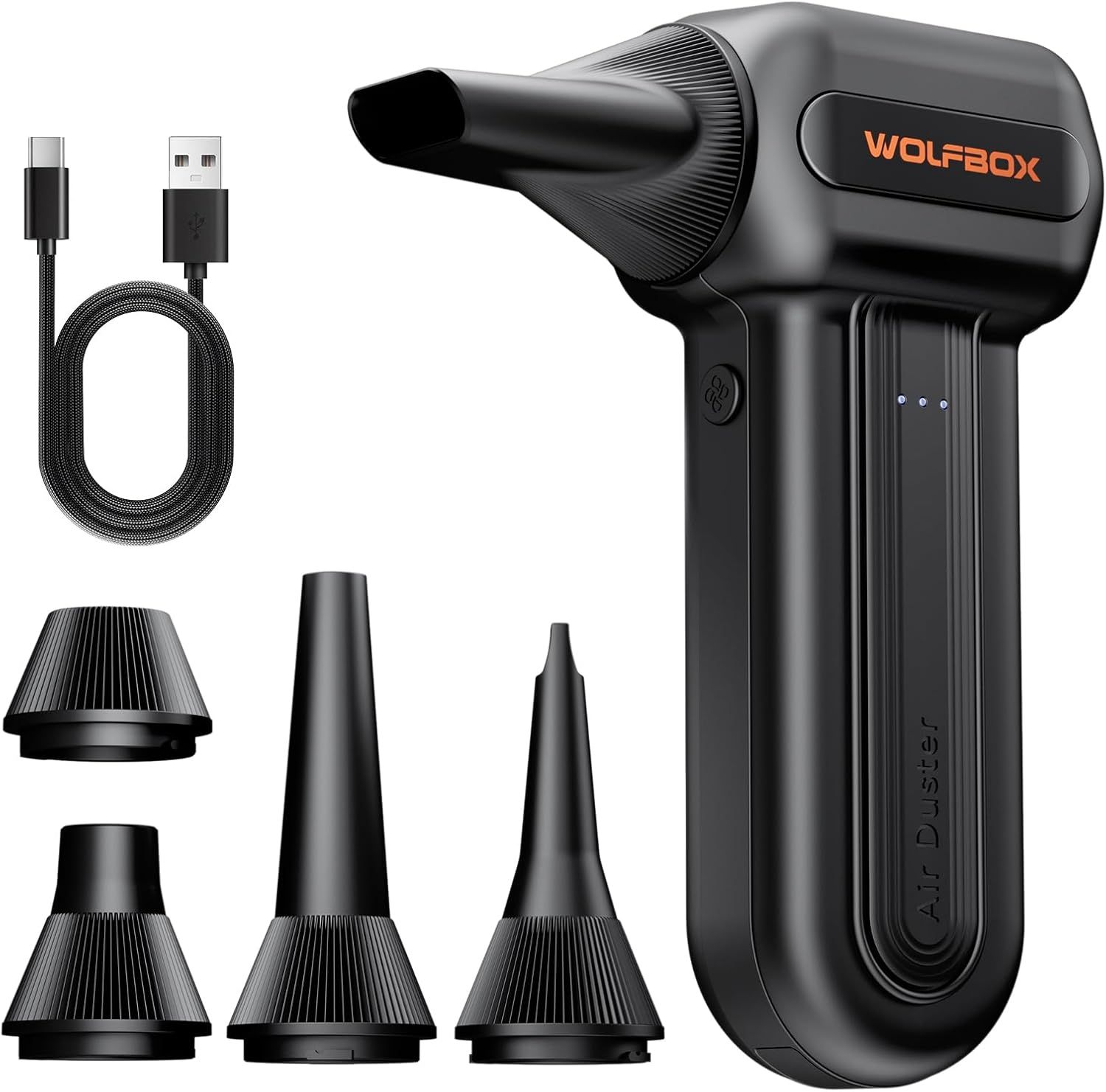
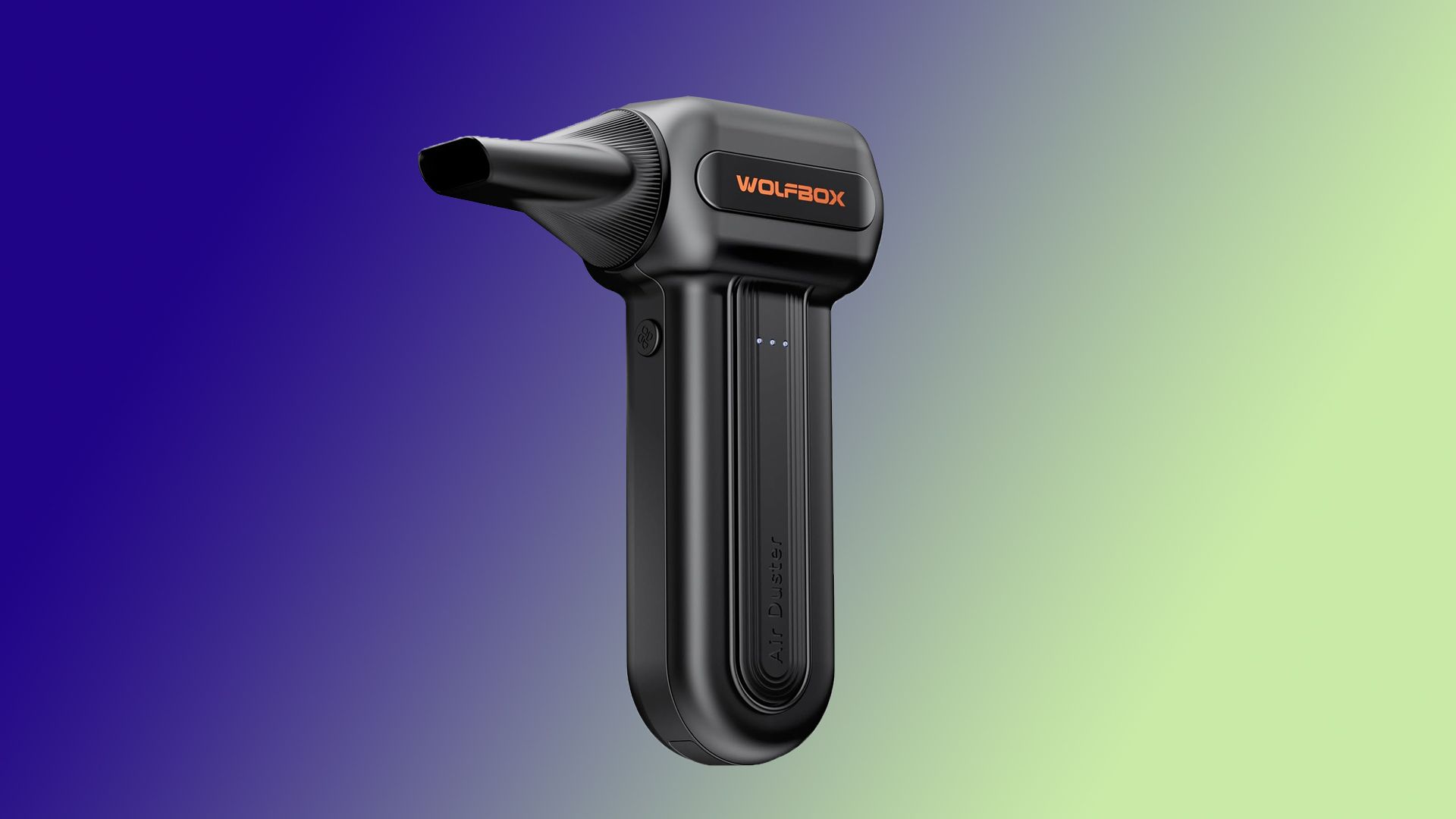
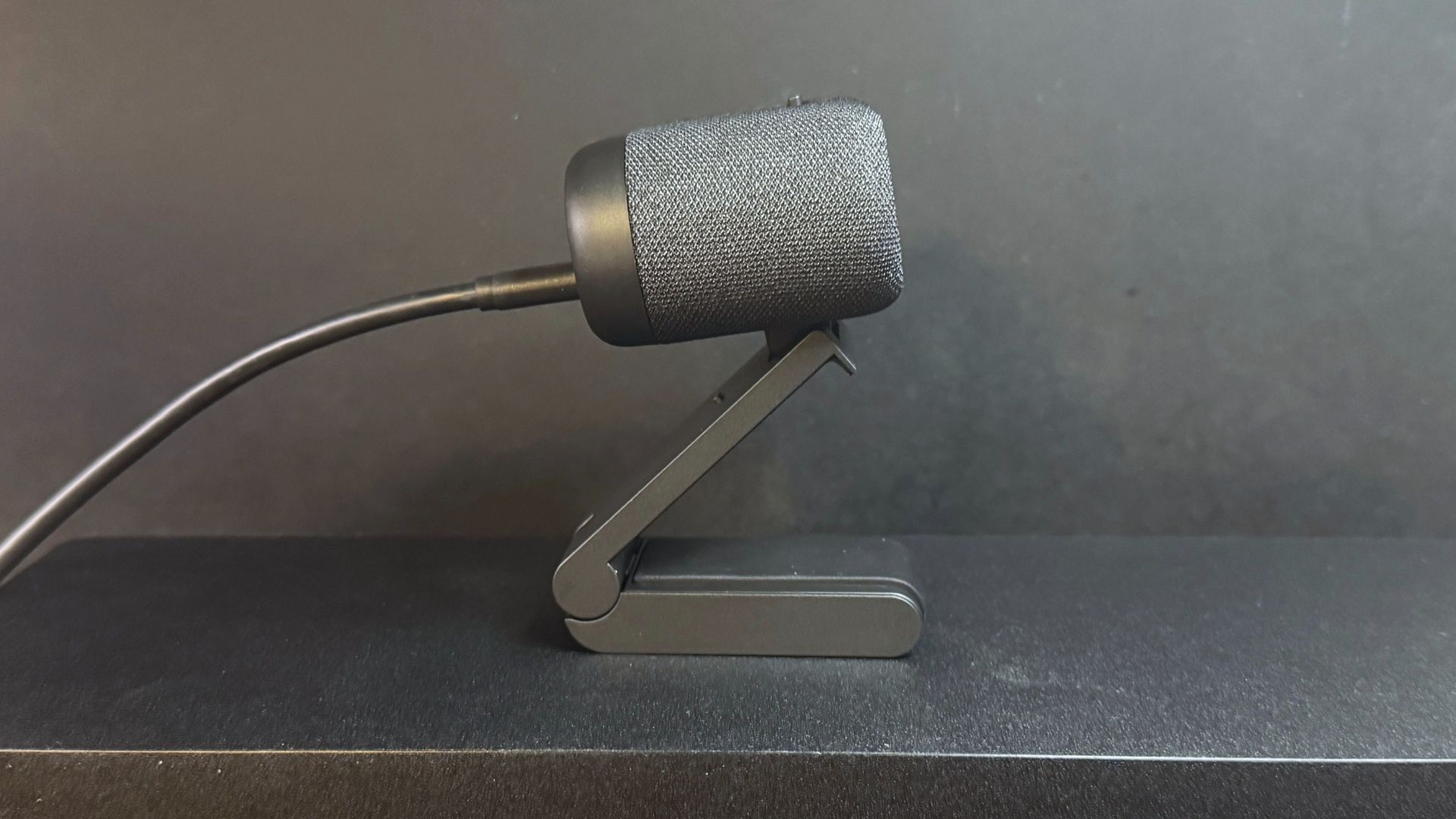
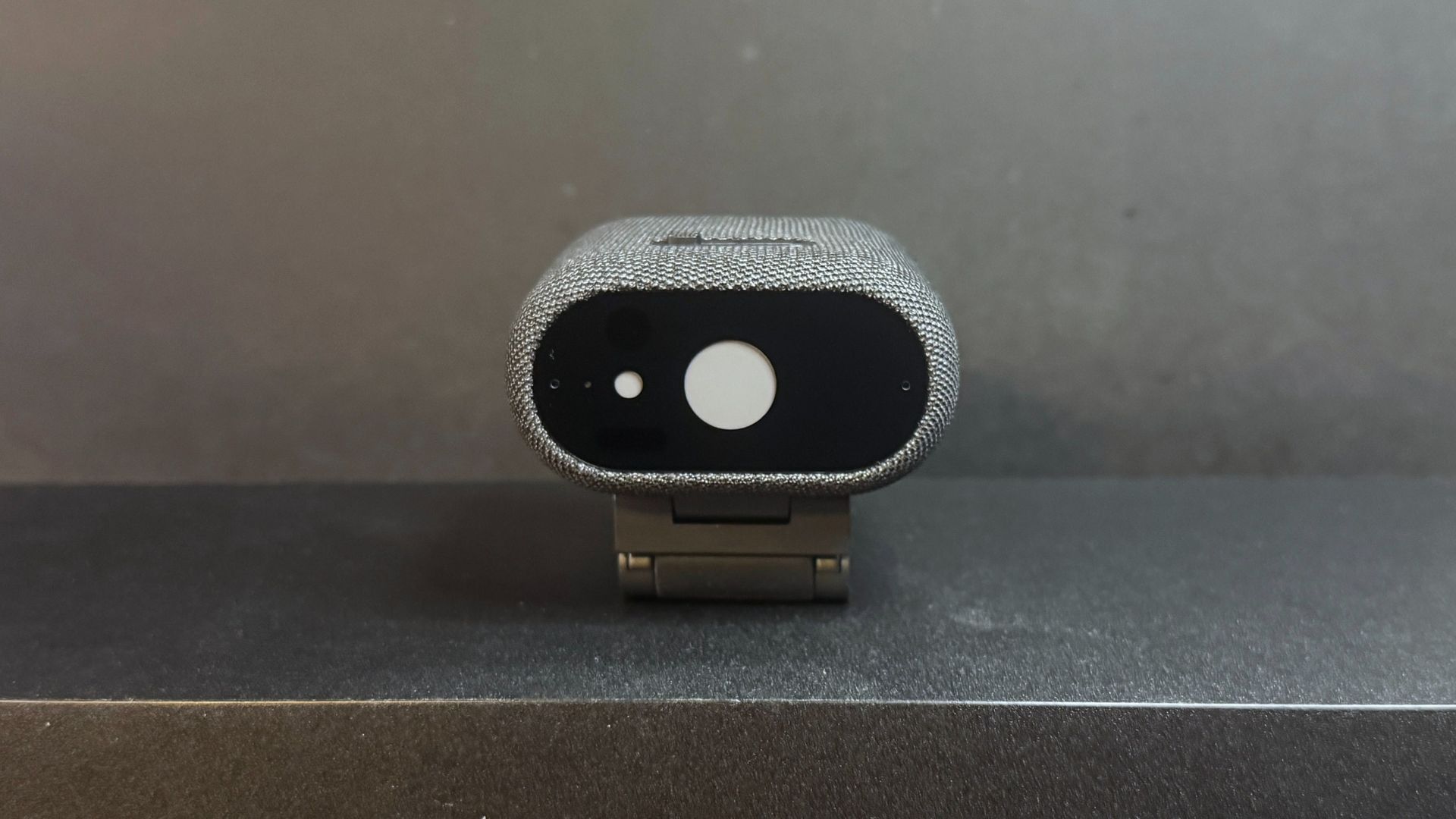
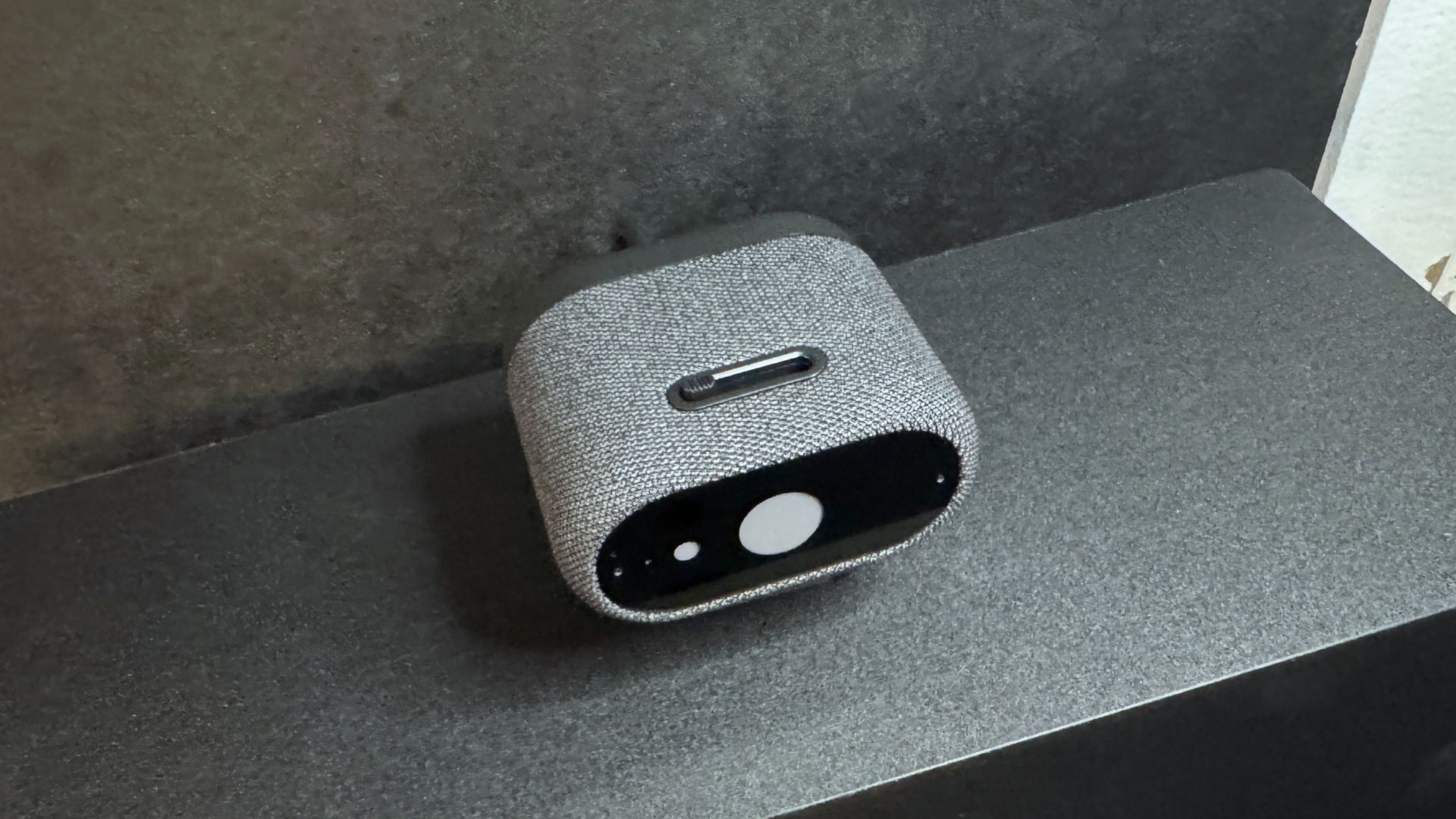
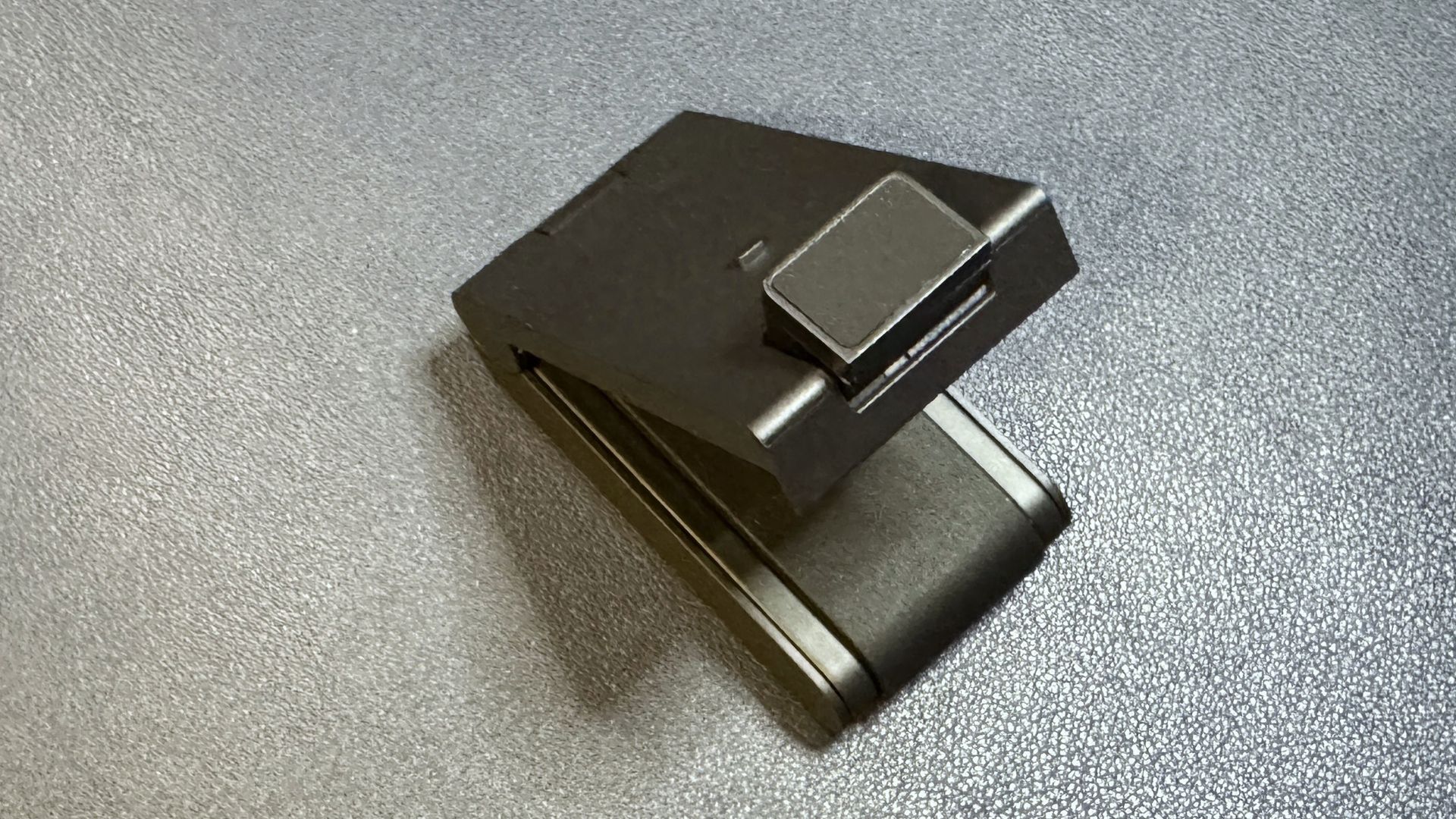
Dust buildup is one of the primary causes of performance throttling, and it is highly recommended to clean your PC as part of its regular maintenance. One of the easiest ways to keep your system dust-free is to invest in a powerful air duster. Right now, the Wolfbox MF60 is currently available at a 32% discount on Amazon, bringing the price down from $49.99 to just $33.99.
Cooling fans within your PC case or laptop end up pulling in a lot of dust, lint, and even small debris that can clog heatsinks, radiators, and various other components. This results in inefficient heat dissipation that can lead to hotter components and a drop in performance. While compressed air cans work well, a high-powered electric air duster is a much better option in the long run.
The Wolfbox MF60 is a wireless rechargeable air duster offering three fan speed levels and is claimed to deliver air speeds of up to 72.4 m/s with fan speeds of up to 110,000 RPM. Featuring dual 2,500mAh batteries, the company claims up to 240 minutes of runtime at its lowest fan speed of 25,000 RPM. The air duster can be fully recharged via USB Type-C in about 3.5 hours. It also includes multiple attachments, including a round all-purpose nozzle, a flat nozzle for blowing dust off PC cases and desks, a long nozzle for deep-cleaning computer keyboards and car vents, and a dedicated nozzle for inflating pool floats, beach balls, air mattresses, and more.
If you're on the lookout for a convenient way to keep your PC clean without relying on disposable compressed air cans, the Wolfbox MF60 is definitely worth considering. At its discounted price of $33.99, it's a practical addition to your PC maintenance toolkit, especially if you regularly clean your PC, laptop, or other electronics.
The best webcams are getting smaller, cheaper, and faster, apparently — Dell's newest premium webcam is a 4K webcam that streams video at a maximum resolution of 4K / 60fps, which is definitely a faster and smoother frame rate than your typical Dell webcam buyer needs. There's not much you can really do with those numbers if you're not a content creator — and especially not in a professional setting, as most video conferencing apps limit your outgoing stream to 1080p or lower.
Luckily, the Dell Pro 7 has more than just smooth, high-res video going for it — it also features Windows Hello compatibility, presence detection, smart image enhancements, and built-in dual beam-forming mics that might be the first built-in webcam mics we can actually recommend. At $199.99, it's priced right alongside 4K webcams such as the Logitech MX Brio and the Insta360 Link 2 4K, which means it has some pretty tough competition.
Design
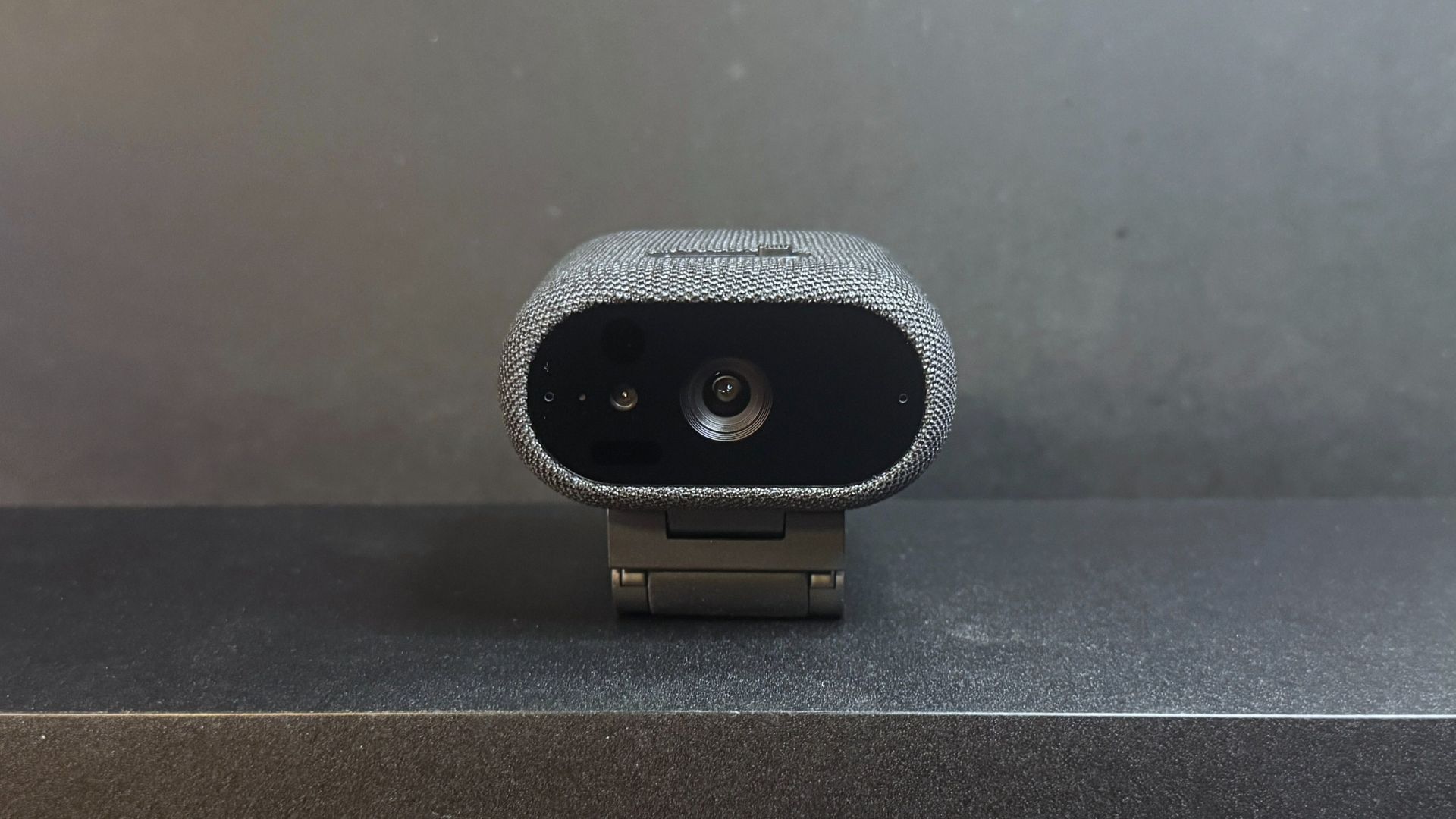
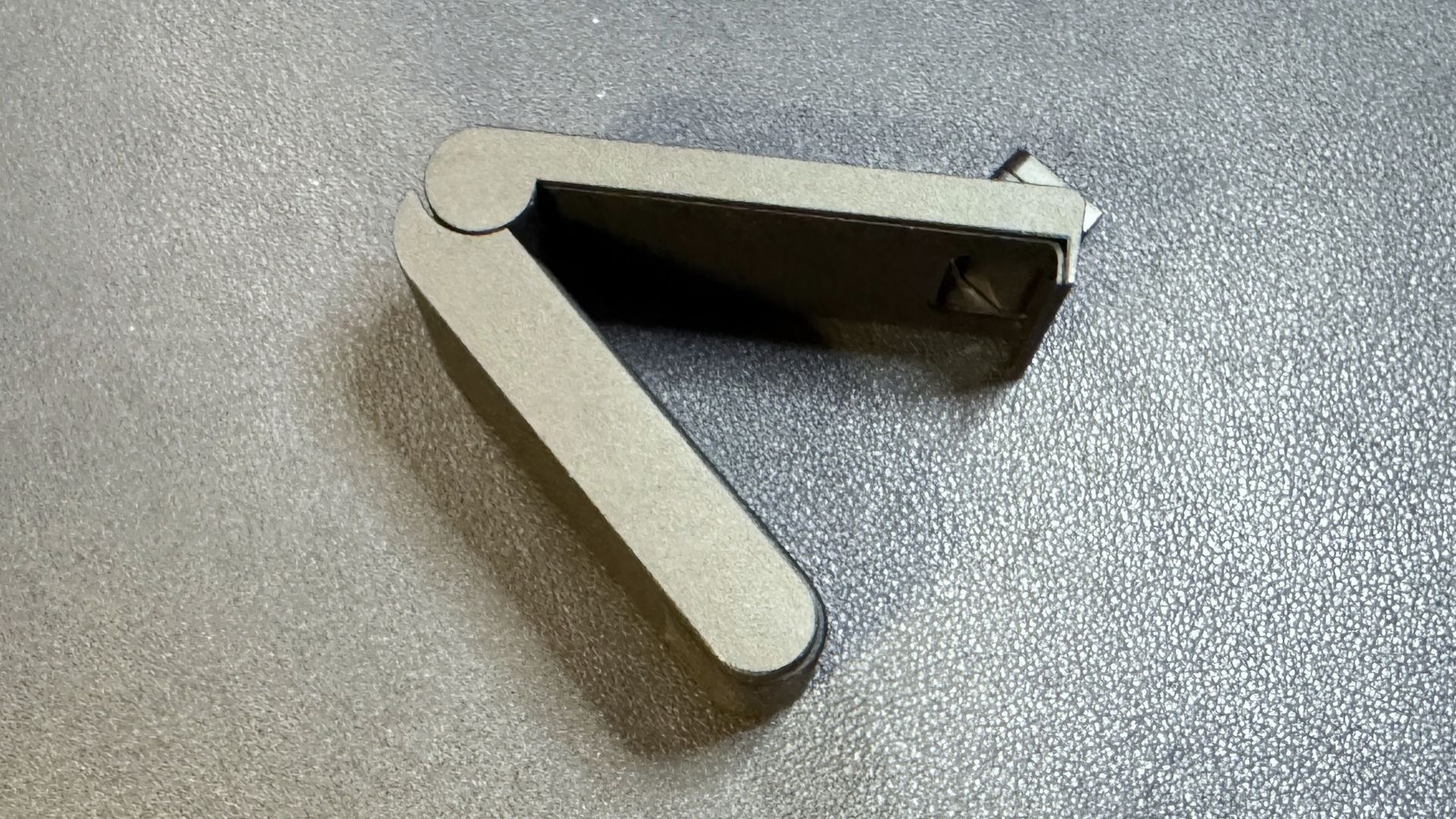
The Dell Pro 7 webcam is a 4K / 60fps webcam with a solid, sturdy fabric-covered chassis and a glass lens cover. It features a large Sony STARVIS CMOS sensor, an auto-focus lens, 4x digital zoom, and it has a maximum aperture of f/2.0. It has a built-in physical privacy shutter and comes with a detachable USB-C cable and monitor mount.
(Image credit: Tom's Hardware)
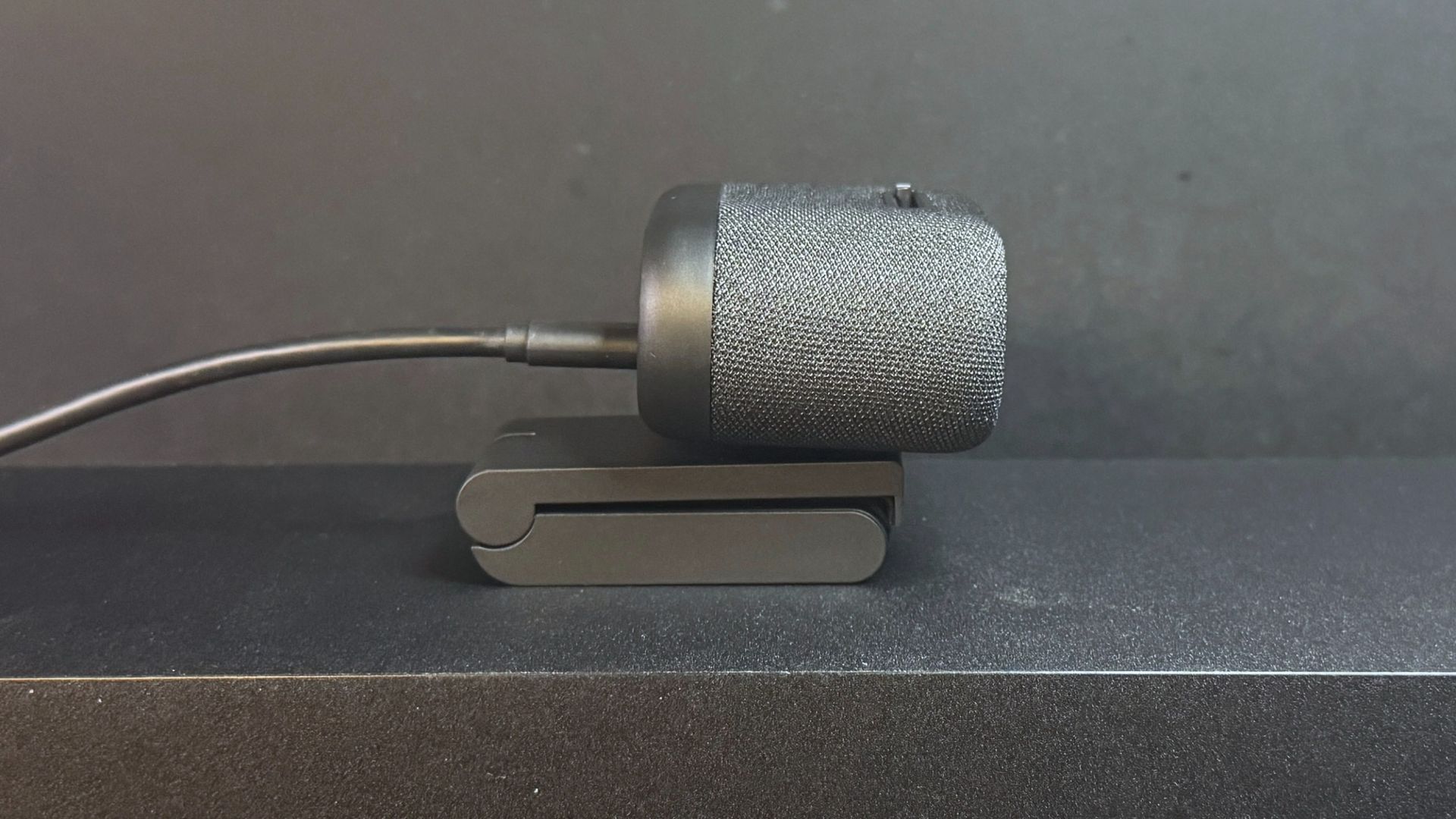
The Dell Pro 7 is similar in design to the cheaper Dell Pro 5 Webcam 2K — it features the same low-profile oval-shaped body, though the Dell Pro 7 is quite a bit larger and heavier than the Dell Pro 5. The Dell Pro 7 measures approximately 2.6 inches (66mm) deep by 2.1 inches (53.3mm) wide, and is about 1.4 inches (35.6mm) tall. This is the same height as the Dell Pro 5, though the Dell Pro 7 is both deeper and wider than its cheaper sibling. It's also heavier — Dell lists its weight at 8.48 ounces (240.4g), but that includes the mount. However the webcam alone still weighs around 3.46 ounces (98g). By comparison, the Dell Pro 5 weighs 7.41 ounces (210g) including its mount, and weighs 2.57 ounces (73g) without it (but including the cable, which is not detachable).
Tom's HardwareTom's Hardware
It is heavier than the Dell Pro 5, but it's not unusually heavy for a premium 4K webcam. The Razer Kiyo Pro Ultra, for example, weighs about 6.28 ounces (178g) alone, and that jumps up to 11.89 ounces (337.08g) when you include the mount. The Logitech MX Brio weighs just 4.83 ounces (137g) alone, but it weighs 11.04 ounces (313g) with its mount. And the Dell Pro 7 is also quite a bit smaller than its competition — I especially like how relatively low-profile it is at 1.4 inches, which is less than half the height of the 3.01-inch (76.5mm) height of the Kiyo Pro Ultra.
Tom's HardwareTom's Hardware
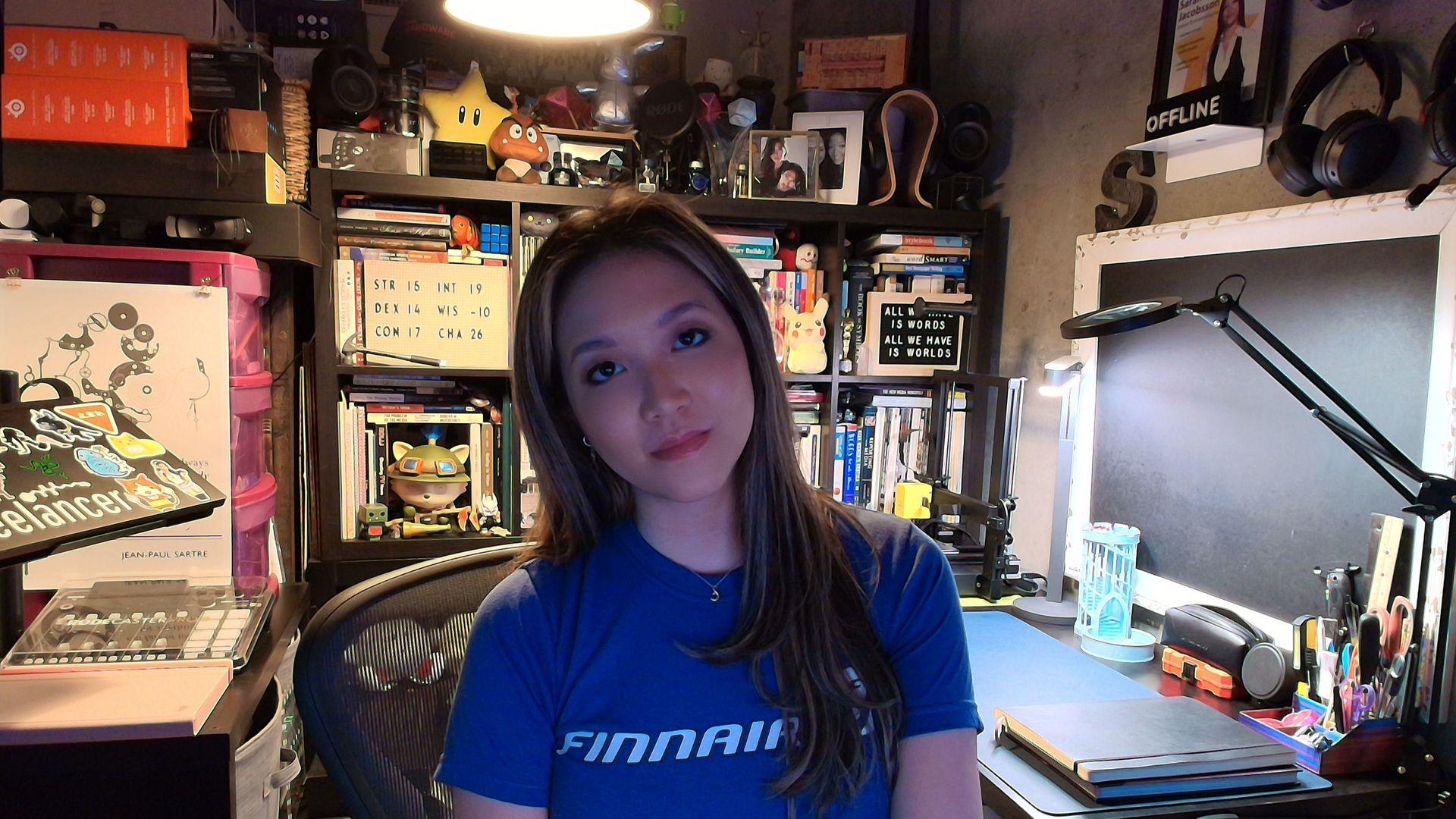
The Dell Pro 7 has a built-in physical shutter that you can close with a switch on top of the webcam. It looks just like the built-in physical privacy shutter on the Dell Pro 5, but it has a built-in spring-loaded mechanism so it snaps into place when you slide the switch. (The Dell Pro 5 doesn't have this mechanism — you need to manually slide it all the way.) The spring-loaded mechanism definitely made it feel more premium than the Dell Pro 5, but it still needed to be pressed fairly hard to activate, which means you can't really use the shutter without messing up your frame.
Tom's HardwareTom's HardwareTom's Hardware
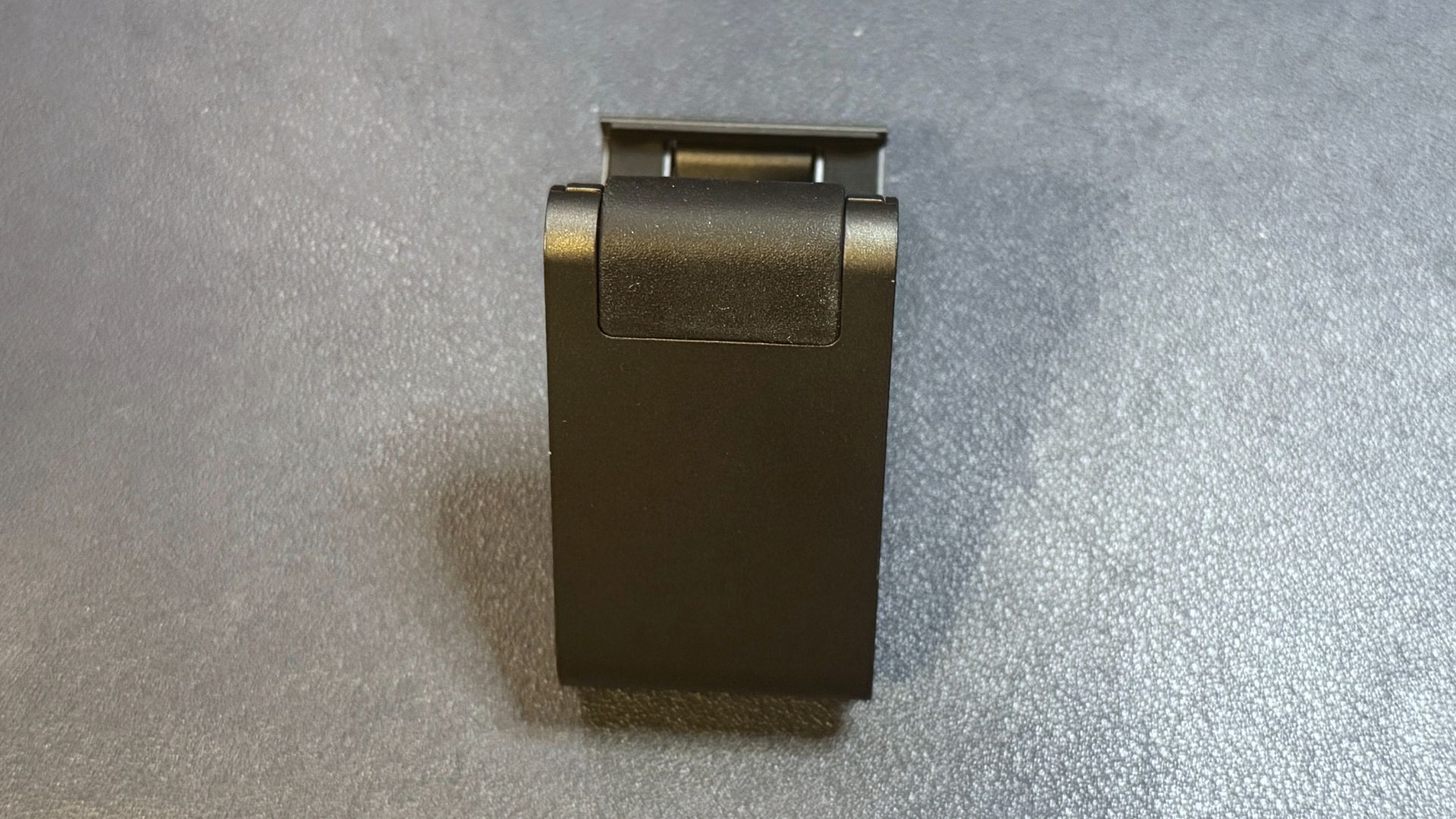
The Dell Pro 7 comes with a detachable monitor mount that attaches to the webcam via magnet. The mount is a pretty standard clamp-style monitor mount, with a lip at the front that hooks over your monitor and a rubber-coated adjustable "foot" that sits against the back of your monitor to stabilize the setup. The mount attaches to the Dell Pro 7 via a relatively stable magnetic attachment point, and the camera can tilt (approximately 90 degrees forward) and swivel while mounted. On the bottom of the webcam you'll also find a universal tripod attachment mounting point so you can use it with a tripod or a different, third-party mount. The mount itself does not have a tripod attachment point, which is a little disappointing as it means you'll be limited to the movement options of whatever third-party mount/tripod you're using.
The mount is hefty and stable, weighing about 4.83 ounces (137g). It's basically the exact same mount that comes with the Dell Pro 5, though it has a slightly textured rubber coating on its "foot," while the Dell Pro 5's mount features soft, smooth rubber. The weight and quality feel much more consistent with the build of the Dell Pro 7, however.
(Image credit: Tom's Hardware)
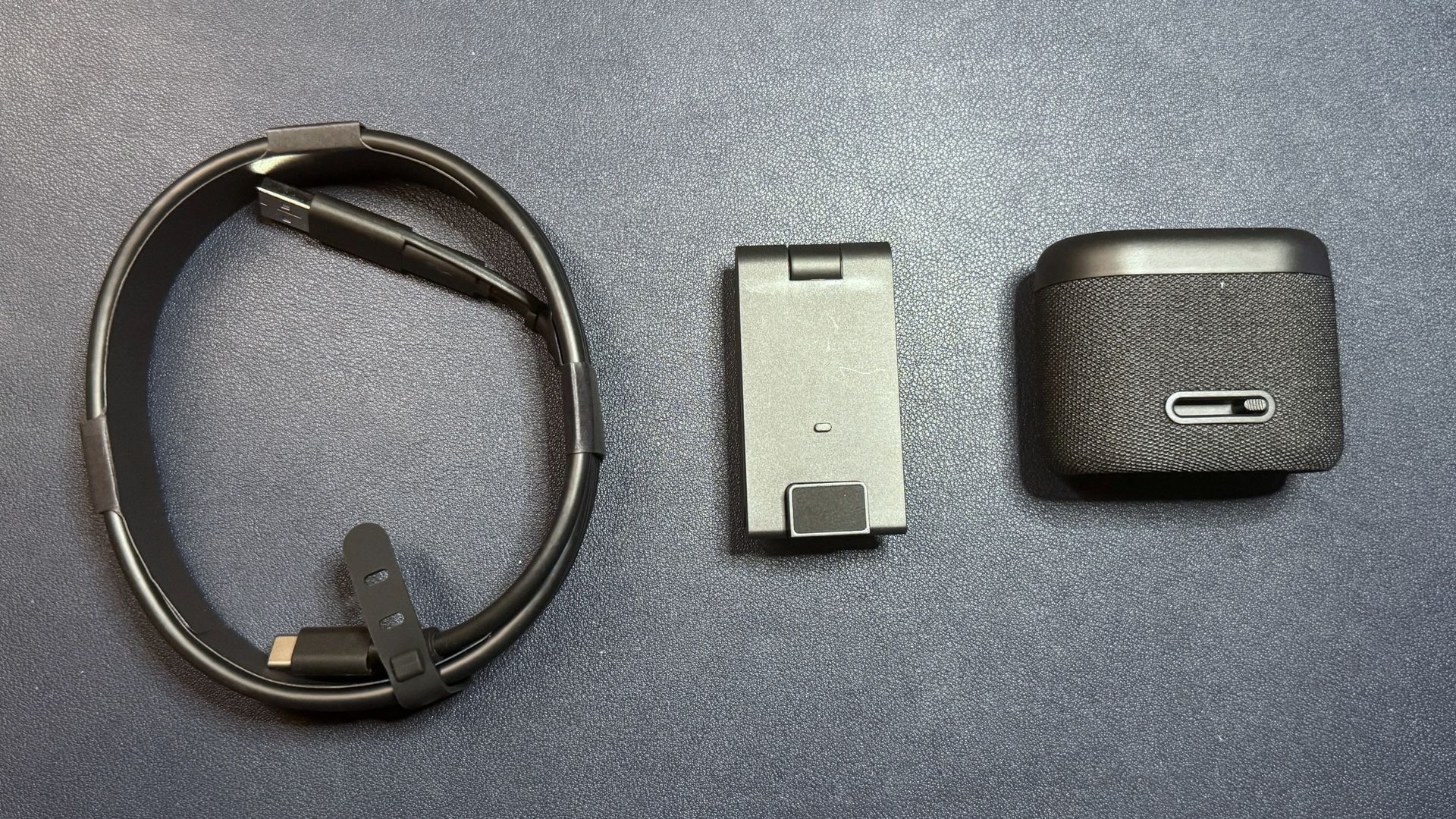
In the box, the Dell Pro 7 comes with a 6.5-foot (2m) heavy-duty USB-C to USB-C cable (USB 3.0) with a built-in USB-C to USB-A converter, the detachable monitor mount, and the webcam itself. The cable is definitely very thick and sturdy — a little too thick and sturdy, as bumping it kept displacing the webcam. The built-in USB-C to USB-A adapter is a nice touch, though you will still need to plug it into a USB 3.0 port if you want to get the full 4K picture quality and use some of the "smart" features (such as the "smart" HDR).
The Dell Pro 7 is a 4K webcam that records video in 4K, 1080p, and 720p resolution at both 60 and 30fps — which makes it somewhat rare, as most 4K webcams record a maximum of 4K / 30fps. Not that this matters for most users, as streaming and video chat platforms still generally limit outgoing streams to 1080p at most. Still, I guess it's worth noting if you're looking for a webcam that you can use to record action sequences on.
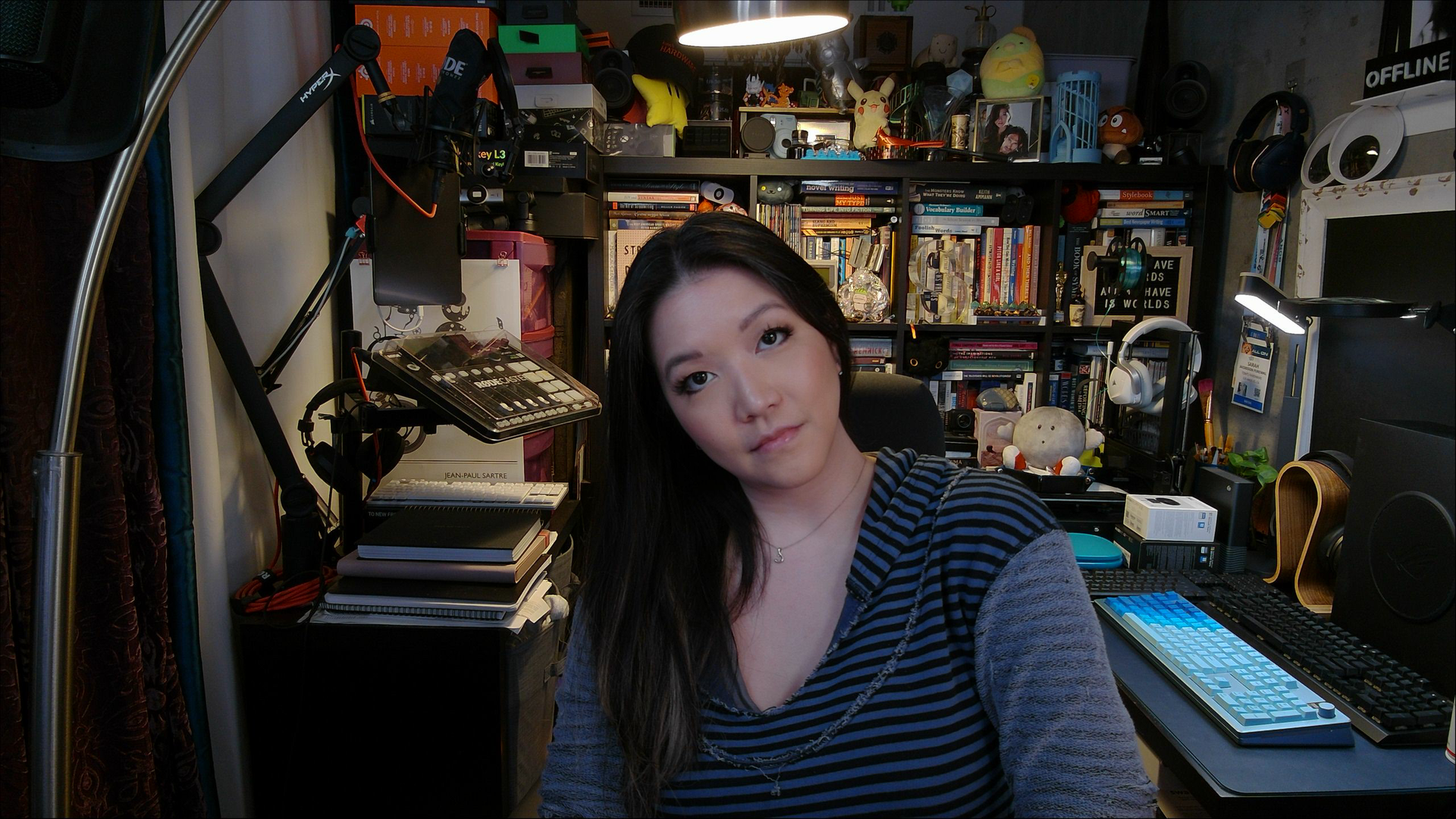
We started out by testing the Dell Pro 7's performance in what is basically an "ideal" (and very unrealistic) webcam lighting scenario. In this scenario there are two professional lights in front of me (behind my monitor set up): a ring light and a key light. I also have four monitors — three 27-inch monitors and one ultra-wide 34-inch monitor, plus some negligible ambient lighting from various peripherals (including my desk). There are two desk lamps behind me, as well as an arching floor lamp above me. All in all, this is an aggressively well-lit scenario (and a very unlikely one, unless you happen to be a professional content creator).
Dell Pro 7Tom's HardwareElgato Facecam ProTom's HardwareLogitech MX BrioTom's HardwareRazer Kiyo Pro UltraTom's Hardware
The Dell Pro 7 looked very good in our well-lit scenario. It did a great job of reigning in its auto-exposure in response to the lighting, which is something even the best webcams usually have more trouble with. It managed to keep the scene pretty evenly lit, even as I moved around the room, while also keeping it from looking too evenly lit, i.e., flat and featureless. Its auto white balancing was okay, though it trended toward the cool end of the spectrum. Actually, the colors on this webcam always seemed to be just a little too cool, even with some tweaking in the software. Not the worst thing in the world, but it was frustrating that I couldn't get the color to where I wanted it with adjustments.
That said, while the Dell Pro 7 produced an objectively very good image overall, it didn't really stand out in any way aside from that. I suppose that's not a bad thing, especially for a webcam that's (maybe) slightly more aimed at the workplace, but it mostly made me think of all the other $200 4K webcams you can pick up instead of the Dell Pro 7. Also, while the webcam did a pretty solid job of capturing still photos, the auto-focus was a little slow — which sort of negates the benefit of a 4K / 60 fps capture rate.
Low-Light Performance
To test the webcam's low-light performance, I turned off all of the lights and all of my monitors except for one 27-inch monitor. For consistency, I opened the standard Google home page, which is mostly white, on one half of the monitor and the Windows 11 camera app on the other half. This scenario leaves me in complete darkness save for the light from one 27-inch monitor, which is still quite a bit more light than a laptop user would have if they were sitting in the dark.
Dell Pro 7Tom's HardwareElgato Facecam ProTom's HardwareLogitech MX BrioTom's HardwareRazer Kiyo Pro UltraTom's Hardware
The Dell Pro 7 performed moderately well in our low-light scenario. It did an okay job of lighting the scene — the picture looked better than most older webcams, but that's about it (and that's not saying much). There was a lot of noise / graininess and artifacting, however, especially when I moved. And the autofocus had (unsurprisingly) even more trouble tracking me in the dark, and an evenly-lit blurry mess is still a blurry mess.
No webcam performs particularly well in low light, because sensor size is a major factor in low-light performance and webcams are... just not that big. But compared to other 4K webcams such as the Elgato Facecam Pro and the Logitech MX Brio, the Dell Pro 7 definitely comes in a little below average.
Overexposed Performance
To test the Dell Pro 7's performance in overexposed lighting scenarios, I turned off all of the lights in front of me and three of my monitors. That left me with my overhead and background lights, as well as one 27-inch monitor. This isn't the most extreme overexposed lighting scenario, but it's a fairly common one as most offices tend to have a lot of overhead lighting (and only professional streamers put bright, studio-grade lighting directly behind a monitor).
Dell Pro 7Tom's HardwareElgato Facecam ProTom's HardwareLogitech MX BrioTom's HardwareRazer Kiyo Pro UltraTom's Hardware
The Dell Pro 7 performed fairly well in this lighting scenario, though it struggled to find a natural-looking color balance (and it kept veering cooler). This is another scenario in which no webcam does particularly well — for the most part, it's enough to just not get blown out by the lighting behind you. But the Logitech MX Brio, which is probably one of the Dell Pro 7's closest competitors, did a much better job here.
Features and Software
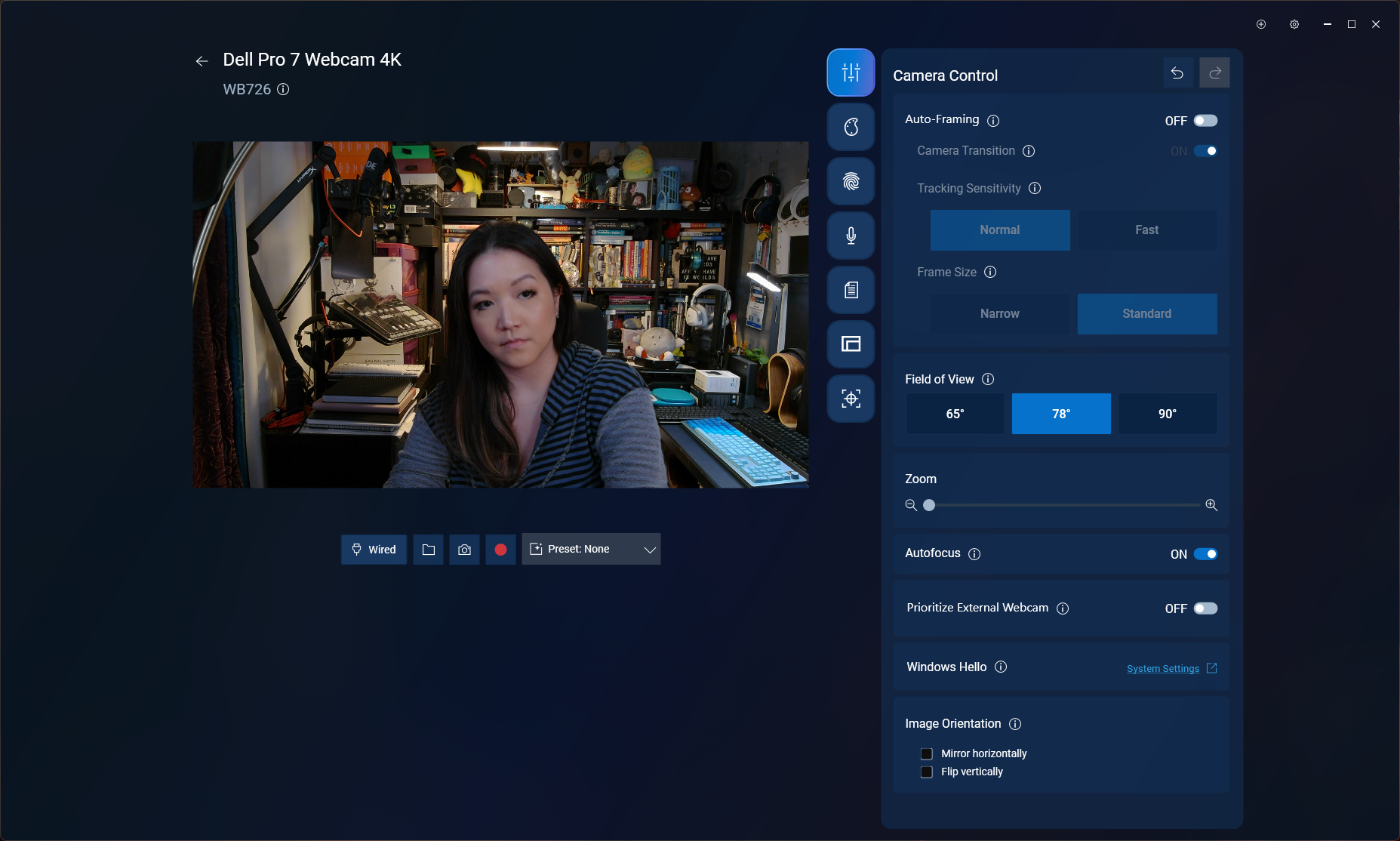
The Dell Pro 7 is configurable via the Dell Display and Peripheral Manager, which lets you adjust camera and picture settings and set up the webcam's various features, such as Windows Hello, presence detection, and the "smart" image enhancements.
(Image credit: Tom's Hardware)
While the Dell Display and Peripheral Manager has all the settings and adjustments you might expect in a webcam app, I didn't feel like the various manual adjustments for exposure, saturation, contrast, sharpness, and vibrance were very powerful, which was a bit surprising as usually these settings are too powerful. But this wasn't too much of an issue for me, as the picture is already pretty good — just not perfect — out of the box.
In addition to image enhancements and color adjustments, you can also set up several features in Dell Display and Peripheral Manager — such as face-tracking and auto-framing; "smart" HDR, exposure, and auto white balance; and Windows Hello compatibility. Like the Dell Pro 5, the Dell Pro 7 also has a "document view" feature designed to better focus on and display documents, as well as an "object focus" mode that can be activated using gesture controls (or manually).
The Dell Pro 7 has built-in dual beam-forming microphones, and while a built-in microphone is not really something most people are looking for in a webcam (especially as they generally tend to be terrible), the Dell Pro 7's built-in mics were surprisingly good — and not just for a webcam, but... in general. In fact, this might be the first webcam with a mic I can actually recommend.
The Dell Pro 7's mics picked up my voice very well — it came through loud, clear, and surprisingly vibrant and full, even when I was sitting at a normal distance from the webcam and speaking casually (i.e., not trying to speak "into" the mic). There was a little fuzziness and distortion around the edges of my words, and it picked up the clacking on my keyboard and the clicking on my mouse almost as well as it picked up my voice (and the software-based noise reduction in the app almost immediately started swallowing my words), but as long as you're not trying to type and talk at the same time the Dell Pro 7's mic sounds good. Not as good as a standalone USB gaming mic, of course, but on par with the average gaming headset mic.
Bottom Line
The Dell Pro 7 is actually a pretty solid 4K webcam, if not a particularly thrilling one. While I don't think most people looking at the Dell Pro 7 are going to be fiending for 60fps, I'm sure there are probably at least two people who will appreciate it. For everyone else, the Dell Pro 7 has a nice suite of office-friendly features, including presence detection to lock your PC when you're not sitting in front of it, Windows Hello compatibility for extra security, and things like document view and gesture control and an extra-wide field of view for when you need to run a remote 4K, 60fps meeting with lots of people (and documents).
But if you don't see yourself running speedy, highly-detailed multi-person webcam meetings, the similarly-priced Logitech MX Brio does a better job at making you look good... which is a big part of what webcams are for, right? The Dell Pro 7 outputs a decent picture (in relatively "ideal" lighting), but this webcam is not really about the picture — it's about everything else.
Four plaintiffs subscribed to ChatGPT, Claude, Grok, or Gemini filed a proposed class-action lawsuit alleging that the developers of these AI models violated antitrust laws when they agreed to slow AI development. According to the Associated Press, the lawsuit argues that this agreement would “reduce the value consumers get for paid AI subscriptions” and that this coordination started in July 2026 after the leading AI labs signed a statement admitting there is “intense competitive pressure not to unilaterally slow” development.
The plaintiffs recognize the need for AI development to slow for the sake of safety, but they say that Anthropic founder Dario Amodei’s cooperation proposal is a “shortcut” that “substitutes collective restraint for individual accountability.” Attorney Nick Rowley, the lead counsel for the plaintiffs, says, “AI will quickly spin out of human control and could kill us all if we allow AI safety and protocol … to be controlled by private self-serving agreements between the world’s most powerful ‘for profit’ technology companies.”
Amodei’s essay acknowledged the antitrust risk and indicated he was hoping that the government would make an exception. OpenAI’s Sam Altman responded to this call on X, saying, “We welcome a federal framework that sets consistent safety requirements for frontier AI. But we do not believe we need to wait for an antitrust exemption or legislation to begin the work of providing this confidence.” However, the Trump administration shot down this idea, with the president himself saying, “AI taking over the World, destroying Humanity, and all other things bad, is a HOAX.”
Chinese state media also criticized this announcement, saying that the call to put the brakes on AI development is nothing but a response to Chinese competition, especially as Amodei’s essay explicitly mentioned the desire to slow China’s progress and widen the U.S.’s gap over Beijing. China Daily called the proposed agreement a “club whose membership rules have been drafted before the guest list is announced” and added that “a global AI-safety framework that excludes China is not quite global.”
There have been a couple of bizarre incidents where AI agents took their users’ commands too literally, like kicking out another person from a waitlist just to get their user ahead of the queue or deleting a company’s entire database when their AI agent faced a problem and it guessed that making the move was the best option. However, there have been more sinister events, such as when unreleased AI models broke out of their testing environment and hacked HuggingFace’s production servers. Big Tech is making the call to slow down development to catch up in terms of security, but people are calling them out for antitrust activity probably because they do not trust these companies.
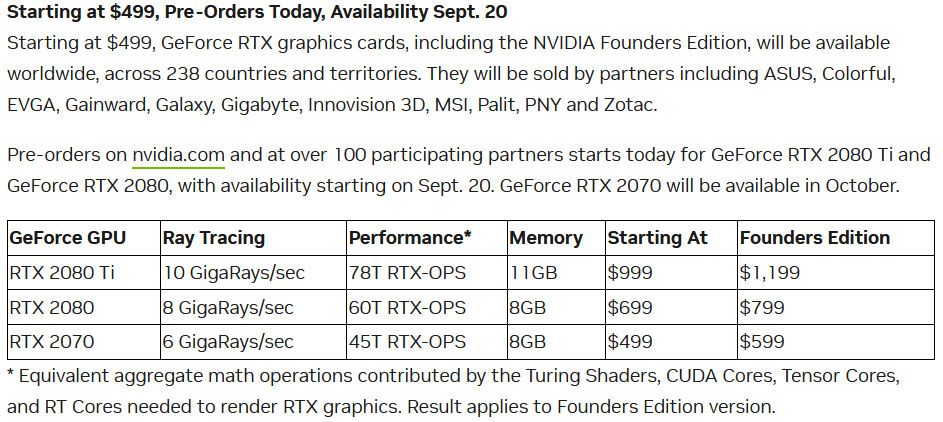
Nvidia’s Turing GPUs became available to enthusiasts for the first time on this day eight years ago. This wasn’t just another accelerated GPU generation, though, at least according to Nvidia. The GeForce 20 series pioneered a “20 years in the making” ability to deliver hybrid graphics enhanced by real-time ray tracing. Nvidia made this new technology available at the high-end first, via the GeForce RTX 2080 and RTX 2080 Ti (review links). The more mainstream RTX 2070 wouldn’t become available until October.
In a blog post a month ahead of the release day, Nvidia CEO Jensen Huang didn't hold back in heralding the arrival of Turning for PC gaming graphics. “Turing opens up a new golden age of gaming, with realism only possible with ray tracing, which most people thought was still a decade away.” He went on to claim that “Once you see an RTX game, you can’t go back.”
Despite Huang’s boasts we can look back and confidently say that many gamers still don’t care about ray tracing. Nor do they wish to endure the performance impact even the latest generation mainstream graphics cards from Nvidia (and AMD, and Intel) still suffer from when this feature is turned on. Moreover, at the time of launch back in 2018, and for quite a few months onwards, there was little in the way of content that made the new RTX 20 series' distinguishing feature seem worthwhile. Early in-game showcases that garnered a lot of pixel peeping and chin rubbing included Battlefield V, Metro Exodus, and Shadow of the Tomb Raider.
Our review of the RTX 2080 Founders Edition noted that this new second-fastest Turing architecture card managed to outpace the legendary GTX 1080 Ti. However, we grumbled about it being $100 more expensive than the former flagship. During this era, Nvidia Founders Editions were actually more expensive than the base models from AIBs. Thus the RTX 2080 FE had an MSRP of $799, but you might have been able to pick up an Asus, Colorful, EVGA, Gainward, Galaxy, Gigabyte, Inno3D, MSI, Palit, PNY, or Zotac for $699.
Our review of the GeForce RTX 2080 Ti flagship was more positive, despite the conclusion that the “$1200 price tag is out of reach for most gamers.” The 71% uplift in price wasn’t really worth it for the ~26% faster performance vs the GTX 1080 Ti. It was also about 20% faster in gaming than the pro Titan V, though.
Our review of the RTX 2080 Ti was 14 pages long, but here’s a direct link to some gaming benchmarks featuring the likes of Tom Clancy’s Ghost Recon, The Witcher 3, and World of Warcraft: Battle for Azeroth. During gaming, this new consumer flagship would typically consume about 280W.
Eight years later, we can say that realtime ray tracing has indeed proved popular. Even consoles and mobile games now use and boast of this visual tech, and probably couldn’t ignore it without getting sidelined. But adoption has been slow, and it has taken yet more layers of technology, such as DLSS for the green team, to make ray tracing at all accessible for budget / mainstream gamers, even in 2026.
Do you still rock a Turing GPU in 2026? If you do, or are just curious about how well an 8-year-old card would do in 2026, I'm sorry to say that Turing has slipped off the end of our famous graphics card hierarchy. However, the following generation RTX 3070 at $499 offered very similar performance to the prior-gen $1,199 flagship. Those were the days (except that the cryptomining craze happened).
A team of researchers from The Netherlands’ Delft University of Technology built a lightweight whisker-based tactile sensor that allowed drones to navigate purely by touch. According to TechXplore, the system is designed for tiny autonomous robots weighing under 3.5 ounces or 100 grams, which face challenges in carrying heavy sensors, processors, and power sources, while sensors such as cameras, rangefinders, and LiDAR often have trouble navigating in poor conditions, such as dark environments or dust- and smoke-filled areas.
“Here, we aim to equip drones with rich tactile sensing — not for manipulation in the air, but for a novel concept of tactile navigation: using touch to explore and fly through the unknown,” Associate Professor of Aerial Physical Interaction and Embodied Intelligence Dr. Salua Hamaza told the publication. “But this comes with a challenge: for tactile sensing to work on drones, it needs to be lightweight, low-latency, and low-power. Inspired by nature, we found the answer in whiskers.”
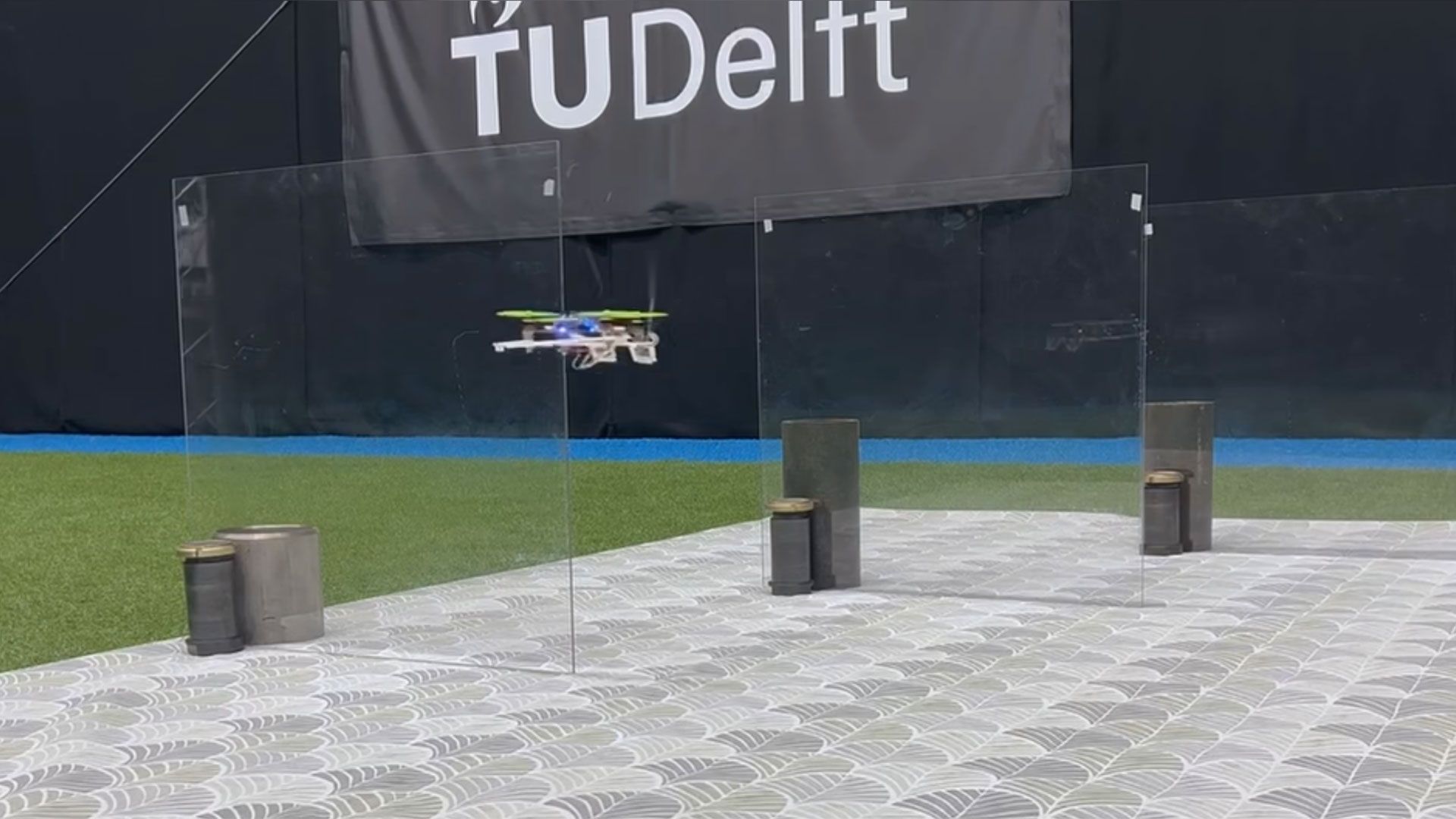
Rodents and other small mammals use vibrissae, more commonly known as whiskers, to navigate in tight and dark spaces with low visibility. So, the team emulated this capability by attaching two whiskers to the front of the drone pointed upwards at an angle, with each one connected to three miniature pressure sensors at the base. As the whisker contacts a surface, the changes in each of the pressure sensors allow the drone to estimate its relative depth and location. The drone can then estimate the surrounding surfaces to avoid obstacles, follow the surface, and even map the area based on what it can feel.
Another challenge with equipping drones with whiskers is that airflow could potentially disrupt the system. So, the researchers built a lightweight, real-time processing pipeline that accounts for these minute changes and gives the whiskers millimetric precision. What’s more interesting is that this program, which can separate turbulence from surface detection, only uses 34 kilobytes of memory. “We wanted to show that touch does not have to come at the cost of size or computational power,” researcher Chaoxiang Ye told TechXplore. “Our entire tactile perception pipeline runs onboard using just 34 kilobytes of memory, allowing a tiny drone to sense and respond to its environment in real time.”
While this lightweight system won’t be useful for the world’s fastest drone, it’s still a great option for tiny drones designed for search-and-rescue operations. Rescue units equipped with these tiny drones could deploy them onsite to explore collapsed structures without endangering people or animals and would even pair well with this 3D-printed cyborg cockroach designed for rescue operations.
With storage prices hitting insane peaks across both SSDs and hard drives, it's a safe bet that many gamers are carefully counting every wasted gigabyte — particularly as most AAA productions get bigger with each iteration. Final Fantasy VII fans looking to play Revelation, the final entry in the remake series, might have to delete another game on their console or PC to make way for the potentially over-200 GB title.
This revelation came about at the Tokyo Game Show, in an interview where Video Games Chronicle (VGC) talked to Final Fantasy VII remake series director Naoki Hamaguchi. He says the game might take up 200 GB or more, needing the one UHD Blu-ray disc (to the tune of 93.1 GB usable) along with an additional download for the remainder of the data — potentially putting the required download at 100+ GB.
The director remarks that the figure is an estimate, but it's not hard to believe considering the series' gigantic scope plus the fact that the previous entry in the series, Rebirth, took roughly 146 GB. When prompted about fitting the game in two discs (hypothetically, two UHD Blu-rays), he stated that doing so would require a "compromise" for the game's scope, or presumably, visual fidelity.
Furthermore, he clarified that delivering game content digitally allows for patching up until the release date, whereas the standard disc manufacturing process needs around three months' planning.
Hamaguchi added that there are two character backstory DLCs planned for Revelation. One will go over Vincent's story, while the other will be centered around everyone's favorite ōdachi-wielder Sephiroth. Considering that the INTERmission DLC for Remake was roughly 8 GB, there's a chance that a fully loaded install of Revelation could ring in at as much as 215 to 220 GB.
That storage requirement would make Final Fantasy 7 Revelation what appears to be the first game to require 200 GB for strictly a base install. Even the infamous 300+ GB requirement of Call of Duty Black Ops 6 was only doable if one installed every single content pack and language. Some PC games like DCS titles, Microsoft Flight Simulator, and ARK: Survival Evolved can hit many hundreds of gigabytes, but that's by way of added maps and content packs.
Revelation is coming April 8, 2027, giving gamers plenty of time to prepare. Even still, PC and PlayStation 5 owners can easily add storage, since both systems can use bog-standard NVMe drives — up to 8 TB in the case of Sony's console. Meanwhile, Xbox owners are worse off, since increasing available storage requires specific and pricier expansion modules that cap out at 4 TB.
More games are taking advantage of the free-to-play model, and Microsoft is building systems designed to deliver ads without disrupting the gaming experience. According to Respawn First, the system would first give players some ad-free playtime, which could either be based on time or in-game progress, such as levels and bosses. Once this expires, the company will then open a window and briefly serve “promoted content.”
However, this system will not just show ads out of the blue. Instead, it will work with the game engine so that they will only appear during downtimes, like after a boss fight, at the end of a cutscene, while a new level is loading, when you complete a quest, or enter a menu. While the ad is being served, the game enters a frozen state to ensure that player progress isn’t disturbed. After you finish watching the ad, it resets the ad-free playtime, allowing gamers to play another round with no distractions.
The patent application itself describes it as “a content management system” and that it could obtain a promoted content trigger event based partially on the game, suspend a user’s interaction with the game based on the promoted content trigger event, obtain promoted audiovisual content and present it to the user, commence the user’s interaction with the game, and establish “a credit based at partially on the promoted audiovisual content, wherein the credit delays suspension of the user’s interaction with the interactive software application during a credit duration.”
Based on this description, it works similarly to some free-to-play mobile games, where ads are automatically served after you finish a round or after a few minutes of playing. The difference with this system is that it doesn’t serve ads arbitrarily; instead, it works with the game engine and even uses machine learning to determine when it’s the best time to show players the ad.
While this is still a patent application and it’s not even clear if this has been deployed in actual games, it shows what Microsoft is considering for how it could monetize free-to-play games. We’ve seen similar moves with Xbox Cloud Gaming, with the company experimenting with an ad-supported free tier for the cloud gaming service.
While the tech that Microsoft applied for a patent on could actually be a good thing, as it would make in-game ads less jarring, we could argue that it would encourage both gamers and publishers to focus on free-to-play titles. The idea behind these games and services is that it would allow more people, especially those who don’t want to spend cash, to enjoy gaming. However, some say that they’ve actually broken the diversity and innovation in the gaming industry, as developers and publishers focus more on monetization instead of unique games and quality titles. You can view the USPTO application here [PDF].
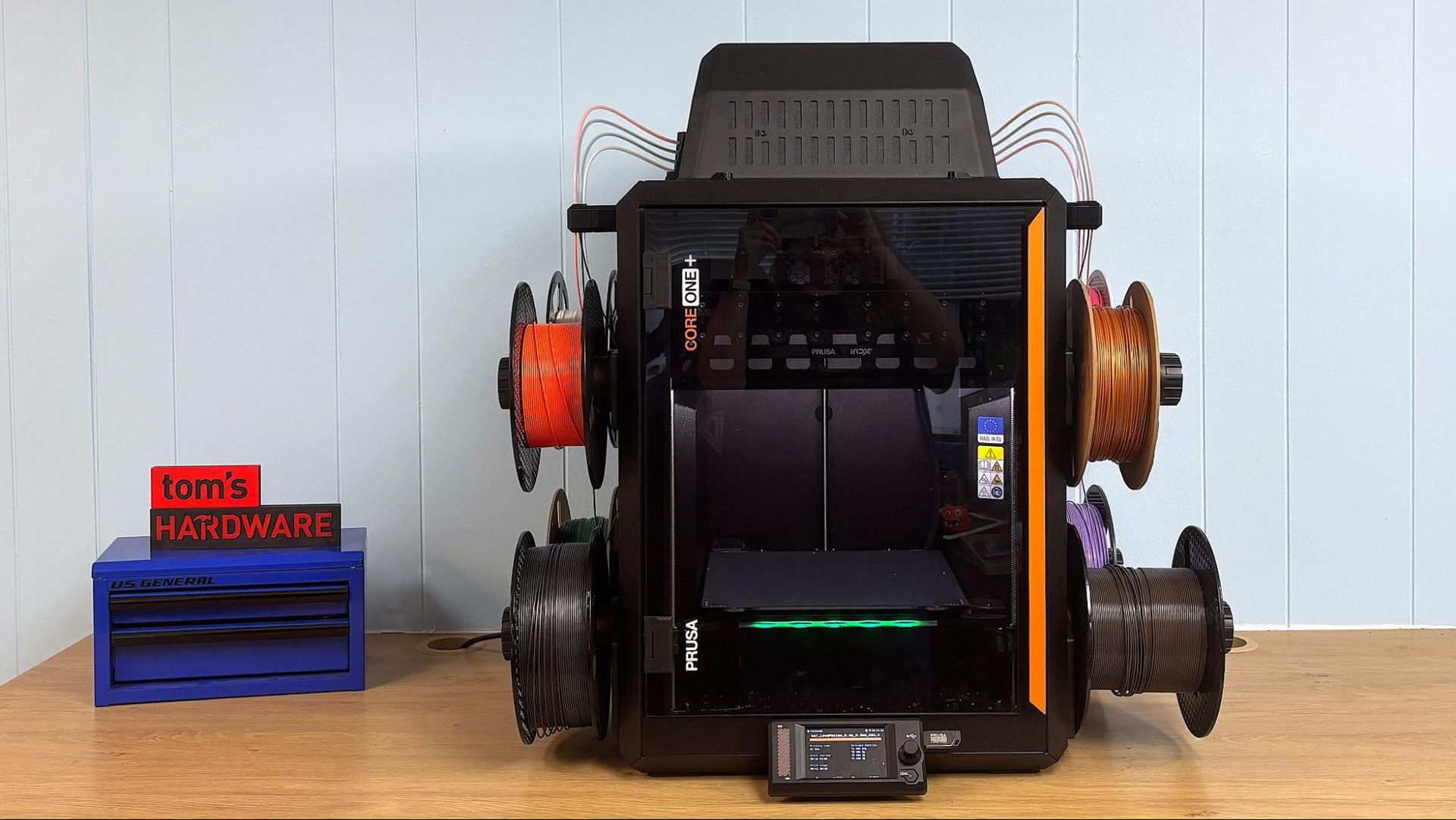
The Prusa INDX is a revolutionary new toolchanger capable of printing up to eight colors of various materials. INDX stands for Induction Dynamic Extruder, with each slim toolhead having no moving parts, just a nozzle and filament path. The extruder, or “smart head,” does all the work.
INDX is a collaborative project between Prusa Research and Bondtech. Prusa makes the platform, in this case a CORE One+ Gen 2, while Bondtech produces the toolhead system. The two companies have a long history of working together, going back to 2017’s MK3 bedslinger. The INDX can also be purchased separately on Bondtech’s site as a DIY kit to be mounted on any open-source 3D printer you feel like modding.
There are definite advantages of going with the Prusa INDX. You can buy it ready to roll, premounted on CORE One that’s ready to print ten minutes after removing it from the box. Even purchasing it as a kit from Prusa removes a lot of hassle and headache, as the kit is custom-fitted to CORE One, with all the wiring, programming, and whatnot done for you.
Sorting through the website to figure out what combination of kit and printer you need is the hardest part of the INDX experience. If you already have a CORE One, prices start at $749 for a four-color INDX “conversion” kit. Prusa optimistically says the kit takes 5 to 6 hours to install, but it took me the better part of a weekend to disassemble my machine and rebuild it as an INDX when I tested out the early Founder’s Edition.
The Prusa INDX is the first multicolor 3D printer to ditch the prime tower, making it practically waste-free. While all toolchangers can seriously cut down on wasted material by virtue of having a nozzle for each color, they still need to “prime” the nozzles before printing. This priming creates a tower of wasted material. Prusa has circumvented the prime tower with a new wiper mechanism that quickly shoots out a tiny blob of filament that’s about 13 milligrams in size – smaller than a grain of rice.
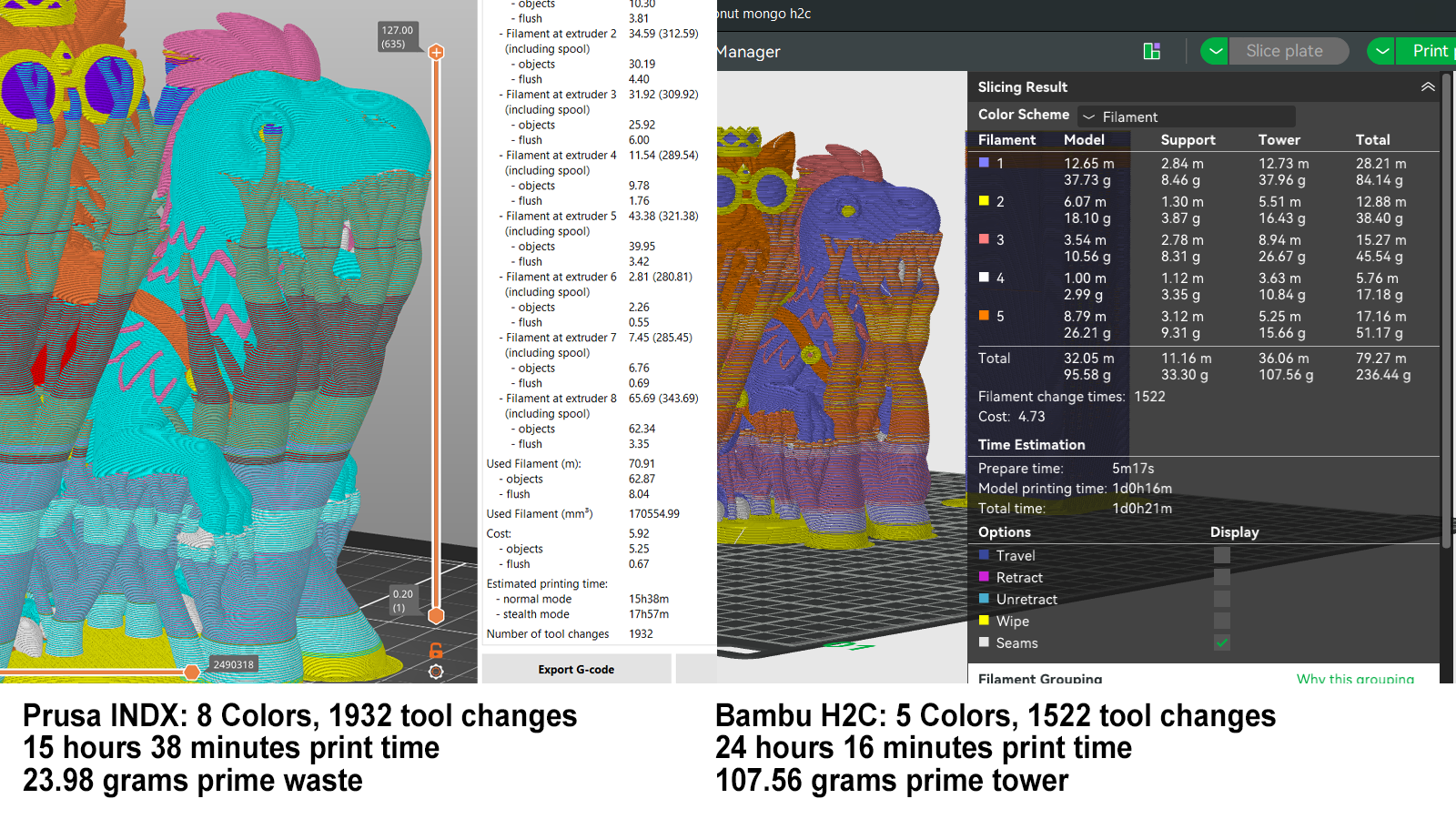
In my testing, I found the Prusa INDX was faster and less wasteful than any other toolchanger in the workshop. I ran the same model with similar settings on both the Prusa INDX and the Bambu Lab H2C, the closest machine to a toolchanger that Bambu currently has in production. The INDX was able to run it nearly nine hours faster, with 83.58 grams less wasted material (not counting supports) and 3 more colors.
(Image credit: Tom's Hardware)
The CORE One+ INDX starts at $1,699 for a DIY kit with four toolheads and goes up to $2,119 for an assembled 3D printer with eight toolheads, plus a Buddy Cam and Advanced filtration. If you already have the printer, the conversion kit is $749 for four toolheads and $999 for eight. There is no pricing for individual toolheads at the moment, but you can start with four toolheads and later add more. Individual tools are currently $45 on the Bondtech website.
The Prusa CORE One+ INDX lives up to its reputation and is one of the best 3D printers we’ve tested to date.
Specifications
Prusa CORE One+ INDX
Prusa CORE One
Prusa CORE One L
Prusa CORE One L+
Build Volume
248 x 205 x 270 mm (9.76 x 8.07 x 10.6in)
250 x 210 x 270 mm (9.84 x 8.3 x 10.6 in)
300 x 300 x 330 mm (11.8 x 11.8 x 12.99 in)
300 x 300 x 330 mm (11.81 x 11.81 x 12.99 in)
Material
PLA/PETG/TPU/ABS/ASA /PC (up to 300 degrees)
PLA/PETG/TPU/ABS/ASA /PC (up to 300 degrees)
PLA/PETG/TPU/ABS/ASA /PC (up to 290 degrees)
PLA/PETG/Flex/PVA,ABS/ASA/PA/PC (up to 290C degrees)
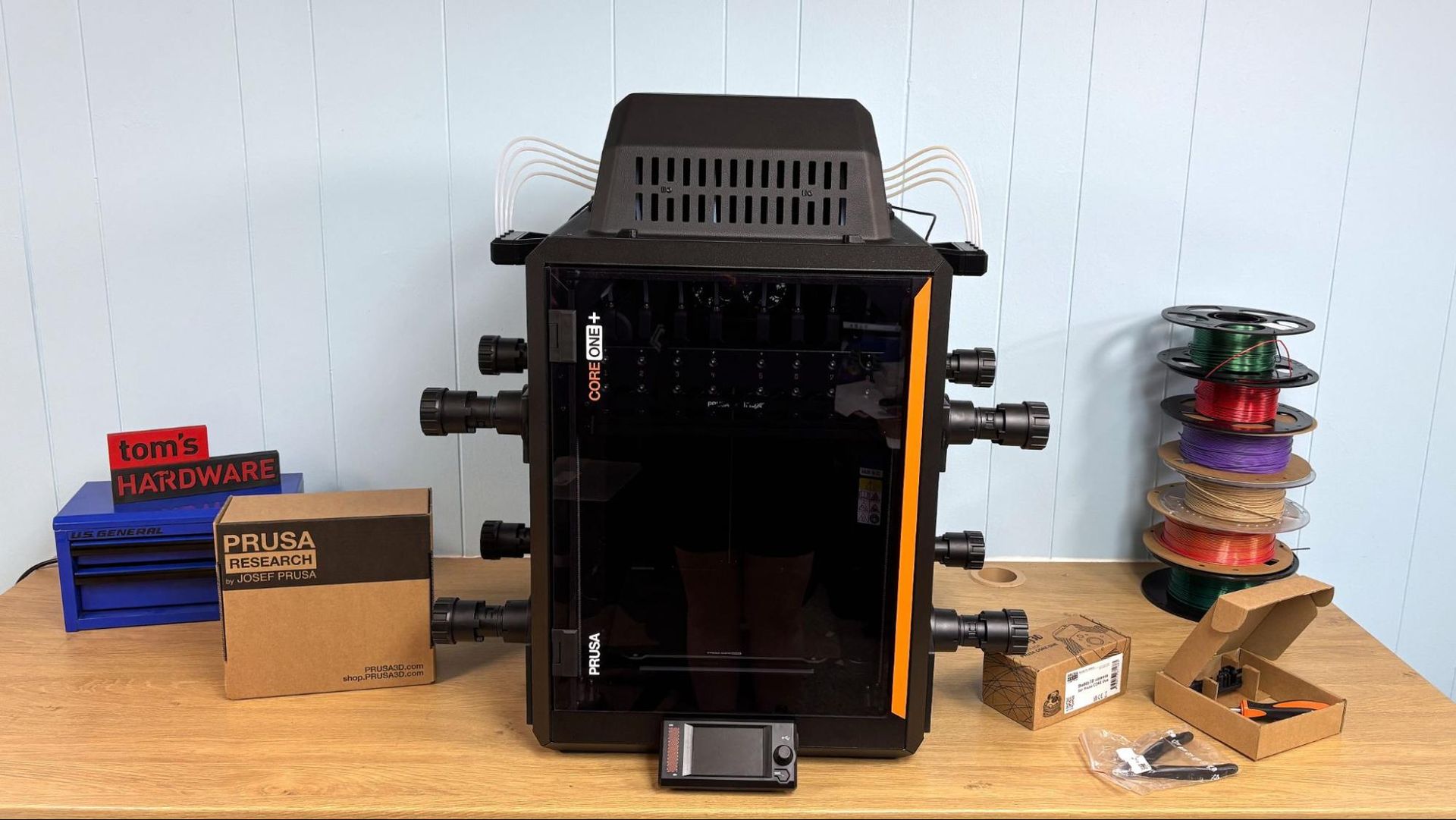
The Prusa CORE One+ INDX we received was pre-assembled and included eight toolheads. It only needed to be unpacked, have its screen mounted, then snap on the spool holders and Bowden tubes. Besides tools, the printer comes with a full spool of Galaxy Black Prusament PLA, a USB Stick, a handbook on 3D printing with your new machine, and a bag of Gummy Bears. The USB stick contains several models, while PrusaSlicer is available for free download from the website.
We also received a Buddy Camera and several boxes of filament to perform the review.
Design of the Prusa CORE One+ INDX
(Image credit: Tom's Hardware)
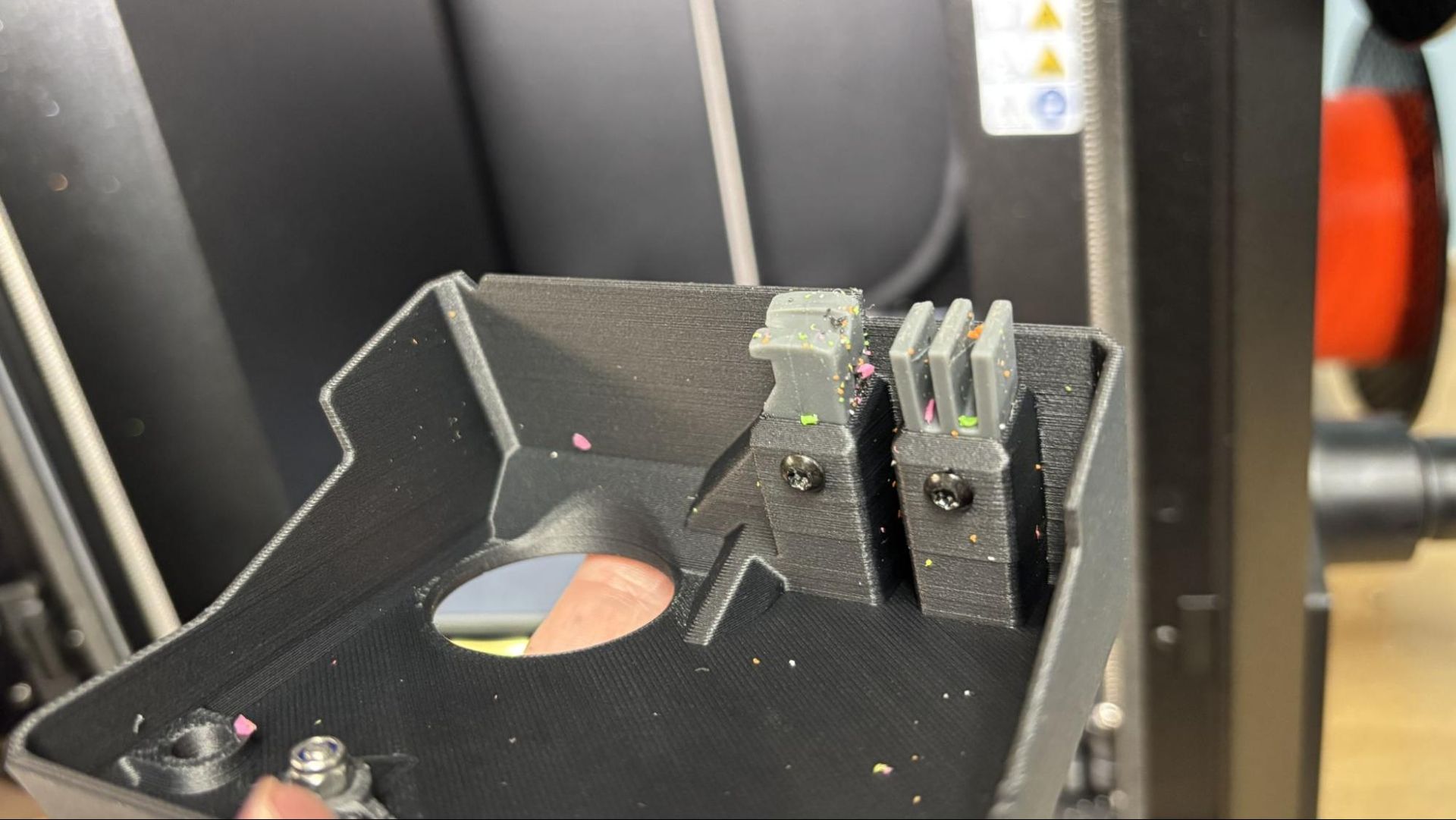
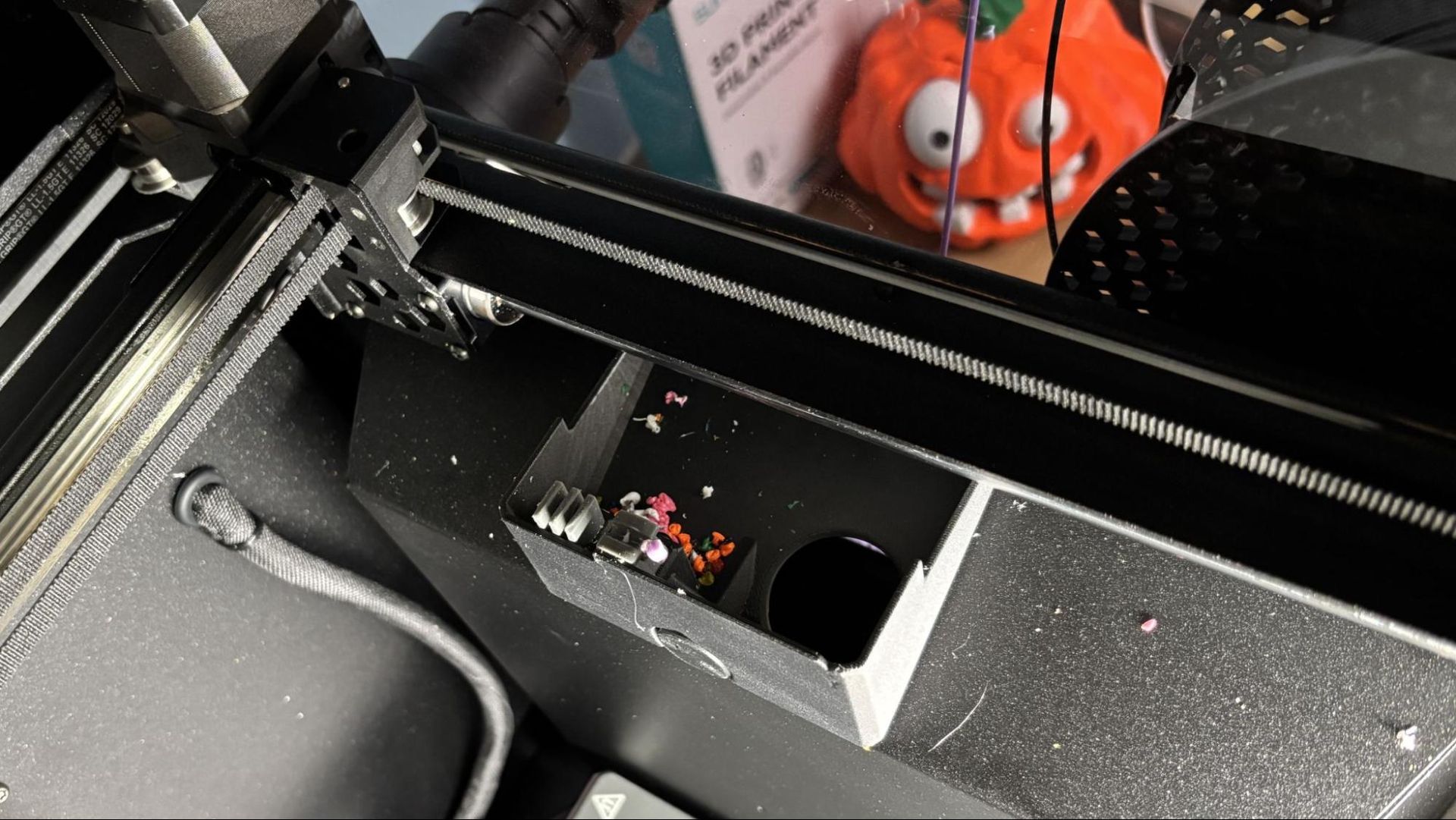
The CORE One+ INDX is a Core XY 3D printer converted into a toolchanger. It has a slim, steel exoskeleton with indents on either side. The right side holds a 3D-printed waste container on the outside for the tiny bits of filament the machine drops from the wiper system inside the chamber. We’re unsure if this mod is a permanent feature or an apology bonus for being unable to deliver fully hardened steel nozzles at launch.
Like the original CORE One, the door and upper parts of the side panels are translucent black polymer. The top panel is now replaced by a “top hat” to give the multitude of Bowden tubes room to work. Since the shell is made of folded steel, it’s not exactly airtight, but so far we haven’t had any trouble printing ASA or ABS in the machine.
The exoskeleton is an interesting concept. It provides a strong, stiff frame for the printer while also minimizing materials and avoiding that cheap plastic feel that plagues many other designs. The indented sides do more than slim down the printer’s silhouette; they reduce the interior space of the printer, allowing the chamber to be sufficiently heated (when needed) by only the heater bed.
Like every other Prusa printer before it, several of the CORE One+ parts are 3D printed with PC Blend Carbon Fiber, though more pieces are moving to in-house injection molding. Most of the machine is manufactured at the main factory in Prague, though printers assembled in the United States will have some parts printed locally in Delaware.
The CORE One+ has a door that can be flipped to open on either side. And thankfully, that door can remain closed at all times thanks to an active cooling system and automatic top vent.
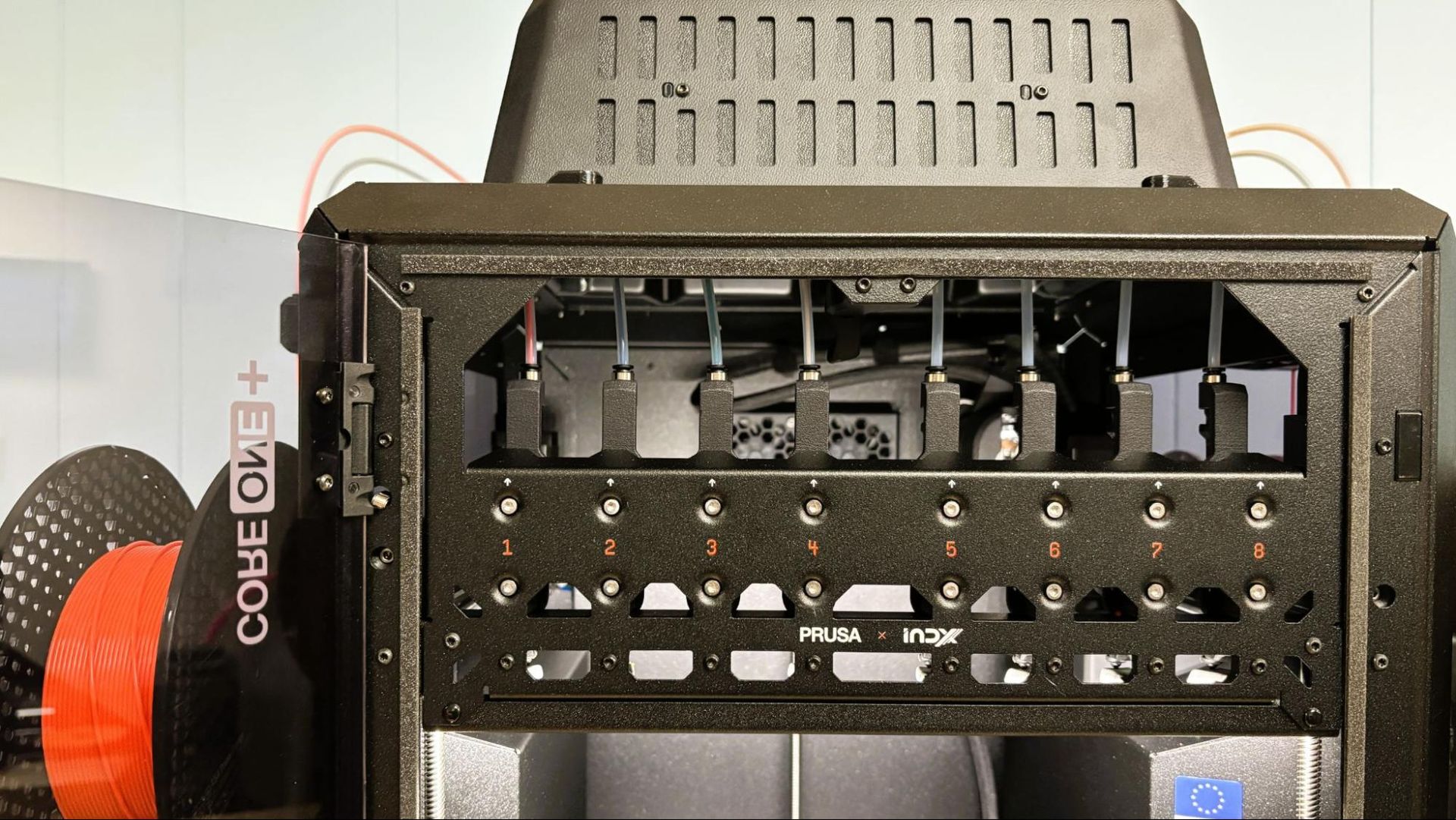
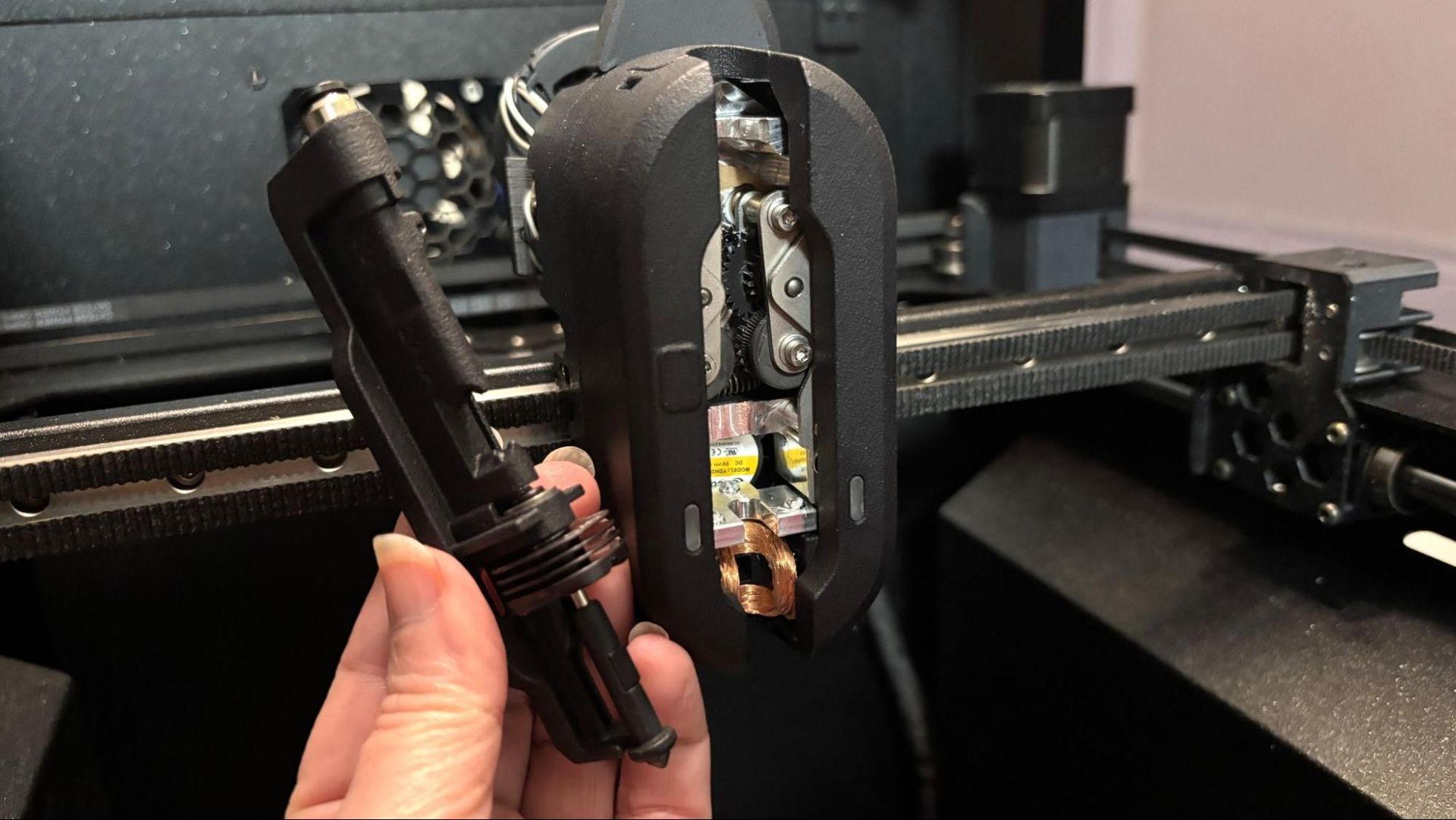
The INDX ditches the Nextruder extruder for the Bondtech induction-heated toolhead. The toolhead looks way too exposed out of necessity, as it picks up the passive nozzles by simply ramming itself onto the rack and grabbing the toolhead with magnets. The motion system is extremely accurate, and I had no problems with it during testing. You can see the copper coils of the induction heating system very plainly.
(Image credit: Tom's Hardware)
Unlike the Prusa XL, the toolheads mount on a rack in the front of the chamber. They take up very little space, but you will lose 15 mm of Y and 2 mm of X on the build plate compared to the CORE One+.
The rack does make seeing inside the printer a bit of a challenge, but the optional Buddy Cam has a clear view from the inside.
(Image credit: Tom's Hardware)
The wiper is located to the side, on top of the indent. In the Founder’s Edition, the wiper dumped into a small removable cup clamped to the side panel. Our review unit has a hole drilled into it to dump into a large exterior container, which is a huge improvement.
Tom's HardwareTom's HardwareTom's Hardware
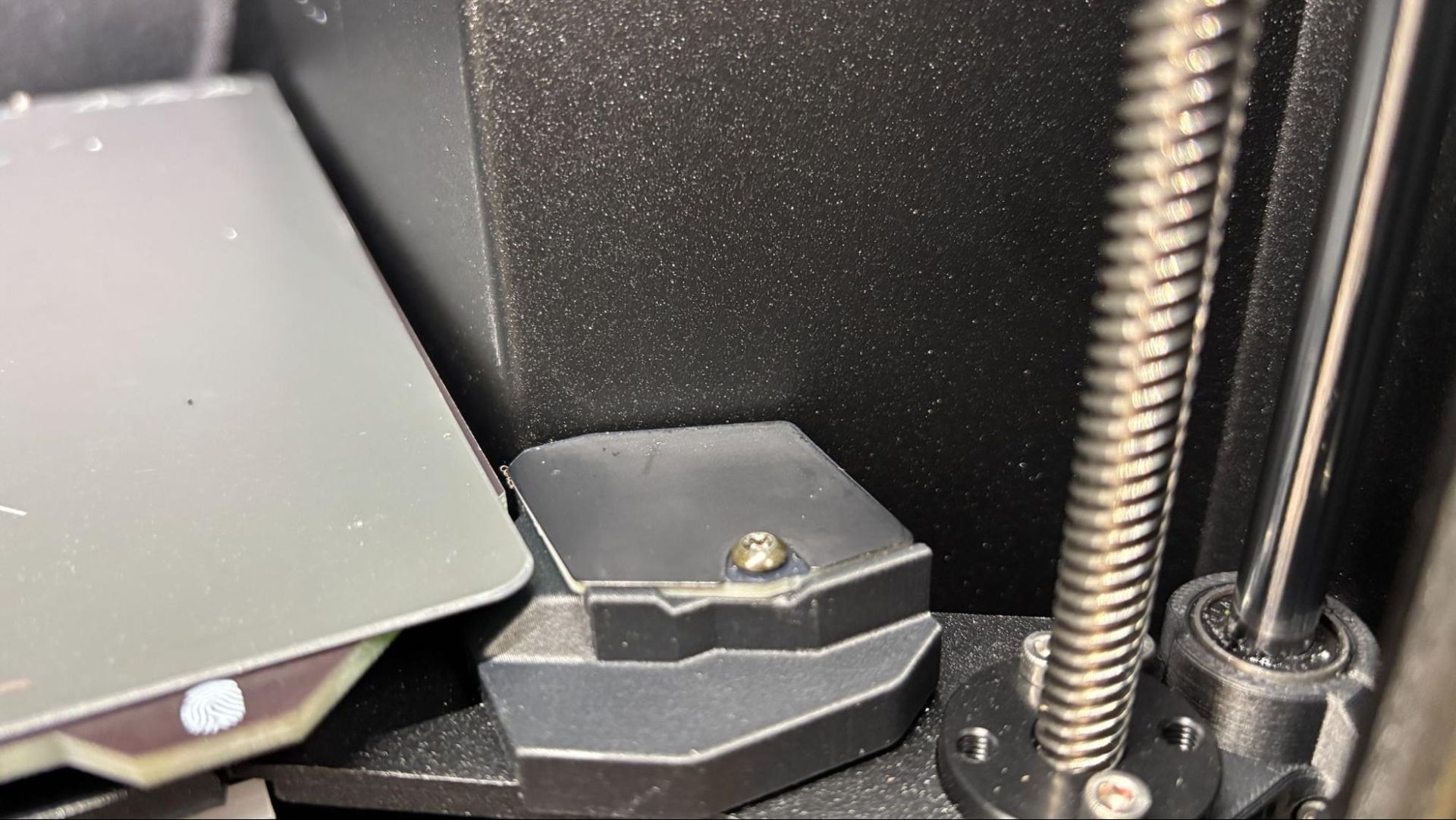
Anyone who’s had to calibrate an XL will rejoice at the new automatic tool offset calibration system. A calibration sensor sits in the front corner of the machine, and you don’t need to do a thing but keep it clean.
(Image credit: Tom's Hardware)
The CORE One+ has active chamber temperature control, which is NOT the same as chamber heating. Instead, the machine’s interior geometry is optimized to capture heat thrown from the bed to heat the chamber up to 55C. A fan and smart ventilation system likewise keep the chamber cool enough for PLA even with the door closed.
Assembling the Prusa CORE One+ INDX
(Image credit: Tom's Hardware)
The Prusa CORE One+ INDX we reviewed came fully assembled and only needed to be unpacked. Simply pull it out of the box, remove the packing materials, snap the screen on and the spool holders, and plug it in.
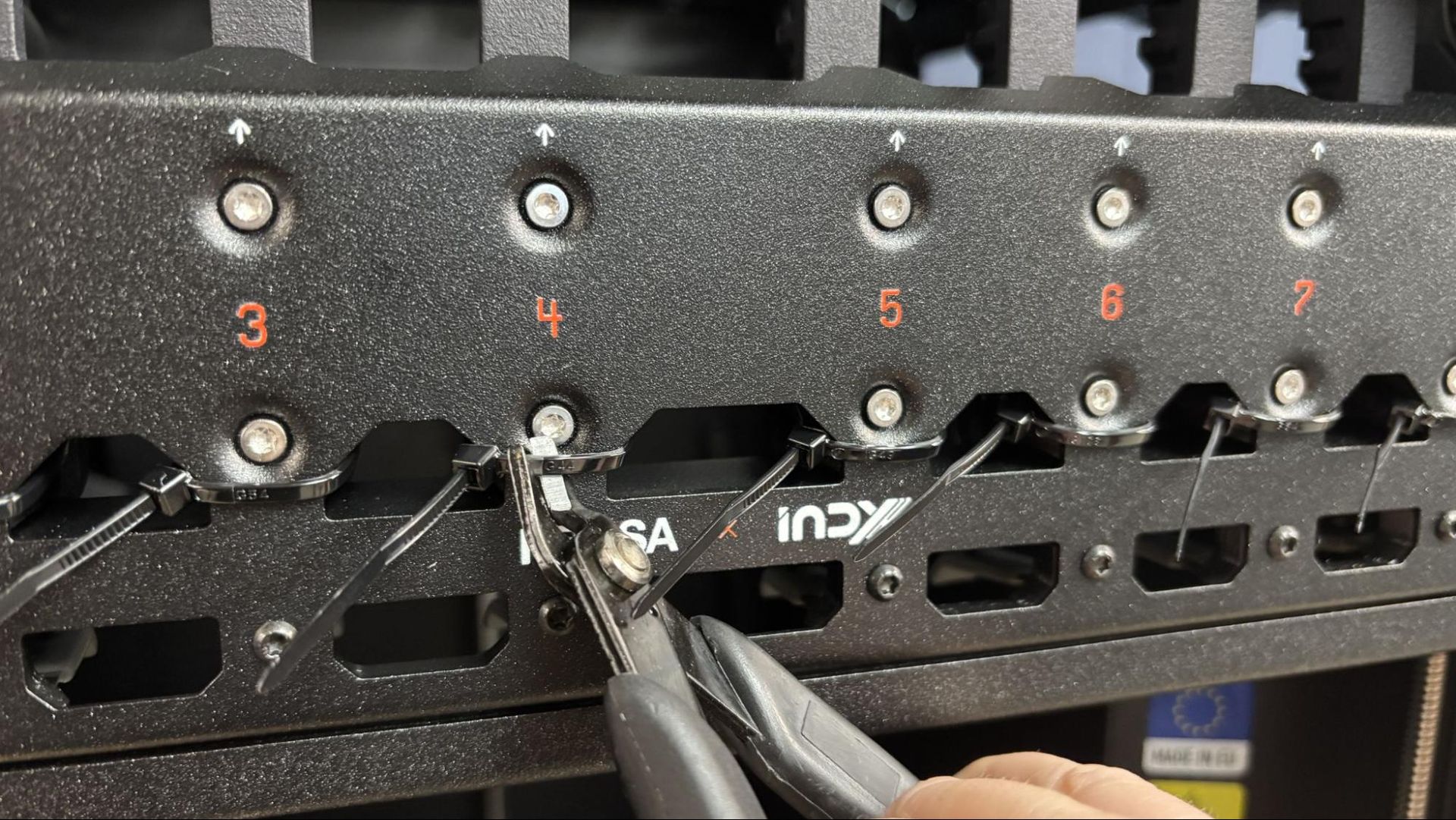
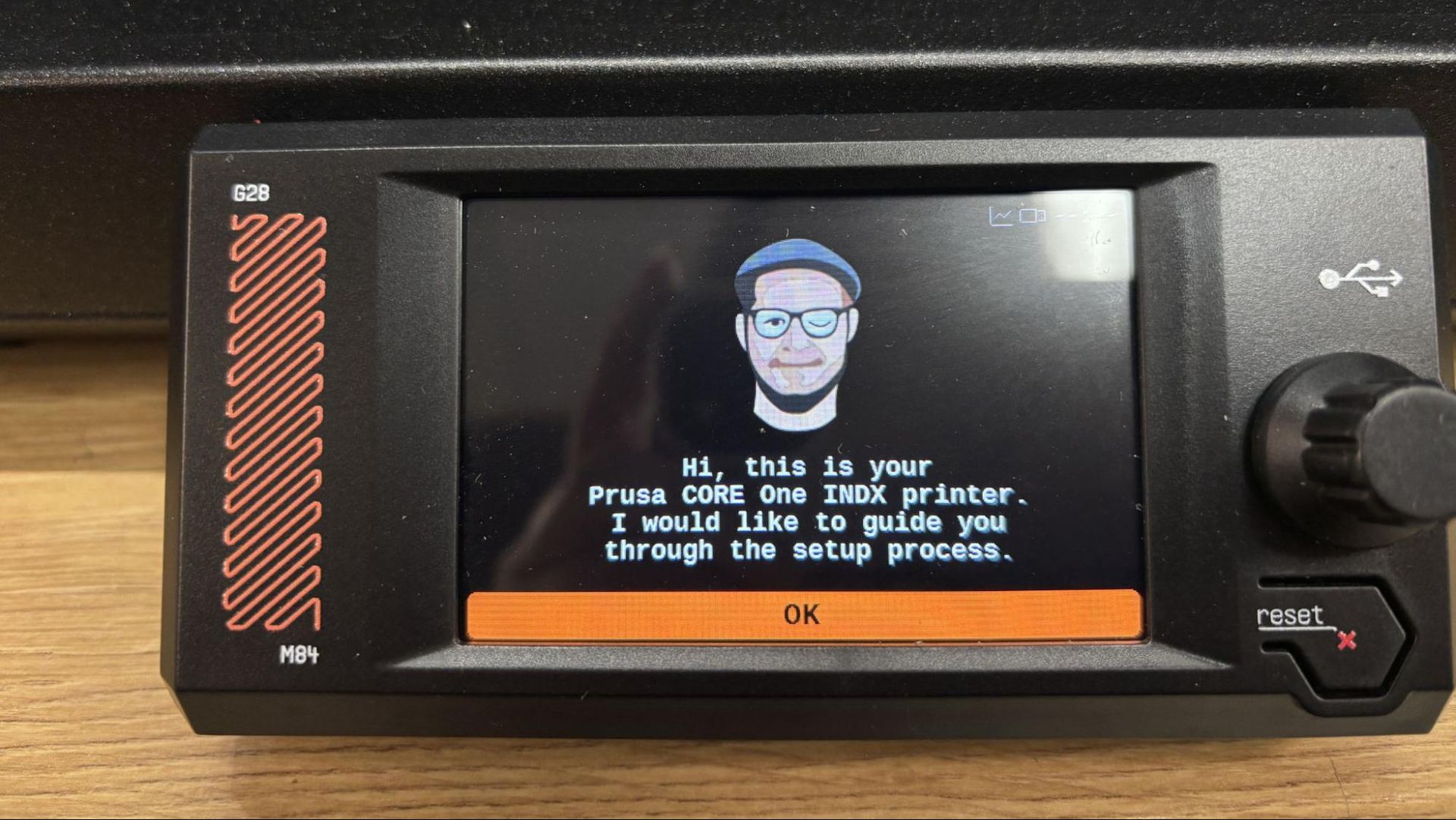
Once the machine is turned on, you’ll see a cartoon version of Josef Prusa to guide you through setup. However, calibration is now handled at the factory, so there’s nothing left to do but make sure you’ve removed the zip ties and carry on your merry way.
Leveling the Prusa CORE One+ INDX
(Image credit: Tom's Hardware)
Bed leveling is a no-brainer, as the Prusa CORE One+ is fully automatic. There are no manual adjustments and no need to adjust the Z offset. The printer uses a load cell sensor connected to the nozzle, which physically taps the print surface for precise measurement.
The printer trams the bed and calculates the required Z height before each print. And yes, if you need it, live Z adjustments are available in the control panel.
Loading Filament on the Prusa CORE One+ INDX
(Image credit: Tom's Hardware)
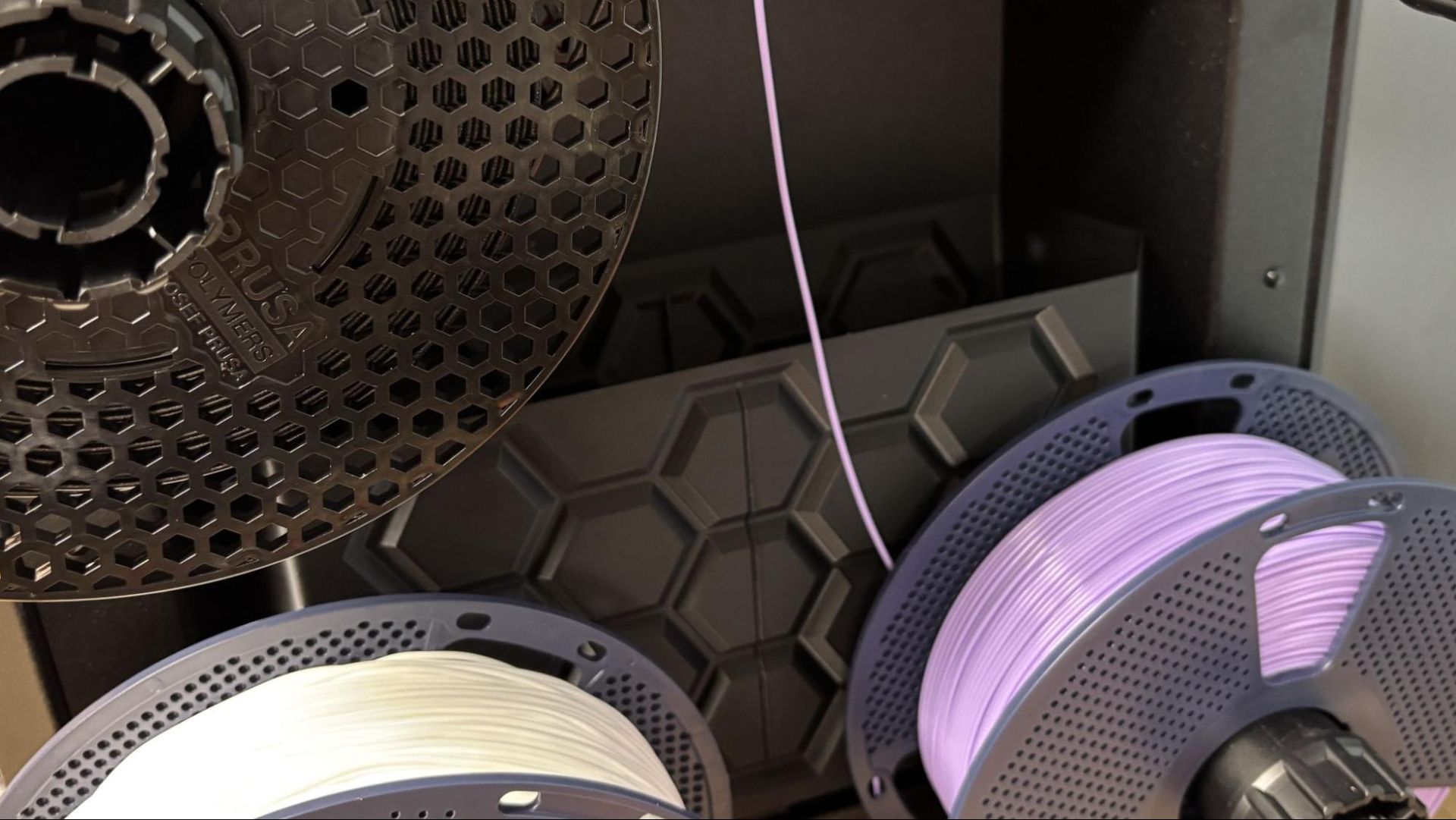
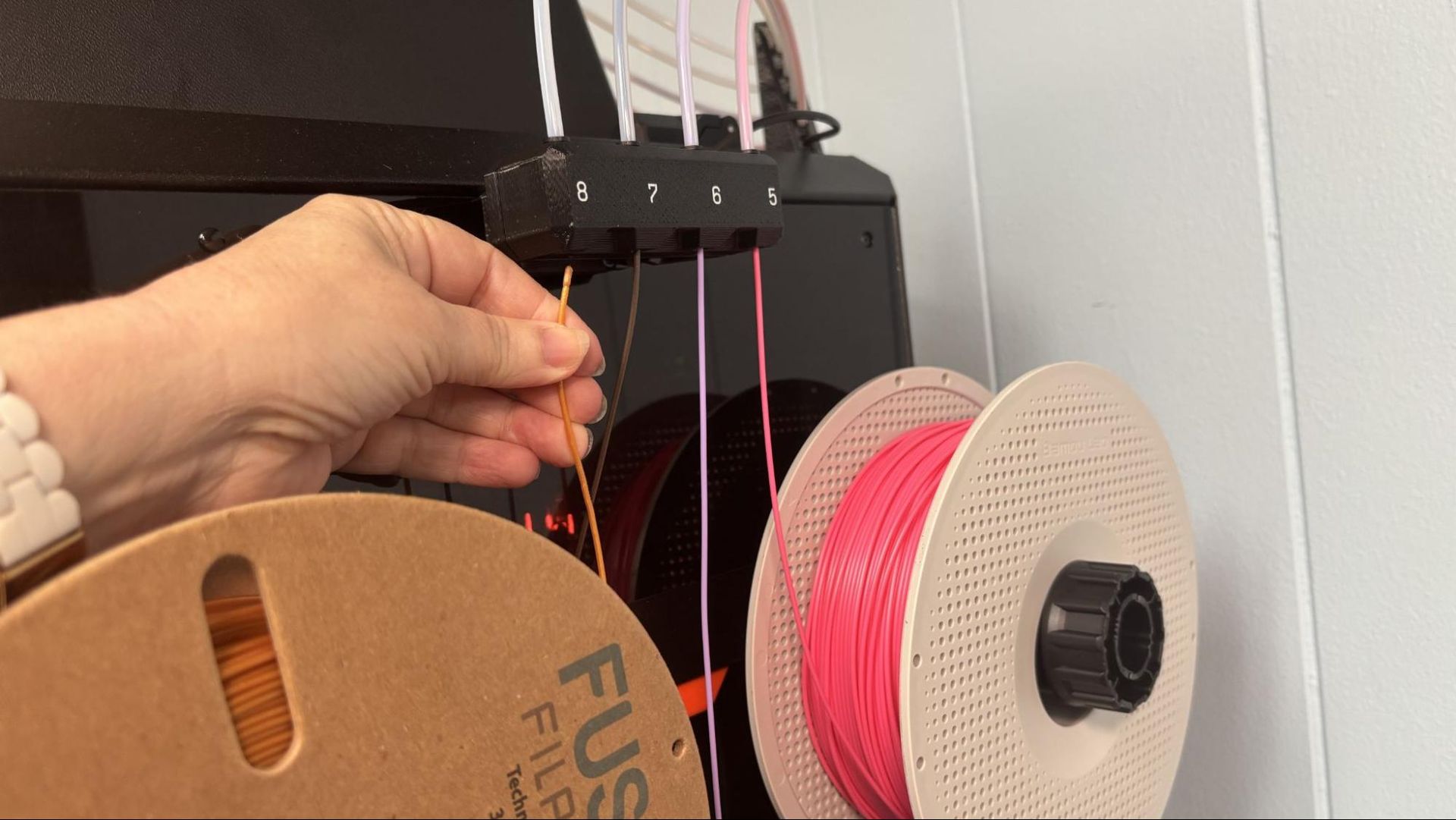
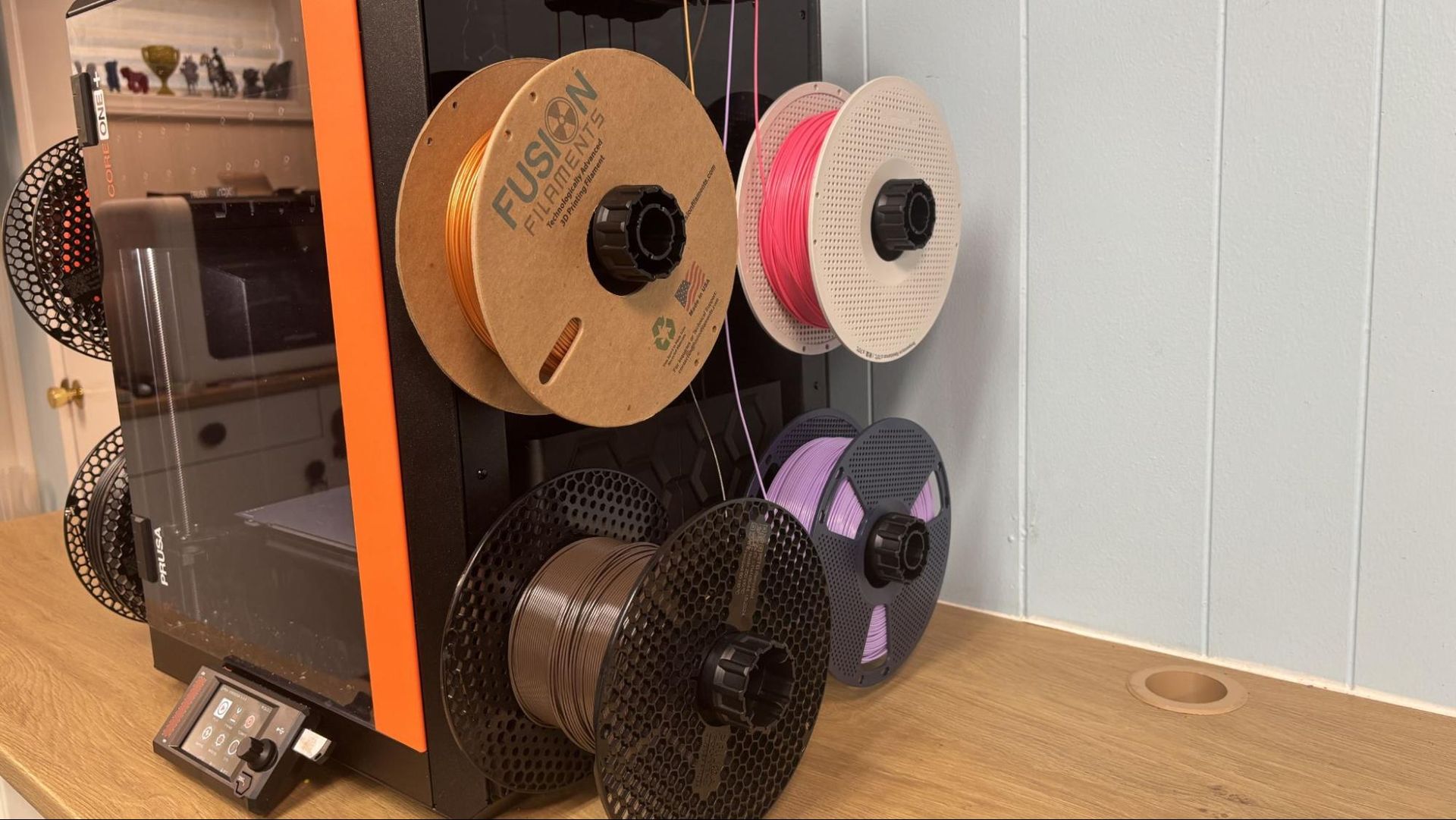
Loading filament is very simple. Simply place the spools on the side-mounted rack and feed the plastic into the reverse Bowden tube until it reaches the hotend. You’ll need to open the printer menu and tell it which toolhead you’re loading, since the toolheads themselves are passive. The carriage will zip over, grab the requested tool, and take it to the nozzle wiper to purge a small amount of filament into the cup. It will wipe the nozzle and park the toolhead when you’re done.
The inductive heater brings each nozzle up to temperature in a matter of seconds.
Unfortunately, the printer only asks what kind of filament you’re loading (PLA, ASA, Flex, or more) but not what color. This is probably due to the fact that the slicer does not constantly communicate with the printer over the cloud, but I’m hoping that this feature will become available with a future firmware update. For now, you’ll have to manually enter your filament colors into the slicer. There is a remapping option on the control screen, but shifting around eight spools' worth of information in this fashion is tedious.
The spoolholders are sturdy manual devices that can hold literally any brand of filament you might be using. They even expand to hold 3KG spools.
(Image credit: Tom's Hardware)
Preparing Files / Software for Prusa CORE One+
(Image credit: Tom's Hardware)
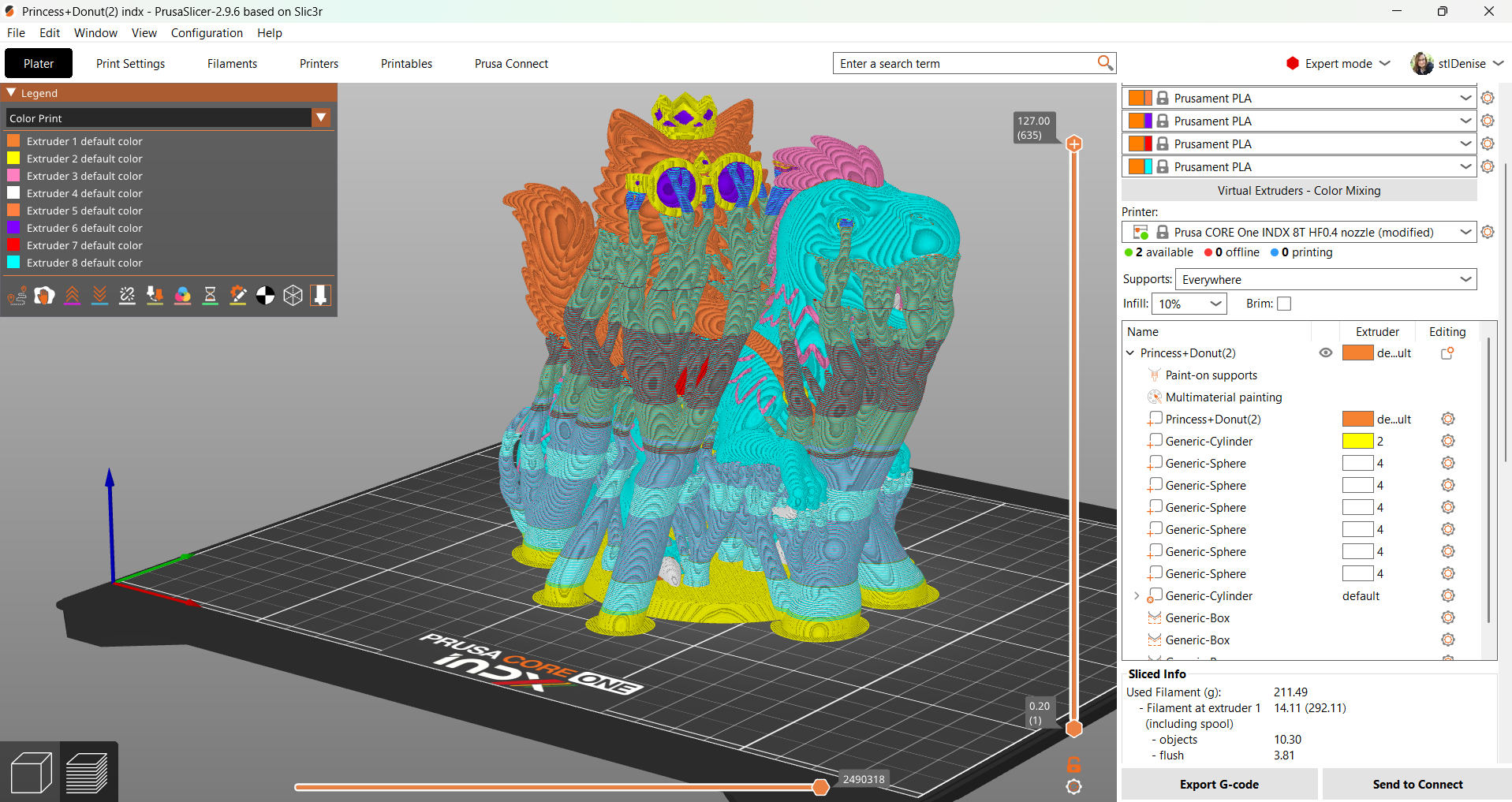
The Prusa CORE One+ uses its native slicer, PrusaSlicer. This open-source slicer is developed by Prusa Research and serves as the foundation for many other slicers. It comes with dozens of profiles for every material and nozzle size that Prusa Research makes.
The slicer also has built- in Color Mixing, which allows you to blend two or three colors with ultra-fine layers to create the illusion of more colors.
The CORE One+ can also use Prusa’s web-based slicer, EasyPrint, to print directly from Printables, Prusa’s free library of files, or from a mobile device.
Printing on the Prusa CORE One+ INDX
The fully assembled CORE One+ comes with a full 1 KG roll of Prusament PLA Galaxy Black. If you want more colors and materials like silks and multicolor filaments, you should check out our guide to the best filaments for 3D printing for suggestions.
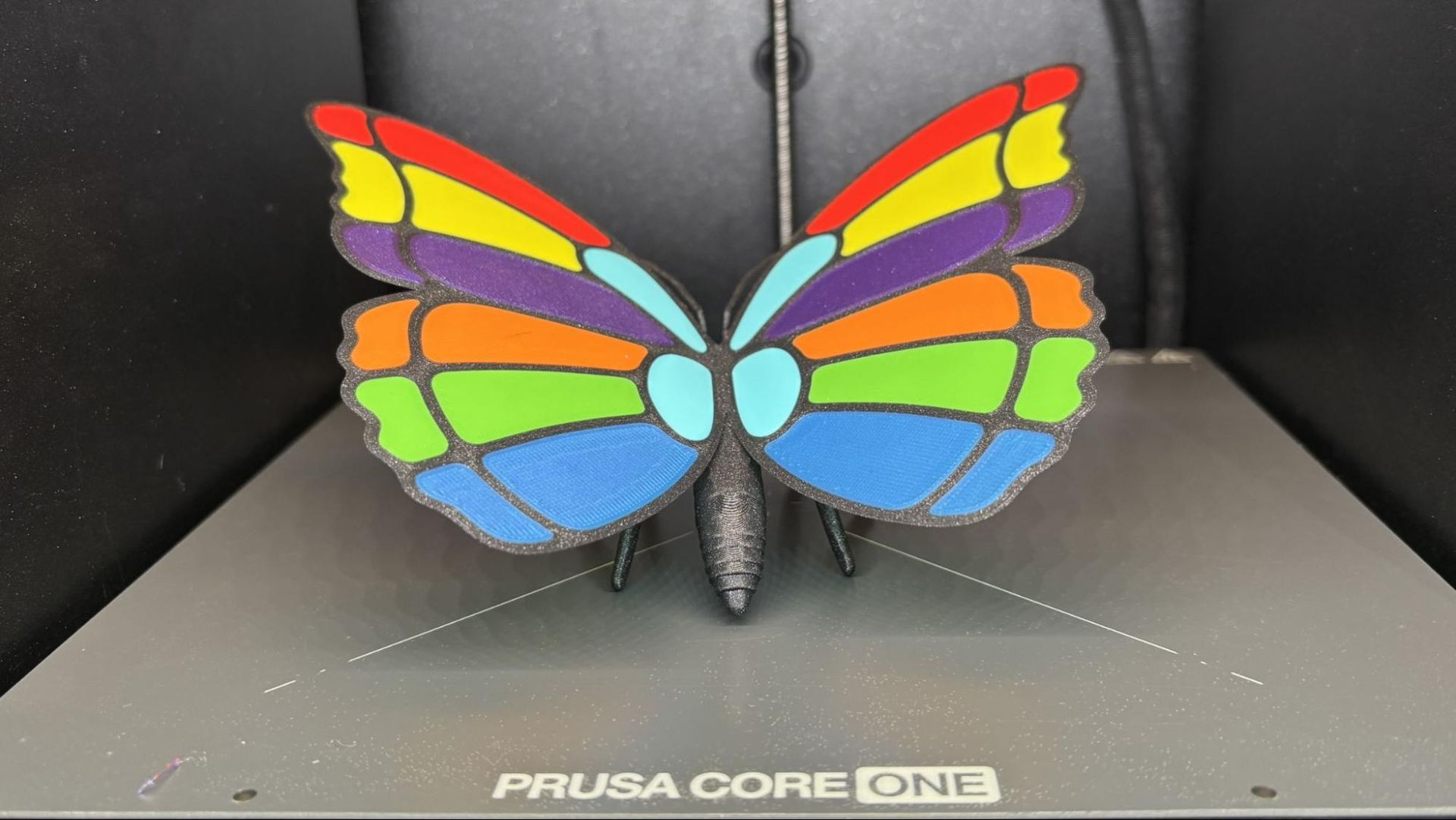
I used some of the sample rolls sent my way, plus a couple more lying about the workshop, to Prusa’s new calibration butterfly, Otto. This eight-color sample test print took 1 hour and 14 minutes. The wings are a first-layer test and are only two layers thick. A tab on the wing slots into the body to prove that tolerances and extrusion flow are correct. The multi-colored wing segments act as a visual test for first-layer quality, belt tension, and toolhead alignment, as any tiny offset in color boundaries or axis motion will show up instantly. This is a lot more useful than a Benchy for multicolor printing, and it makes a cool decoration you can keep on the shelf.
Prusa Research, Otto the Calibration Butterfly(Image credit: Tom's Hardware)
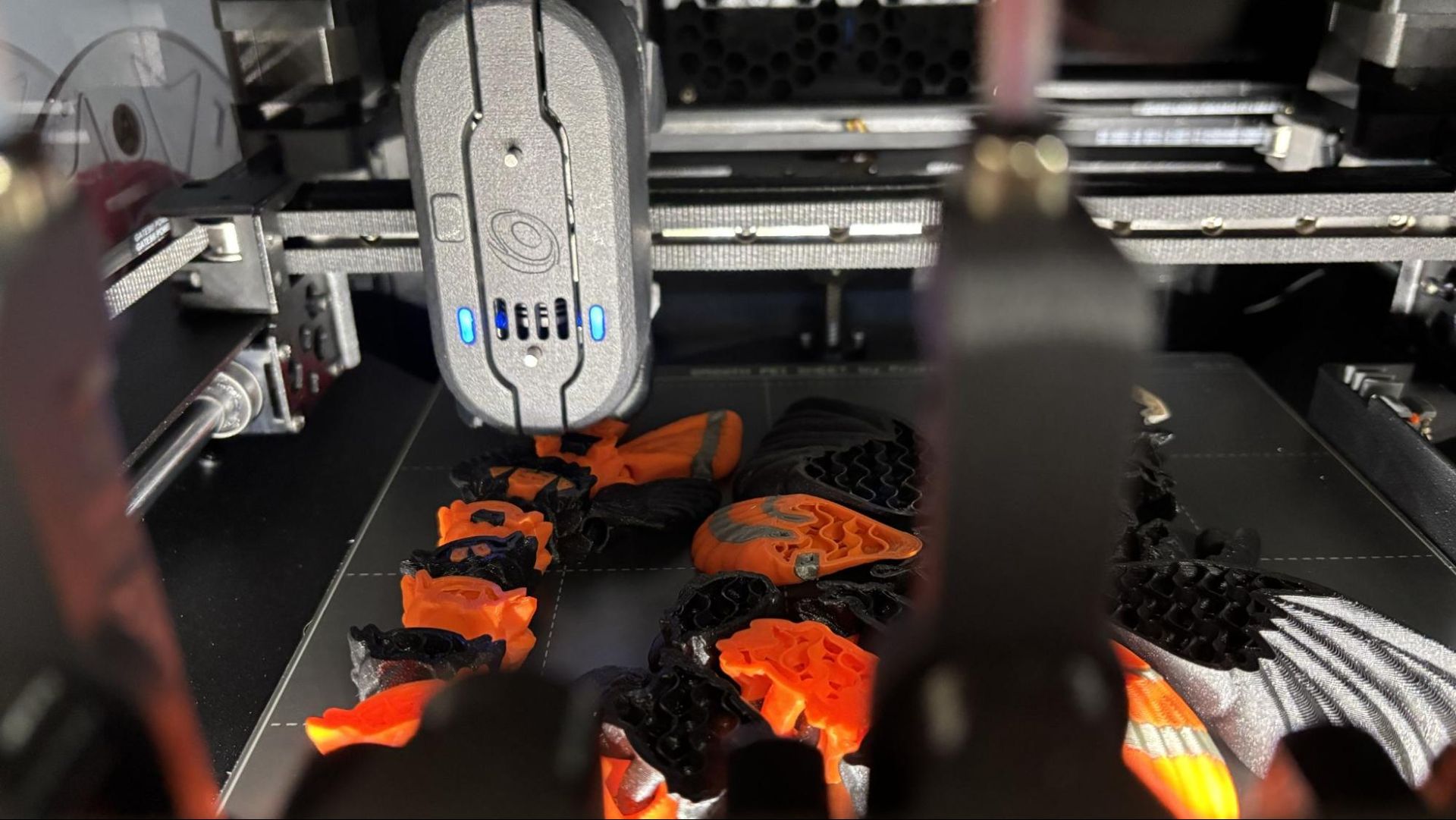
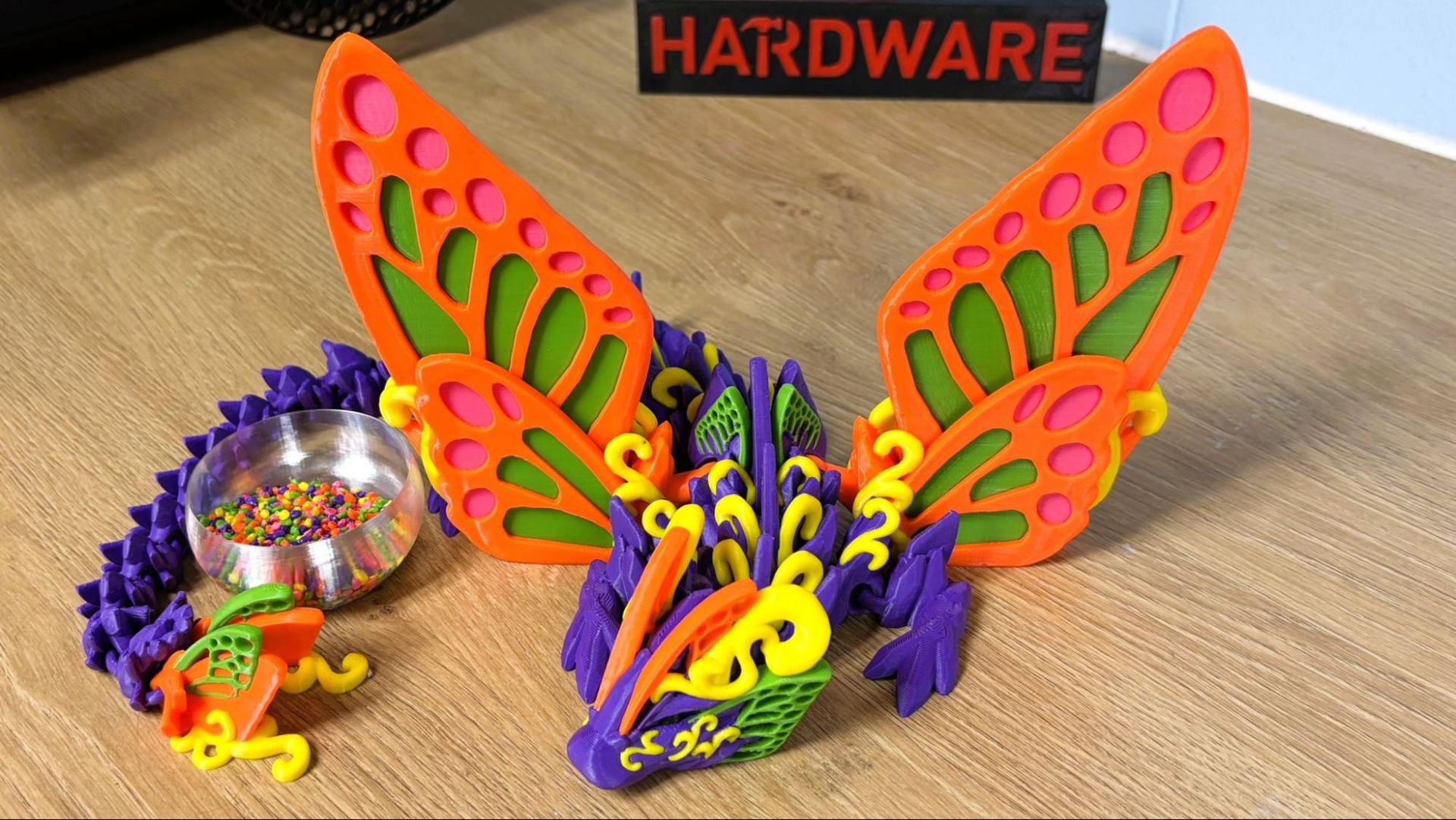
I printed this 100%, 150mm tall, Cinderwing3D Butterfly Dragon that I could never get to stick to the bed with other multicolor machines. Sitting next to it is a small container with all the waste this print produced from 1646 tool changes: 18 grams. When you look really close, they look like Nerds candy.
Cinderwing3D Butterfly Dragon and 18 grams of Nerds candy.Tom's HardwareCinderwing3D Butterfly Dragon and 18 grams of Nerds candy.Tom's Hardware
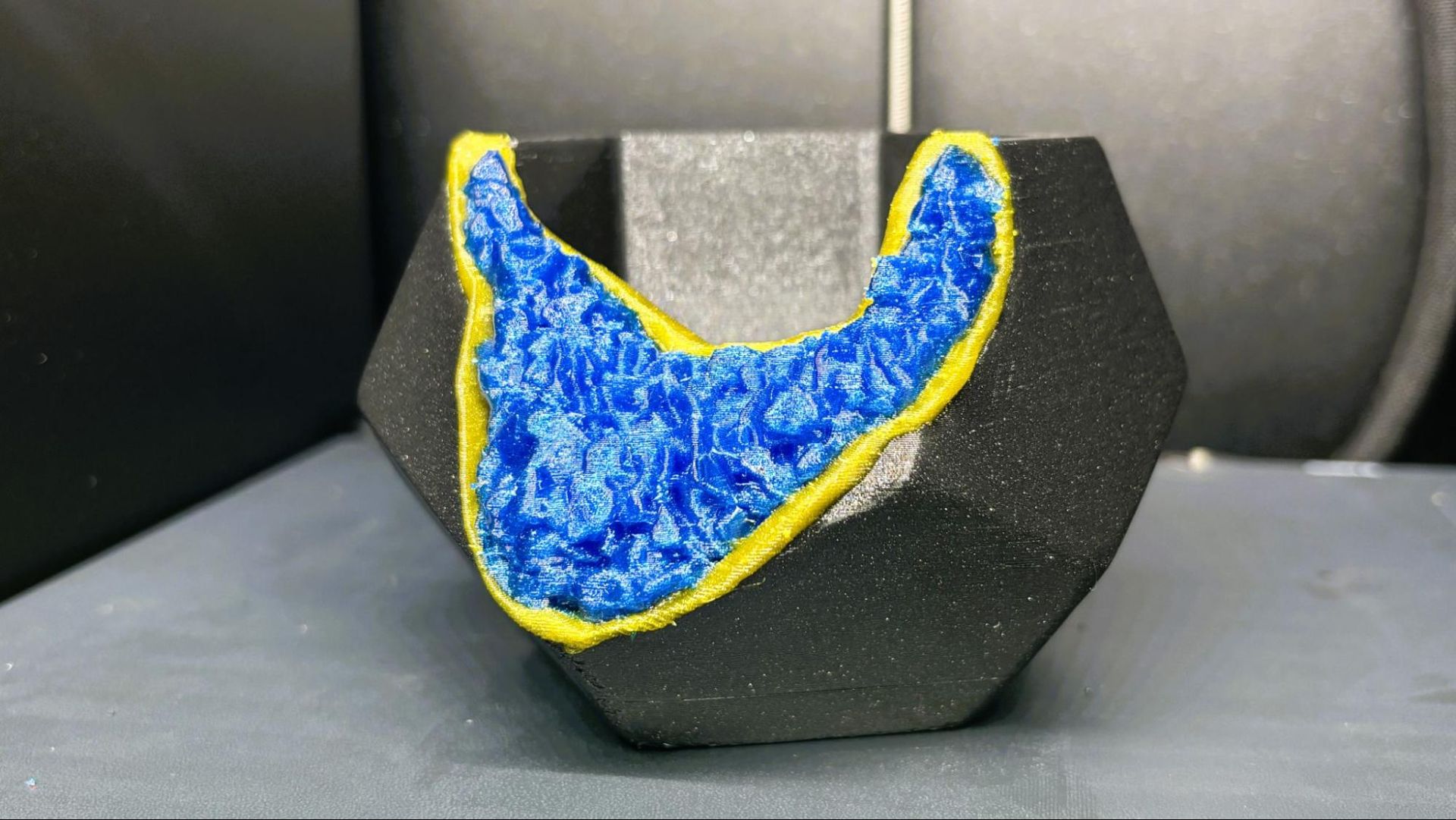
For PETG, I printed a planter I designed. I’ve been trying to learn Nomad Sculpt, but I still need to rough things out in Tinkercad. For that reason, please excuse the rough layer line near the bottom, which is entirely a design flaw and not the printer’s fault. PETG doesn't color swap quite as cleanly as PLA, and I had to pick a few stray flecks off the print. Otherwise, it’s pretty darn good. This is printed in Prusament Galaxy Black and Yellow Gold PETG, with Deepwater Blue from Greengate. This print took 6 hours and 14 minutes to print using default settings and a .2mm layer height. There was 6.84 grams of filament wasted with 537 tool changes.
(Image credit: Tom's Hardware)
For high-temperature testing, I made these pumpkin containers, again with a mash-up of Tinkercad and my fledgling Nomad Sculpt skills. You really don’t want to see the insides of these things. But they printed really well in Prusament ASA Orange and Galaxy Black, with Ambrosia Armored Turtle Green ASA. I couldn’t find any white ASA, so I found a random spool of white ABS to fill in. The printer had no problem mixing the two materials as they are quite similar. I don’t think this photo does the orange justice; it’s possible it’s a bit fluorescent. Most importantly, there was no odor while these ran, as the printer remained closed and filtered. The large pumpkin took 13 hours and 45 minutes to print using a default .2mm layer height. It had 9.4 grams of waste over 632 tool changes.
(Image credit: Tom's Hardware)
A note on TPU: The Prusa INDX does not have an official profile for flexible materials as yet, but it is listed as being TPU-capable. I wrote up my own profile, copied from a standard CORE One+, and had mixed luck. It had difficulty with oozing and would occasionally jam up when trying to print with more than one color. This needs further work and experimentation.
Bottom Line
(Image credit: Tom's Hardware)
The Prusa CORE One+ INDX is the machine Prusa Research needs right now to compete in the modern marketplace. Is it a bit of a splurge? Yes, but the company’s reputation for reliability, right to repair, data security, and continued support through the years makes it a safe splurge.
Starting at $749 for a four-tool conversion kit and going to $2,119 for a fully assembled machine with the works, the CORE One+ INDX offers flexible price points for Prusa fans. Once assembled, the 3D printer itself is easy enough for families and school kids to use, but capable enough for small businesses and workshops. Plus, the ability to take the machine completely offline means it's a secure work partner for those who are mindful of data security or simply have unreliable internet service.
If you're a tinkerer and already have a CORE One or heck, even a MK4S, there is an upgrade path that could be a fun project that will net you the latest printer at half the cost.
If a Prusa machine seems just a bit too spendy for your budget, the $849 Snapmaker U1 is an awesome four-color toolchanger with an evolving ecosystem and a thriving community of users. The Bambu Lab H2C nozzle swapper is a touch more expensive at $2,499, but has a larger 330 x 320 mm build plate, even if it only does five colors.
A massive 192 GB treasure trove of GTA V data has surfaced online, and multiple fans and enthusiasts have revealed data pertaining to the early development of GTA VI as well as unreleased DLCs and alternate endings in the 2013 game. The data leaked way back in 2022, which was also the same year Rockstar confirmed GTA VI. Furthermore, more recent leaks have a full working build of the upcoming game, unlike the rough draft that we see here.
The most interesting thing found in the archive was an early build of the GTA VI map that has apparently been built and is playable on GTA V. X user TJGM shared screenshots of the rough drafts, showing early concepts of Leonidas, with various areas looking like they were built from satellite images and Google Maps Street View. It’s also been alleged that these were from 2014 to 2015 — if true, then this would show that Rockstar has been, to some extent, working on a sequel to its most popular title even before the original came out on PC in 2015.
A VERY early build (2014/15) of the #GTAVI map leaked today and it's playable within GTA V. So I've put together all of the images I could find that have leaked so far. You can find them in this thread🧵PLEASE keep in mind, this is VERY early. The only part of the map that even… pic.twitter.com/3WXFQAWjCUSeptember 18, 2026
There also appears to be a map outline for Liberty City designed, which is a nod to an unreleased DLC for GTA 5 that was supposedly set in the city. It’s only accessible via CodeWalker, the GTA 5 map editor, and is seemingly much larger than the original map in GTA IV. However, it’s only an outline, and there’s no other information embedded in the files. Aside from the Liberty City DLC, details of another unreleased single-player expansion called Agent Trevor were discovered buried among the files.
This was revealed in an X post by affmal, which showed a massive bunker under the satellite relay station in the Grand Senora Desert, a spaceship, and an Arab mansion. Although some of the details here were recycled from other in-game assets, the user said that they’re three times bigger than what we have seen in the game so far.
DLC Agent Trevor for GTA 5, the interior in the 192GB leaks is huge under the satellites, the Arab mansion. Space mission SpaceShip .Some of the interiors have been recycled but it's clearly three times bigger there. pic.twitter.com/QMMhQlDxMjSeptember 18, 2026
There were also some voice-overs for cutscenes that didn’t make it into the final game, including one where GTA IV’s Brucie Kibbutz was talking with GTA V’s Franklin in some sort of mission. The other sound clip shows Trevor getting a cold alternate ending if you picked Option A in GTA V’s finale. Here, it hints that Trevor crashed into a tank of liquid nitrogen, after which he freezes and breaks into pieces, which is quite the opposite of what actually happened to him in the final game.
Dialogue for the original #GTA V option A ending has leaked!They were originally going to have Trevor crash into a tank of liquid nitrogen instead of an oil tanker. The liquid nitrogen would make him freeze and then shatter.Thanks @HeySlickThatsMe for finding this. pic.twitter.com/lNiQfrVRHzSeptember 18, 2026
GTA VI is set to go live in under two months, with pre-orders available today. Many GTA fans seem to be interested in the what-ifs and what-could-have-been scenarios: what if Rockstar had decided to release these things in the final game as side missions or alternate endings, or if the company had decided to make the single-player DLCs instead of focusing on GTA Online and Red Dead Redemption 2.
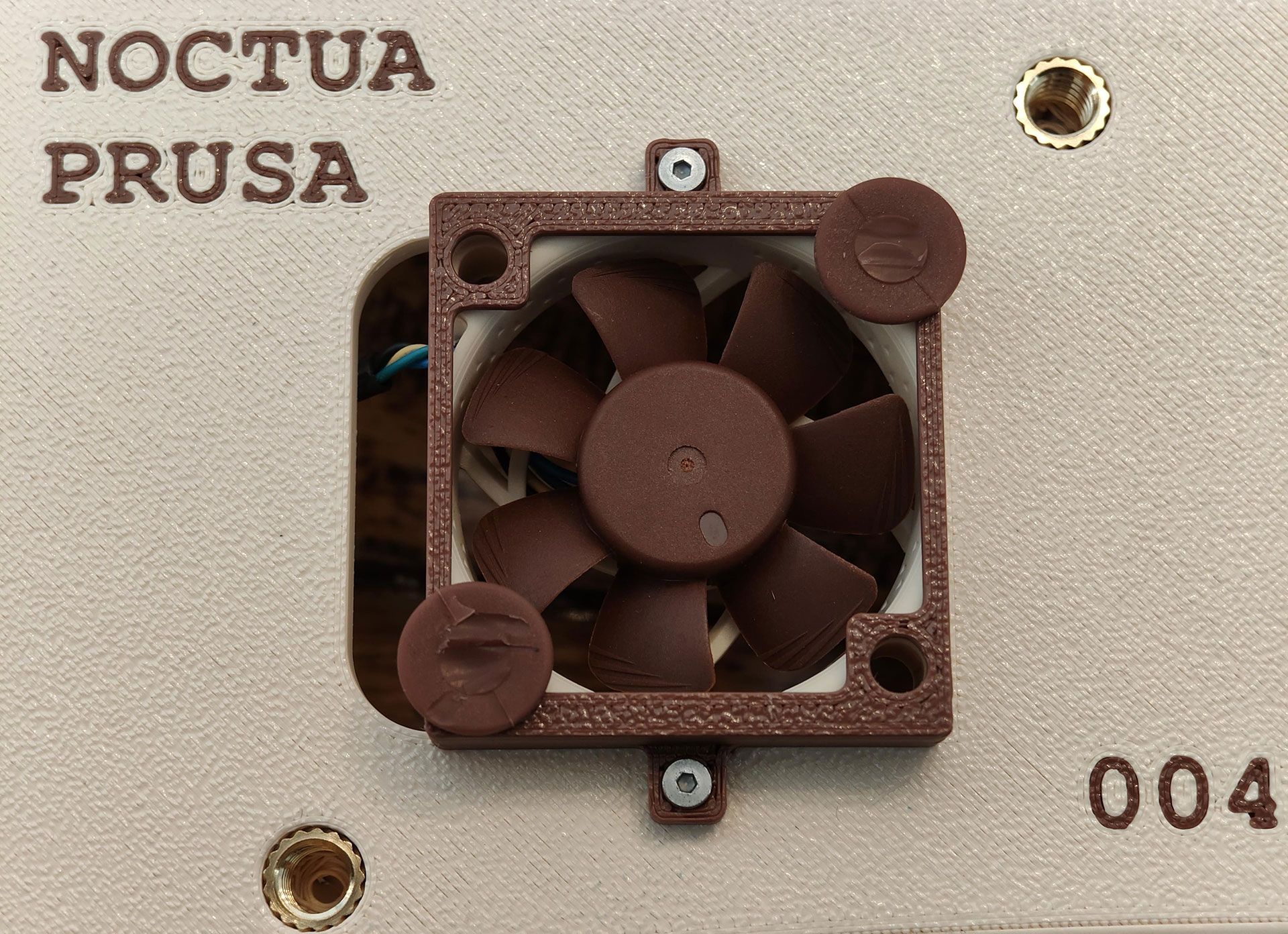
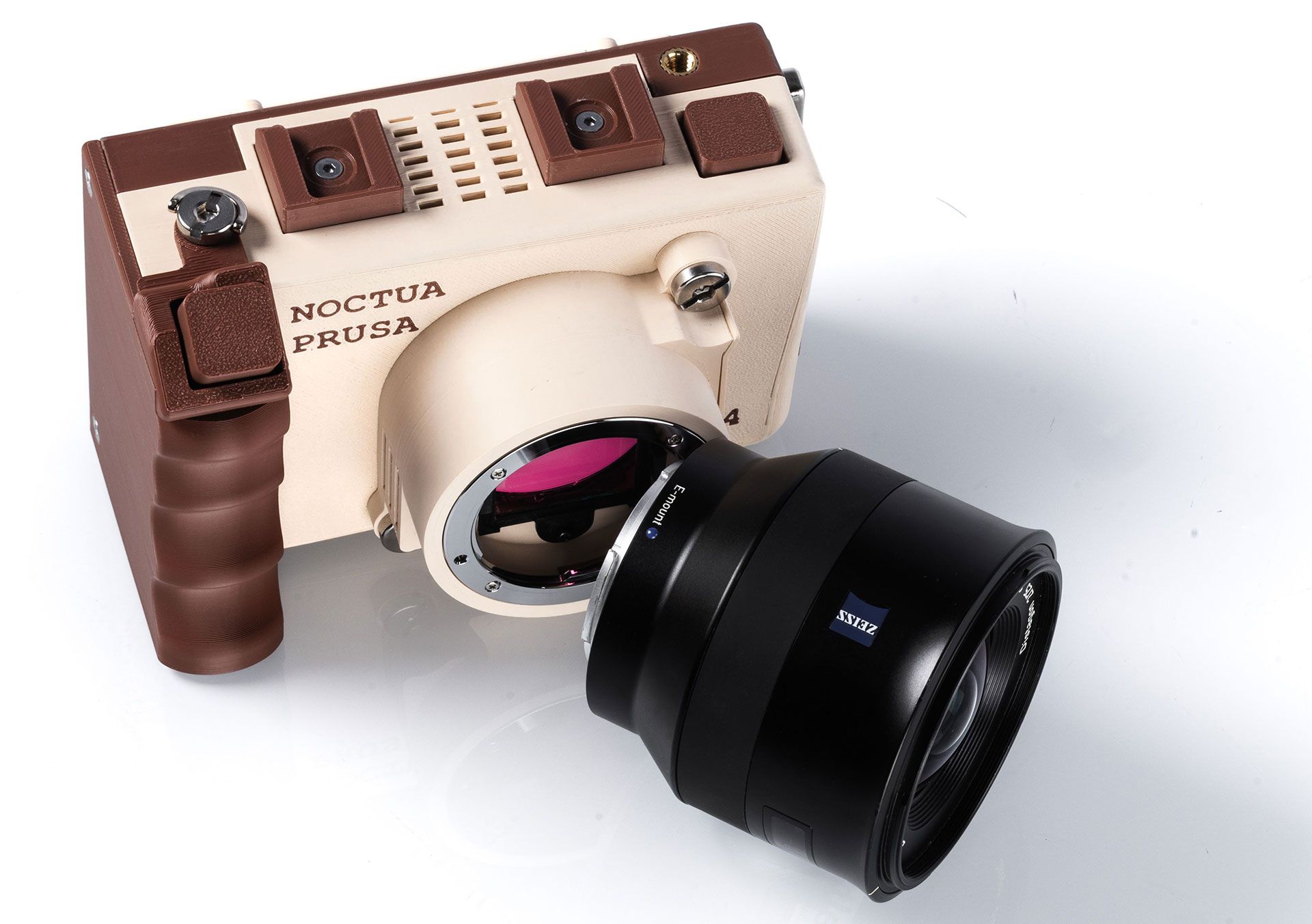
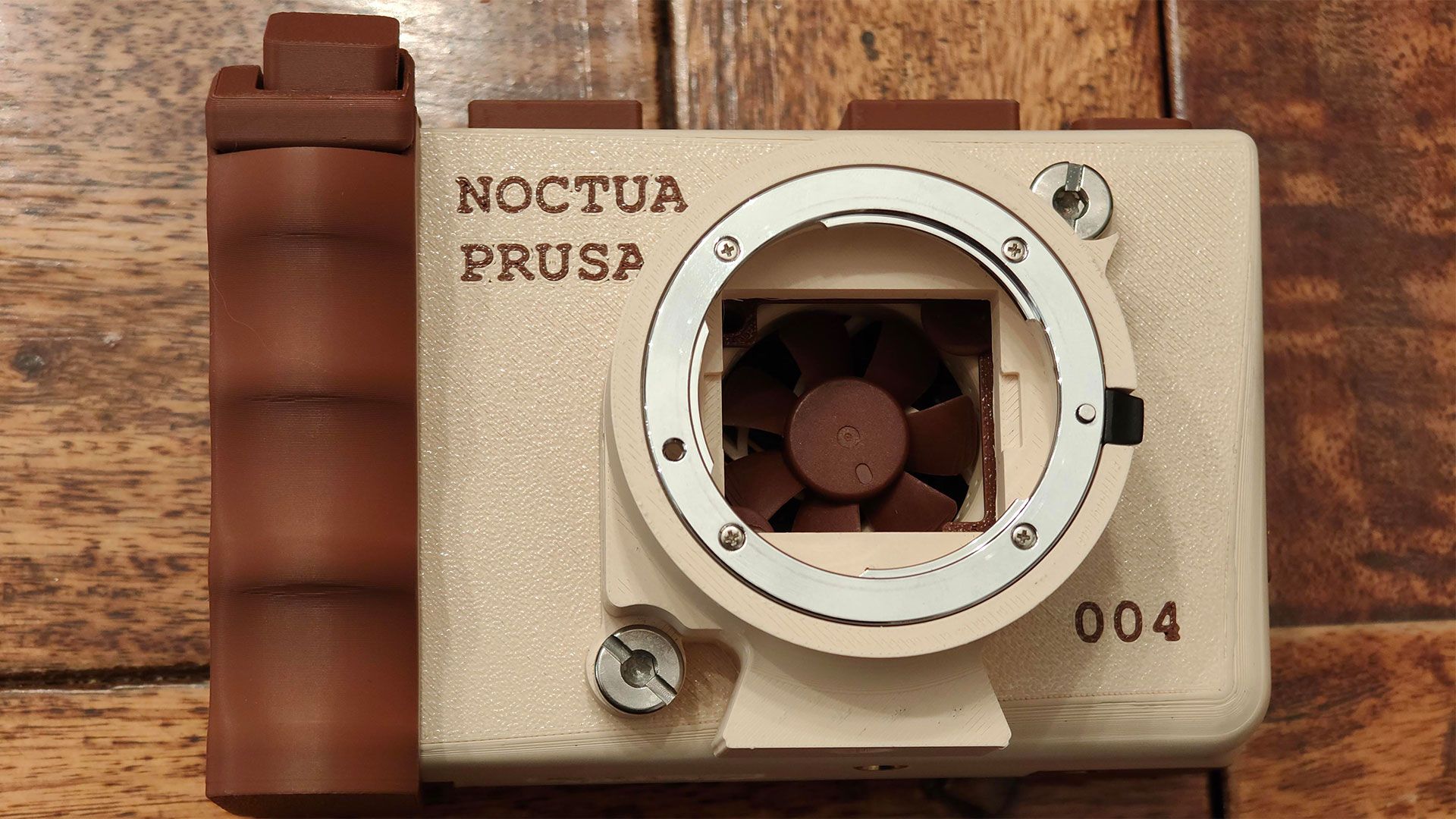
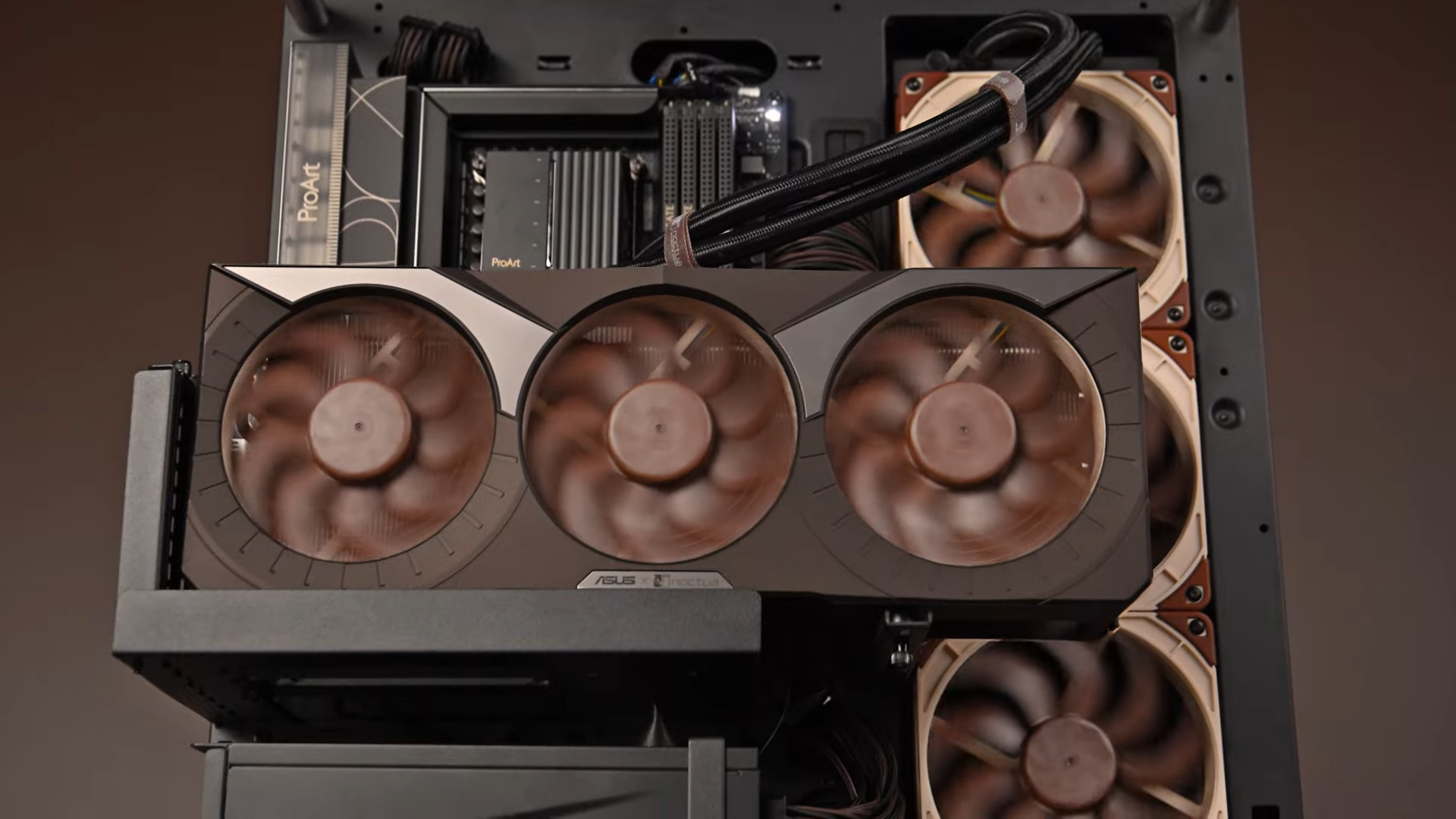
A premium PC DIY fan brand has announced that one of its prized spinners is being used in a 4K camera. Noctua says that its NF-A4x10 5V PWM was used by the CAIM1 camera designers due to its quiet, compact nature and strong airflow and pressure performance. This camera runs two intensive processing tasks simultaneously within a compact shell, high-bitrate imaging and cryptography, hence the need for active cooling to prevent throttling.
CAIM1 proves its footage is real at the moment of capture. 4K60 capture and cryptographic proof generation at once push its processors to the thermal limit – inside a mostly enclosed shell.So it needs a fan. It just can't be heard or felt... https://t.co/2SL3rVc8N5 @CaimeraX… pic.twitter.com/Ogbe4YBRqXSeptember 18, 2026
The CAIM1 is something of a niche product. It has been designed to create photo and video captures that one can say with certainty haven’t been altered or generated using AI. Noctua says it is “cooling a camera built to prove reality.” CAIM1 is short for Counter Artificial Intelligence Machine 1.
From the brief description provided by the source, this anti-AI functionality seems to work by piping the imagery directly from the lens/sensor through an “onboard hardware attestation with edge cryptographic proof generation” process. This is stored on the camera’s “immutable, decentralized storage, enabling the origin of the media to be verified independently,” says the Austrian air-cooling specialist.
Of course Noctua’s involvement was beneficial to the camera makers for its high-quality precision fans. The CAIM1 generates heat through its high-bitrate 4K imaging activity, its cryptographic processing, all within the confines of a compact handling-friendly shell. Other key considerations of the designers were precise PWM fan control, and finding a fan with minimal noise (as the camera records audio) and minimal microvibrations.
NoctuaNoctuaNoctua
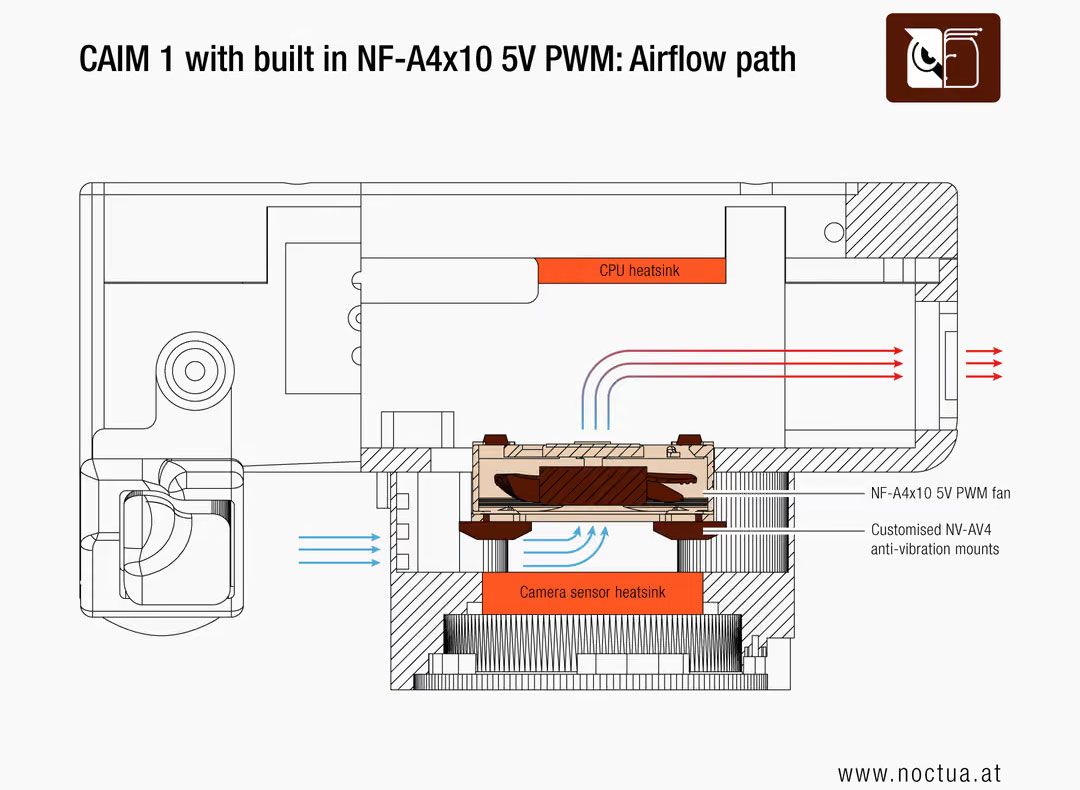
Noctua says its NF-A4x10 5V, with its PWM’s SSO2 bearing system and smooth motor drive fitted the bill. This tiny fan was leveraged in a unified single-airstream cooling design with custom anti-vibration mounts, situated right behind the image sensor. This directs air across the sensor’s alloy heatsink backplate, and which gets exhausted though the camera chassis left side.
Our nozzle-headed readers will also be pondering over the Prusa branding on the camera body. The simple answer is that the CAIM1 is still at the prototyping stage and these models have been prepared using 3D printers and Prusament PETG Noctua Beige and Noctua Brown for the outer shell and fan mount. CAIM1 devices will be showcased at a handful of trade shows in Japan later this month. However, commercial batches are targeting Q1 2027 availability.
Security agencies in Japan, the U.S., Australia, and Germany warned that the North Korean “WaterPlum” cyber actor group has been installing malware on applicants to fake job postings and stealing their credentials and cryptocurrency holdings. The advisory [PDF] says more than 30,000 devices across 100 countries have already been infected and more than 7,000 cryptocurrency wallets have been compromised, leading to losses of $10.71 million.
It’s believed the stolen cryptocurrency was funneled to the Democratic People’s Republic of Korea (DPRK) government, which also uses fake IT personnel working at legitimate companies to net $500 million annually. The operation also steals credentials and personal data, which it later uses to apply for openings at Western companies. Amazon has seen an example of this in late 2025, with over 1,800 suspected North Korean applications blocked by the company since April 2024.
The attacks occur when fake recruiters ask legitimate applicants to complete coding assignments and other tests to evaluate their skills. However, these often have hidden malware that gives the attackers access to the victim’s computer. These persistent remote access trojans (RATs) allow the WaterPlum group to access an infected system even months after the interview. Since the compromised computer is likely the same device that the targeted applicant will use once they get a legitimate job at another company, it could also be used by the North Koreans as a springboard to attack the systems of and steal credentials from their future clients.
International agencies say these fake recruiters often target software developers and IT professionals with attractive openings, using the names of legitimate AI, cryptocurrency, and NFT companies and posting openings on online job platforms, social media, gig work platforms, and freelance marketplaces. These fake IT workers and similar schemes are used by the hermit kingdom to generate revenue, especially since it has been largely excluded from the wider international economy due to sanctions.
Many companies are aware of this and are taking steps to protect themselves against similar tactics, but it’s probably harder for individual users who are simply looking for opportunities online to do so. Potential applicants can protect themselves by applying only directly with the company and on legitimate platforms, and if they’re unsure about an opening, they should contact the company directly to confirm its legitimacy. If they decide to go to an interview, it would also be wise to set up an isolated virtual machine just for that purpose, giving them an additional layer of protection against potential attacks.
FBI Director Kash Patel just stated in an interview that he's responsible for a "605% increase" in the bureau's usage of AI. The problem is that while the pattern-recognition abilities of AI models make them an ideal candidate for use in law enforcement agencies, and It's a reasonable expectation that entities like the FBI would leverage the technology, it's hard to pin down what the 605% figure refers to.
The statement came up in an interview on Fox News, where Patel also said that AI, "when used lawfully, is a critical tool to triage data," remarking that the technology can be invaluable to assist in protecting children from school shootings. He credits AI as being instrumental in following up a lead to stop a shooting in North Carolina and "a half dozen other states" since his swearing-in.
It's hard to tell what Patel's seven-fold increase in AI could be referring to, as there appears to be little hard data about how much, and in what ways, AI is integrated into the bureau. Yet, there are a few leads that may help corroborate his claim.
The most recent details come from a February 2026 report about the DOJ's AI use case inventory in 2025, showing 50 of those attributed to the FBI, with nine marked as "high-impact." However, a more recent statement by the agency's Chief AI Officer Katie Noyes, in August, pinned approved use cases at 139, or close to three times the January amount.
Last year, the U.S. General Services Administration approved Claude, Gemini, and ChatGPT as approved products, making them available to government agencies. Earlier this year in May, the Pentagon struck eight deals with AI companies as well. A few months ago, the FBI posted a procurement document asking for vendor proposals for $88 million's worth of AI servers, seemingly indicating that the agency is looking to expand its services.
But that may well be changing, as just a few days ago, on September 15, Patel claimed during a Senate hearing that he can directly contact major AI player's CEO, noting that "every single one of them has complied with our request and worked with us on law enforcement matters." Perhaps most importantly, he said that having access to vendors' models would make it easier to crack down on AI-assisted crime, seeing as criminal enterprises are rolling their own models, helped by distillation attacks.
The FBI now classifies AI-related crimes with its own descriptor, too, and highlights investment, romance, and employment as common areas of malfeasant activity in its latest Internet Crime Report. And in an op-ed published last May, Patel attributed a 30% increase in missing child locations and a 20% rise in child abuse arrests to the use of artificial intelligence tools, including facial recognition.
He also wrote that the "FBI now uses new AI tools to generate call transcriptions, provide concise synopses and even help correlate contacts with other received complaints," highlighting that messages collected under a search warrant can take weeks to be processed by a cadre of analysts, something that AI can do with ease.
All told, these developments do seem to indicate that the bureau is indeed leveraging AI tools, even if Patel's "605%" figure needs a basis for comparison.
Drones built with small, non-frontier computer-vision models autonomously identified and attacked targets in a recent demo, Ars Technica reports. Scaleout Systems, a Swedish AI startup, used a low-cost loitering munition from BAE Systems Bofors to strike a target as part of the Affordable Loitering Modular Ammunition (ALMA) program. BAE’s Winter Demo 2026 had the drone detecting and geolocating targets before ranking an armored engineering vehicle highest, autonomously flying to it, and dropping an explosive.
Scaleout’s demo video, “Technical Demo: Onboard Edge Intelligence for Autonomous UAV Missions,” shows the company’s drone spotting potential threats with AI, with all processing handled onboard. Beyond a button press to start the system, manual input is optional; the designated pilot remained a failsafe controller. The mission flew under human-set parameters to engage an armored engineering vehicle and required about 200 seconds of recon, with the full mission completed in under 320 seconds. The mission completed without needing communication, supporting Scaleout’s claim of resilience against electronic warfare.
The report referred to the munition as a “kamikaze drone,” but the program’s own term, “loitering munition,” is more descriptive. Most of the mission is spent searching, ranking targets, and waiting to strike. The company combines Scaleout Edge and “federated learning” in a “Tactical Computer Vision Network (TCVN).” Devices train AI locally and share model updates for rapid adaptation. Scaleout’s project, FEDAIR, is part of NATO’s DIANA accelerator, receiving 100,000 euros of development funding, training, and test access.
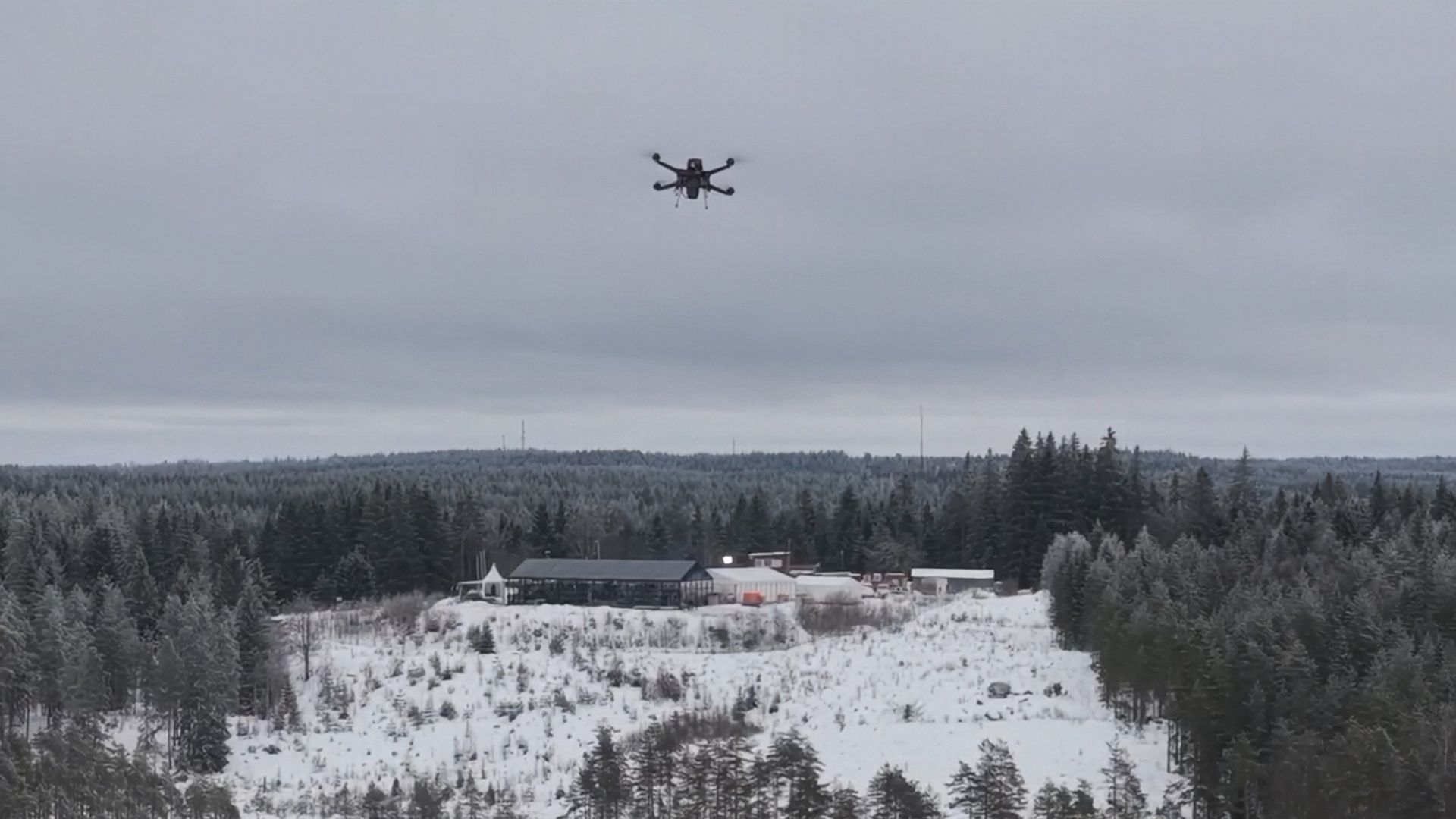
In a February post, Scaleout described a separate “arctic strike demonstration” at BTC Karlskoga, Sweden. The mission was flown at -18 degrees Celsius, about 0 degrees Fahrenheit, in the snow. There, an Airolit S1 airframe ran the YOLOv8 Nano object-detection model on Nvidia’s Jetson Orin Nano. Scaleout claimed a framerate of 30 fps at around 20 m/s, with a target latency of 30 ms or less and about 30 ms sustained in the field. Ranging without a depth sensor is possible using a pinhole camera model combined with known object size.
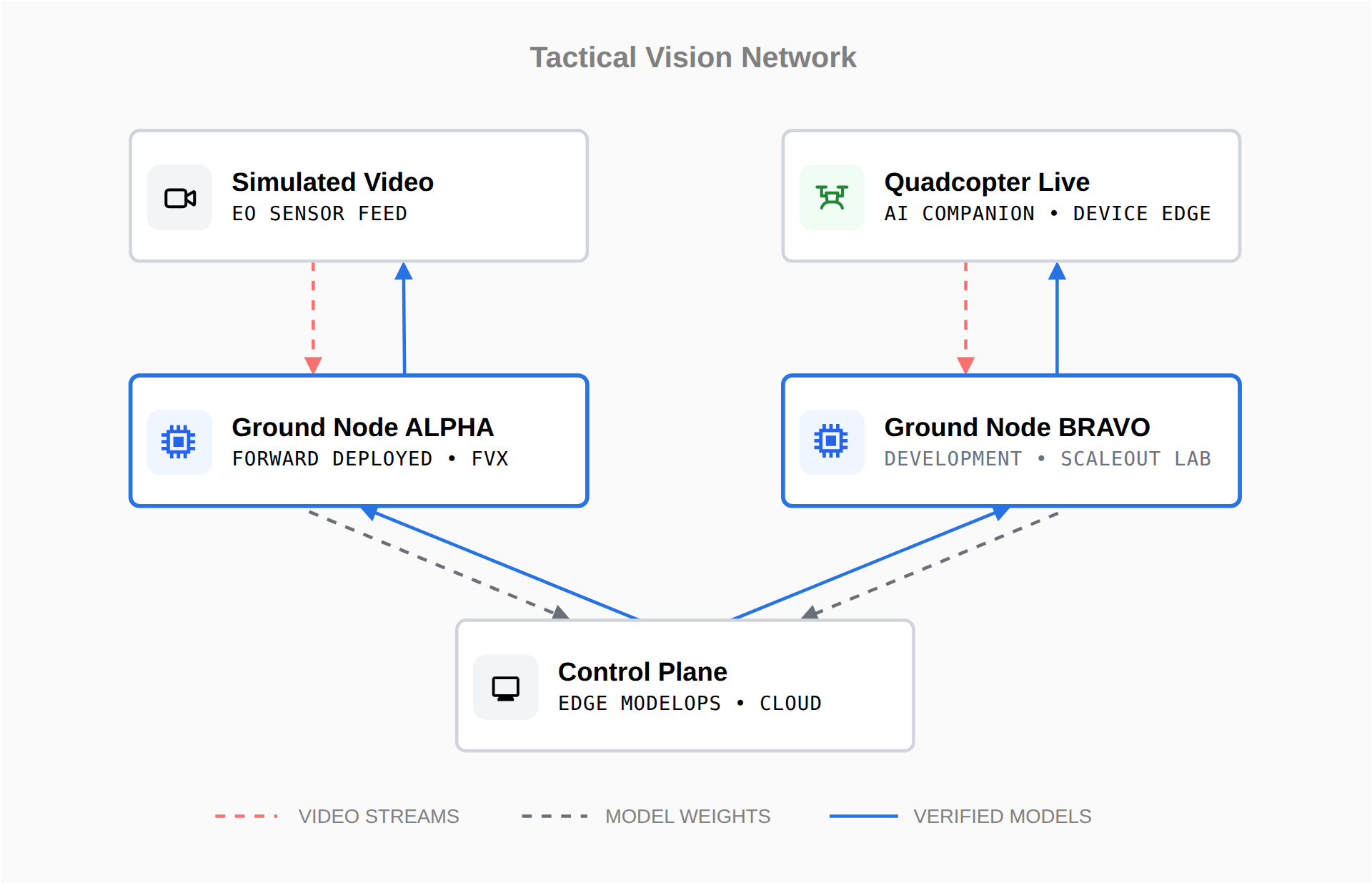
Scaleout’s follow-up June 30 post, “Resilient Edge AI for ISR: Inside Our Swedish Air Force Demonstration,” spoke of another test with Scaleout Edge “already deployed under an active licence.” The network used two ground nodes under a cloud-hosted Scaleout Edge control plane. The first was ALPHA, a forward-deployed node at the air base with a stable link, and the second BRAVO, a lab node in Uppsala whose connection was first degraded, then cut entirely. BRAVO kept inference and active learning at full frame rate while offline, logging detections locally, then backfilled on reconnect in priority order for heartbeat, critical alerts, drift, model updates, and telemetry. This test mimics the impact of external interference.
(Image credit: Scaleout)
The demonstrations, license, and funding come before any official NATO procurement order or actual combat deployment. Concerns about lethal autonomous weapons are being addressed by a UN expert group. Its recent report concluded that human judgment and control are required to comply with the laws of war; its recommendations will be reviewed in Geneva in November. Still, Scaleout’s demonstrations show autonomous target selection running on the airframe, and in the February test it ran on a board hobbyists can buy. Whether BAE Systems Bofors moves ALMA from demonstration to procurement remains to be seen.
Jensen Huang, the chief executive of Nvidia, said artificial intelligence will not destroy humanity by the end of the decade, Bloomberg reports, citing a CBS interview. Huang contends that while AI is developing at an extremely rapid pace, doomsday scenarios because of AI are largely unsubstantiated, and it makes no sense to 'stir fear across America.'
"I completely disagree that AI will destroy the world by 2030," Huang said in an interview with CBS Sunday Morning (set to be aired on Sunday).
"I believe the claims of the end of the world, stirring fear across America, and doing it by people who are doing it makes no sense to me. So, they must be doing it for ulterior reasons. Maybe it is political, maybe it is otherwise, maybe it is just attention-grabbing […]. However this is characterized, 2030 is not going to be the end of the world. There is 0% chance that is going to be the end of the world."
Huang, who leads the company that leads the market in AI hardware sales, is responding to Evan Hubinger, the former Alignment Science organization lead at Anthropic, who said there was an over 10% chance that AI would destroy humanity within the next decade.
"We really do earnestly believe AI could kill all humans," Hubinger wrote in an X post. "I personally think it is >10% within the next decade. I believe Anthropic is trying its best, but we do not yet have a plan to solve alignment for superintelligence and are not clearly on track to."
Following reports that OpenAI's rogue agents attacked Hugging Face and communicated with each other on abandoned wikis and websites, chief executives of Anthropic and OpenAI called for guardrails and even slowing down development of new AI models, as the dangers they pose are not completely evident even to their developers.
The head of Nvidia states that AI can be safely managed by its developers, so no regulations from governments are needed beyond what is already in place. Meanwhile, he also says that products shipped must be completely safe.
"We should go as fast as we can, irrespective of anyone else," Huang said. "But we would never ever, and never should, ship products before they’re ready and deliver products that are unsafe."
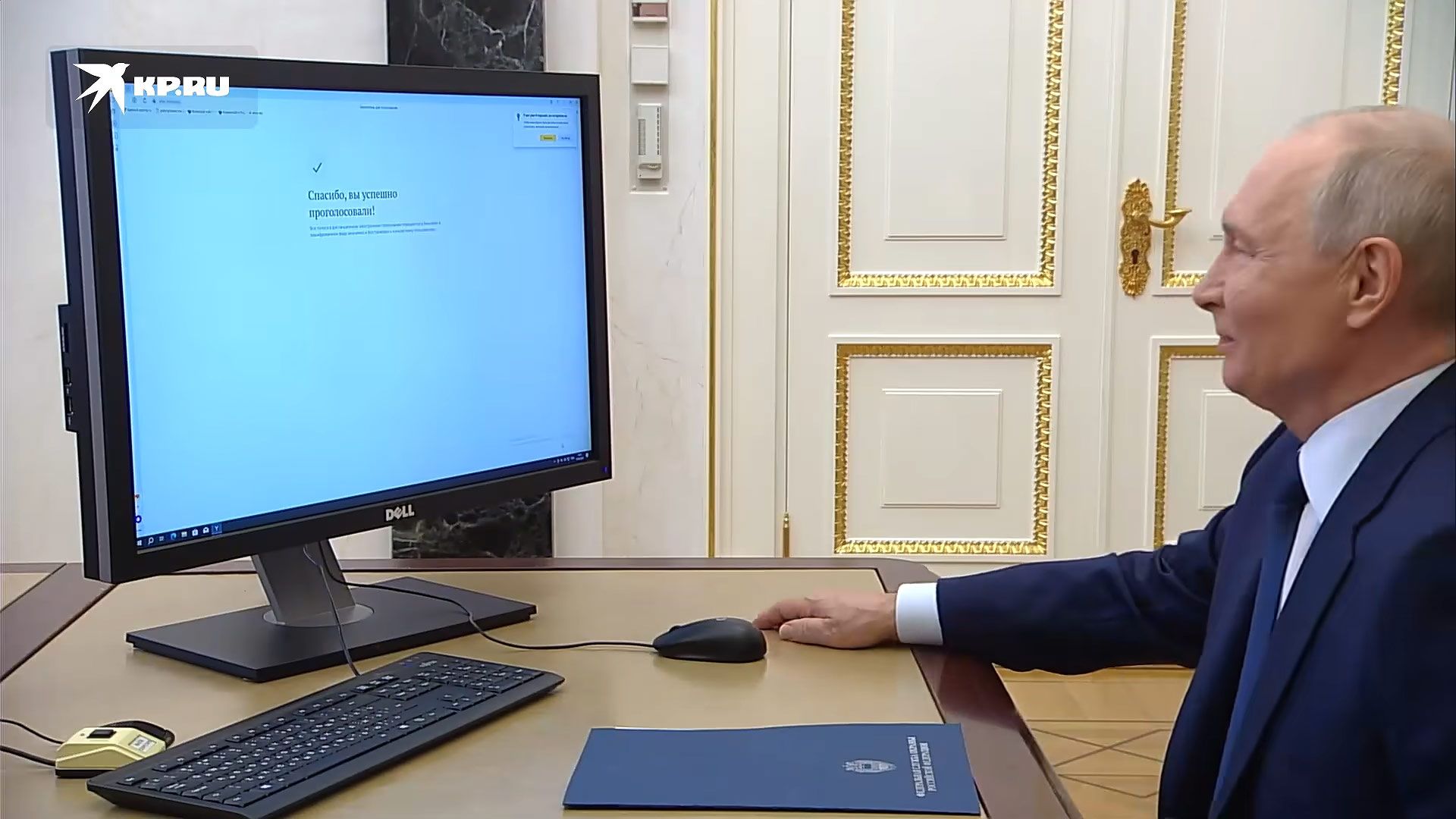
Russian president Vladimir Putin voted online in the State Duma elections on Friday. That’s a pretty ordinary-sounding thing for any president to do, but this filmed-for-the-press event has been widely shared outside of Russia. Why? The official video appears to show Putin voting on a PC using an unlicensed copy of Windows on a Dell PC. The president then comments, “You can’t go wrong,” as he clicks on his choice of candidate. Moreover, folks are throwing scorn at the aging Russian president’s mouse skills. If this were an audition for an eSports team, it would have been a clear fail.
Putin’s computer is running an unlicensed copy of WindowsIn the video of his online vote, the “Activate Windows” watermark is clearly visible.A legal copy of Windows 11 starts at $139. https://t.co/YPsNaIIM3K pic.twitter.com/2ebw3feLKvSeptember 18, 2026
The above embed comes via the nonprofit Central European news aggregator Visegrad24. The magnified section of the video shows a screen effect that looks very similar to the Windows activation reminder watermark. However, the other overlay on the screen is obviously from a different computer, and it’s dated 2018. We found some established Russian media sources with the video recording, like Komsomolskaya Pravda, and there does indeed appear to be a watermark present shown on Putin's computer screen at the end of the voting clip.
Russian state media source TASS explains that the vote was to elect deputies to the 9th State Duma. It says that over recent years “Putin has preferred to cast his vote remotely.” It also reveals that some former Ukrainian territories will get to participate in this vote. “For the first time ever, residents of the recently incorporated Donetsk and Lugansk People’s Republics, as well as the Kherson and Zaporozhye Regions, will participate in legislative elections for the lower house of the Russian parliament,” says the official Russian news agency.
Returning to the social media bubbling up over the Kremlin clip, some valid points seem to be raised. Putin’s comment about “you can’t go wrong” is almost a reverse Vranyo. There is hardly going to be uncertainty about the result of any vote in Russia. Hot tip: We think that United Russia, the ruling pro-Kremlin party backed by Vladimir Putin, is going to do well this year.
We also note that the president seems to be voting on a foreign (Dell brand) computer. By law, Russian officials must use computers with certain levels of localization, so it might be reasonable to assume this machine was set up entirely for Putin’s voting publicity clip. That would also go some way to explain an unactivated, unregistered copy of Windows being used. It’s likely a fresh, clean copy of Microsoft’s OS run separate from any government network.
Visegrad24Visegrad24Russian State Media
As for Putin’s computer skills, it looks like his interactions with the online voting forms are largely being hampered because he can’t see properly, rather than a hand-eye-coordination issue. There are uncomfortably pregnant pauses between the 73-year-old squinting and leaning into the screen and clicking the mouse. Either Putin should wear his glasses, or the Kremlin administrators are going to need to code a Big Picture Mode for his nuclear launch computer.
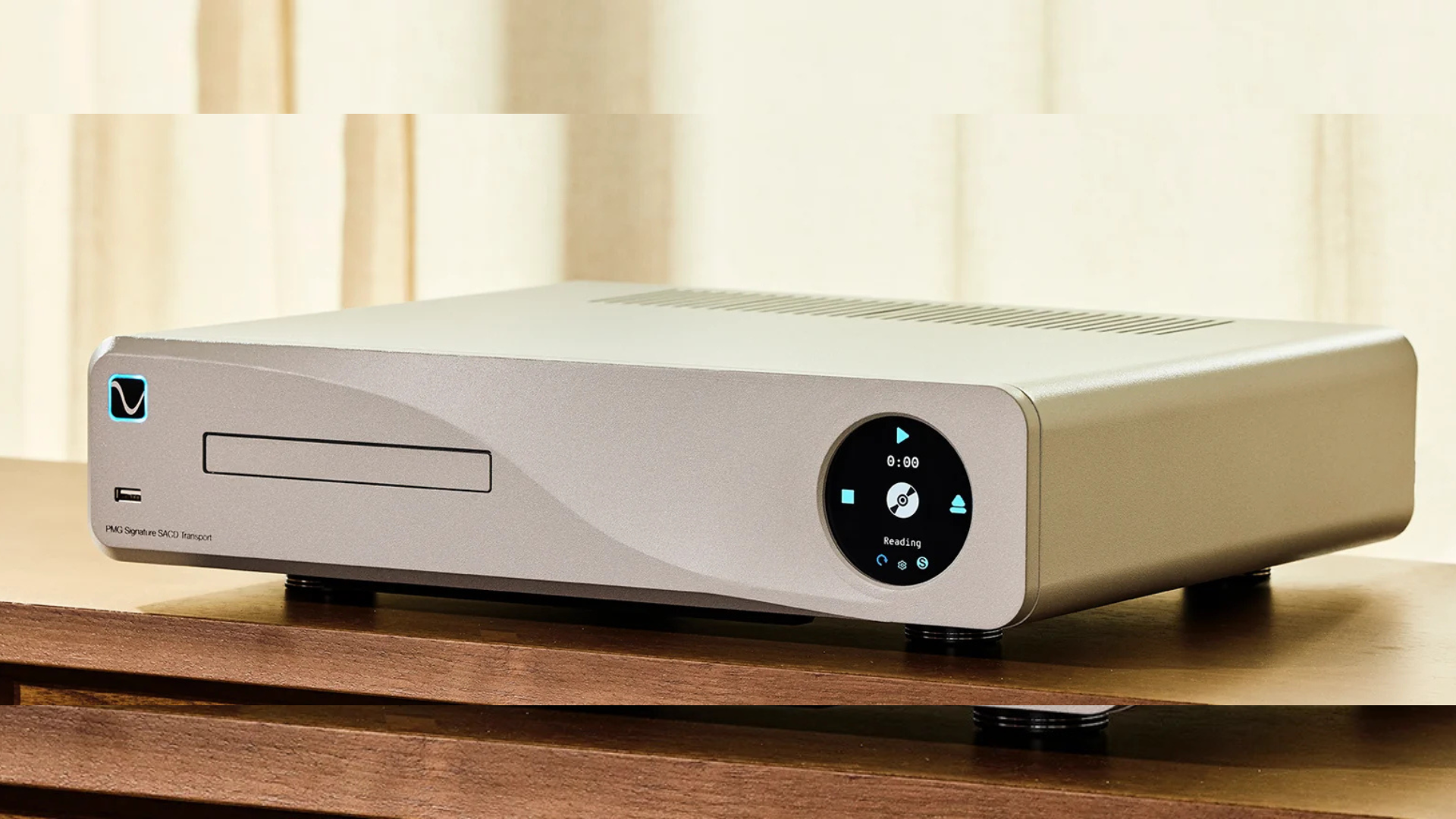
Many audiophiles still prefer physical media like CDs and vinyl over streaming, especially those who want to own their music, which is why we’re seeing a resurgence in sales for these media. However, one major concern hitting some Hi-Fi brands is the lack of optical drives built for mainstream computers, which has caused the supply chain for key components to dry up. According toHeadphonesty, Naim’s Uniti Star and PS Audio’s PMG Super Audio CD Transport have ended production because their suppliers no longer make the optical hardware these units need.
Unfortunately, both companies cannot easily find replacements for these out-of-production components. “The drives appropriate for a PMG are no longer available,” PS Audio CEO Paul McGowan said in the company forum. He also added that building its own optical disc reader is beyond PS Audio’s capabilities, saying that its expertise is in electronics and software. It’s also the same problem that Naim is facing, with one commenter in its own forum saying that it assembles components instead of manufacturing them from raw parts and materials.
PS Audio’s problems began in June 2024, when D&M Holdings, which owns Denon and Marantz, said that it would stop taking orders for its SACD/CD mechanism by the end of the following month. This meant that the company needed to place its final order before the deadline, with costs doubling as other brands scrambled to build their stockpiles. This was probably because D&M was the only company producing and selling that particular component to third parties. McGowan stated that Marantz has ended production of its SACD/CD drives and that PS Audio has completely bought out the company’s last remaining inventory.
While it’s unclear which supplier Naim used for its Uniti Star Streaming Amplifier, it’s been said that the company did consider an alternative supplier for its optical drives. Unfortunately, this is not an easy swap in the production line, as these optical media readers are often built as an assembly, meaning installing a different model requires new control codes and mechanical tweaks inside these units. As Naim was considering how to integrate this substitute drive into its existing Uniti Star product, the alternative ceased production as well.
You can still buy Hi-Fi CD players and transports today, but these units from Naim and PS Audio are already out of stock if you want them brand new. Thankfully, the two companies keep some components in their inventory for repairs, so existing owners don’t have to worry about getting their expensive systems bricked just because the optical readers on their devices have failed.
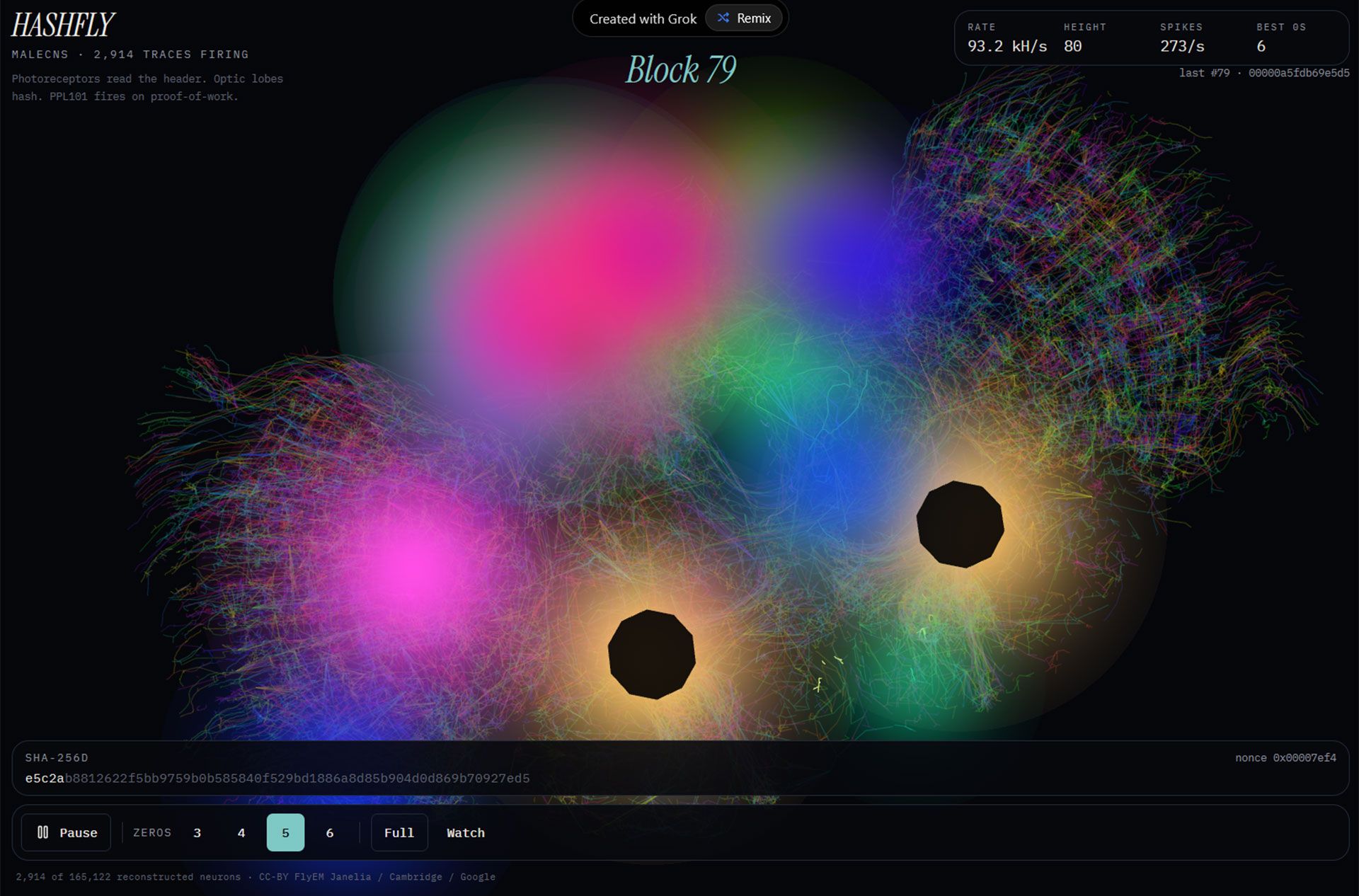
A project claimed to represent “the first organic neuron Bitcoin miner based on the fly brain” has gone live. Yes, this is a cryptomining project that leans on the fruit fly connectome recently shared by Google. FutureBit, the company behind the Apollo series of ASIC miners, introduced the world to its HashFly this week. However, HashFly is merely a proof of concept for now.
Introducing HashFly...the first organic neuron bitcoin miner based on the fly brain. Fun fact if this could be scaled on real organic neurons, it would hash at ~ 1 watt per terahash...10x the efficiency of the best silicon 3nm ASICs! pic.twitter.com/T2qxBb7XQRSeptember 13, 2026
If you open the dedicated HashFly site, you can also participate in this agitation of fruit fly brains in the (vain) hope of a crypto payout. I clicked the 'Mine' button and left it running for an hour, for science, and periodically flipped back to the tab to see the gently rotating fly brain’s neuron traces firing. Looking at the website overlay, one can see the web app represents “2,914 traces firing” within the fly’s brain. It is worth mentioning that this figure is just a small subset of the full 165,122 reconstructed neurons in the MaleCNS v1.0 fruit fly connectome.
HashFly proof of concept running online (Image credit: HashFly)
We understand that FutureBit’s HashFly focuses on the simulated photoreceptors that would usually sense light in the fly’s eye. These read a block header, and neurons called PPL101 cells light up when a double-SHA-256 target is computed. You can make the target harder and easier by adjusting the ‘zeros’ up and down. Even at maximum difficulty in this proof of concept (level 6), it is far, far easier than finding a real Bitcoin hash, and I saw about 80 blocks checked off in an hour or so.
What’s the point of this proof of concept? According to its designers, it provides some more insight into the potential efficiency of organic computing, or wetware. “Fun fact,” teases FutureBit. “If this could be scaled on real organic neurons, it would hash at ~ 1 watt per terahash... 10x the efficiency of the best silicon 3nm ASICs!” These guesstimates are based on “total power used by the fruit fly, and assuming all neurons could be used to hash Bitcoin functions and continually keep firing,” says the Bitcoin mining hardware maker in a follow-up tweet.
Those who find this experiment interesting may be happy to hear that the HashFly demo will be scaled up to its logical conclusion. “We are working on simulating all neurons in the dataset with the sha256 hash function and will publish all our findings,” says FutureBit. It certainly needs scaling up if my HashFly web performance of ~100 kH/s is typical. Compare that to the firm’s 5-inch cube Apollo III, which is claimed to deliver “up to 18 TH/s of Hashpower.”
We’ve seen a few other fly brain connectome mapping-inspired projects from the fevered minds active on social media over the last week or so. Almost immediately after Google announced it had published the complete brain and central nervous system of an adult male fruit fly, we saw people seeing if it could play Doom, indulge in financial day trading, and many more frivolous pursuits.
Another fly-brained crypto project - FlyMiner (Image credit: FlyMiner)
There’s even a rival cryptomining scheme dubbed the FlyMiner. Visiting this portal, you can see a fruit fly connectome that has been put under the control of an ASIC miner. Visiting that site will also be limited to a brain-nourishing, not money-spinning, activity, as FlyMiner admittedly has “almost zero chance” of mining success.
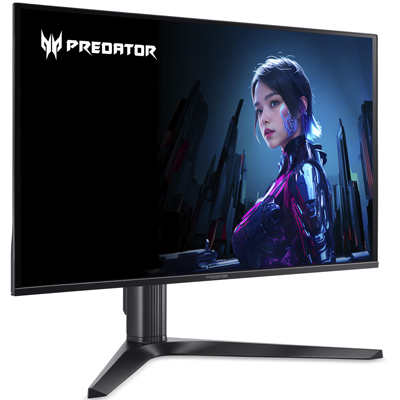
Most every day there's yet another bit of news about how RAM, SSDs, and hard drives are insanely expensive. Today, though, there's a reprieve from high prices, in the form of a sale on an exceedingly nice display. The Acer Predator X27U, or model F5bmiippruzx as it's known to friends, is a 27" 1440p QD-OLED display with a whopping 500 Hz refresh rate and DisplayHDR True Black 500 certification, making for a consistently bright experience. It can be yours for a mere $509.99 at Newegg right now.
The Predator X27U's display is one of the latter-generation QD-OLED 27" 2560x1440 types, granting it that massive 500 Hz refresh rate and increased brightness compared to earlier offerings. It's as good a time as any to note that Acer reused the "Predator X27U" moniker — the F5 model on sale is the nicer revised version, just in case you go searching and find the old specs.
Broadly speaking, OLED displays all have near-zero black levels, an infinite contrast ratio, and "perfect" viewing angles and response time. However, this model's DisplayHDR 500 True Black certification is the star of the show, as it ensures that brightness in HDR mode must be at least 500 nits, but most importantly, that full-screen brightness is at least 300 nits.
Put together, this means that for standard desktop usage, you get a consistently bright image regardless of what's on screen, and that brightness fluctuations ought to be tame — all unlike OLED displays of old. Those 500 nits in HDR mode are also a minimum, too, as Acer says that this display's peak brightness should top out at 1000 nits for 3% panel coverage, for nice highlights during action. As with most any OLED display, the color gamut covers 99% of the DCI-P3 space, and there's true 10-bit input support.
To make the best use of the 500 Hz refresh rate, the Predator X27U has both AMD FreeSync Premium Pro and Nvidia G-Sync Compatible support. The included stand is height-, tilt-, and swivel-adjustable. The newer revision eschews a proximity sensor and other similar accessories for its lower price, but it does include USB-C connectivity alongside two DisplayPort 1.4 inputs and two HDMI 2.1 ports. A pair of 5W speakers round out the main specs. Get yours now from Newegg for $509.99.
Now 108 years after its transmission, an encrypted World War I German radio message has apparently been deciphered for the first time. The decoded and translated message relays information about the movements of an English cruiser and an Allied squadron near the Crimean Peninsula. Prinz, the developer who reckons they successfully decoded this covert WWI communication, used GPT-Astra to solve the cipher.
Prinz picked the code from a relatively famous list of 50 unsolved ciphers maintained by the German science blogging portal Scienceblogs.de. It was known to be “encoded using the ADFGVX method,” says the developer on their Substack.
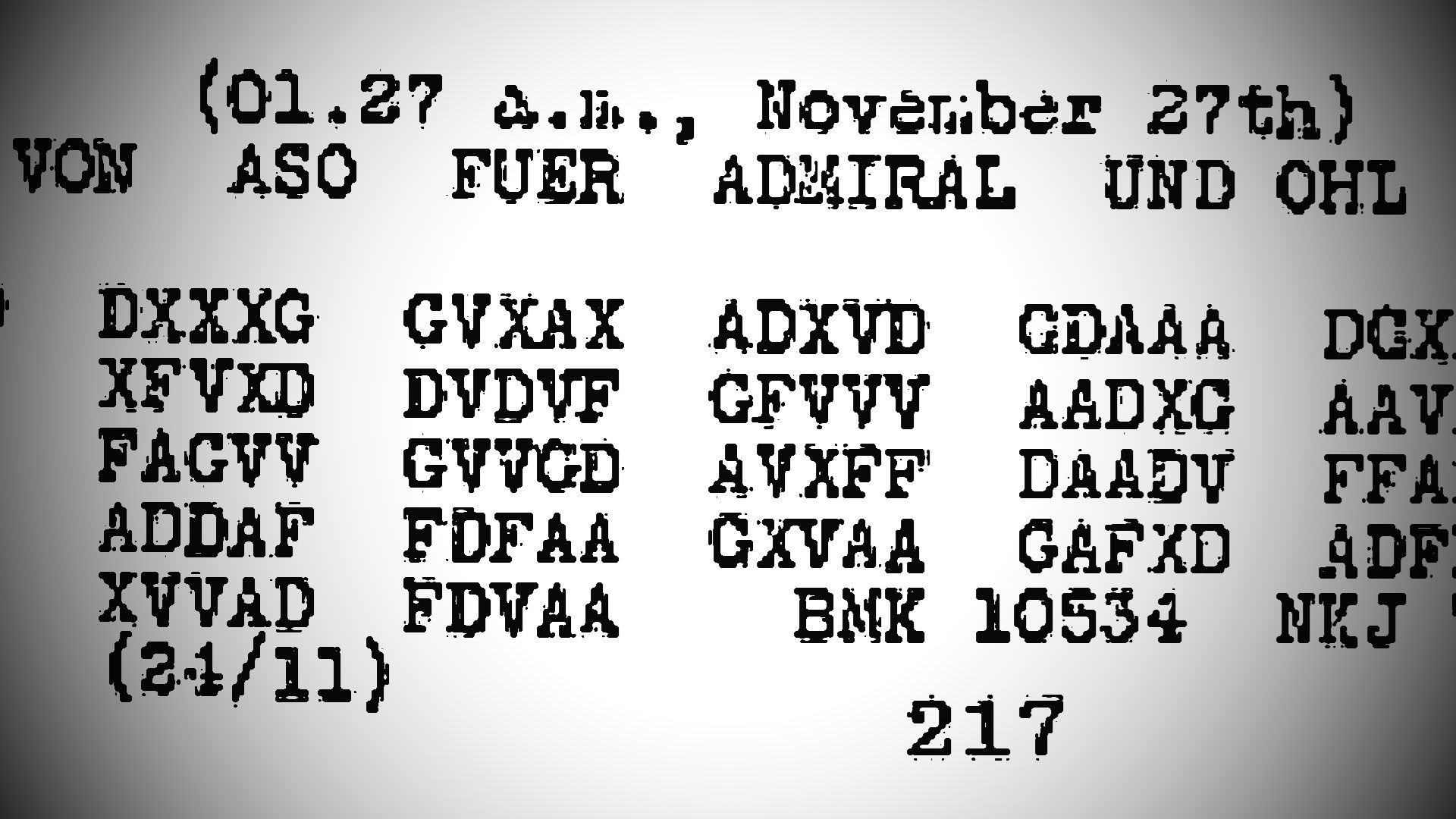
Addressed to the German High Command and for the attention of an admiral or perhaps Naval Command, the ciphered message looks like gobbledygook, surely as intended. The German military at the time used a convoluted grid of letters that shuffled depending on the current keyword.
GPT-6 Astra deciphered a 1918 German radio transmission that, to my knowledge, has never been deciphered before.The message below translates to:"EIN ENGLISCHER KREUZER EINLIEG X SEWASTOPOL X S4STEN X EIN GESCHWADER DER X ALLIIERTEN FOLGT 26STEN X"or, in English:"AN… pic.twitter.com/8kjDdI2Q5OSeptember 17, 2026
Astra solved the cipher using the word “TRUPPENVERSCHIEBUNG” as the key. This resulted in the decoded message: “EIN ENGLISCHER KREUZER EINLIEG X SEWASTOPOL X S4STEN X EIN GESCHWADER DER X ALLIIERTEN FOLGT 26STEN X.” Translated into English, we can at last understand that the radio message was the following alert: “AN ENGLISH CRUISER ARRIVED AT SEVASTOPOL ON THE ?4TH AN ALLIED SQUADRON FOLLOWS ON THE 26TH."
Astra also checked its work against military logs. The details about the cruiser’s arrival time aligned with the arrival of the British cruiser HMS Canterbury in Sevastopol, Crimea, on November 24, 1918. So the ‘?’ was perhaps a typo made in transmission. However, the Allied squadron's arrival date was spot on (November 26), according to the historical records Prinz checked.
GPT-Astra hypothesizes that previous attempts to decipher this German message failed because code sleuths made an incorrect assumption. Before this decoding feat, it was thought that the keyword “TRUPPENVERSCHIEBUNG” was used only as a key starting December 9, 1918. Remember, this message was transmitted on November 29 of that year.
This codebreaking feat is a cool result and a good example of Astra’s flexible problem-solving capabilities.
Interestingly, he’s had no issues with losing work, saying that “jobs come and go. I’ve worked my whole life; I’ll find another job… I’ve got two hands, I’m healthy, I’m capable of working. So, if losing my job was the worst that came out of this, I’d honestly probably be okay.” Unfortunately, he’s still on the hook for the massive bill, and it's gotten to the point where he and his wife are talking about selling their home to help pay for it.
Despite the depressing development, Dave and Mike were still about to joke around a bit about it. After Dave thanked his son for bringing him some water, Mike answered, “67.” He then asked, “Mike, do you even know what 67 means?”
To which the kid replied, “To say the least, I do not know what it means, but I think it doesn’t mean anything. It’s just something that makes people laugh and smile.”
The dad then replied, “Yeah, I would have to agree with that, Mike. Actually, I know what 67 means, Mike. That’s how old you’re going to be when you finally have to stop mowing lawns… That’s retirement age for the general public, but not for your old man. After this situation, apparently, I’m going to be working until I’m like 94.”
Interestingly, Dave said that he doesn’t want to accept external help, like setting up a GoFundMe or a crypto coin to help with the bill. “We do not have a Mighty Mike coin. We don’t have a 67 coin. We don’t have any coins. No crypto. We don’t have a GoFundMe. We have no fund raising set up.”
He set up a merch website with 14 different shirt designs that remind people of Mighty Mike’s misadventures, but only three designs are currently available.
(Image credit: Mighty Mike Plays/YouTube)
A few comments said that this was a scam or a made-up story, but Dave shared a screenshot of the credit card bill (which was eventually removed) showing the $118,479.83 bill on the American Express Business Gold Rewards Card.
Several others encouraged him to take the help being offered and let big news channels talk to him, but he seems to want to deal with the problem on his own. “So, I felt like if I sit down with Fox or CNN or whatever, and I tell them my story, what has that changed?” Dave said during the YouTube video. “I’m still living in this reality, and I still have to sort of dig myself out of this hole. I don’t know if I have the mental bandwidth to sit there and talk to some reporter, but I might, anyway.”
 登录
登录