普通视图

发现新文章,点击刷新页面。
昨天 — 2026年7月28日IT News

Re-examining the DDR4 gaming gap with Intel’s LGA 1700 CPUs in mid-2026 — performance drops of 14% on average, and up to 25% in some games

2026年7月28日 18:32

Unless you already have a kit of DDR5, or deep pockets for PC hardware, you’re stuck right now. Despite seeing some of the best CPUs for gaming released just in the past year, the DDR5 tax represents a major hurdle to building or upgrading your PC. Intel’s LGA 1700 CPUs hold an unintended solution, offering support for both DDR4 and DDR5. We wanted to see if this on-ramp to a next-gen platform was really as smooth as it looks at first glance.

The idea is simple. If you already have a DDR4 kit, you can upgrade to a relatively new CPU while keeping the door open for a transition to DDR5 without buying a new chip. It’s inexpensive, and a bit more of a practical solution than upgrading to DDR5 with a single DIMM and worrying about pairing it with another later.

Our testing shows how much of a performance difference there is with DDR4 in games. We’re focused on games here for a few reasons. First, in non-gaming applications, memory speed is highly dependent on the specific workload you’re running. Games, despite using different engines, are largely similar workloads that stress the hardware in similar ways. Further, those workloads are continually evolving as new games, new technologies, and new hardware targets are released.

We kept our testing focused on Intel’s LGA 1700 CPUs because they’re the only options that give us a true apples-to-apples comparison between DDR4 and DDR5. We don’t have any AMD CPUs in our test pool because there aren’t any chips that support both DDR4 and DDR5. This isn’t intended to be a competitive analysis between AMD and Intel. That conversation opens up a much broader conversation about total platform cost.

Testing DDR4 vs. DDR5 on Intel’s LGA 1700 CPUs

To test DDR4 and DDR5’s gaming performance, we ran Intel’s main LGA 1700 stack through a 15-game gauntlet of benchmarks. Notably, we don’t have results for the Core i9-12900K, as our sample has a janky memory controller that won’t boot on DDR5 systems. You can read a full breakdown of how (and why) we tested in the way we did in the section below.

We ran all of the games through our 16-game benchmark suite, though we cut Doom: The Dark Ages from the results here. An update for the game rolled out mid-way through testing and skewed our results, so we’re omitting it. The 15 remaining games still paint a clear picture of the performance difference between DDR4 and DDR5.

As usual, we tested with the RTX 5090 Founder’s Edition at 1080p with a mixture of High and Ultra settings. We test at 1080p to maximize the differences between CPUs, and it remains the most widely-used resolution for gaming. Deltas between CPUs will decrease as the resolution climbs and the GPU becomes a larger influence in performance.

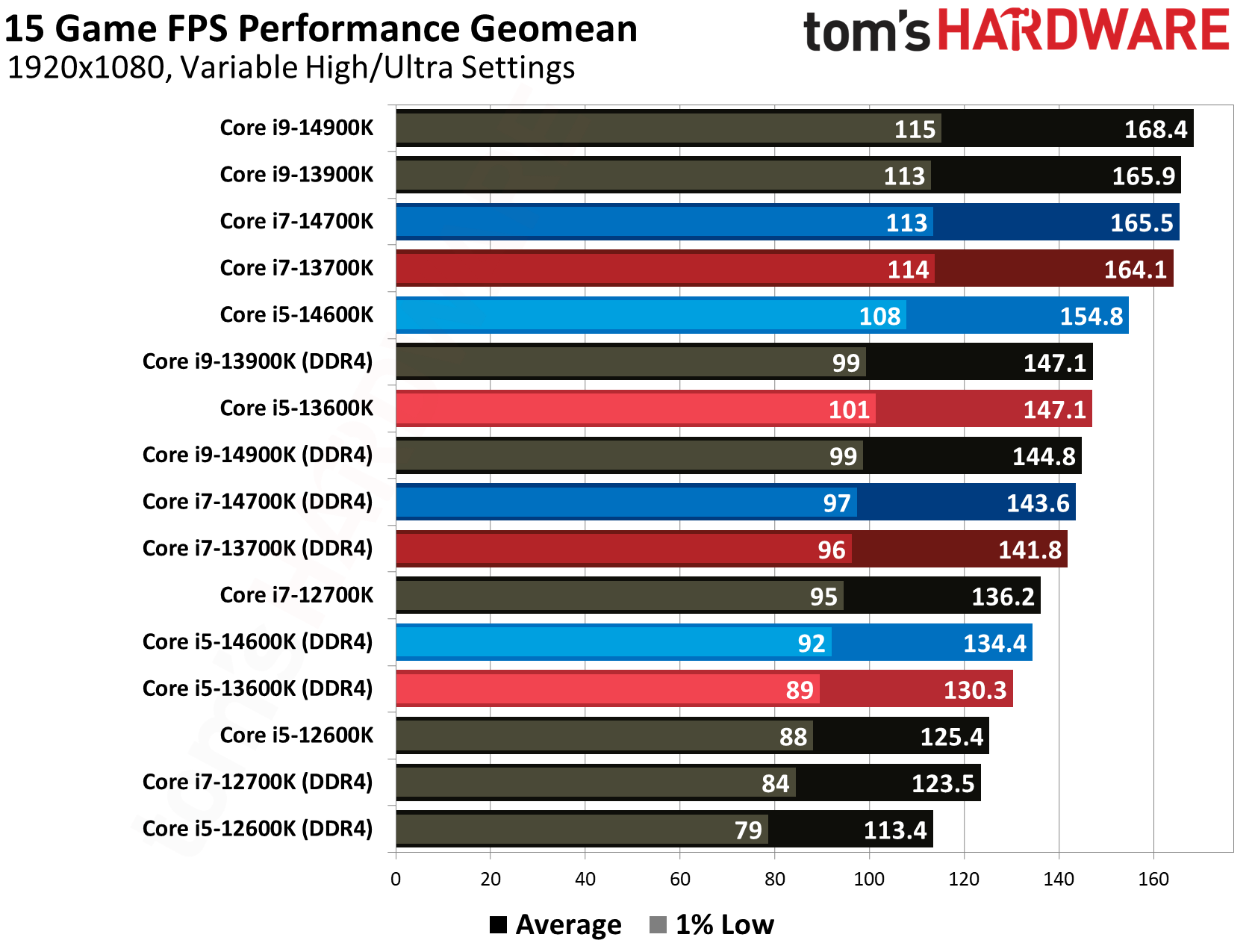
Below is our geomean from testing across the suite. Given that we’re looking to compare a single CPU’s performance with DDR4 and DDR5, we’ve highlighted some CPUs with the same color (13700K is always dark red, for instance, while 14700K is always dark blue).
DDR4 vs DDR5

(Image credit: Tom's Hardware)

The chart above is a bit difficult to parse, mainly because we’re often jumping several entries to get to a comparison point. For the stack of chips we tested, here’s a clearer overview of the performance difference with DDR4:

CPU

DDR4 % Difference

Core i9-14900K

-14%

Core i7-14700K

-13.2%

Core i5-14600K

-13.1%

Core i9-13900K

-11.3%

Core i7-13700K

-13.5%

Core i5-13600K

-11.4%

Core i7-12700K

-9.3%

Core i5-12600K

-9.5%

As we’ll get into with the individual game tests below, the drop in performance between DDR4 and DDR5 can be much larger than the comparison in our geomean (and, in turn, smaller in other games). What’s important for the overall performance drop is the trend as we move to newer chips. You can see a 9% drop grow to 14%, as DDR4 becomes a more significant bottleneck when the processor it’s feeding becomes more powerful.

That trend is one of the main driving forces behind our look at DDR4 and DDR5 gaming performance today. We looked at DDR4 and DDR5 performance extensively near the Alder Lake launch, and even more recently last year, evaluating performance across a wide range of applications. The testing here is focused solely on gaming to answer a critical question of building a PC today: Are you really giving up that much gaming performance with DDR4?

The answer is, yes, you’re giving up around 11% to 14% of your gaming performance overall when the memory is the only variable that changes. That’s a consistent drop, as well. Older titles care see less of a benefit from DDR5 generally, but we saw a steady decrease of around 11-14% across the games we tested, with some titles pushing above a 20% drop.
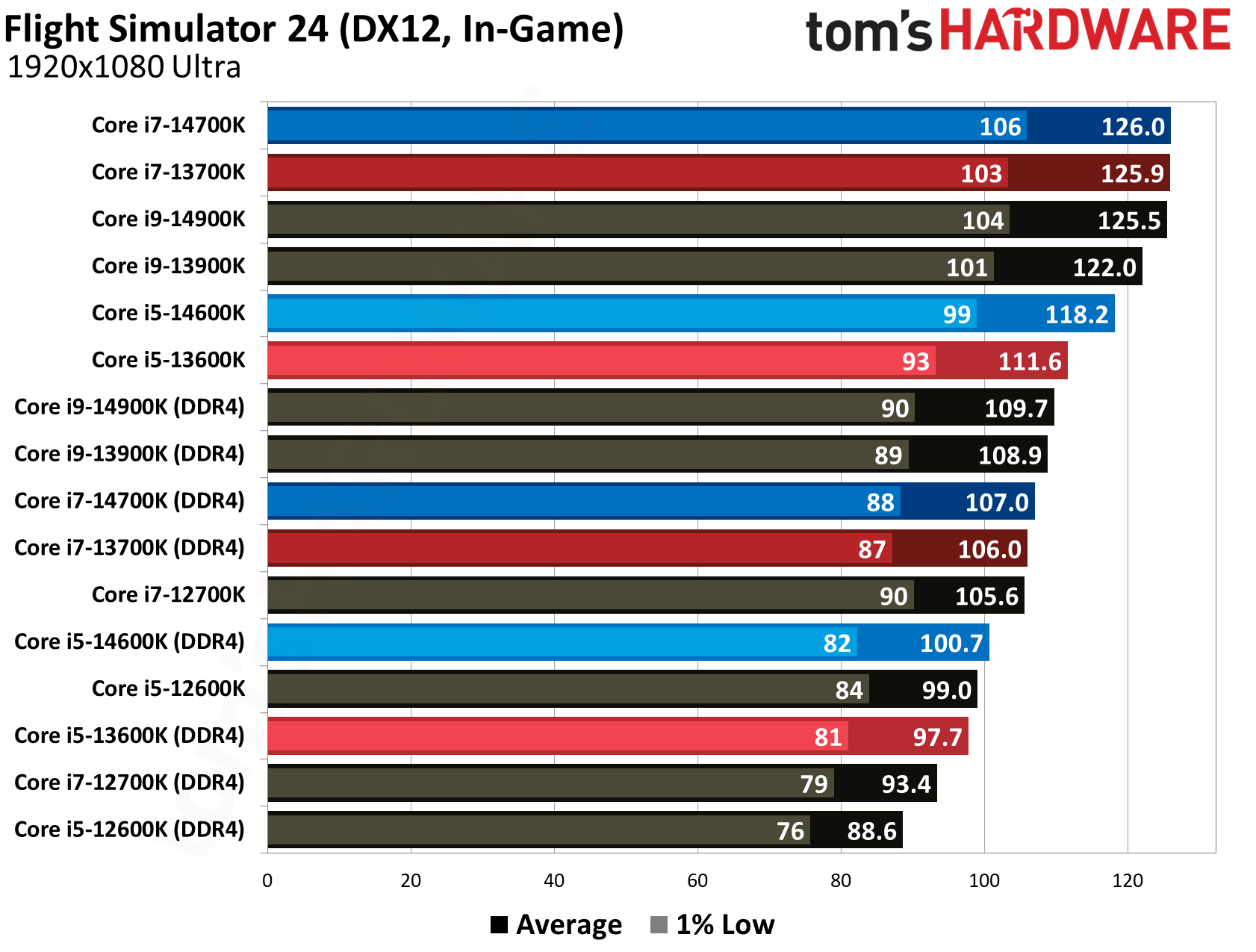
DDR4 vs DDR5

(Image credit: Tom's Hardware)

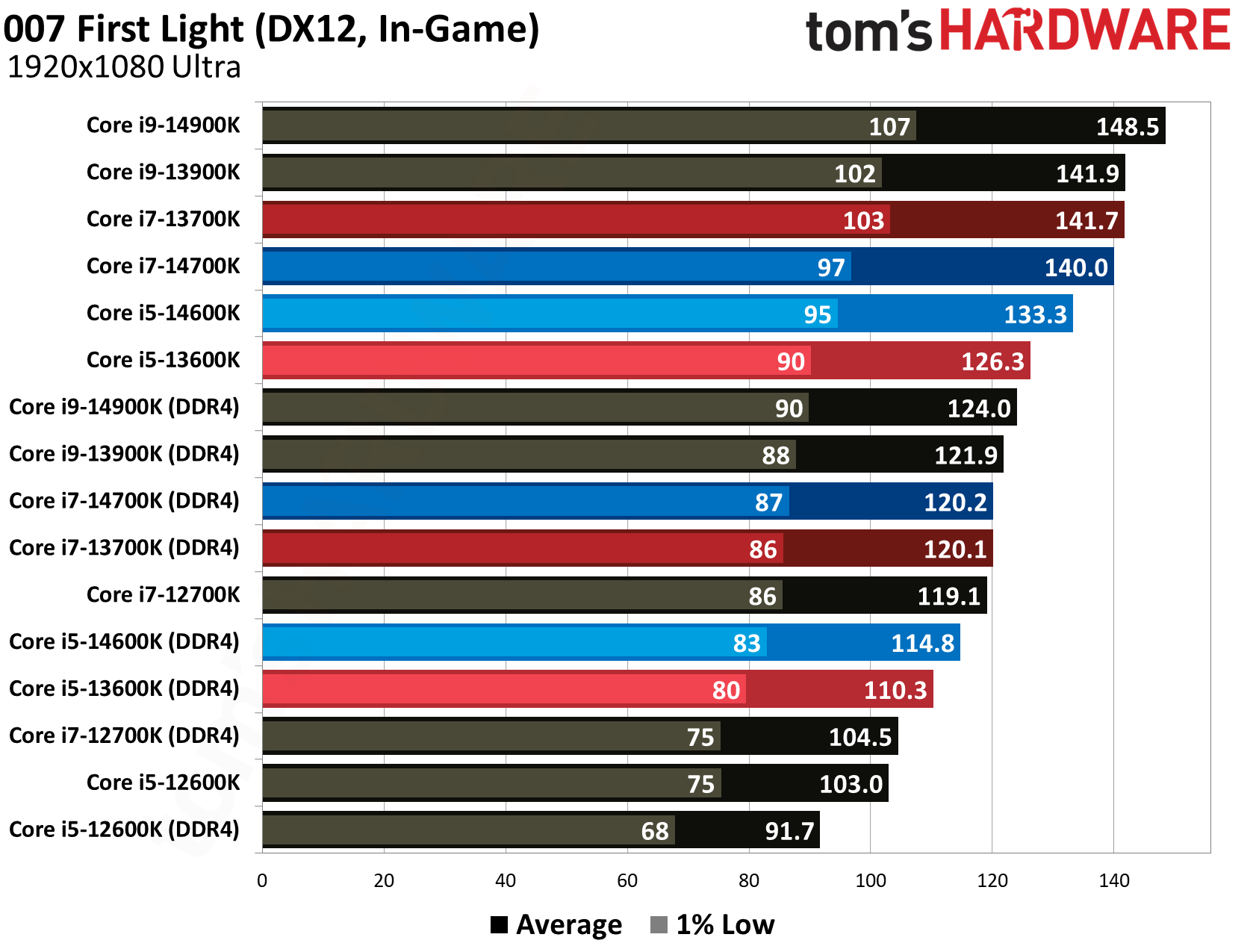
007 First Light is the newest game we tested, and it outpaces our averages. The 14900K sees a 16.5% drop with DDR4, while the 13600K drops 12.7% of its performance. Especially among the most powerful CPUs here, you can see DDR4 level off performance in a way that’s undesirable. The 14900K, for instance, is just 1.7% faster than the 13900K with DDR4, but it’s 4.6% faster with DDR5.
DDR4 vs DDR5

(Image credit: Tom's Hardware)

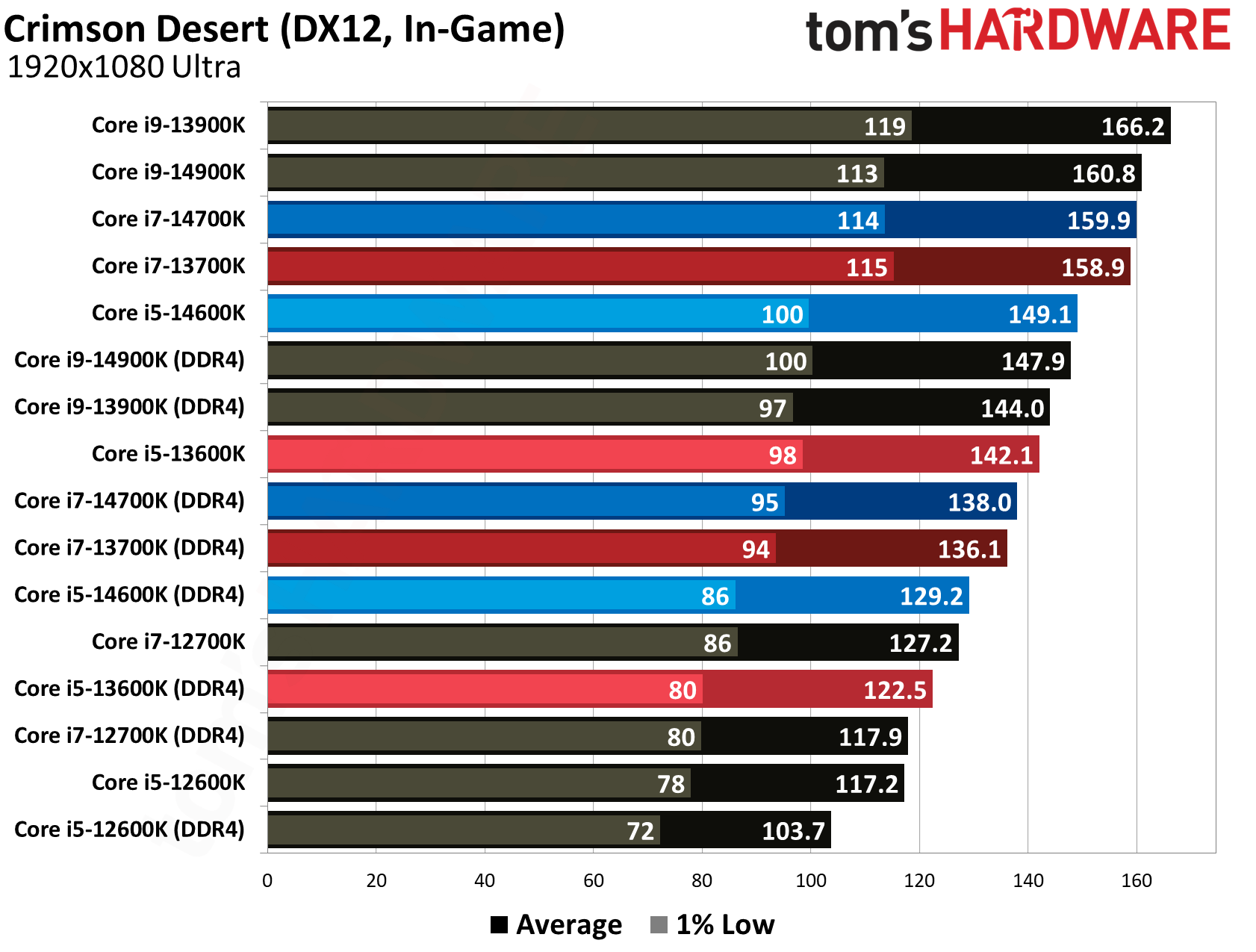
Similarly, in Crimson Desert, you can see the 13700K lose 13.7% of its performance with DDR4, and the 14600K drop 13.2% of its performance. It’s worth noting that neither of these games are particularly sensitive to memory speed. You can see in our recent Ryzen 7 5800X3D re-review that even a boost from 3D V-Cache doesn’t give CPUs with a robust memory chain an automatic advantage.
DDR4 vs DDR5

(Image credit: Tom's Hardware)

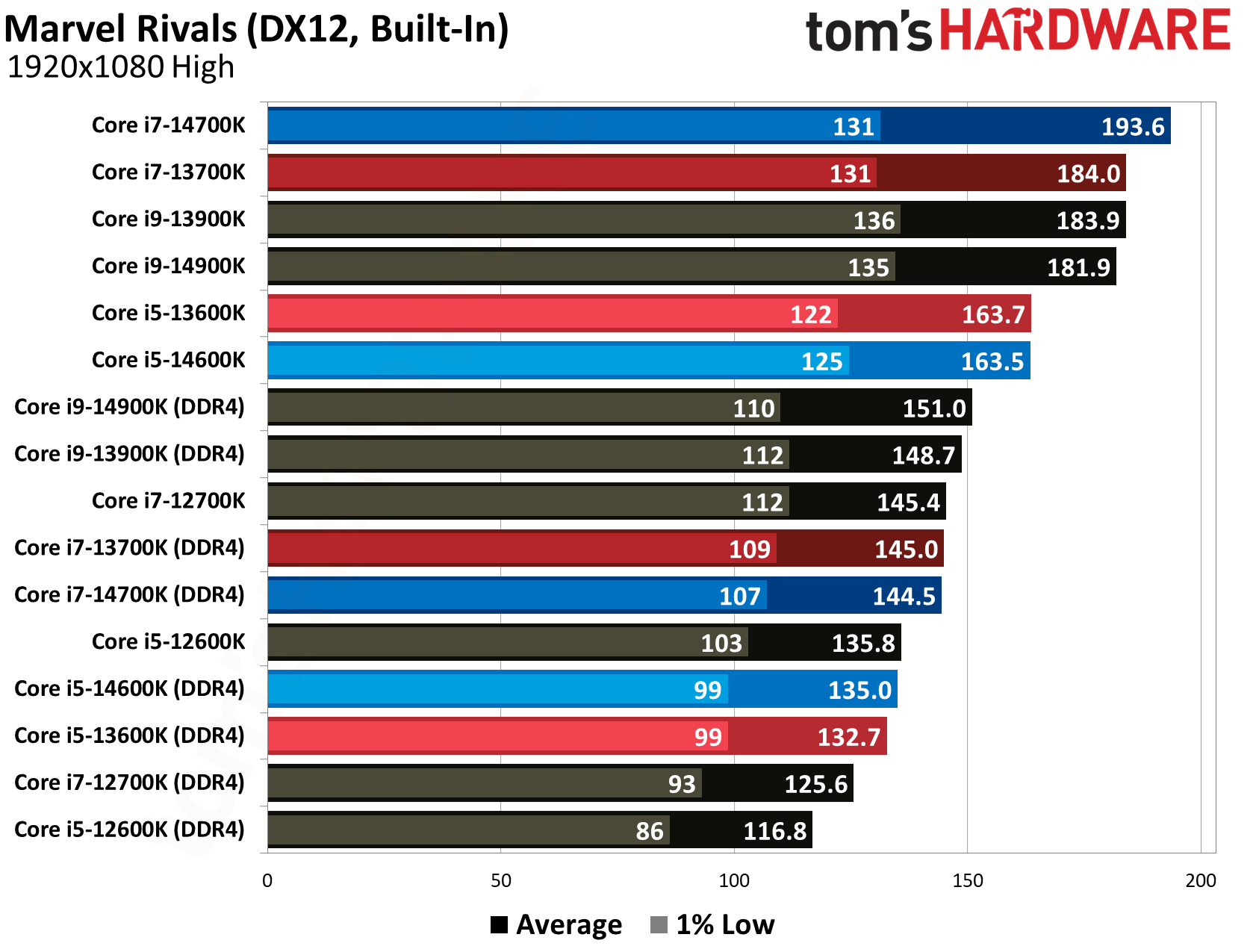
Perhaps the most consequential of the newer games we tested is Marvel Rivals, not only because it shows a much larger gap between DDR4 and DDR5, but also because it’s the most-played game in our test suite by a long shot (short of Counter-Strike 2). For weaker chips like the 12600K, the gap is 13.9%, just slightly above our geomean. For the more powerful 14700K, however, it shows a gap of 25.3%. Even the 14600K drops 17.4% of its performance with DDR4.
DDR4 vs DDR5

(Image credit: Tom's Hardware)

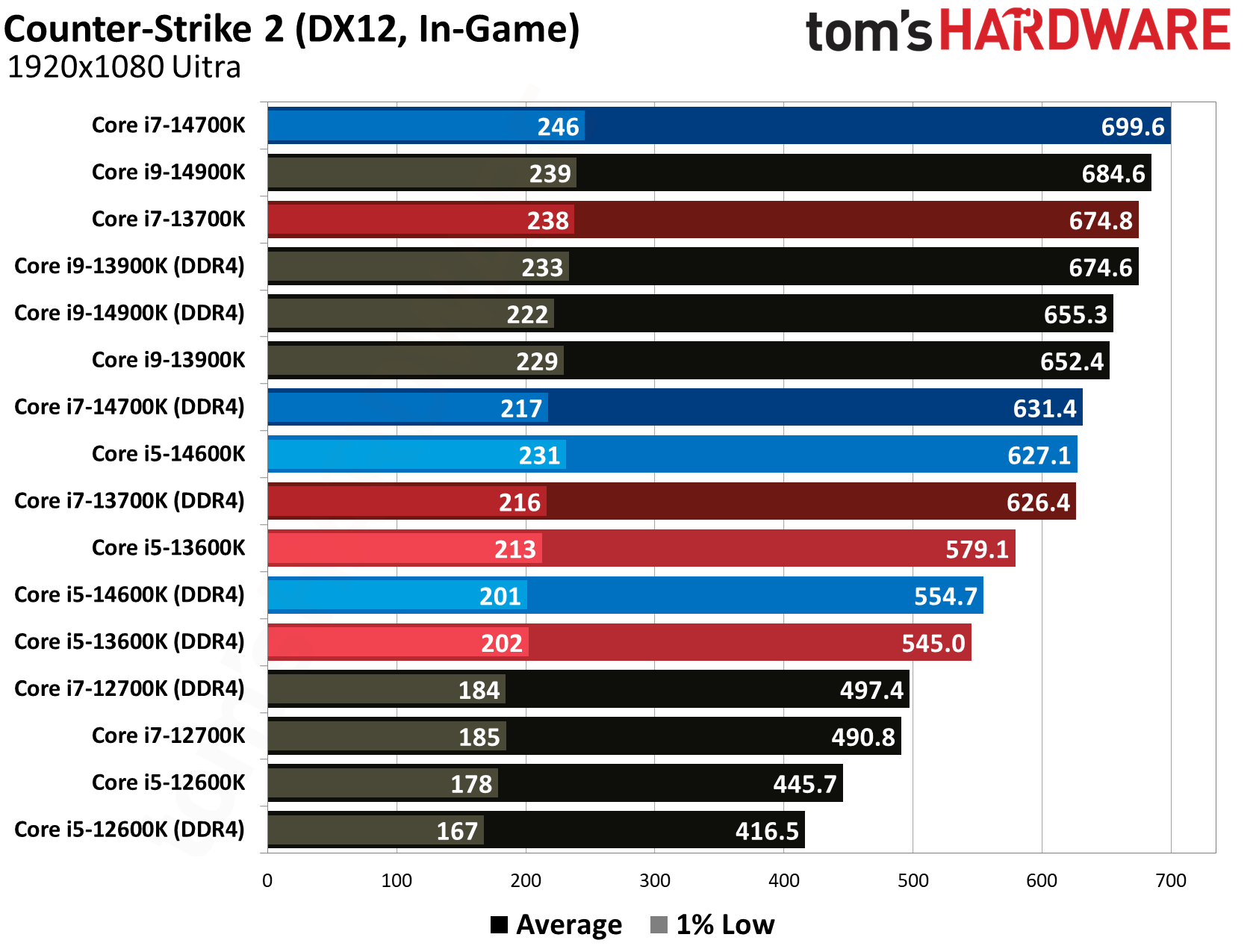
Counter-Strike 2 is less extreme, perhaps as a consequence of having such a high floor for average frame rates. You can see that the Alder Lake chips don’t care much about DDR4, with the Core i7-12700K performing identically across both memory standards. That gap grows with more powerful CPUs, however, with the 14700K creeping up toward a 10% delta.
DDR4 vs DDR5

(Image credit: Tom's Hardware)

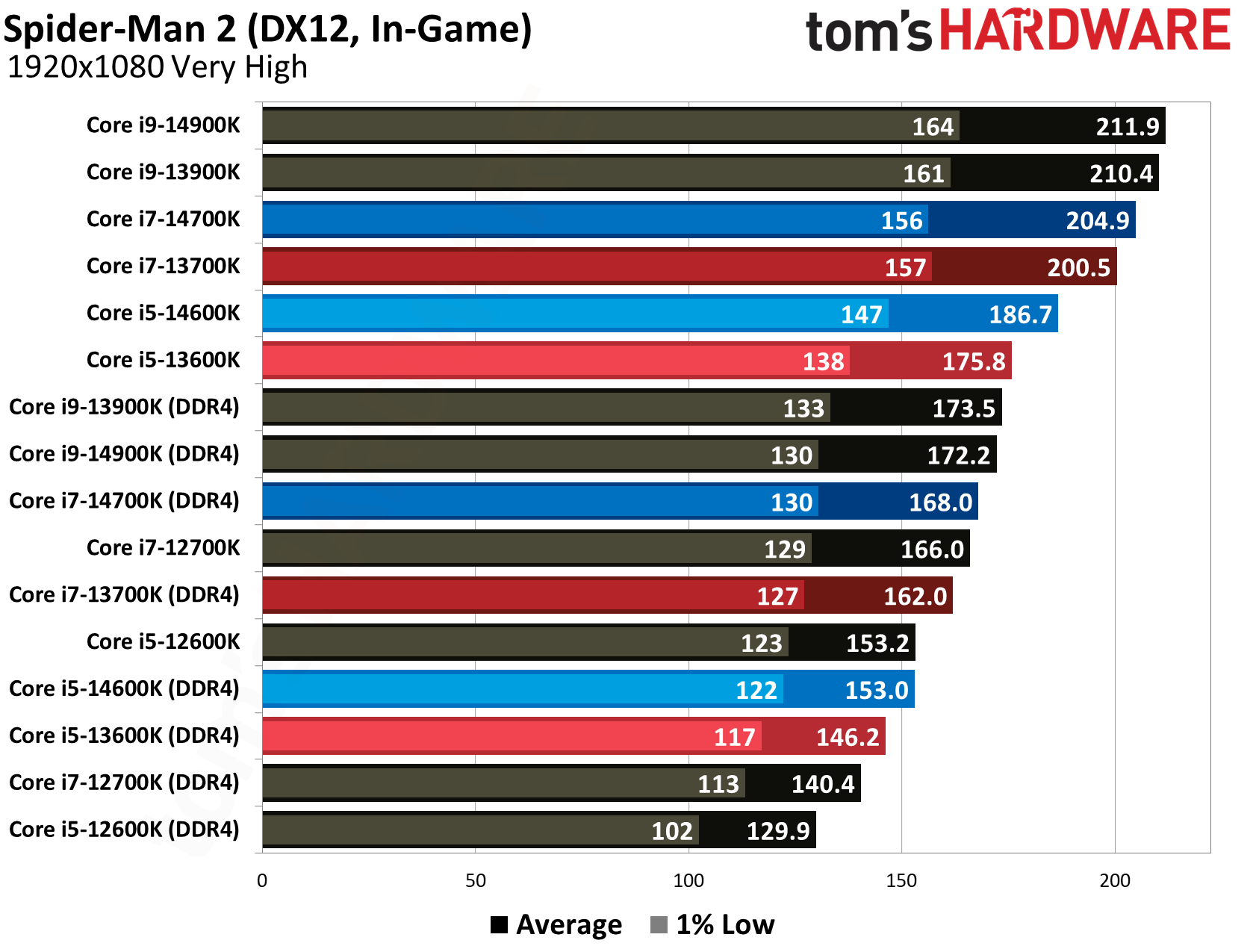
In Spider-Man 2, we can see more consistent drops across the stack of chips we tested, with most CPUs dropping around 18% of their average performance with DDR4. That’s true even on the weaker 12700K, which lost 15% of its performance. The 14900K, meanwhile, was 18.7% slower with DDR4.
DDR4 vs DDR5

(Image credit: Tom's Hardware)

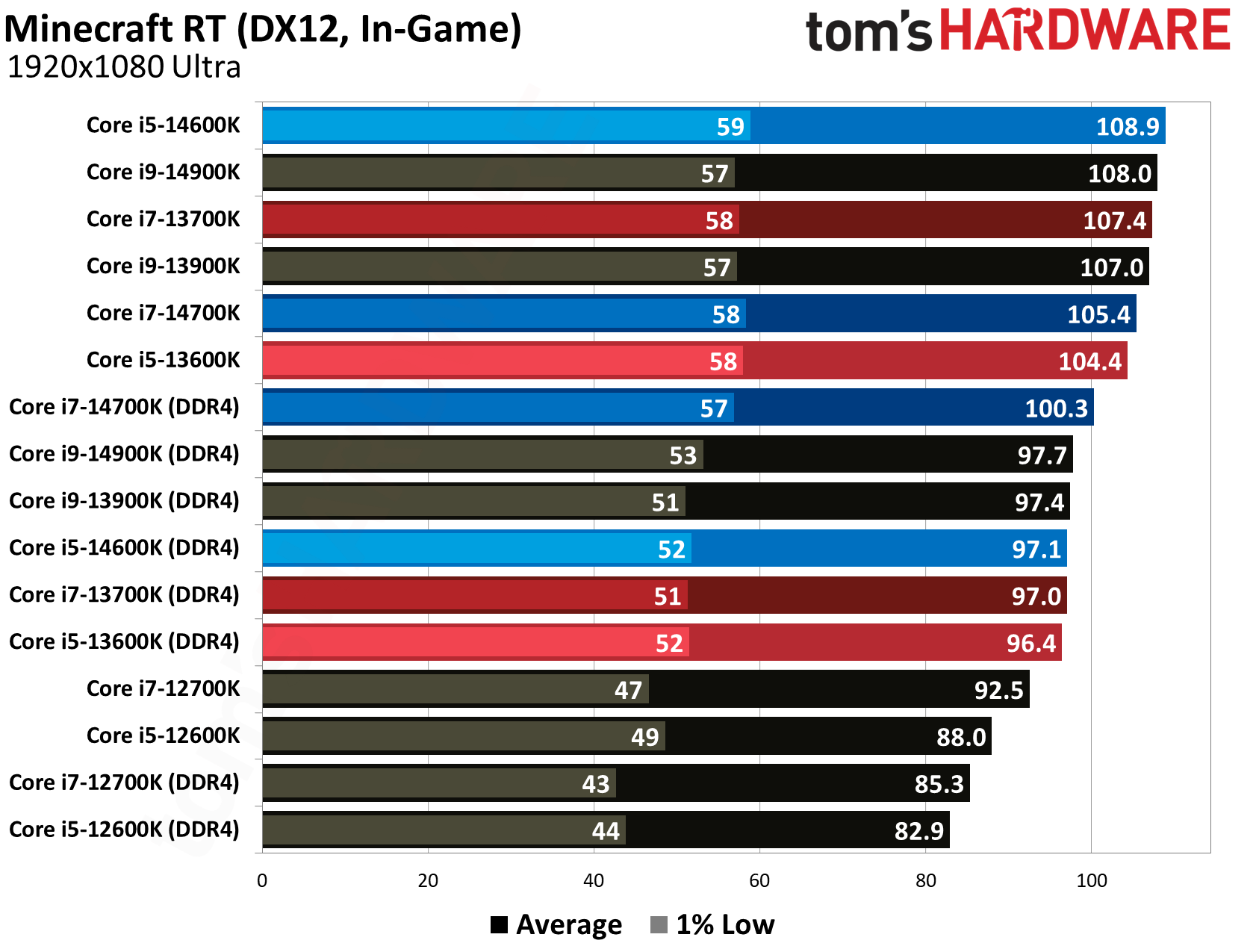
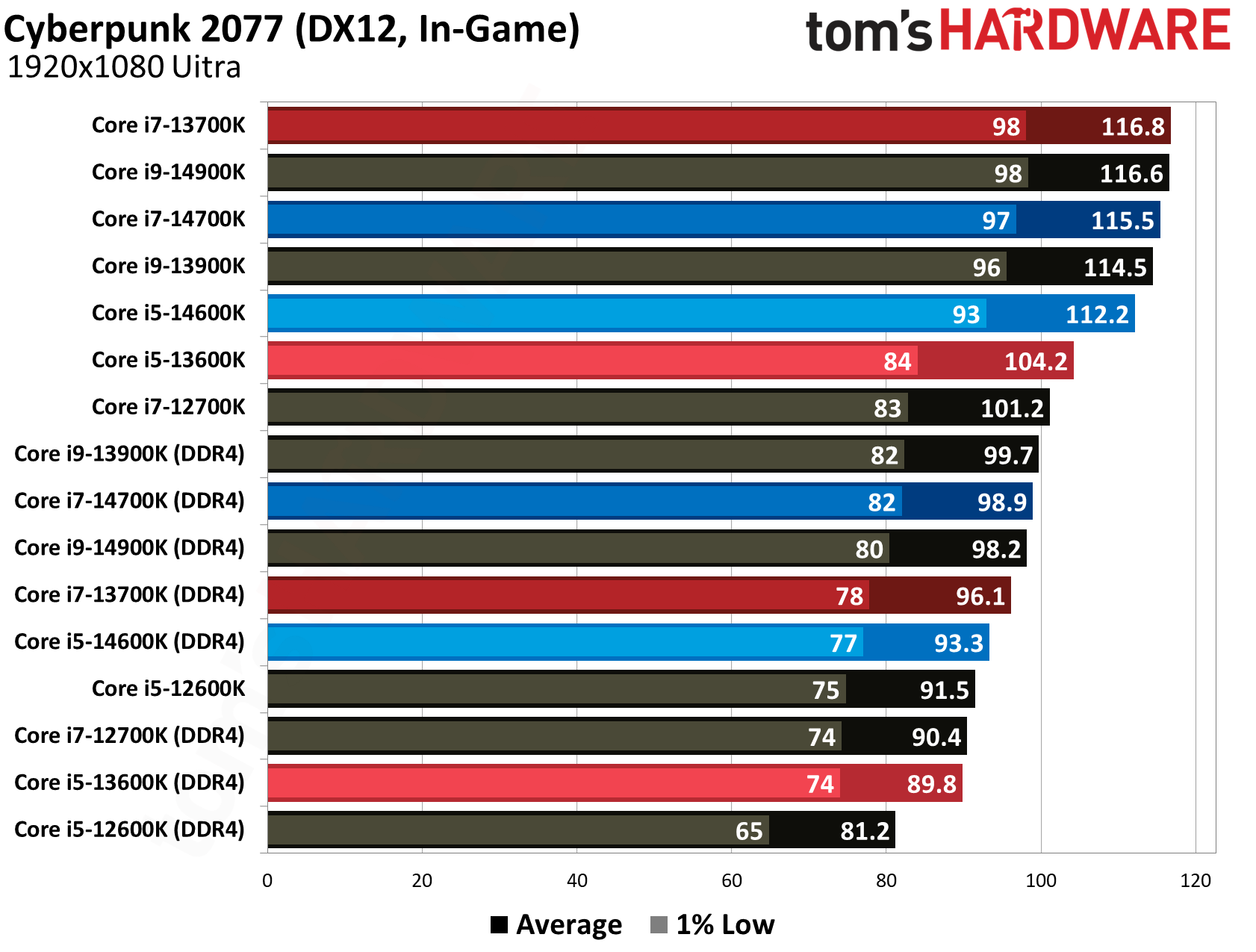
Even in an older, GPU-heavy title like Cyberpunk 2077, we can see a consistent drop. You can see in this game that we become completely bound by the GPU at the top of the rankings, but that’s a level these chips can’t hit when paired with DDR4. The 14700K drops about 14% of its performance, and the 13600K, about 13% of its performance.
DDR4 vs. DDR5
Tom's Hardware
DDR4 vs. DDR5
Tom's Hardware
DDR4 vs. DDR5
Tom's Hardware
DDR4 vs. DDR5
Tom's Hardware
DDR4 vs. DDR5
Tom's Hardware
DDR4 vs. DDR5
Tom's Hardware
DDR4 vs. DDR5
Tom's Hardware
DDR4 vs. DDR5
Tom's Hardware
DDR4 vs. DDR5
Tom's Hardware

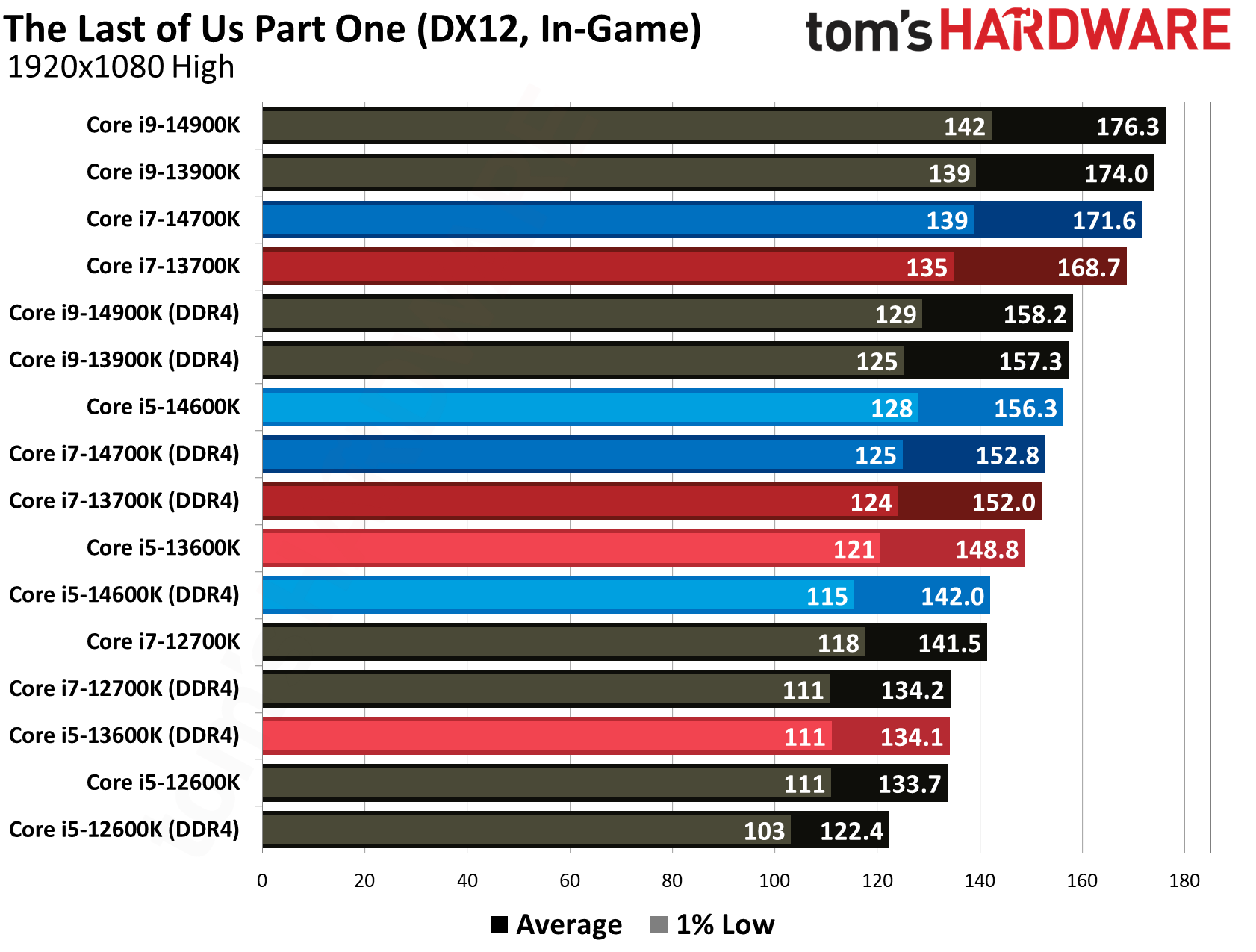
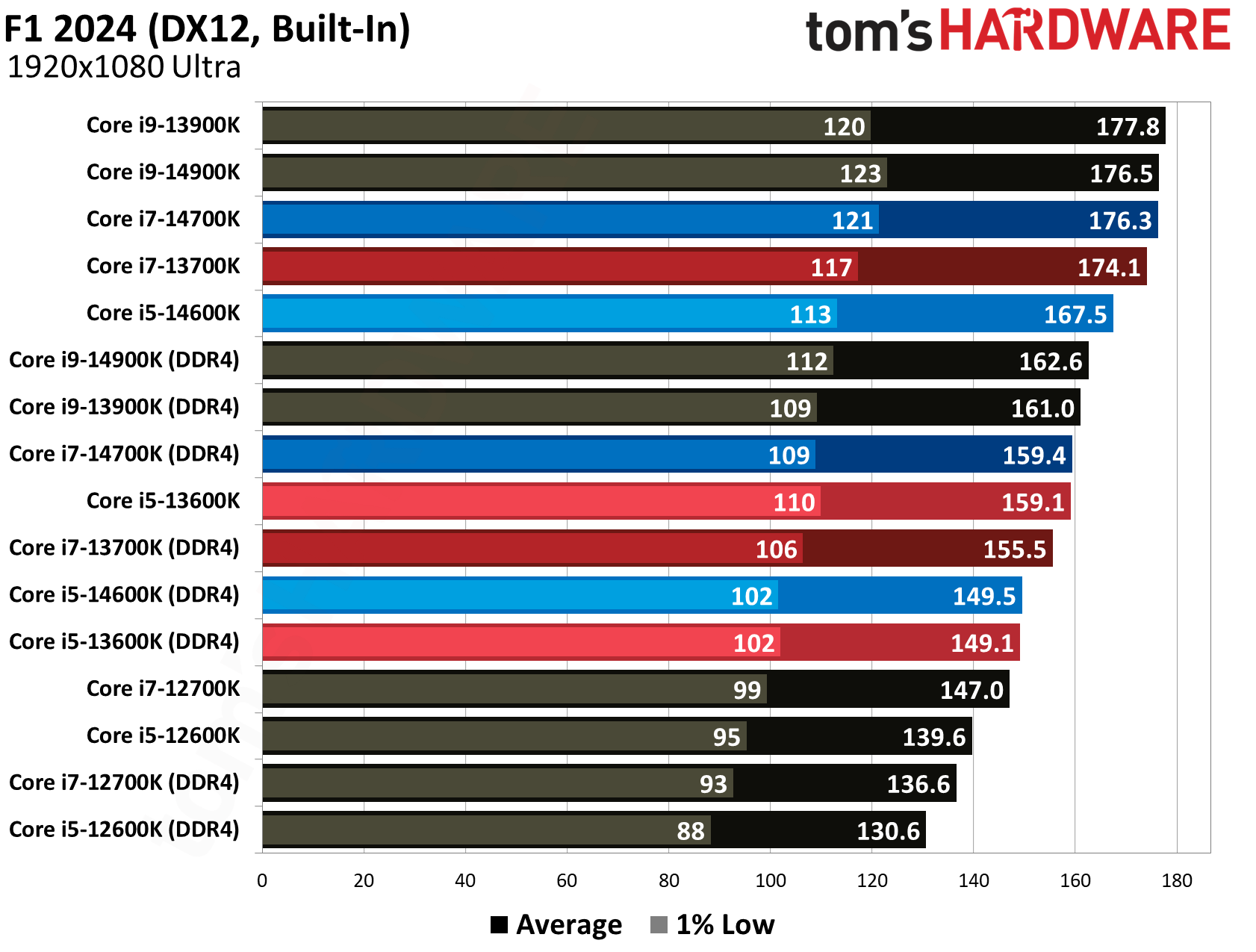
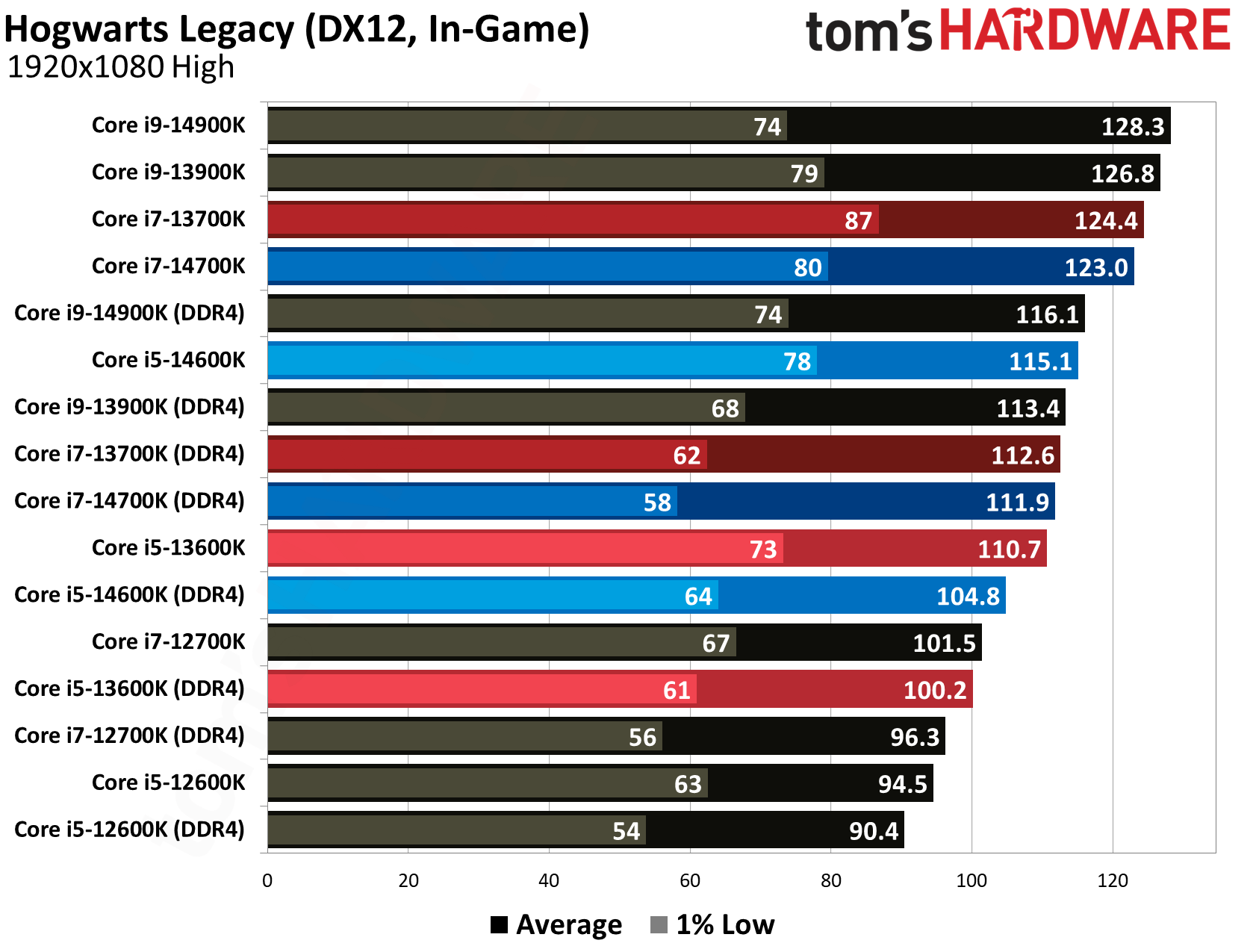
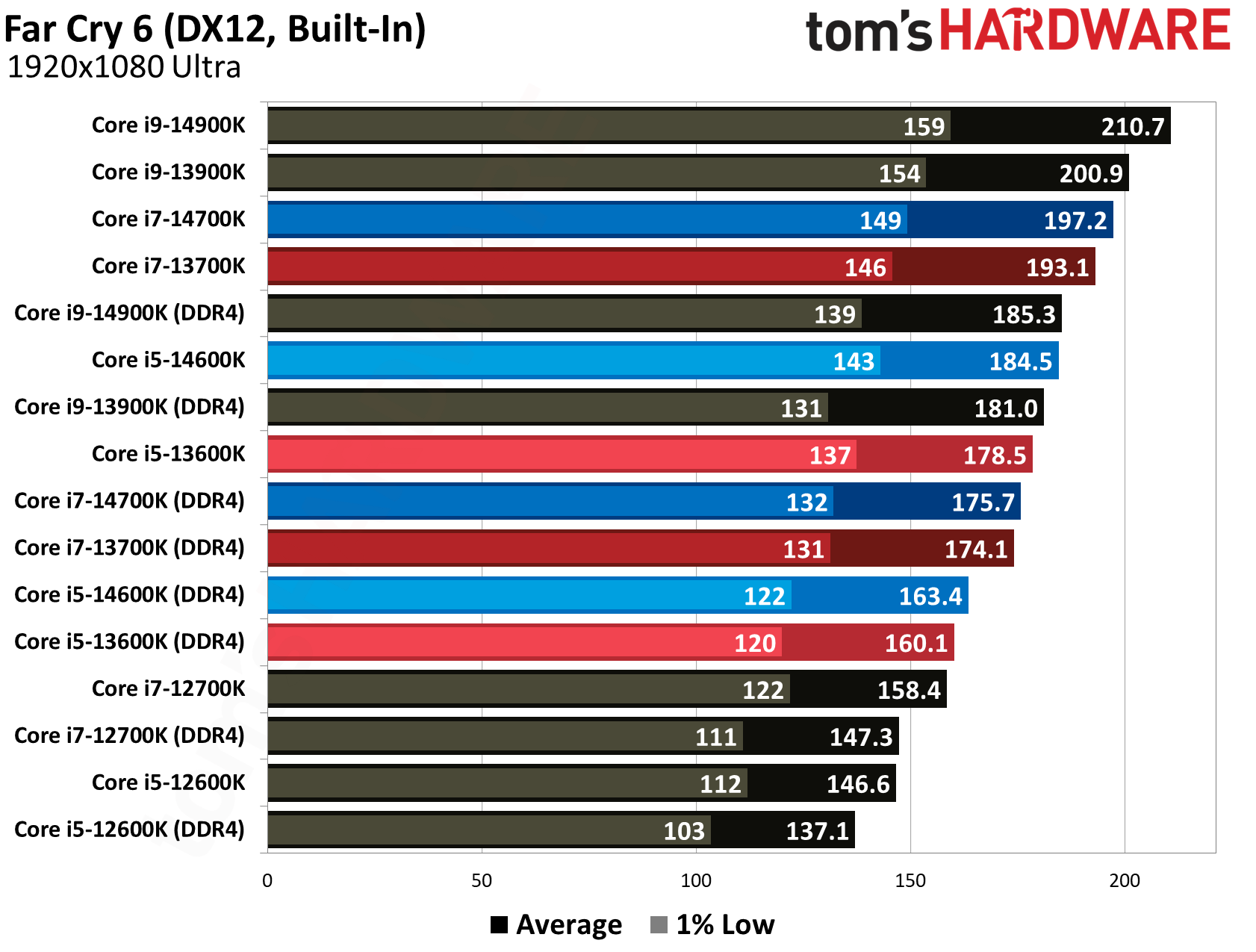
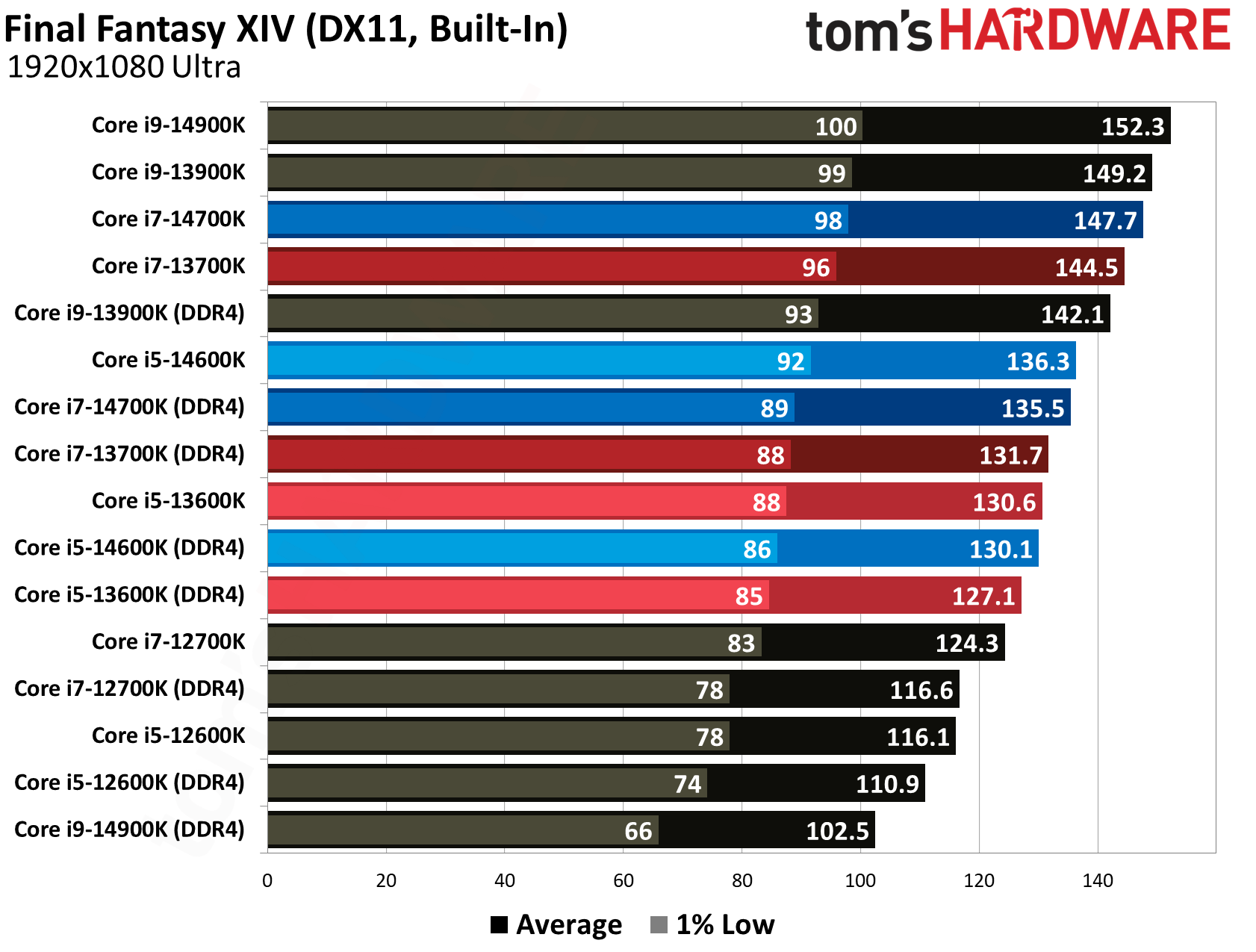
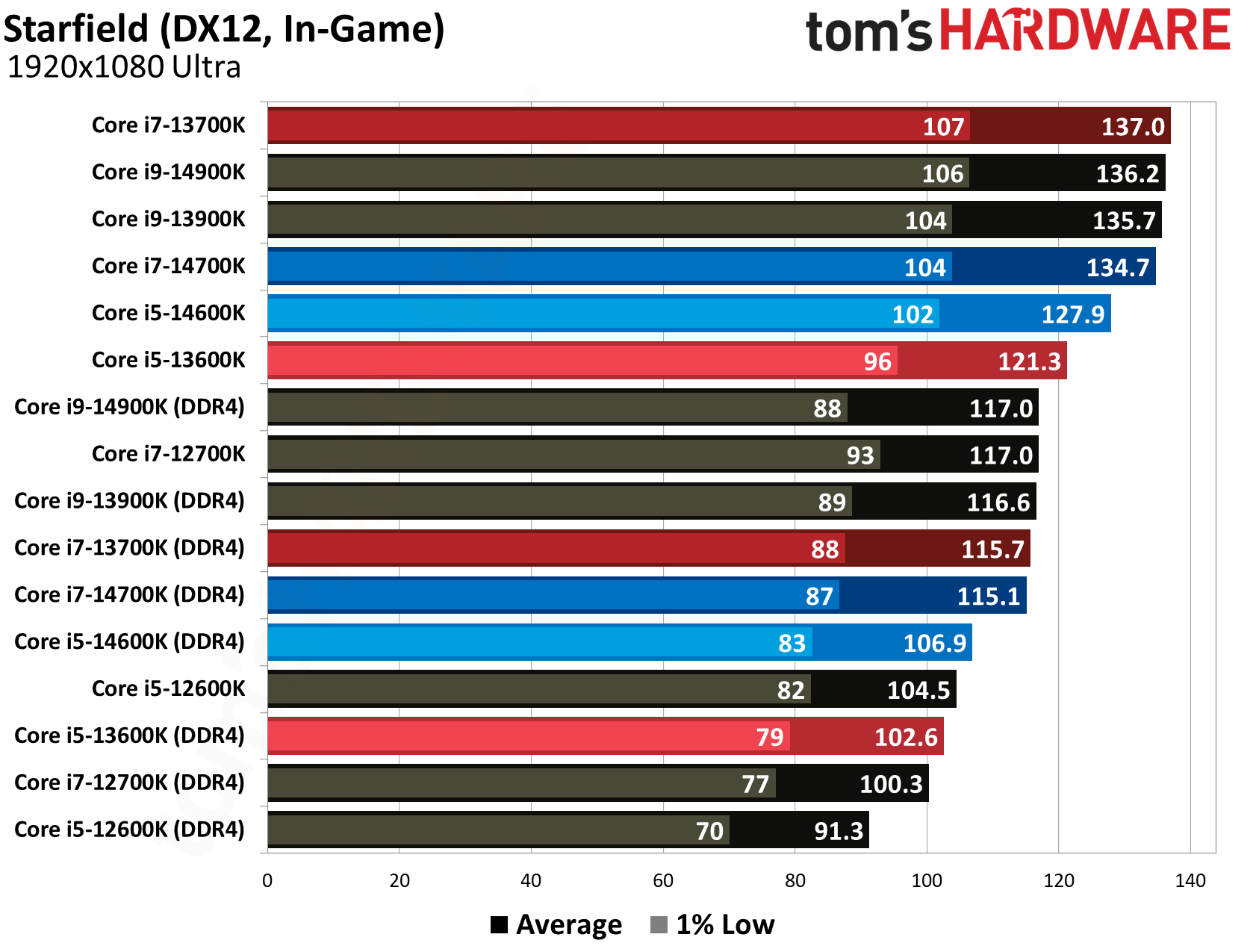
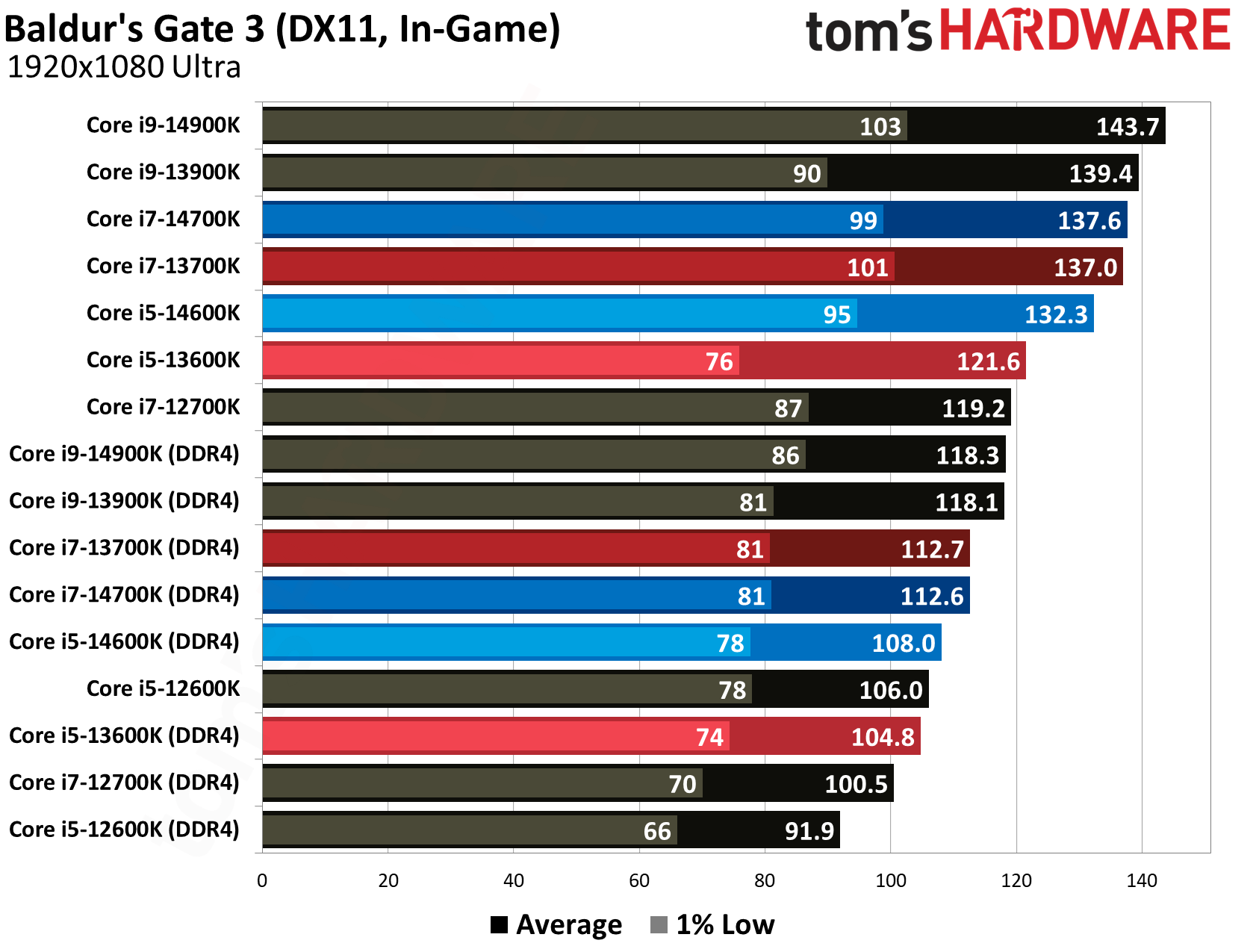
You can browse through our remaining benchmarks using the gallery above, but most games tell a similar story. The gap between DDR4 and DDR5 persists, of course, but there’s another angle to look at the data. DDR4 flattens off performance, creating a bottleneck with faster CPUs. That could be justification for buying a weaker chip if you can only afford DDR4 memory right now.
DDR4 vs DDR5

(Image credit: Tom's Hardware)

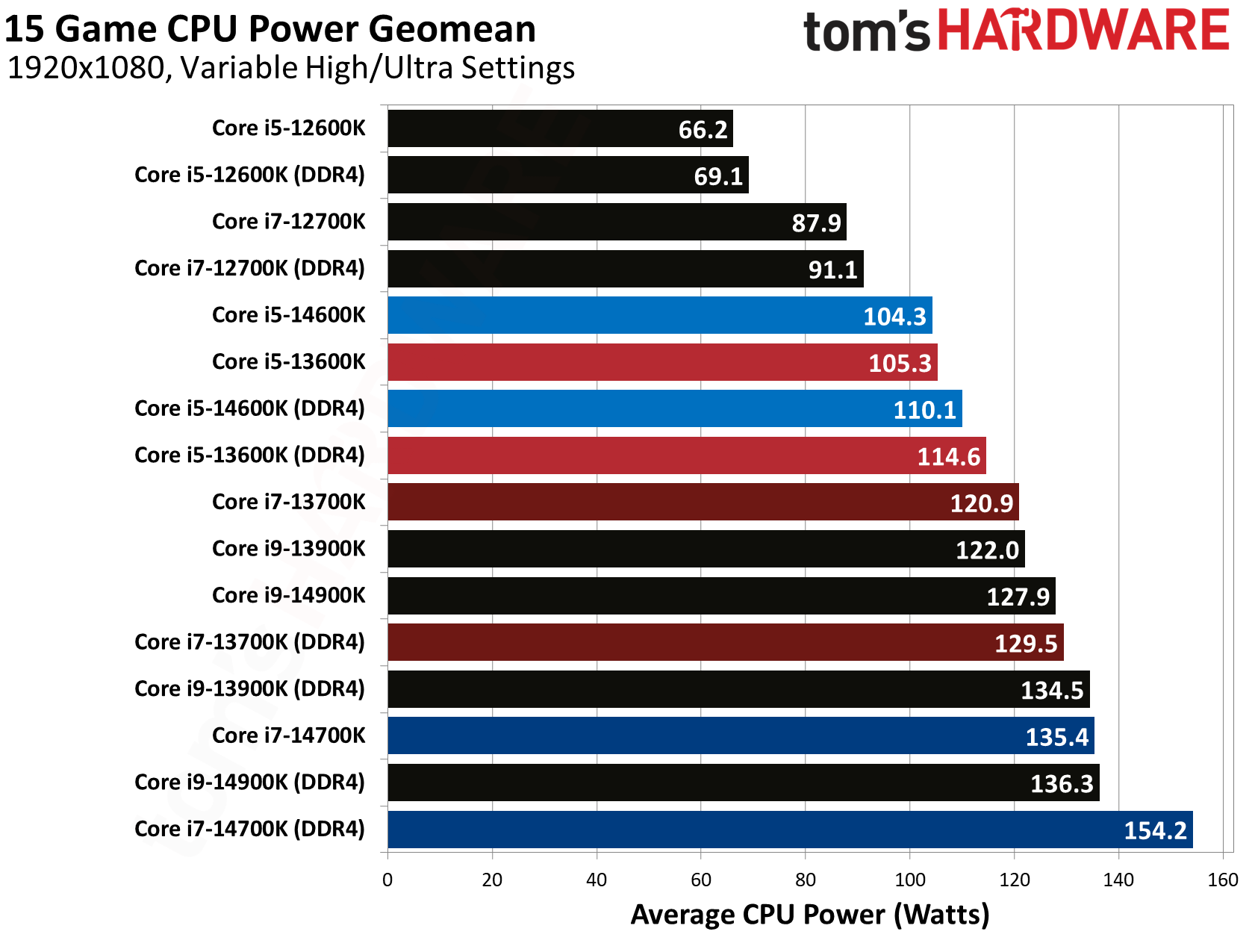
Outside of performance, one important aspect of using a DDR4 system compared to DDR5 is power consumption. With DDR4, power consumption of the CPU increases, as you can see in the chart above. The jump is generally only a few watts, but it’s worth noting nonetheless. In games, we’re well below the operating temperature of all the chips in our test pool, but when pushing toward maximum power draw, DDR4 will post yet another limitation.

How (and why) we tested DDR4 vs. DDR5 now

DDR5 is way too expensive, and Intel’s LGA 1700 CPUs represent a unique value proposition given the unprecedented increases in memory prices over the past several months. The idea is that you can upgrade to a newer platform while sticking with DDR4, giving you a stopgap for an eventual DDR5 upgrade. It seems Intel recognizes this value proposition, as well, as it’s reportedly slated to launch Raptor Lake Next CPUs on the LGA 1700 socket.

We tested the main stack of chips, short of the Core i9-12900K, as described above. We didn’t test variants like KS releases to keep our testing focused, as well as lower-end SKUs like the 12100F or 14400. The memory controllers in these lower-end chips are weaker, sustaining lower DDR5 speeds, so expect less of a difference in performance with them.

Below, you can see the test benches we used. In addition to keeping hardware consistent, we use a frozen OS image with an identical software stack. We’re running the same version of the same apps on the same OS update, with identical drivers.

In the BIOS, we enabled XMP for both kits of memory. We also tested with Resizeable BAR turned on, and Virtualization-Based Security (VBS) turned off. Most motherboard vendors off a profile with the power limits removed on Intel CPUs, which can push the processor outside of warrantied specifications. We stuck with the default “Performance” profile for our testing here.

Intel LGA 1700 (Raptor Lake, Alder Lake)

Motherboard

MSI MPG Z790 Carbon Wi-Fi

RAM

2x16GB G.Skill Trident Z Neo RGB DDR5-7200

Intel LGA 1700 DDR4 (Raptor Lake, Alder Lake)

Motherboard

MSI MPG Z690 Edge Wi-Fi DDR4

RAM

4x8GB G.Skill Trident Z RGB DDR4-3200

All Systems

Gaming CPU

Nvidia GeForce RTX 5090 Founder’s Edition

Cooler

Corsair iCue Link H150i RGB

Storage

2TB Sabrent Rocket 4 Plus

PSU

MSI MPG A1000GS, Gigabyte UD1000GM PG5 V2

Other

Arctic MX-4 TIM, Windows 11 Pro, Alamengda open test bench

Is DDR4 still worth it?

It makes sense that we’ve seen a shift back toward DDR4. Although DDR4 prices have risen in lockstep with DDR5 prices, they started from a much lower base. A kit of DDR4 today is not much more expensive than a DDR5 kit of similar capacity a year ago. And, with estimates that the memory shortage could persist through 2030, there’s a strong argument for going with a DDR4 system if you’re in need of an upgrade.

The performance trade-off alone isn’t as big of a problem as it appears at first glance. You’re going to lose about 15% of your average gaming performance with Intel’s LGA 1700 CPUs (particularly Raptor Lake chips). You’ll spend more than twice as much on a 32GB kit of DDR5-6000 as you will on a 32GB kit of DDR4-3200, as you can see in our RAM price tracker. And, you might already have a DDR4 kit, cutting that cost completely out of an upgrade. Dollars spent for performance gained, DDR4 makes complete sense.

However, performance isn’t the only factor at play, and that’s the unfortunate reality of using a DDR4 platform right now. It’s a dead end, both for performance and upgrade potential. As we saw in our recent testing of the Ryzen 7 5800X3D, there’s a performance wall in games with DDR4, one which the 5800X3D often runs up against. The memory is a bottleneck, and it doesn’t seem like there’s a way around that problem without upgrading to DDR5.

We also aren’t seeing any new DDR4 CPUs, at least right now. AMD re-released the Ryzen 7 5800X3D, and there are murmurs of Raptor Lake Next. But given the current landscape, we don’t expect a CPU that will radically change the performance you can get out of a DDR4 platform.

Instead of sticking with DDR4 for a better CPU, the best course of action right now is to bite the bullet on DDR5 and buy a weaker CPU, particularly if gaming performance is your main concern. Given that memory prices are out of control, there are excellent deals on DDR5 CPUs right now, allowing you to offset the cost of an upgrade and giving you a kit of DDR5 to carry forward in future builds.

As an example, AMD’s recently-released Ryzen 7 7700X3D is $80 cheaper than the re-released Ryzen 7 5800X3D, despite coming in nearly 20% faster in average gaming performance. The $230 Ryzen 5 7600X3D shows similar gains, and it’s even more affordable.

In Intel’s camp, the Core Ultra 7 270K Plus and Core Ultra 5 250K Plus represent some of the best all-around value in the CPU world right now, with compelling gaming performance and chart-topping application performance, all for around $300.

You will spend more on a cheaper CPU and a kit of DDR5. There’s no indication that the memory shortage is ending soon, however. We’ve actually seen prices continue to increase despite the surge leveling off. Opting for DDR5 today buys you better gaming performance, but more importantly, it gives you a kit of memory that you can continue to use as new CPUs and platforms are released.
昨天以前IT News

Gigabyte announces support for Chinese-made CXMT memory — pushes it to 8200 MT/s on Socket AM5

2026年7月24日 22:44

You're probably already well aware of the three largest memory vendors: South Korea's SK hynix and Samsung, and the United States' Micron. There's a fourth player up and coming in the market, though, and that's China's ChangXin Memory Technologies, more commonly known as CXMT. CXMT is pumping out RAM as fast as it can to soften the effects of the RAMpocalypse on domestic (to China) consumers, and it's also expanding capacity quickly. Given these factors and the size of the Chinese market, it should come as no surprise that motherboard vendors, including Gigabyte, are advertising fresh support for the chip.

MSI appears to have been the first major motherboard vendor to publicly promote BIOS optimizations specifically for CXMT DDR5 memory, initially through China-market BIOS releases and later with global announcements. What Gigabyte is saying is a little different: not only is CXMT RAM supported on Gigabyte motherboards for both AMD's Socket AM5 and Intel's LGA 1851, but it's supported at impressive speeds of up to 8200 MT/s on select boards.

A composite screenshot showing many windows displaying memory overclocking success.

Click to zoom in if you want a hope of reading this screenshot. (Image credit: Gigabyte)

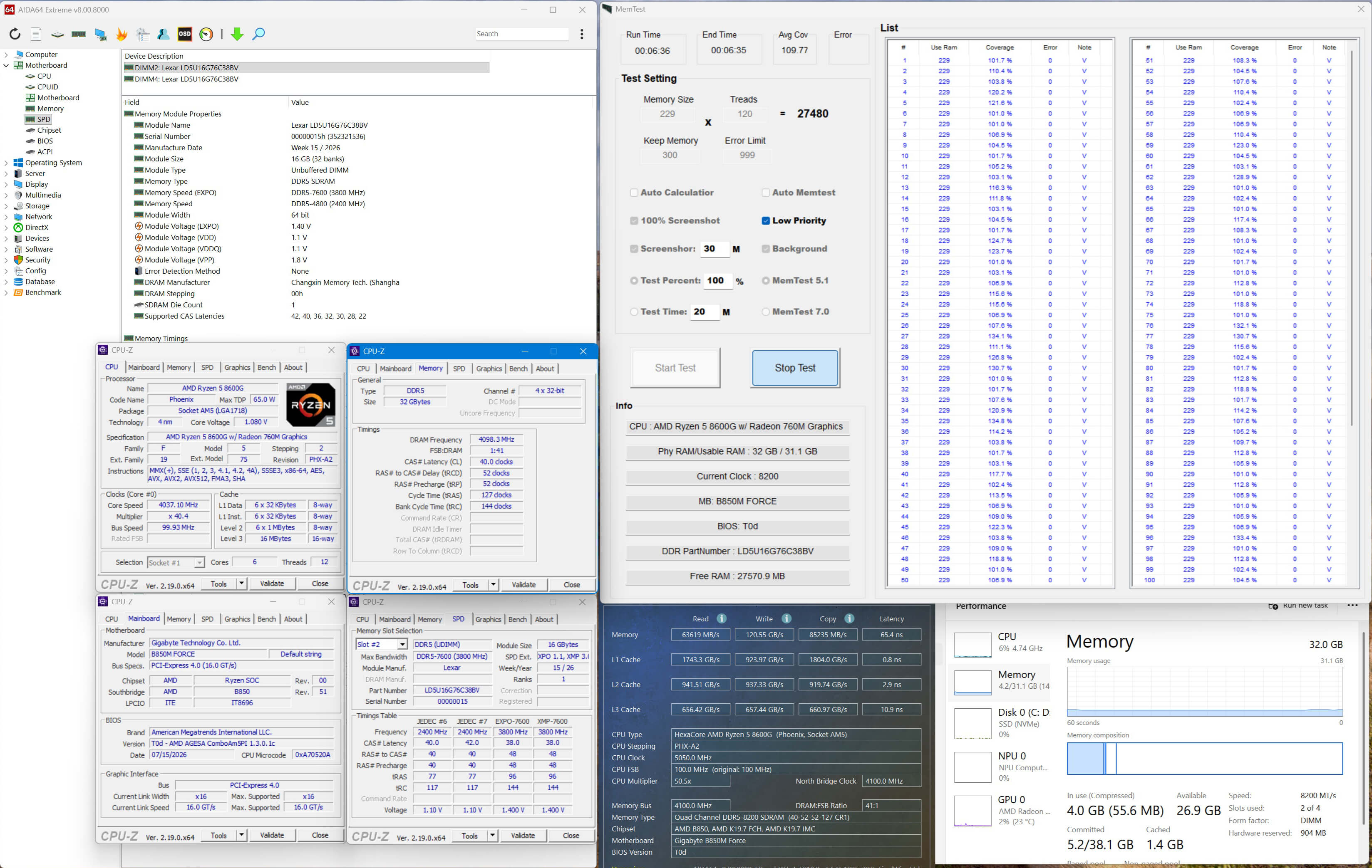
As proof, Gigabyte offers up a CPU-Z screenshot showing a pair of 16GB Lexar modules equipped with CXMT chips achieving a speed of 8200 MT/s with a CAS latency of just 40 cycles on one of its B850M FORCE motherboards. We have to remark that Gigabyte doesn't show the voltage required to hit these speeds, likely for good reason, but the firm did it without disabling the chip's integrated graphics. That doesn't prevent the chips from posting an excellent AIDA64 latency of just 65.4 nanoseconds on the monolithic Ryzen 5 8600G used for the test. For context, typical EXPO kits usually run around 80ns, JEDEC timings are more like 100ns, and LPDDR-based systems rarely come below 110-120ns.

As Gigabyte says, "CXSH (CXMT) chip-based memory offers a welcome additional source of supply for consumers." (CXSH is the JEDEC manufacturer ID code for CXMT) Gigabyte specifically notes that it is modules with 16-gigabit and 24-gigabit ICs that are supported; that means 16GB and 24GB single-rank modules, or 32GB and 48GB dual-rank modules.

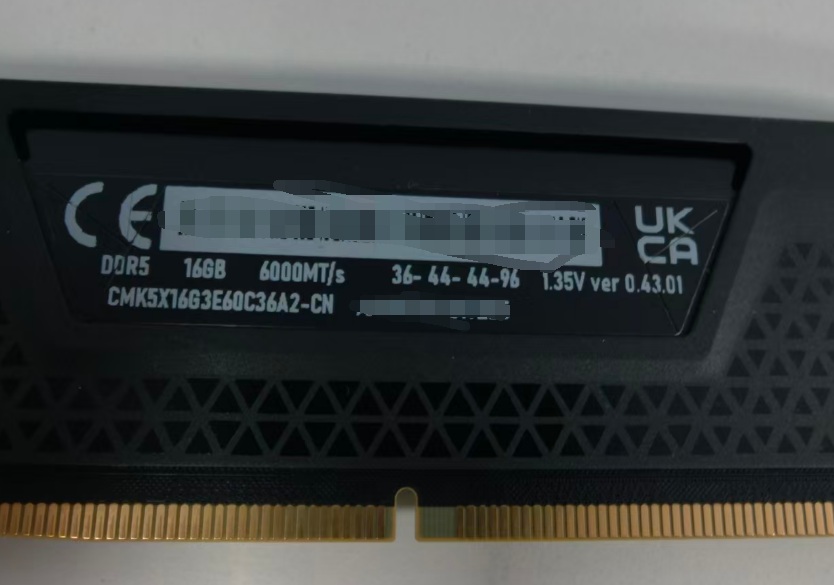
Corsair Vengeance DDR5-6000 memory module with CXMT chips inside

This Corsair module has CXMT chips inside, but it's also exclusive to China. (Image credit: @wxnod on X)

While CXMT memory is certainly a welcome additional source of supply, it's also not really clear how much of that memory is actually making its way outside of China, particularly to the US and Europe. CXMT isn't on the US Commerce Department's "Entity List" yet, so the firm's parts aren't actually banned, but the company is once again considered a Chinese military company by the Department of Defense after being briefly removed from the 1260H list in February. Lawmakers here in the states, likely laden with donations from the big three memory firms, want to see CXMT banned, while US tech companies like Corsair, HP, and Dell are already integrating ChangXin RAM into their products, and Apple wants in, too.

The reality is that, as a DIY builder, you are fairly unlikely to know or care if your memory is manufactured by CXMT. You don't usually buy RAM directly from SK hynix, Samsung, or Micron (certainly not since Micron unceremoniously executed Crucial); you buy your RAM from Silicon Power, G.SKILL, Patriot, Corsair, or one of the many other vendors who assemble DIMMs. If the RAM runs at its rated specifications, there's not a lot of reason for the individual consumer to care where it came from. It's nice to hear that the new chips are officially supported by familiar mainboards, though.

CXMT's DDR5 RAM isn't as performant or as consistent as SK hynix dies, early testing shows — reveals resistance to voltage scaling and inferior manual overclocking capabilities

2026年7月16日 00:34

Homegrown DDR5 memory from China, manufactured by ChangXing Memory Technologies, has been making the rounds lately as more and more vendors start legitimizing it. However, new testing from overclocker Safedisk, shared by Uniko's Hardware, purportedly shows that it actually carries inferior performance compared to similar options from SK Hynix, alongside significant variance in the silicon between different batches.

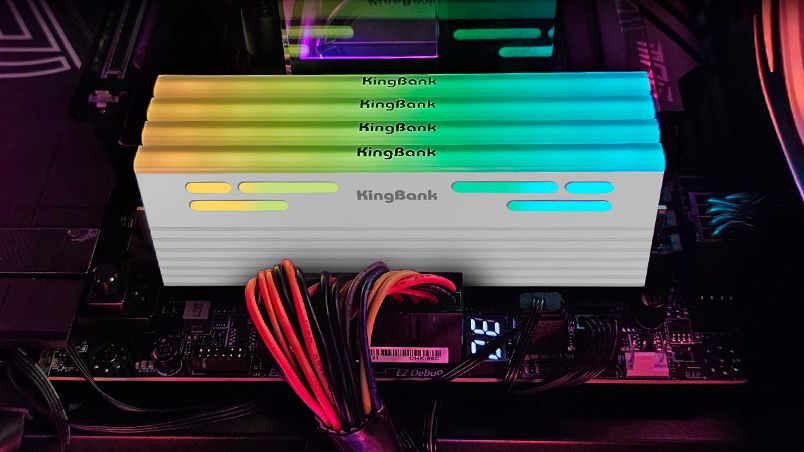
kingbank 2x24 6000c36 1.25 kit (cxmt 3gb dies) on asus c10amanual oc to 8600c44 mt 100%key characteristics of cxmt dies- dont scale with voltage- cant tighten timings- silicon variance appears to be massive between batches- not as strong as hynix when it comes to manual… pic.twitter.com/WNPRiHj233July 15, 2026

CXMT began producing DDR5 in late 2025 despite lacking any cutting-edge EUV lithography tools. Fast forward to today, and reports of the company matching Micron's memory capacity by this year are now floating around. If true, China would become the second-largest memory maker in the world. At such scale, it's no wonder that many companies in China have already started sourcing CXMT-made RAM to fill the gap in the consumer market.

Throughout 2026, we've seen motherboard manufacturers verify CXMT's DDR5 with official BIOS optimizations that allow it to run beyond 8,000 MT/s at this point. OEMs such as Dell and HP are using CXMT RAM in their region-bound systems, and even proper PC hardware companies like Corsair are using CXMT modules. Lexar, Kingbank, Netac, Asgard, Gloaway and more are also producing retail DDR5 kits with CXMT chips.

As such, the testing features a Kingbank 48GB (2x24) DDR5-6000 kit running at CL36 and found several weaknesses despite successfully achieving an 8,600 MT/s overclock at CL44. The first revelation is that CXMT modules don't scale with voltage, meaning you can't just increase voltage in hopes of achieving higher clocks. CXMT's DDR5 apparently doesn't respond well to tuning sub-timings either, forcing you to remain stuck with baseline CAS latency (or higher, like in this case).

Different batches of CXMT-equipped memory perform differently, too, so silicon lottery plays a much bigger role than it would with other vendors. Speaking of which, SK Hynix-made DDR5 modules allegedly performed better at identical clock speeds, while CXMT's modules were less susceptible to overclocking in general. We didn't get any comparative benchmarks for any metric, so take these claims with a grain of salt.

Overall, if the testing is to be believed, it serves as counterprogramming against the popular narrative forming around China as the savior of consumer interests. CXMT's strength lies in the fact that it doesn't have to cater to opulent AI clients as much as the Big Three, which reduces opportunity cost, allowing CXMT to produce more DDR5 memory. That doesn't mean it would be cheaper, though, or at least no evidence has suggested that so far.

CXMT has remained limited to the Chinese region for now, and breaking through to the Western market would mean impressing a lot of skeptics. Not only would pricing play a big factor, but the reliability of a new DRAM manufacturer would raise serious concerns. Stories like these certainly don't help, but with CXMT's IPO on the way, it's only a matter of time before it becomes a serious mainstream contender.

China-made CXMT memory now supports faster speeds on MSI's AMD motherboards — new BIOS adds DDR5-8200 validation on dual-DIMM, DDR5-7200 on quad-DIMM models

2026年7月7日 00:20

ChangXin Memory Technologies, or CXMT, has just received official validation from MSI for its high-speed DDR5 memory modules. The manufacturer has released new beta BIOSes across its AM5 lineup, unlocking stable frequencies up to 8,200 MT/s for 3GB CXMT chips on dual-DIMM motherboards. Previously, RAM using these modules was limited to around 6,800 MT/s despite the hardware itself being capable of much more.

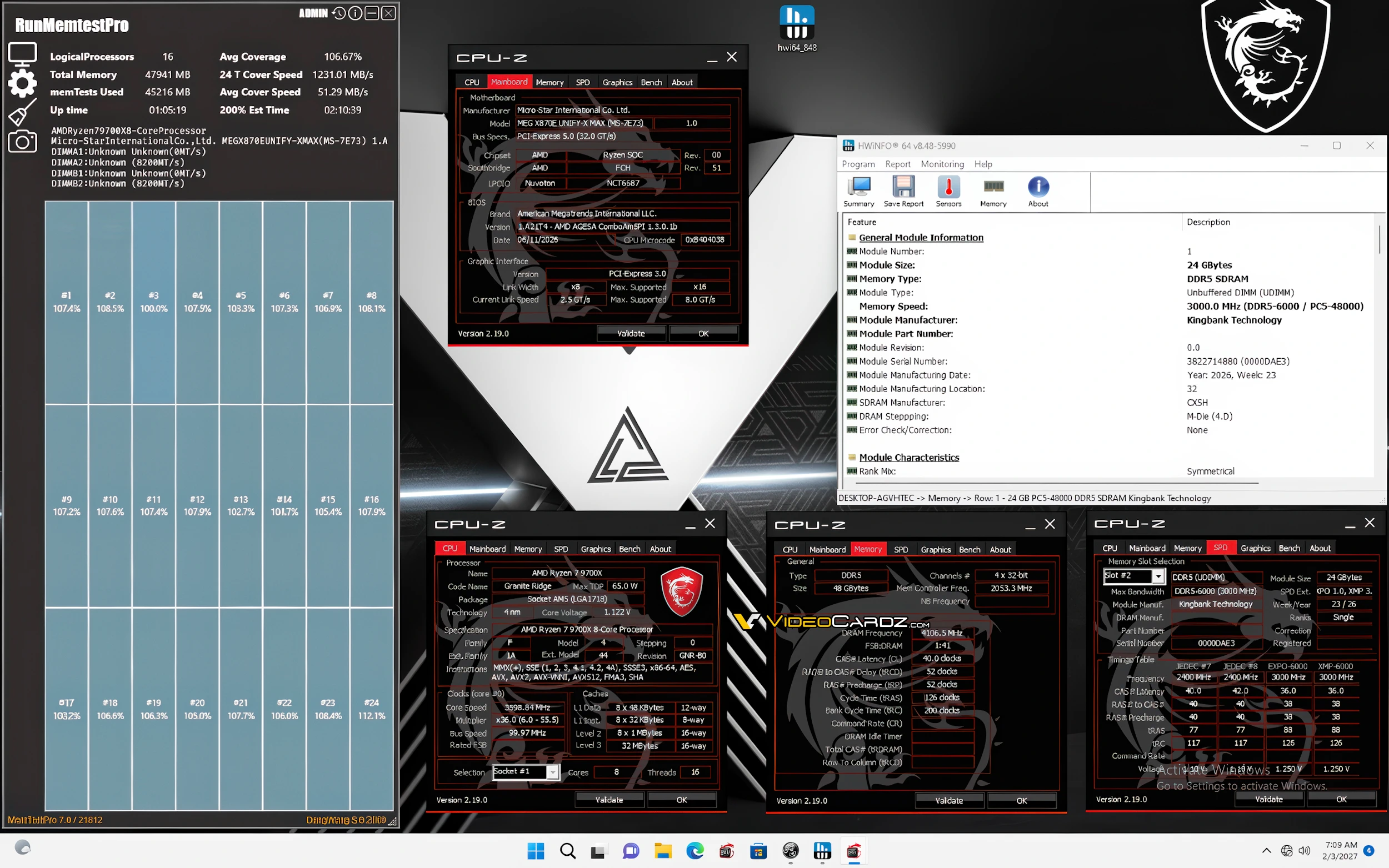
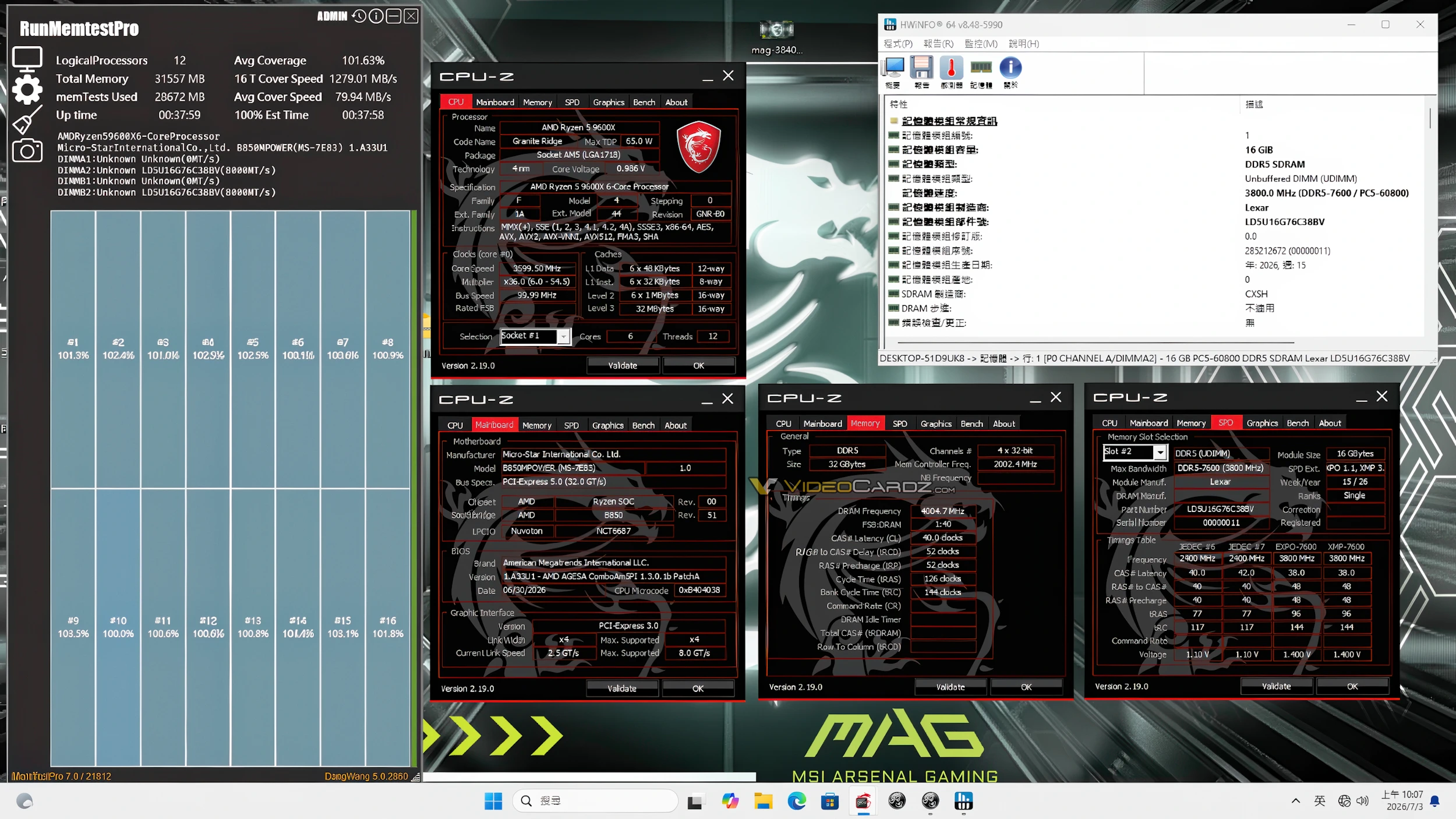
The test BIOS comes from MSI China — there's no announcement on global channels for some reason, and it's only available for select motherboards at the moment. MSI tested region-bound retail kits from Lexar and KingBank on boards with both two slots and four slots, but we only have screenshots for the former, courtesy of Videocardz.

One test was conducted using 24GB sticks (2x24) on the MEG X870E Unify model and a Ryzen 7 9700X CPU. This was mostly a standard kit since it came with a 6,000 MT/s EXPO profile. The other config consisted of 16GB sticks (2x16) with an EXPO profile already running at 7,200 MT/s, so it was somewhat cherry-picked silicon, paired with a Ryzen 5 9600X on a MAG B850 MPower motherboard.

CXMT-made RAM running at high frequencies on MSI motherboards with flying colors
MSI via Videocardz
CXMT-made RAM running at high frequencies on MSI motherboards with flying colors
MSI via Videocardz

The results showed that on dual-DIMM motherboards, 24Gbit (3GB) modules from CXMT were able to clock up to 8,200 MT/s, passing MemTest with 101% coverage. Conversely, 16Gbit (2GB) chips were also stable at 8,000 MT/s on the same test bench with 101% coverage. Moving over to quad-DIMM, the patch notes for the BIOS say they've "also been raised to DDR5-7200," where the limit was stuck at 6,800 MT/s prior.

This is not the first time MSI has optimized Chinese RAM for some of its motherboards. Earlier this year, the company did the same thing for Intel's 800-series models in China. Anyway, these specific BIOSes are meant for the AM5 socket and they're based on existing stable releases — just patched with unlocked memory overclocking features. More motherboards should be supported soon, but for now you can check out the MSI China's community release channel if you want to try one yourself.

Cooler Master is bringing active cooling to DDR5 RAM, promising up to 15-degree temperature drops — 'MasterDIMM' combines G.SKILL memory with a built-in fan, kits run up to 128GB

2026年5月29日 23:34
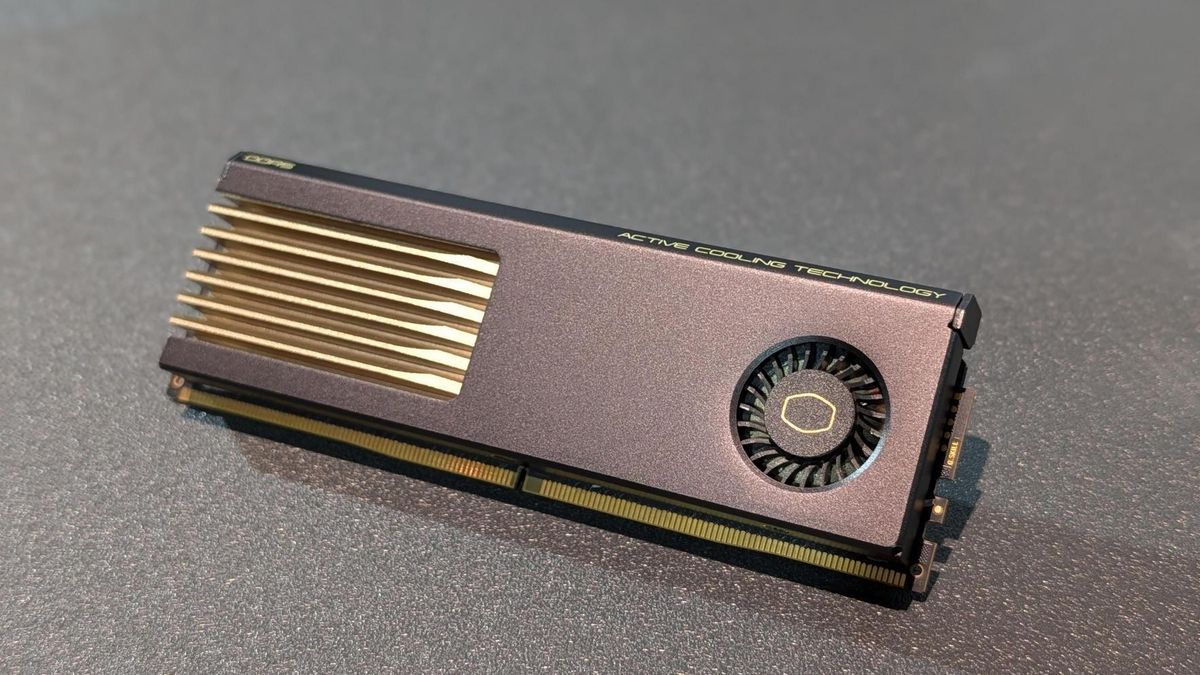
Cooler Master and G.Skill are launching "MasterDIMM" — a new line of DDR5 memory sticks that comes enveloped in a stylishly-thick black and gold heatsink that features a blower fan. Two RGB stripes run along the top to add even more flare to a product that can't be anything other than overpriced.

Chinese memory maker CXMT enters mainstream consumer memory with Corsair Vengeance DDR5 kit — Chinese-made DRAM emerges as an antidote for crushing shortages

2026年5月22日 23:45
Is the answer to the RAM crisis Chinese-made DRAM that's much cheaper to source since those companies aren't tied up in AI data center contracts? It's too early to say yet, but when a manufacturer as big as Corsair starts using DDR5 modules from ChangXing Memory Technologies (CXMT), that notion gains a lot of merit.

Scammers are selling fake DDR5 with empty plastic chips relabeled to pass as legit — fake components mounted to PCBs are yet another sign of the RAMpocalypse

2026年5月11日 18:50
DDR5 memory is overpriced right now, which might make some people desperate to get their hands on a good deal. Unfortunately, that could lead to you being taken advantage of with fake modules that are literally empty inside. A Japanese buyer warns of how this scam works and how to stay away from it.

New cost-effective DDR5 memory 'HUDIMMs' show around 50% reduction in throughput with single subchannel — Two HUDIMMs are as fast as a single stick of regular DDR5 RAM

2026年4月21日 03:28
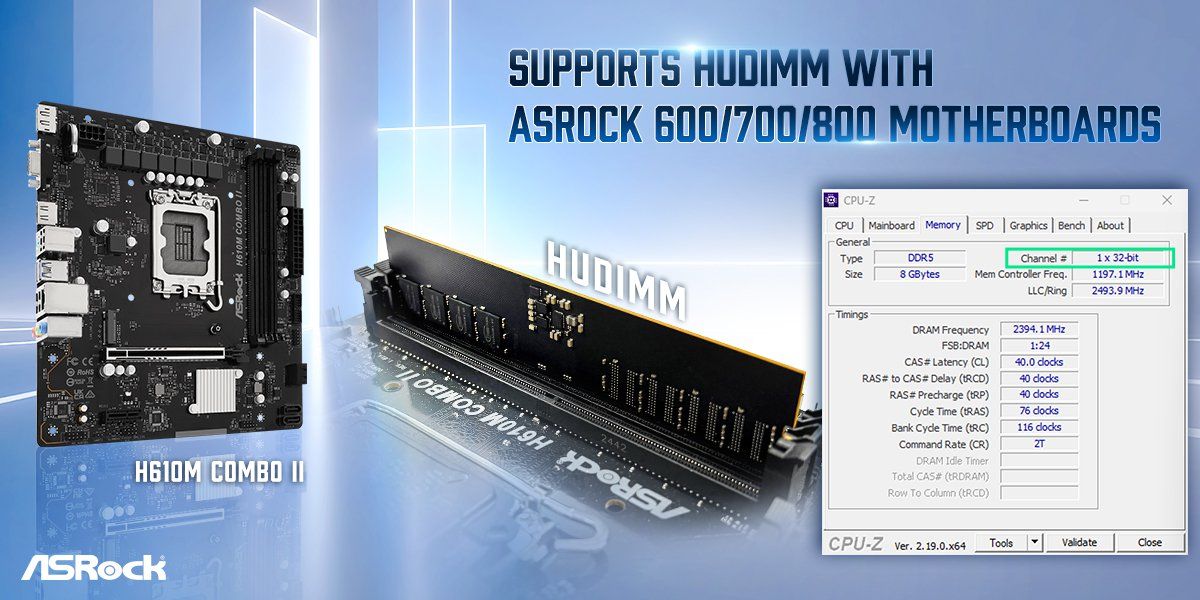
HUDIMM is being proposed as a cheaper memory spec using only 1x 32-bit subchannel per stick instead of 2x 32-bit in order to populate less ICs. Turns out, halving the bandwidth like that actually slashes the performance in half too, alongside the expected capacity reduction. Two HUDIMMs running in dual channel perform similar to a single regular DDR5 stick.

New HUDIMM memory specification debuts with goal of slashing DDR5 prices during RAM shortages — A new, cheaper memory standard with half the bandwidth and half the capacity

2026年4月19日 19:20
DDR5 RAM usually has 2x 32-bit subchannels (single rank), which requires more ICs to populate a 64-bit wide bus. ASRock's new HUDIMM has just 1x 32-bit channel and can work with standard DDR5 in mix-and-matched configs as well. HUDIMM sticks are being made by TeamGroup and are supported on most LGA 1700 ASRock motherboards.

Corsair's discounted 32GB Vengeance is the cheapest DDR5 on the market by a big margin — $300 sale price is $60 less than next best option

2026年3月26日 20:23
You can grab 32GB of DDR5-6200 Corsair Vengeance RAM for $300.99 right now. That's a $130 discount on its (current) list price, a serious saving in a market that the AI boom has left in ruin.

DDR5 RAM pricing begins to stabilize in Germany, January saw only a 0.1% increase — Some kits even saw price cuts as volatility begins to plateau

2026年2月3日 22:52
German retailers' inventory saw DDR5 memory prices stabilizing for the first time in months, with some kits even miraculously seeing price cuts compared to the start of January. This doesn't indicate that the crisis is over, or even that there will be no more price hikes, but rather that the unpredictability is finally starting to wither.

❌
❌