Laptops have long been a more expensive way to game, especially compared to a desktop gaming PC, for comparable components. But with the ever-rising costs of PC hardware in the current economic climate, it's a lot easier and now often cheaper to get a powerful prebuilt gaming PC or ready-made gaming laptop. Today's deal is on a large, 18-inch Asus ROG Strix G18 gaming laptop powered by an RTX 5080, now reduced by $600 to $2,699.99. It's still an expensive piece of kit, but you are getting a somewhat portable form factor and a good amount of memory and storage included in the specs for this large gaming laptop.
Asus's ROG Strix G18 is a large 18-inch laptop with a big screen. The 18-inch display sports an IPS panel with a 240Hz refresh rate and 500-nit brightness. Powering the display and your gaming performance is an NVIDIA RTX 5080 laptop GPU that includes 16GB of fast GDDR7 VRAM, along with the 24-core Core Ultra 9 275HX processor from Intel. Importantly, there's also a good amount of memory: 32GB of DDR5 RAM and a large 2TB PCIe Gen4 SSD for storage.
ROG Strix G18: was $3299.99 now $2699.99 A mighty 18-inch gaming laptop that uses a very powerful Nvidia RTX 5080 laptop GPU with 16GB of VRAM. The onboard processor is a 24-core Intel Core Ultra 9 275HX, sporting boost clock frequencies of up to 5.1 GHz, with an ample 32GB of DDR5 memory. There's also plenty of room for your game collection on the included 2TB SSD.
For any future upgrades, there's easy tool-less access to the SSD and RAM slots, which is a nice feature on a laptop. The keyboard features plenty of RGB backlit lighting that is configurable through Asus's Armory Crate software, along with an RGB light bar along the bottom of the laptop chassis, casting a distinctive glow on your desk that can sync with your keyboard and peripheral lighting.
For video connectivity, there's 1 x HDMI 2.1 port and 2 x Thunderbolt 5 ports, plus an Ethernet port for wired network access, with wireless options including Bluetooth and WiFi 7.
So if you want a ready-to-go gaming setup that's powerful enough to play all the latest game titles on a sharp 2.5K screen at high settings and frame rates, then the Asus ROG Strix G18 with RTX 5080 is a great choice, especially when you can save a hefty $600 off the price tag.
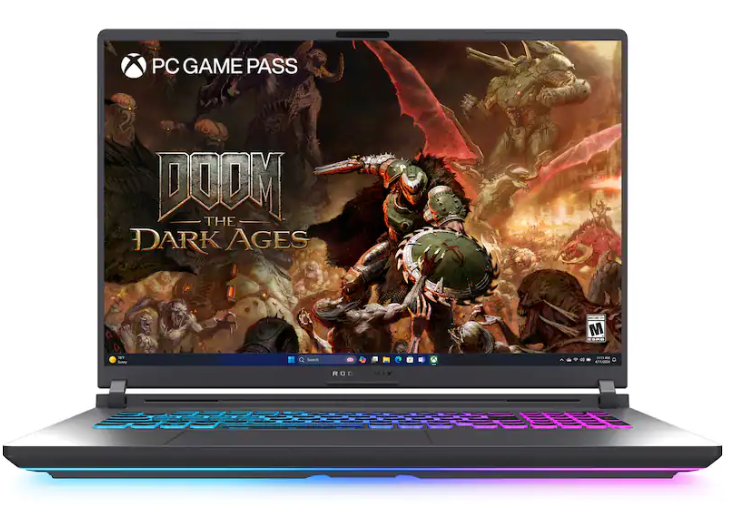
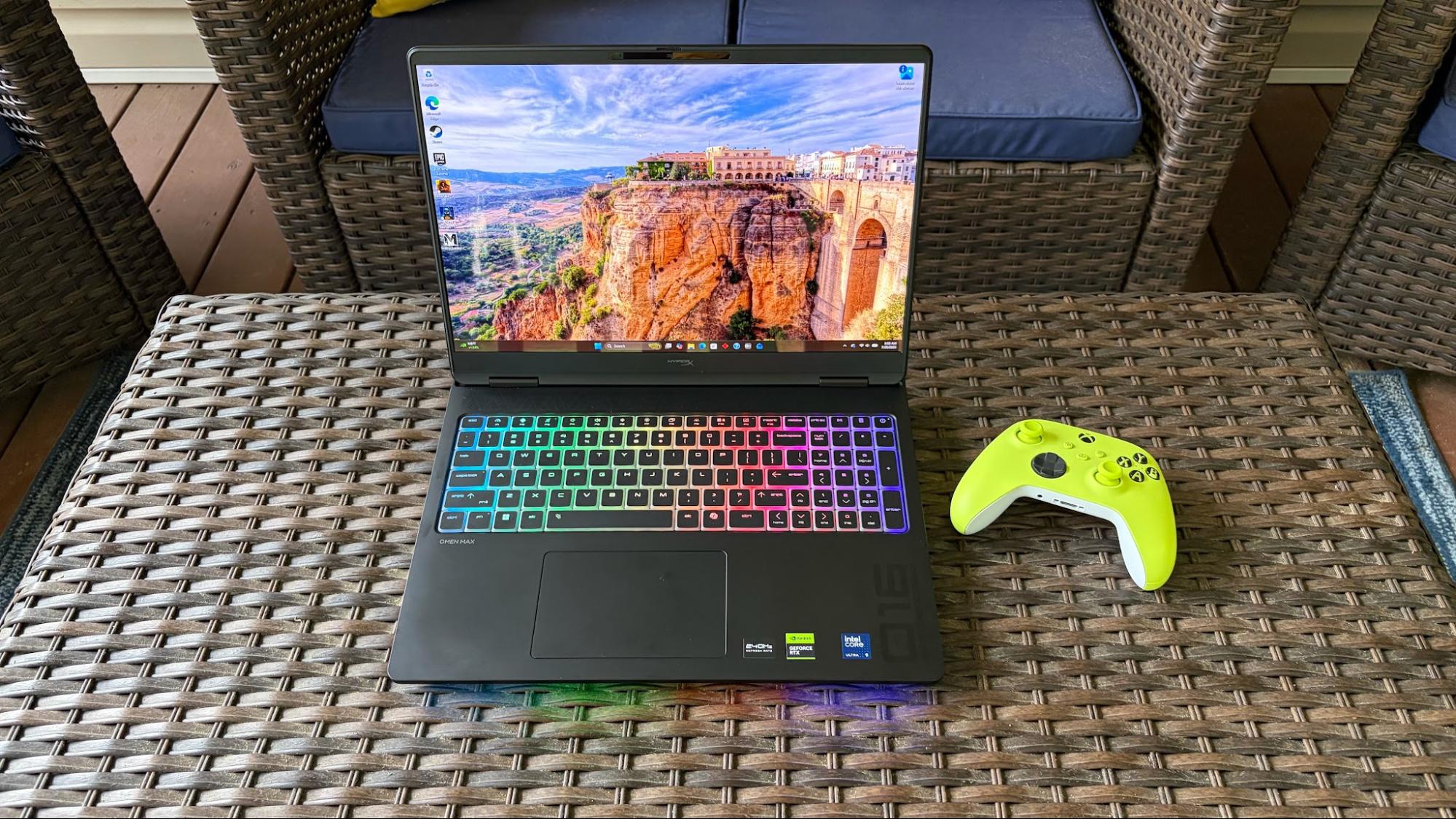
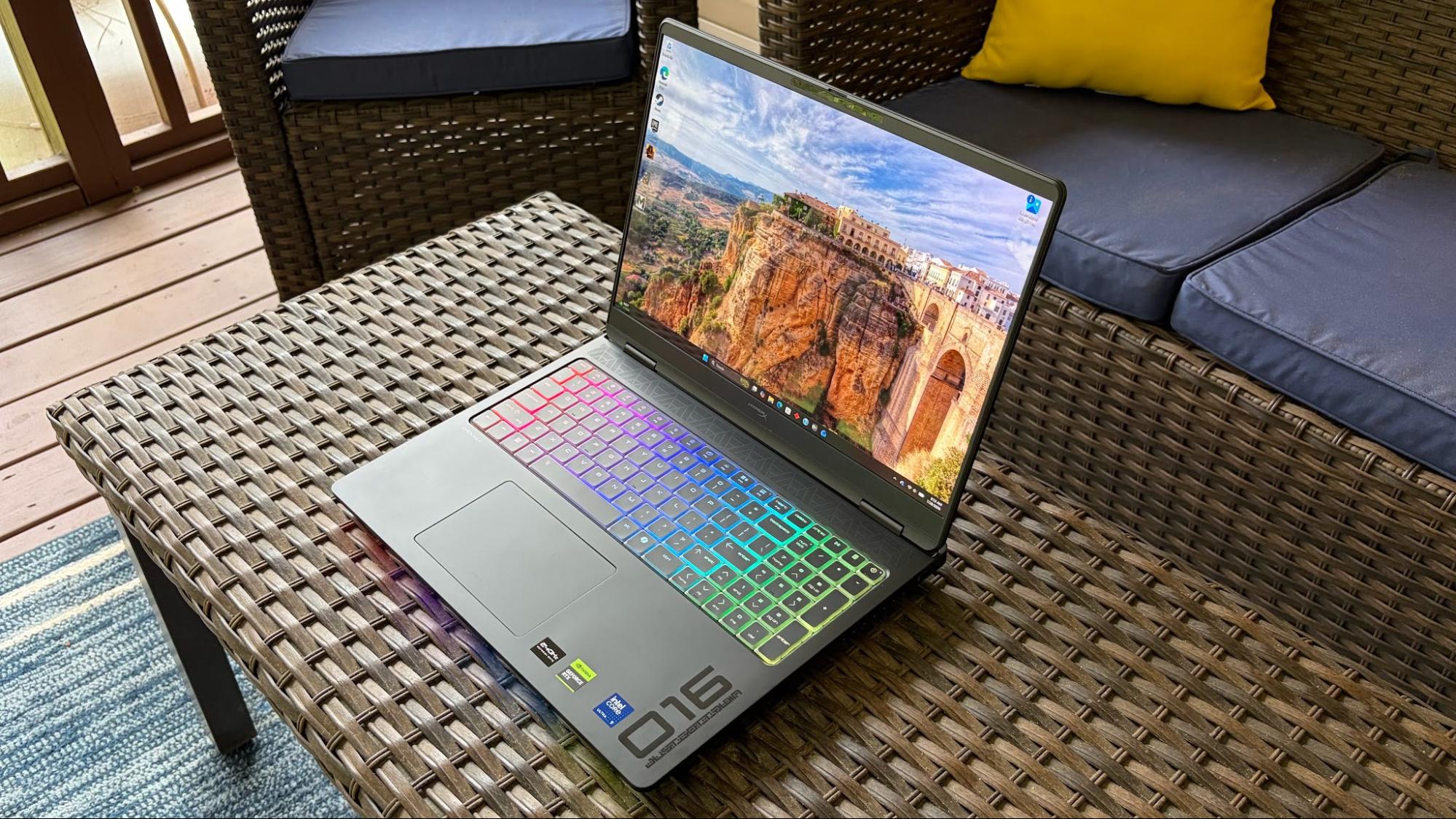
Want a powerful new OLED gaming laptop with a $1,000 discount on top? This HyperX Omen Max 16 gaming laptop from HP is down to $3,699.99 right now and features, among other top specs, an Nvidia GeForce RTX 5090 mobile GPU. You'll struggle to find a better spec'd laptop at this price point, and it's much cheaper than buying or building a top spec desktop gaming PC, too.
The mobile version of the RTX 5090 isn't quite as beefy as its desktop counterpart, but it's still the best GPU for a laptop that you can buy. Specs wise, it has 10,496 CUDA cores as its disposal, with 24GB of GDDR7 VRAM, operating on a 256-bit memory bus. A peak 175W TDP is much less than the desktop's 575W rating, but laptops are designed to be portable.
What's interesting is the pricing here. This laptop costs $3,699.99, and that's for an entire working system. If you wanted to buy the desktop version of the RTX 5090 alone from a retailer that has it in stock, it'd set you back at least $5,899. You could argue that they're totally different beasts, but PC gaming is getting really expensive. Buying a new desktop PC will set cost you thousands of dollars more than it would have last year. A top-spec laptop this like HyperX Omen Max 16 is the better of the two options from a financial point of view right now, especially as it'll still be able to handle modern games with the best settings for years to come.
An OLED gaming laptop with a huge $1,000 discount. This HP-made, 16-inch HyperX Omen Max 16 laptop features a 16-inch OLED panel with a 240Hz refresh rate, capable of outputting at 1600p.
It ships with the mobile version of the Nvidia GeForce RTX 5090, along with the 24-core Intel Core Ultra 9 290HX Plus, 32GB of DDR5-6400 RAM, and a 2TB SSD for storage. View Deal
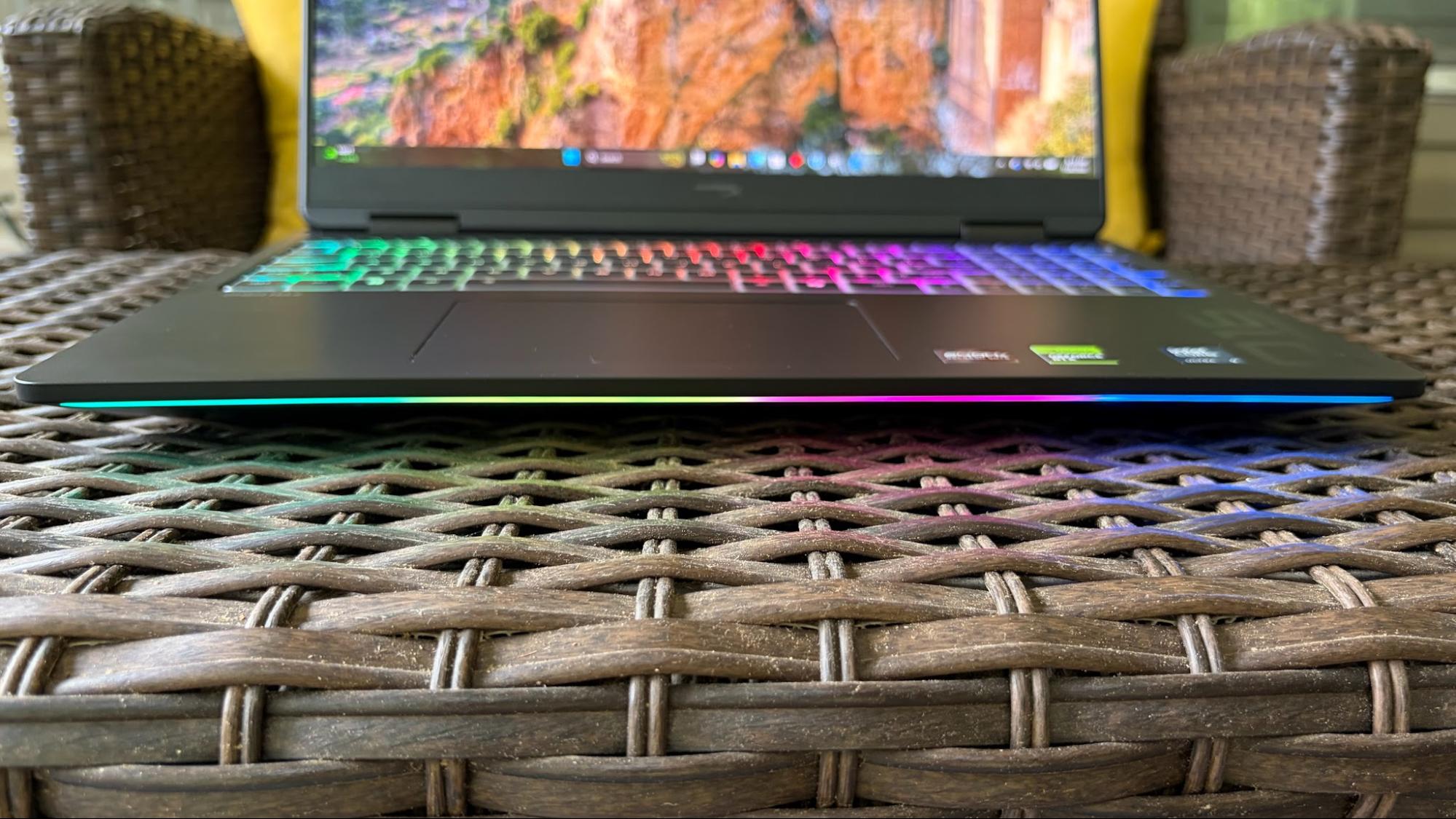
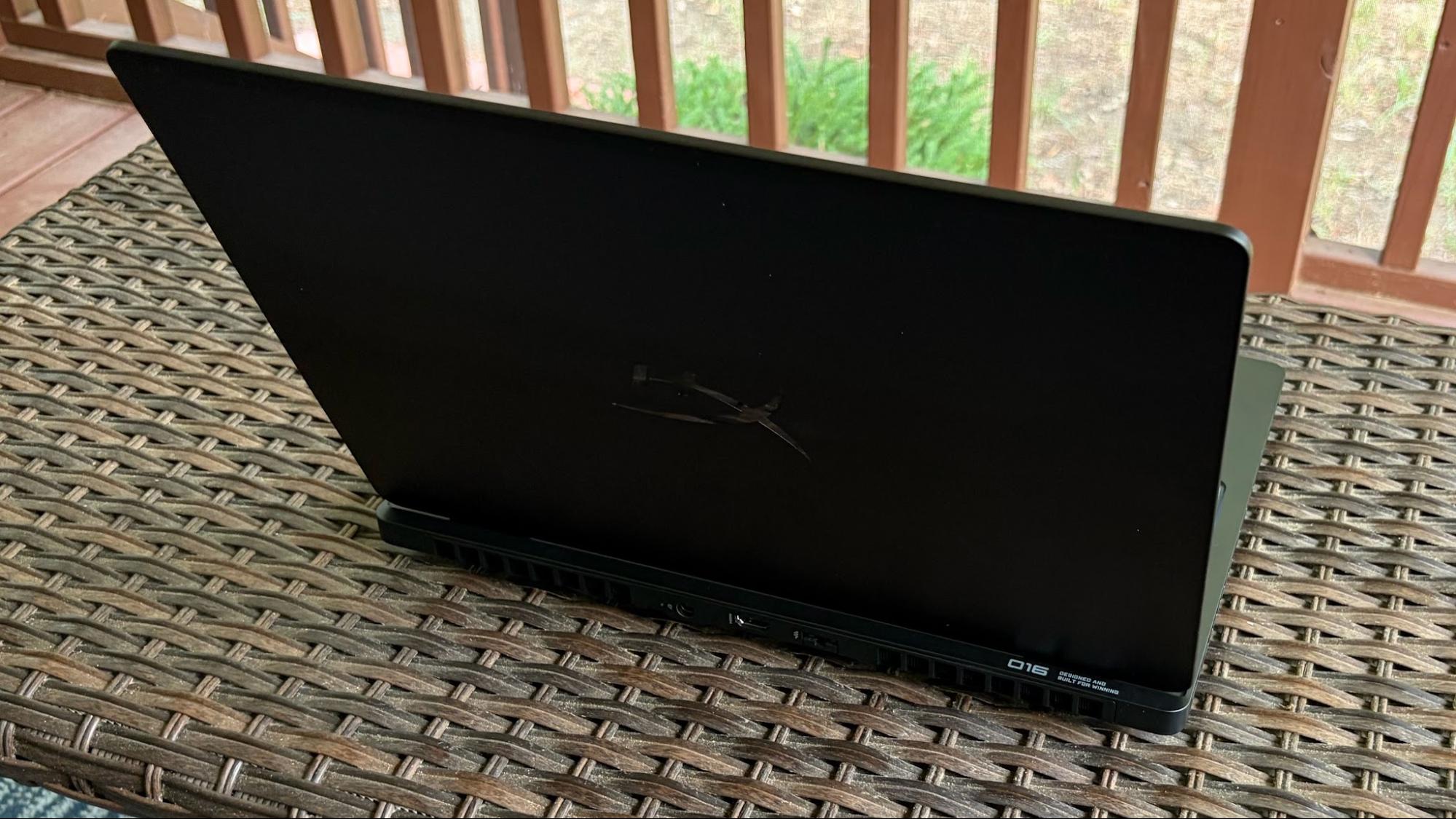
As for this laptop, our HyperX Omen Max 16 review made clear that its original launch pricing didn't quite work, with better performance from rival laptops. The $1,000 drop makes it a much more attractive system, with a gorgeous build quality that's "solid as a rock." It's built with aluminum, with no flashy styling gimmicks, just a matte black finish and RGB lighting for the keyboard. It's weighty, too, measuring 14.04 x 10.59 x 1.03 inches and weighing 6.56 pounds.
This HyperX laptop has a 16-inch OLED display, will give you perfect blacks and infinite contrast compared to a cheaper LCD, with an ultra-fast 240Hz refresh rate for smooth, blur-free motion. The top resolution on this laptop's display is 2,500 x 1,600, and coupled with the RTX 5090, you won't struggle to hit the highest frame rates with Ultra graphics presets applied at 1600p, with the option to hook up to an external display using the supplied HDMI port if you prefer.
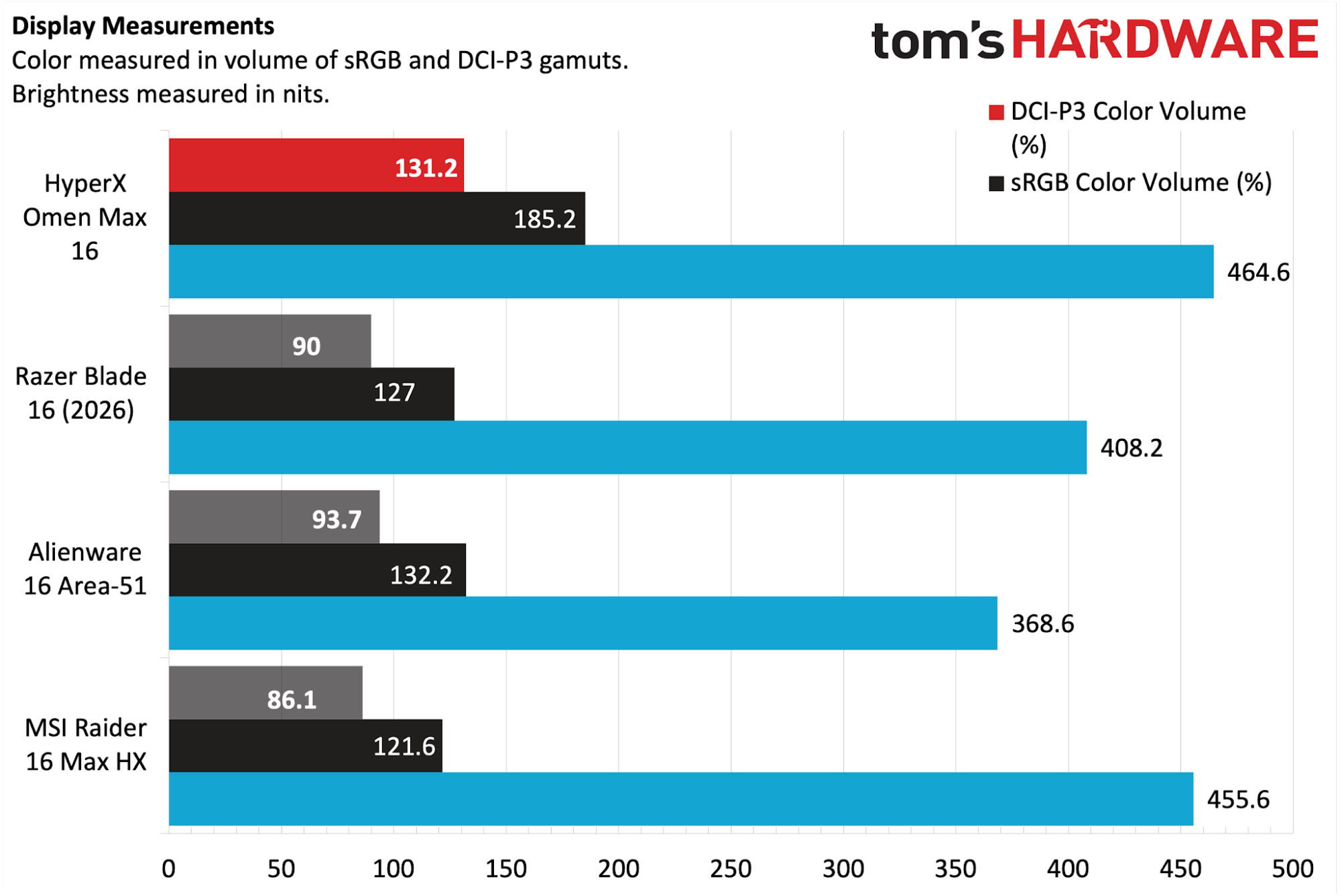
Games, movies and more are going to look incredible on this OLED panel, as it'll produce rich colors with plenty of depth, with 500-nit rated brightness, along with a max 1,100 for HDR content, to keep things vivid on-screen. Our review found it performed extremely well against the competition, with 131.2 percent of the DCI-P3 color space and 185.2 percent of sRGB. It also beat the MSI Raider 16 Max HX for panel brightness in our tests, with 464.6 nits vs 455.6.
(Image credit: Tom's Hardware)
The RTX 5090 is the centerpiece of this laptop, but you're also the Intel Core Ultra 9 290HX Plus as your CPU. It ships with 24 cores, eight of which are performance cores, which are good for gaming, along with 16 efficient cores for multi-threaded work. You're getting 32GB of DDR5-6400 RAM included, so no need to worry about the RAMpocalypse with this rig, along with a 2TB SSD offering Gen 5 speeds.
Wi-Fi 7 and Bluetooth 5.4 support ensures the fastest wireless connectivity, and you've got plenty of I/O too, including 2.5Gb Ethernet, the already-mentioned HDMI, a headphone jack, and two Type-C ports.
The $3,699.99 sale price for this HyperX Omen Max 16 OLED gaming laptop makes it a much more appealing option for buyers. In a market where an equivalent high spec desktop PC can set you back over $6,000, this price for a high spec laptop with an RTX 5090 is a good one in the current market. Grab it while you can, because HP aren't likely to keep it this cheap for long.
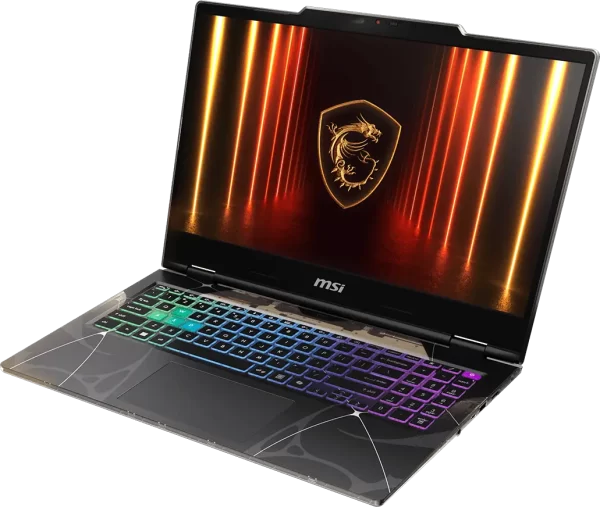
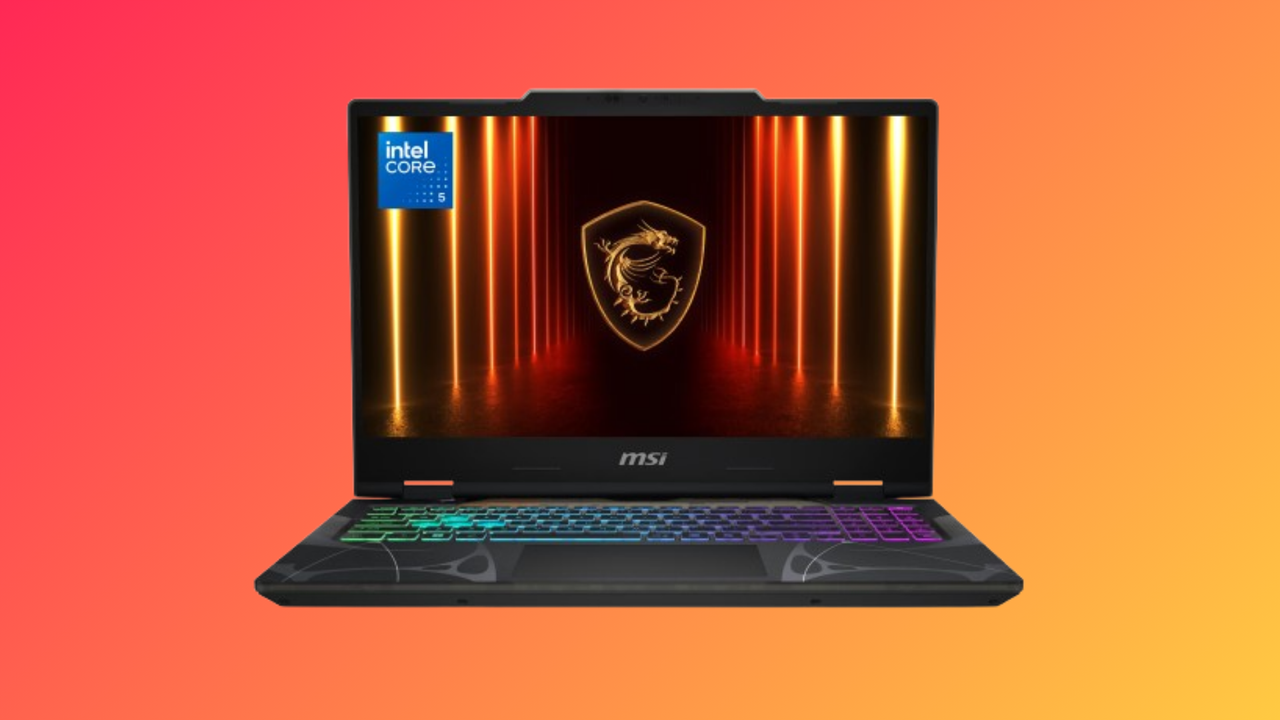
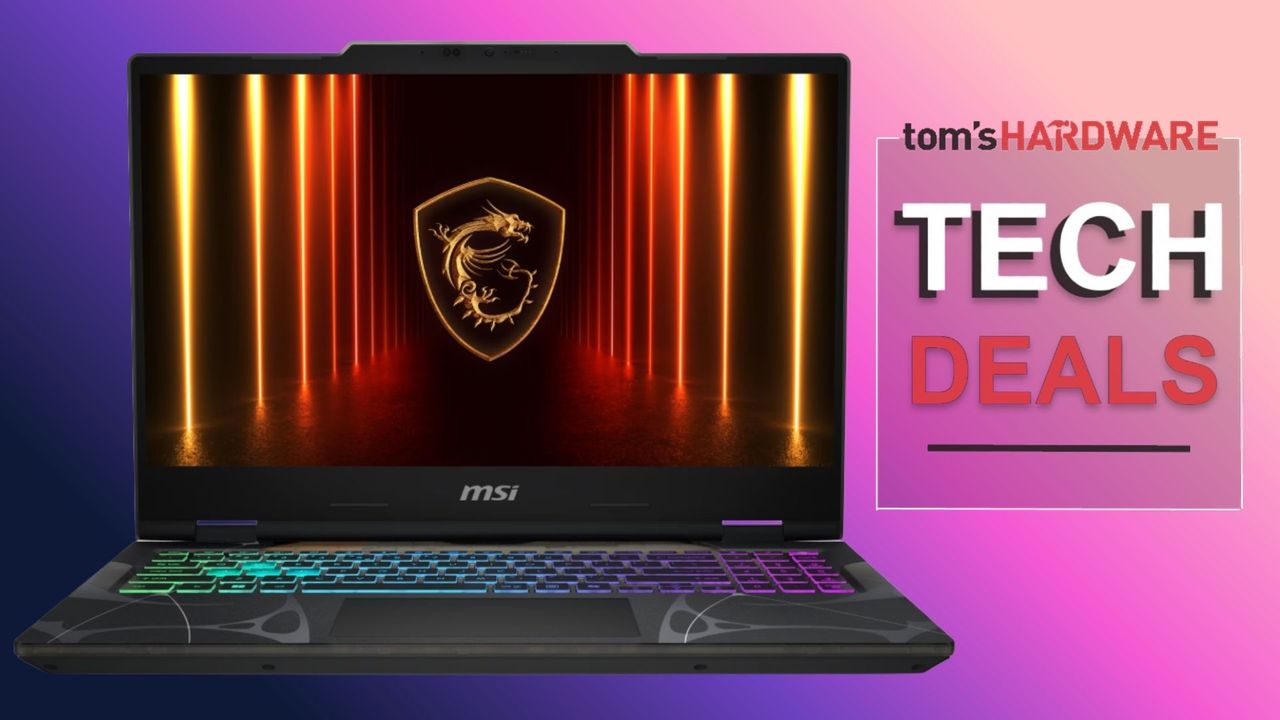
A cracking deal at Walmart could set you up with a brand new gaming laptop, capable of hitting high frame rates at 1080p. This MSI Cyborg 15 gaming laptop is down to $1,049 right now, a saving of $250, and it makes it one of the best value machines you can buy for gaming right now, especially considering the specs.
This laptop was $100 cheaper last month, but given the AI-fueled boom in PC hardware prices, that's a modest increase for a laptop that is still good value at this price. You're getting a 15.6-inch 1080p display with this MSI laptop, featuring a decent 144Hz refresh rate.
The Nvidia GeForce RTX 5060, meanwhile, is the best component in this rig. You're ditching integrated graphics for a current-gen Nvidia Blackwell GPU with 8GB VRAM and 3,328 CUDA cores. With Nvidia DLSS support enabling multi-frame generation for the most intensive games, you're going to easily hit high frame rates in games on this 1080p display.
The CPU, meanwhile, is an eight-core Intel Core 5 210H CPU, featuring four performance and four efficient cores apiece. You're also getting 16GB of DDR5-5600 RAM, which is a plus, as you're not settling for slower DDR4 speeds. A small compromise, given the price, is the 512GB SSD, which is still Gen 4, so it won't be particularly slow.
RTX 5060
Enjoy buttery-smooth gaming with the RTX 5060-powered Cyborg 15, coupled with the 8-core Intel Core 5 210H CPU and 16 GB RAM. Featuring a sleek design, plenty of battery life, and a 144 Hz 1080p IPS display, this is a solid machine for any task on the go — made even better at its discounted price. View Deal
The MSI Cyborg 15 has a clear aesthetic for gamers, with a slate gray chassis, combined with a symmetrical pattern on the keyboard and transparent plastic cutouts. The keyboard has four RGB zones, which you can configure, with the chassis also including a fingerprint reader and webcam privacy shutter. There's also a decently large 55.2 Wh battery for those on-the-go gaming sessions.
As for connectivity, you're getting Wi-Fi 6E and Bluetooth 5.3 support for wireless networking, while a Gigabit Ethernet port is included if you want to max out your connection. You've got USB-A and USB-C ports, along with an HDMI 2.1 port to hook up your laptop to a separate monitor.
The $1,049 sale price for this MSI Cyborg 15 makes it one of the best value laptops on the market right now for 1080p gaming. You're not settling for outdated components, with the RTX 5060 setting you up for gaming for several years to come. If you want a budget-friendly rig before the holiday season, this is the deal you'll want to take advantage of.
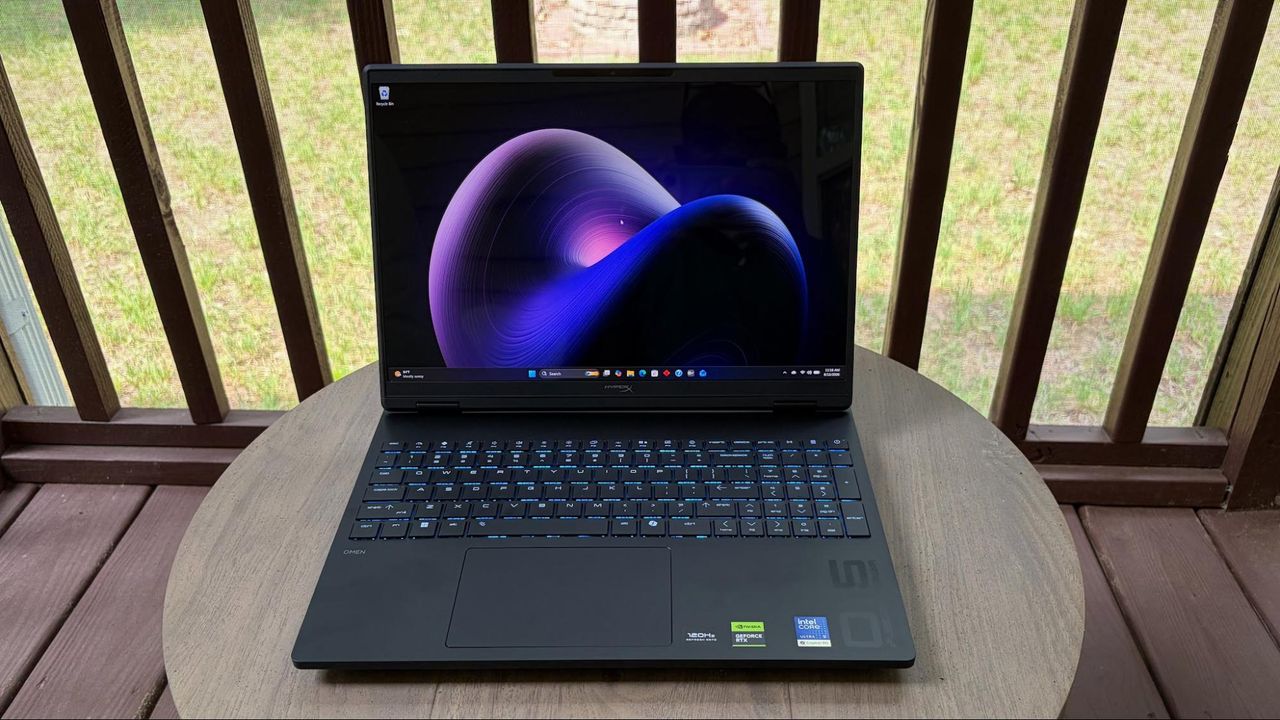
In today’s AI-dominated tech space, gamers have been bombarded with rising prices for storage, memory, and even GPUs. So gamers are increasingly looking for value when purchasing a new system. To that end, HP is attempting to deliver solid gaming performance at an accessible price with the HyperX Omen 15. It’s worth noting that the Omen now takes the place of the Victus 15 in HP’s mainstream gaming laptop range, with the Omen Max occupying the top spot.
The Omen 15 has a strong foundation with a Core Ultra 9 processor, 32GB of RAM, a 15.3-inch 1800p OLED display, and a sleek design. HP delivers all this for just over $2,000, and it has strong gaming performance, but there are compromises in chassis construction and features you’d expect at this price point.
Design of the HyperX Omen 15
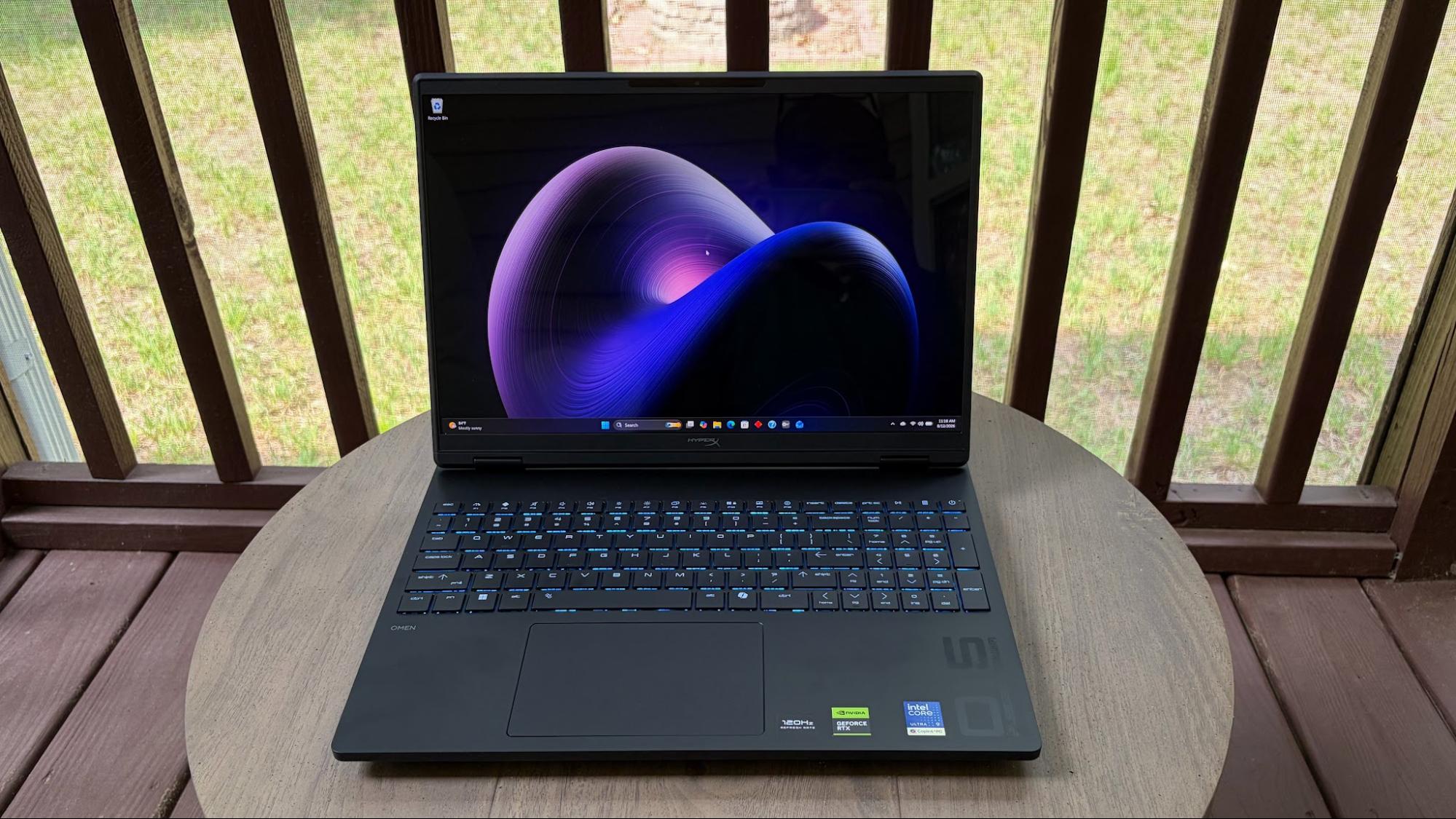
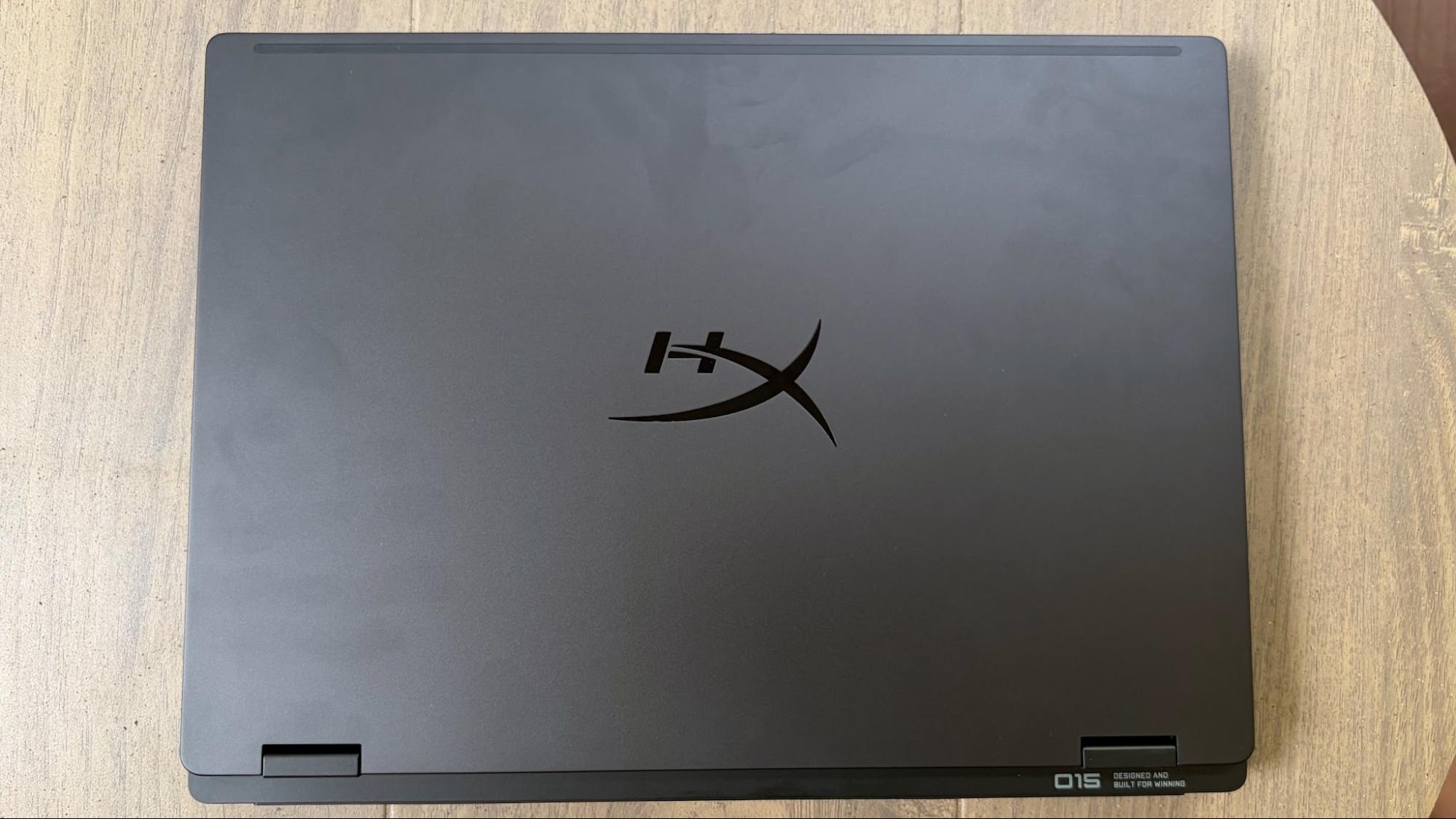
The Omen 15 shares its design language with the slightly larger Omen Max 16 that I previously reviewed. It’s an unassuming design, finished in Shadow Black, with just a hint of shimmering flakes if you look closely under light. There aren’t any garish design flourishes or additional RGB effects (other than the keyboard).
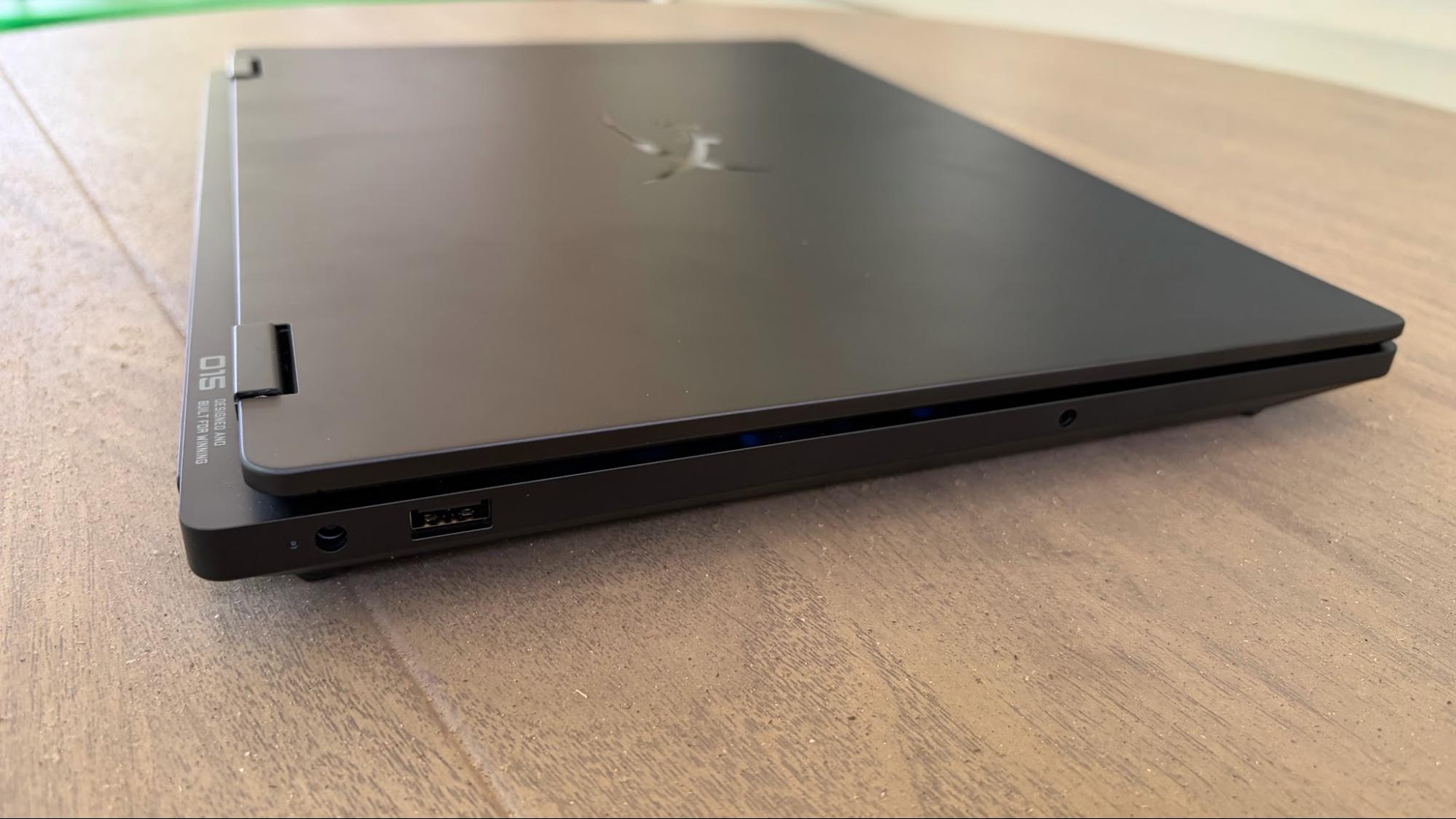
Like the Omen Max 16, the Omen 15 identifies itself with an “O15” script on the right side of the deck. Given that the Omen 15 is less than half the price of its larger sibling, you only get an aluminum lid. Everything else, including the upper and lower chassis, is constructed of a much cheaper (and more pliable) plastic.
The desk easily deforms when pressing on it, and the whole laptop flexes with minimal effort, twisting it from corner to corner. The overall feel of the laptop doesn’t quite seem up to par with what I’d expect from a gaming laptop priced over $2,000.
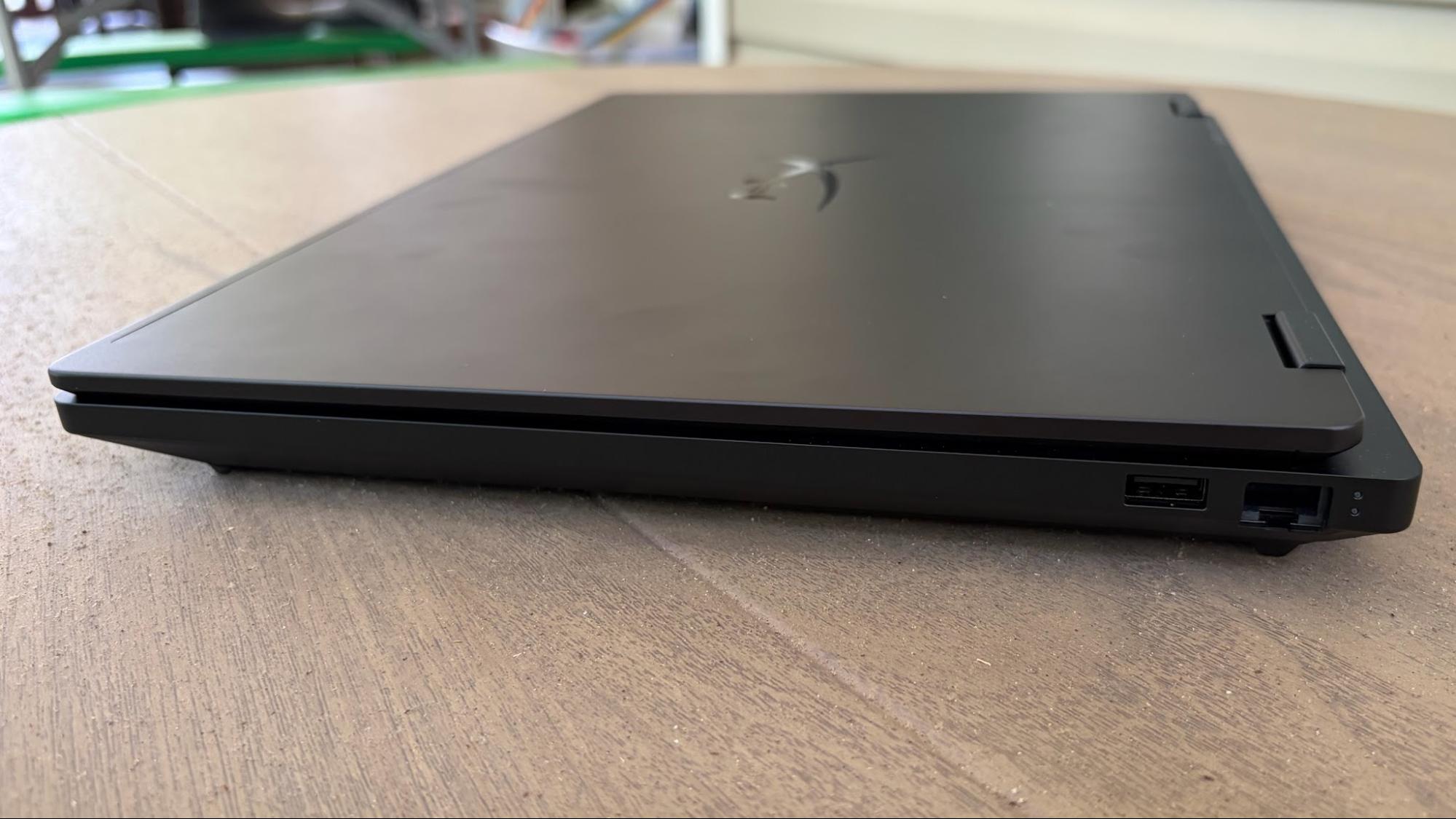
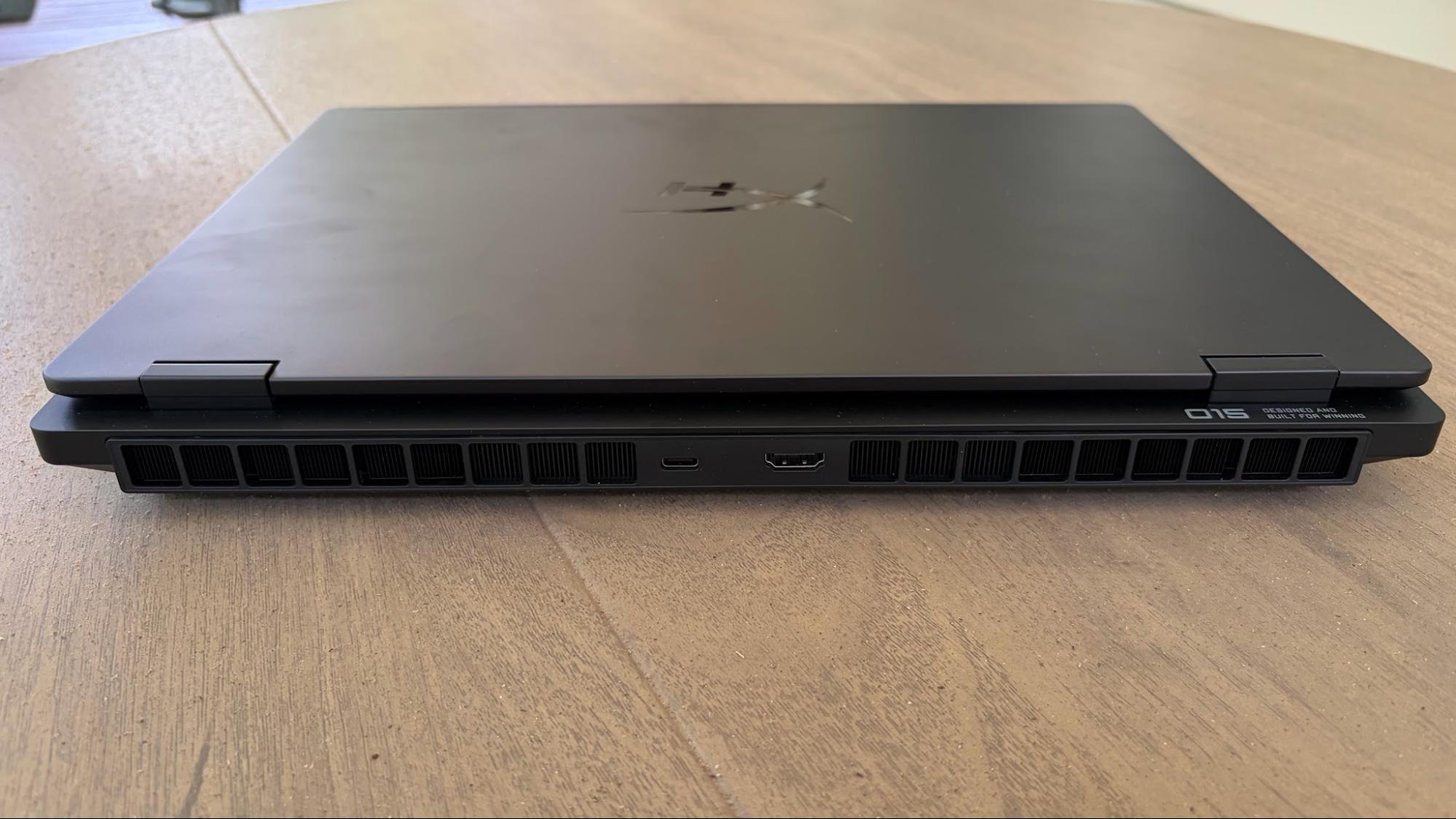
There’s also another interesting omission when looking around the chassis. Despite its price tag, there are no Thunderbolt ports. And you only get one USB-C 3.2 Gen 1 port on the back, beside an HDMI 2.1 port. There’s a GbE Ethernet port and a USB-A 3.2 Gen 1 port on the right side of the chassis, while a proprietary barrel-style power port, another USB-A port, and a 3.5 mm combo audio jack are on the left.
Our Omen 15 review unit measures 13.5 x 9.96 x 0.93 inches and weighs 4.89 pounds. For comparison, the Gigabyte Aero X16 is 14 x 9.9 x 0.78 inches and 4.2 pounds, while the Framework Laptop 16 measures 14.03 x 11.43 x 0.82 inches and 5.29 pounds. Finally, the Predator Triton 14 AI is 12.68 x 8.84 x 0.71 inches and 3.5 pounds (due to its smaller 14.5-inch display).
HyperX Omen 15 Specifications
CPU
Intel Core Ultra 9 386H
Graphics
Nvidia GeForce RTX 5070 Laptop GPU (8GB GDDR7, 1,642 MHz Boost Clock, 85 W Max TGP)
Our Omen 15 review unit came configured with an Intel Core Ultra 9 386H processor, 32GB of DDR5-5600 memory, and a GeForce RTX 5070 GPU (85W TGP).
As for the assembled competitors, we have the Aero X16 (Ryzen AI 7 350, 32GB, RTX 5070 85W), Predator Triton 14 AI (Core Ultra 9 288V, RTX 5070 110W), and Framework Laptop 16 (Ryzen AI 7 350, RTX 5070 100W).
I’ve been playing a lot of Battlefield 6 recently, and I tend to run at native resolution in Overkill detail mode, with DLSS Quality and frame generation enabled. However, I dialed it back to High detail mode instead of Overkill to accommodate just 8GB of memory on the RTX 5070. Using these settings, I was able to average between 70 and 85 frames per second.
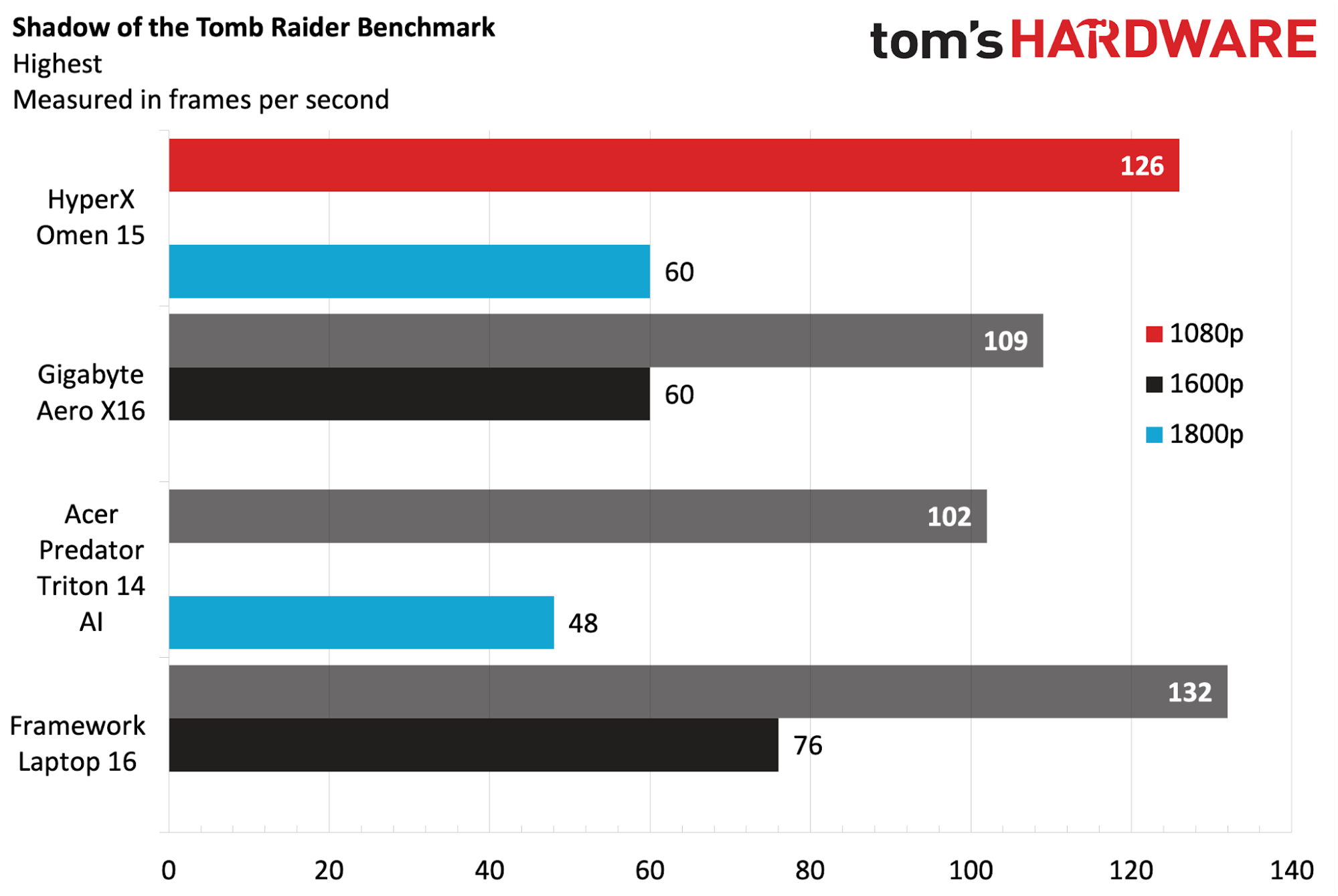
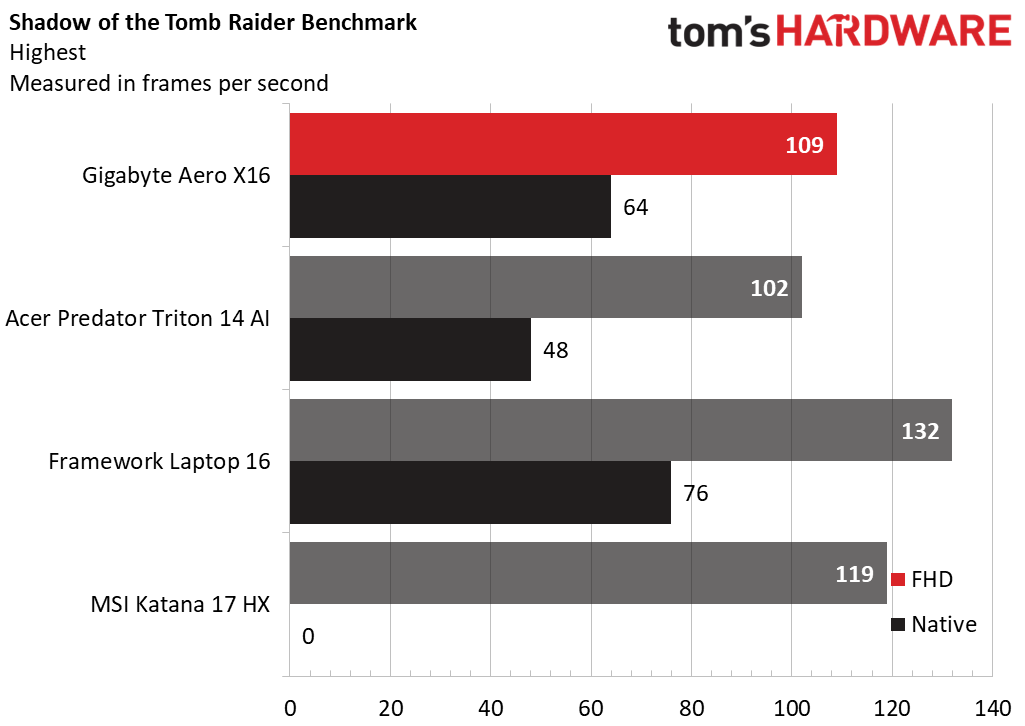
We start off our gaming benchmarks with Shadow of the Tomb Raider (Highest settings), where the Omen 15 started off on the right foot with 126 FPS at 1080p resolution and 60 FPS at 1800p. The Framework Laptop 16 eked out 6 additional FPS at 1080p and another 17 at its native resolution. However, we still consider it a good showing, given that the RTX 5070 in the Omen 15 operates at a 85W TGP (versus 100W for the Framework) and at a higher native resolution (1800p versus 1600p).
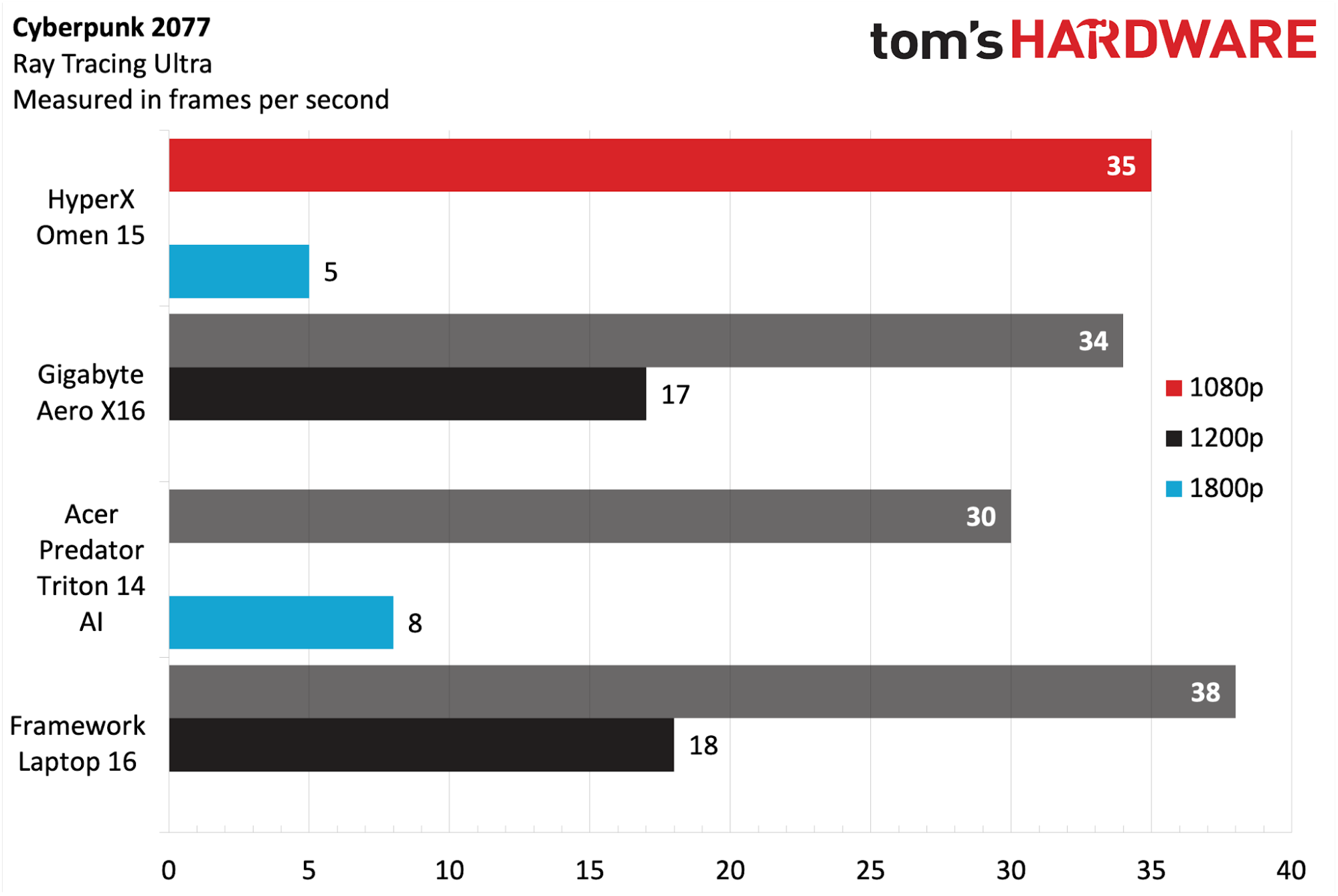
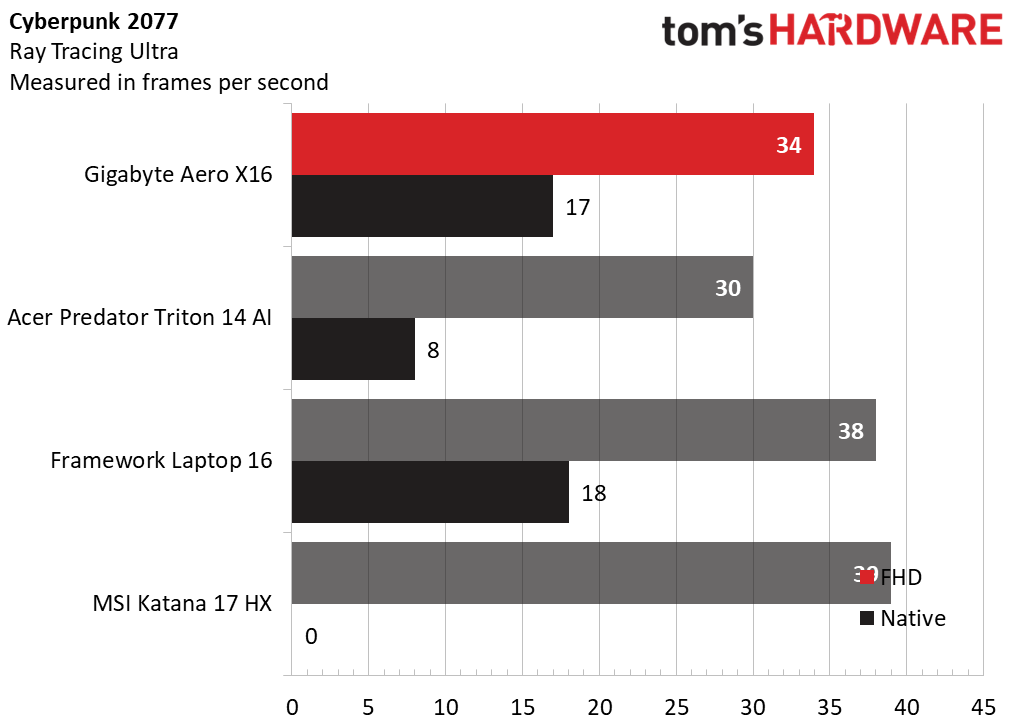
Cyberpunk 2077 (Ray Tracing Ultra settings) again saw the Omen 15 in second place to the Laptop 16. This time, it hit 35 FPS at 1080p resolution compared to 38 FPS for the Laptop 16. Performance at 1800p was in the single digits for the Omen 15, while the Laptop 16 managed 18 FPS. Both are slideshow-worthy numbers that are nothing to brag about.
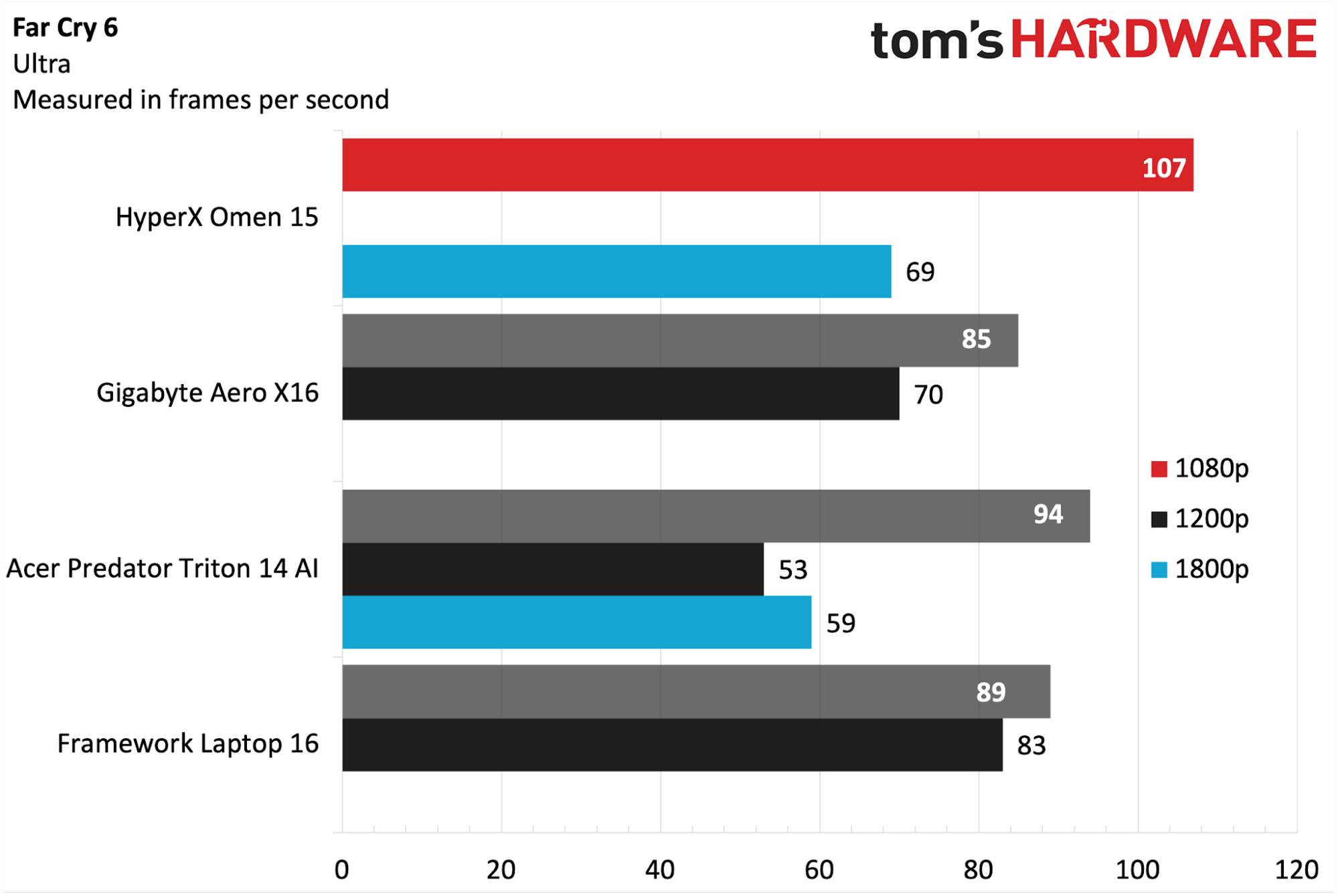
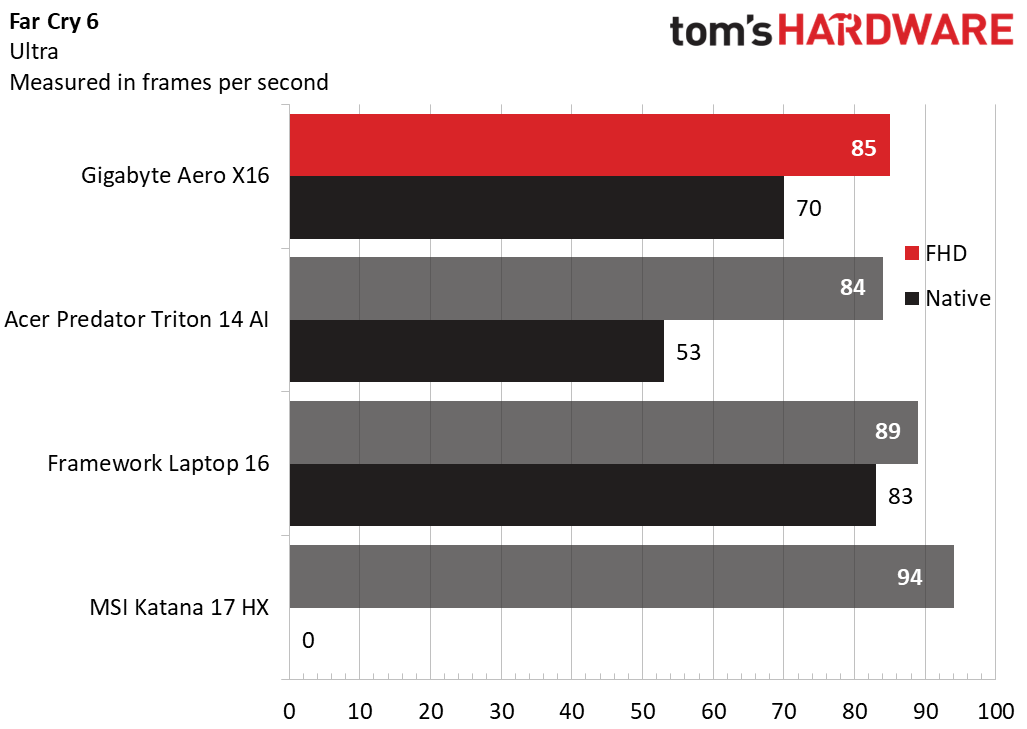
Far Cry 6 (Ultra settings) was a high point for the Omen 15, which bested all competitors with 107 FPS at 1080p resolution. Cranking the dial to 1800p, that figure dropped to 69 FPS, compared to 70 FPS for the Aero X16 running at 1600p. The Laptop 16 forged ahead with 83 FPS at 1600p.
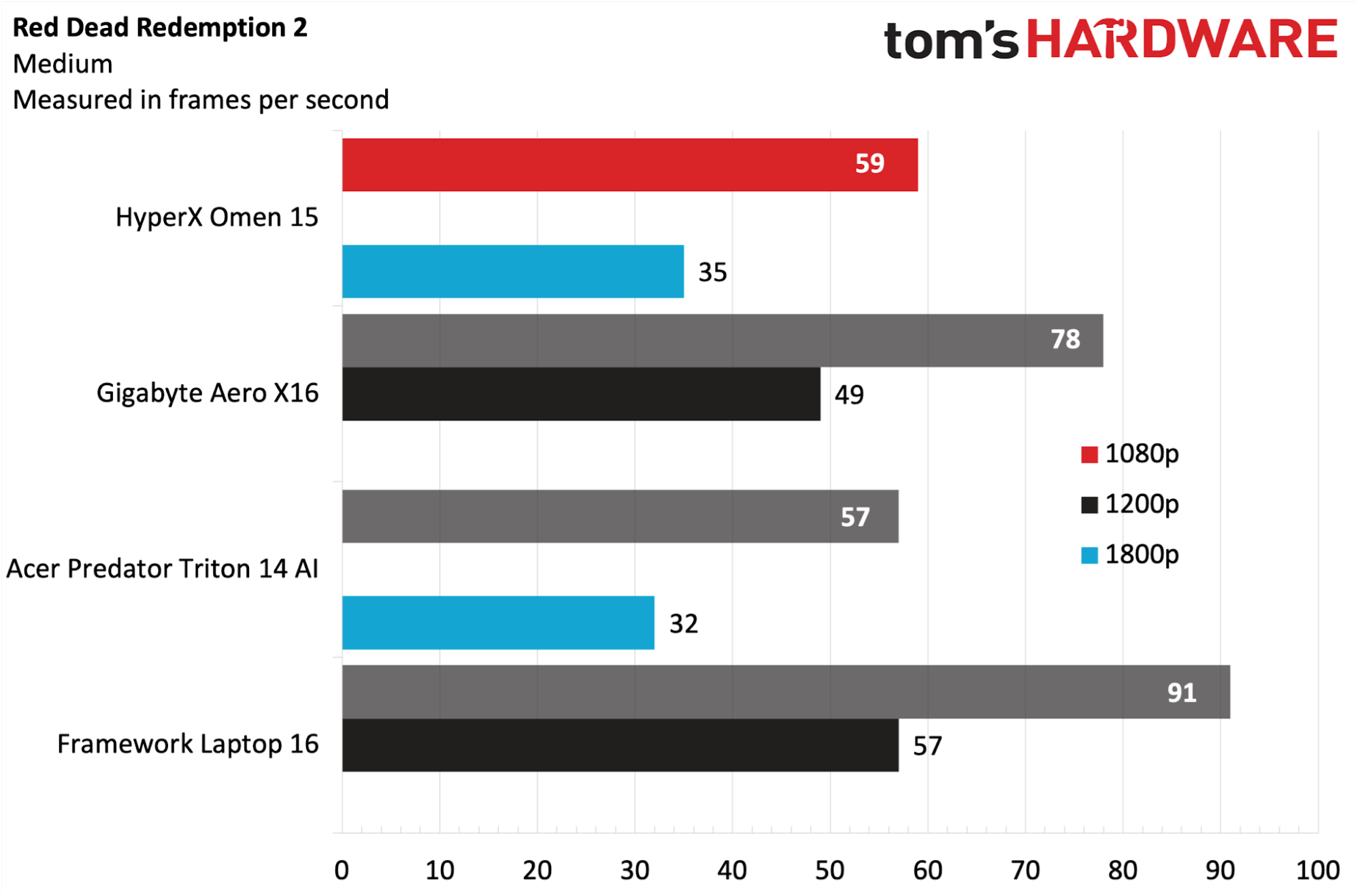
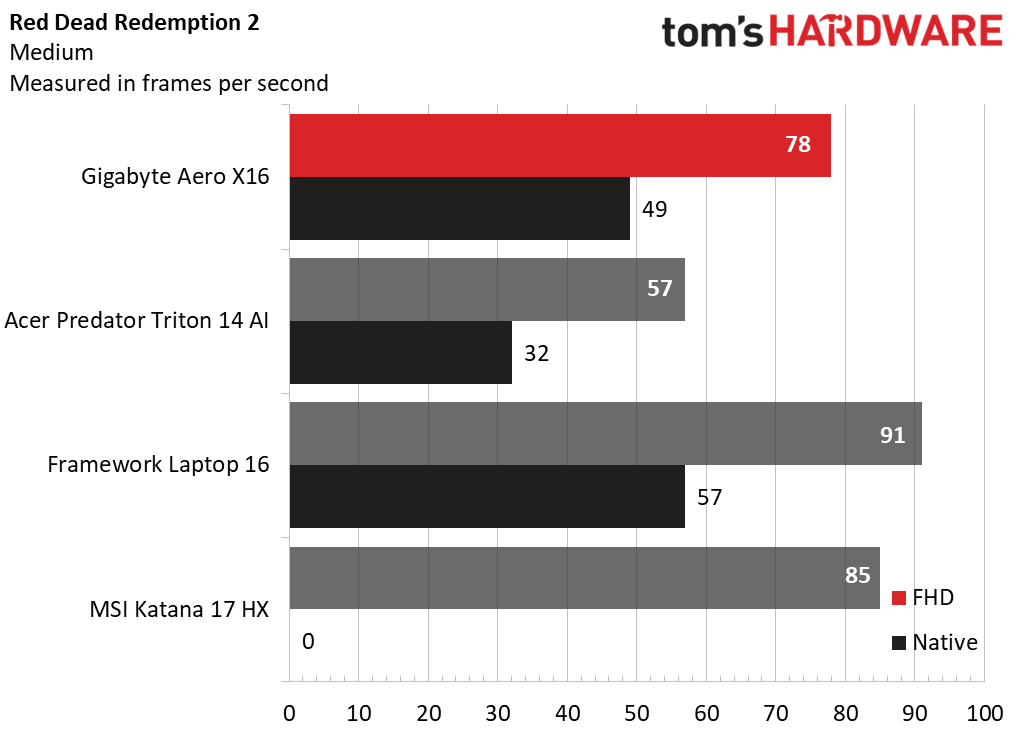
Red Dead Redemption 2 (Medium settings) was something of a sore spot for the Omen 15 (59 FPS at 1080p), which fell well below the Aero X16 (78 FPS) and the Laptop 16 (91 FPS). Boosting the resolution to 1800p also saw the Omen 15 in third place, with 35 FPS, well off the pace set by the Laptop 16 (57 FPS).
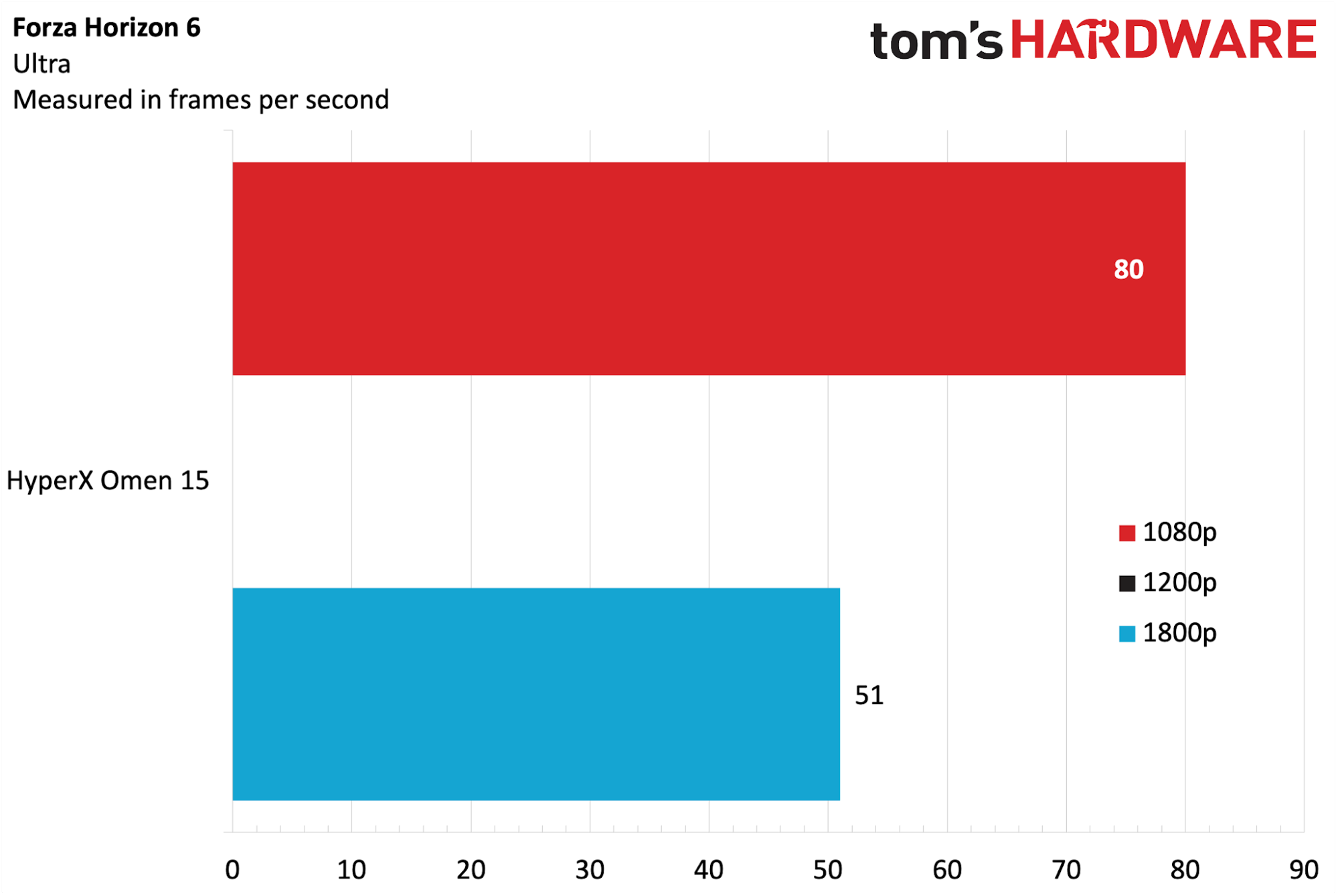
Forza Horizon 6 (Ultra settings) is a more recent benchmark in our testing suite, and so far, the Omen 15 is the only entry in this class of gaming laptops. With that said, the Omen 15 achieved 80 FPS at 1080p and 51 FPS at 1800p.
On our Metro Exodus stress test, the Omen 15 review unit averaged 141.62 FPS at 1080p across 15 loops using the RTX preset. The CPU performance cores averaged 3.52 GHz, the efficiency cores averaged 2.82 GHz, and the low-power efficiency cores ran at 1.9 GHz. The RTX 5070 GPU averaged 2.0 GHz.
Productivity Performance on the HyperX Omen 15
With a Core Ultra 9 386H processor, 32GB of DDR5-5600 memory, and a 1TB PCIe 4.0 SSD onboard, we expected solid performance from the Omen 15. Those expectations were met in terms of CPU performance, while storage performance lagged a bit behind the competition.
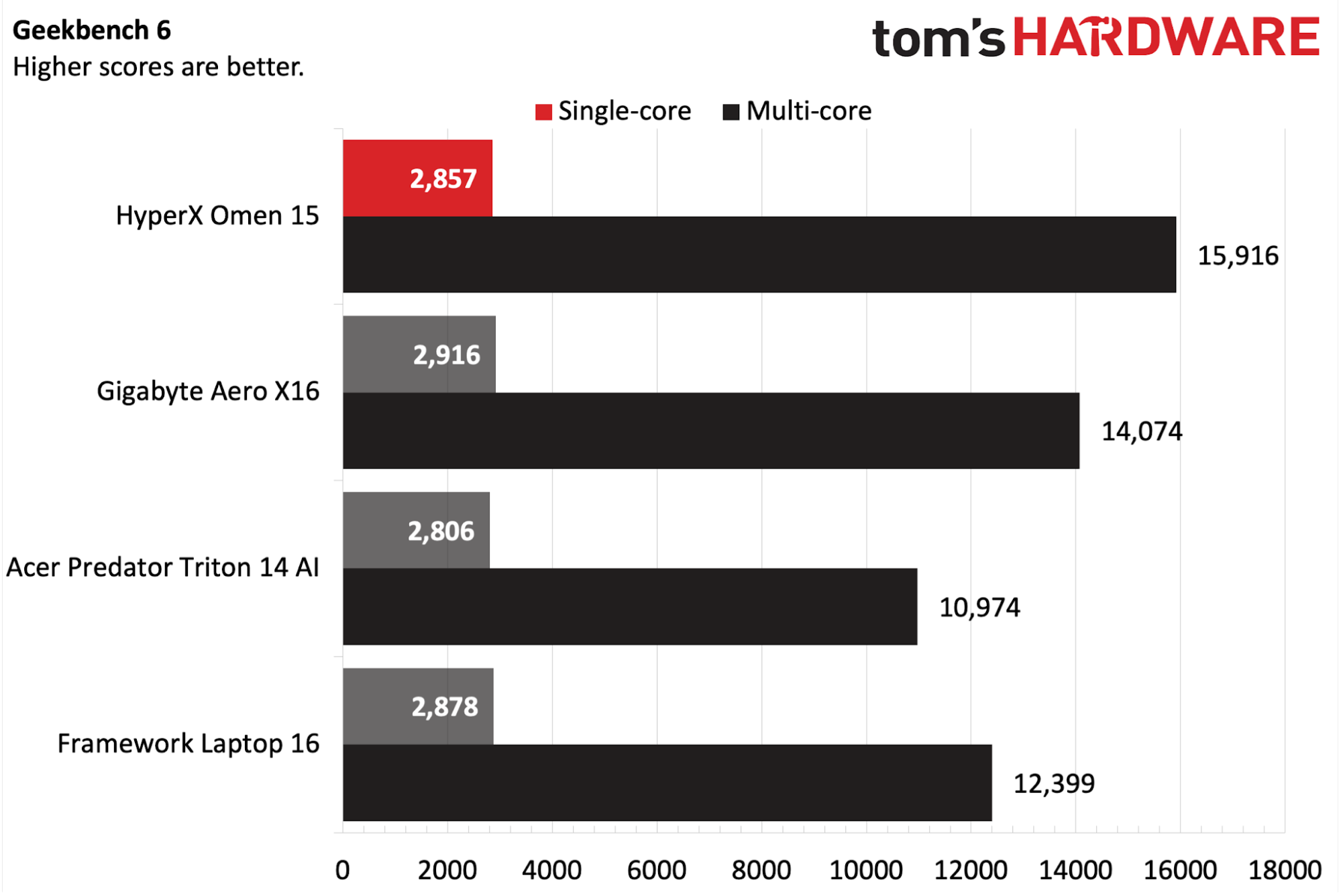
The Omen 15 performed well in Geekbench 6, hitting 2,857 in the single-core benchmark, keeping it right in the mix with the other competitors. However, it sprinted out ahead of the pack in multi-core, delivering 15,916 compared to 14,074 on the second-place Aero X16.
Tom's HardwareTom's HardwareTom's Hardware
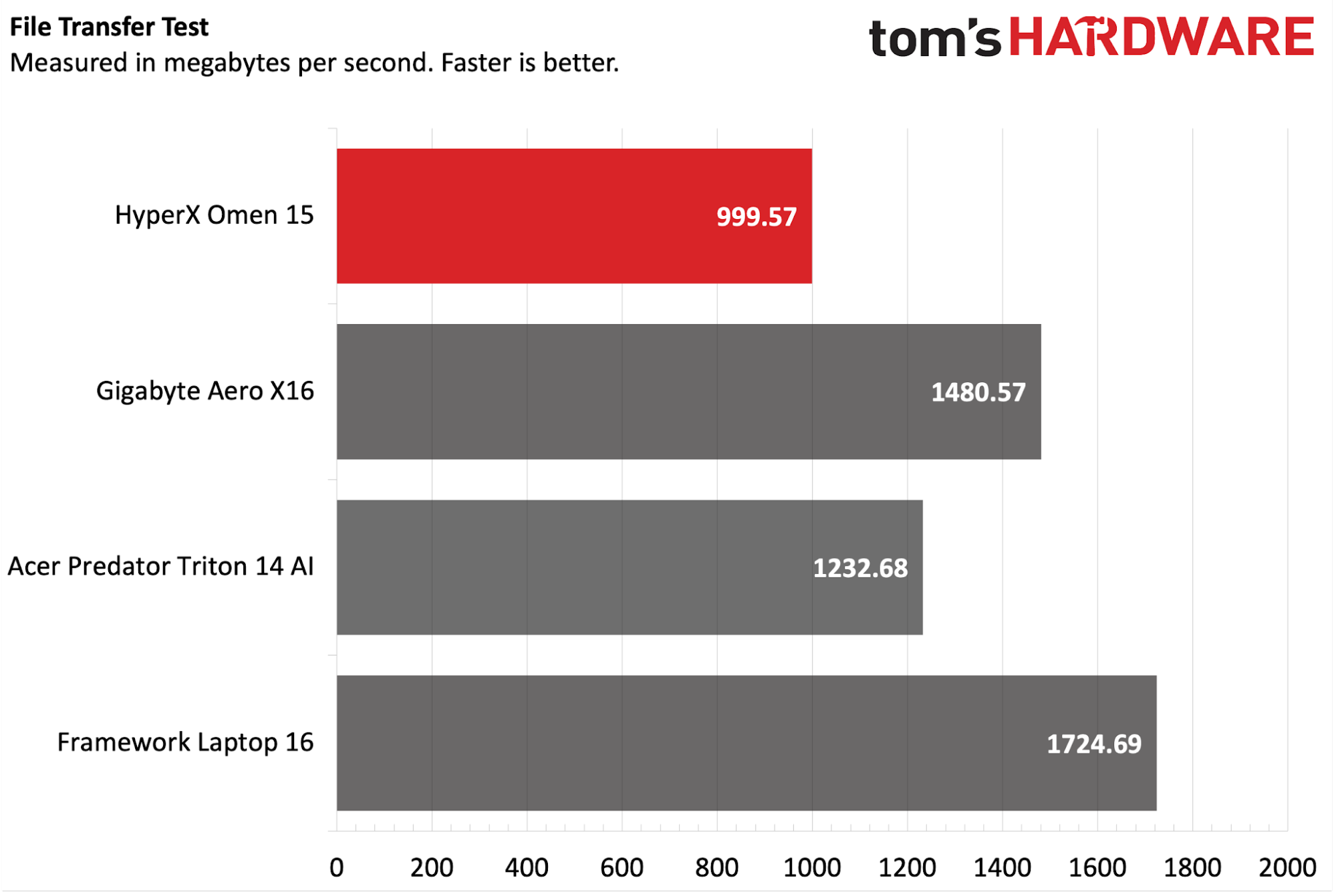
The Omen 15 was at the back of the pack on our file transfer test, coming in at 999 MBps from the Samsung MZVMX1T0HCLD-00BH1 SSD versus an average of around just under 1,500 MBps for the other three competitors.
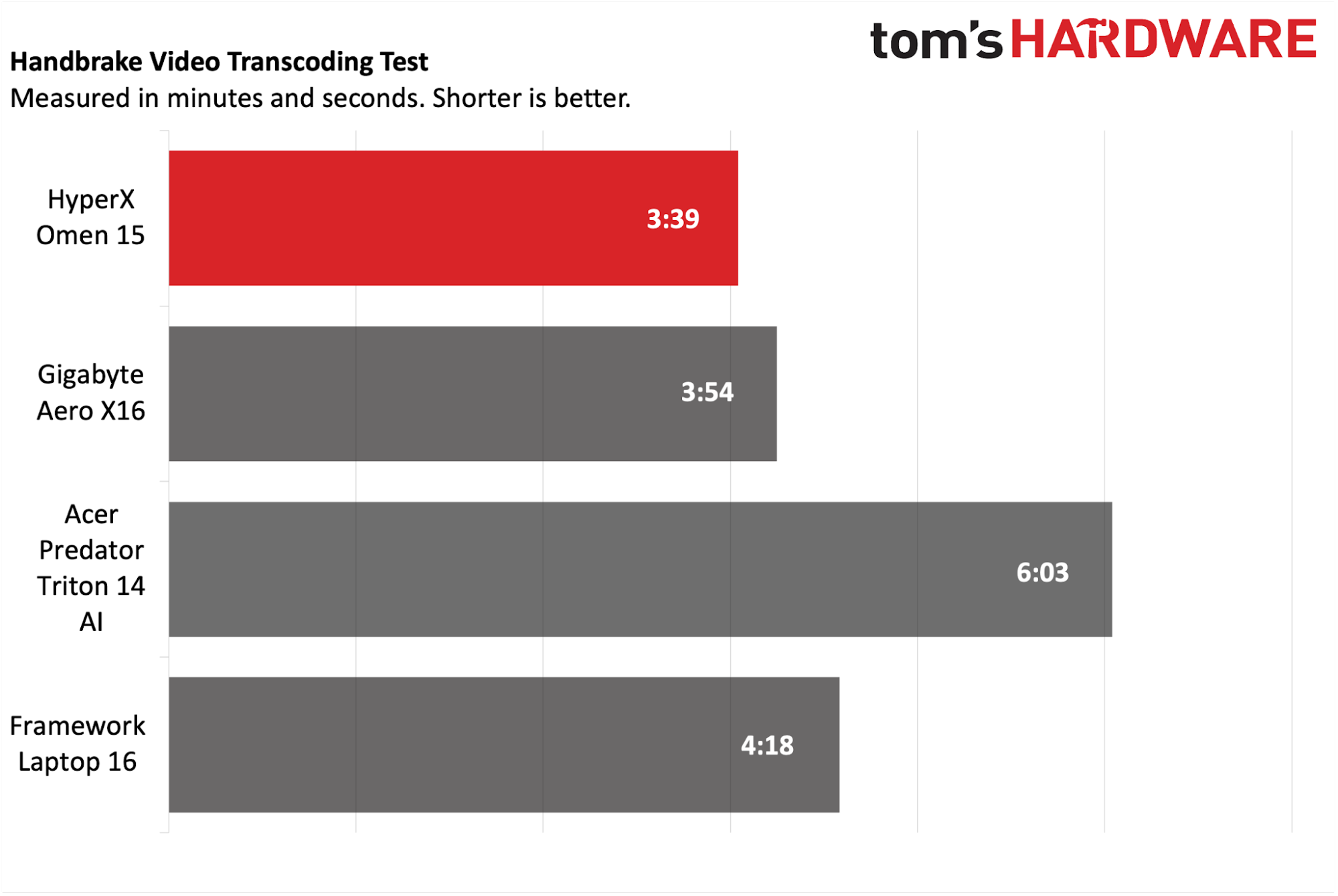
Moving on to our HandBrake test, where we transcode a 4K video file to 1080p, the Omen 15 took the top spot, finishing the task in 3 minutes and 39 seconds. That was about 15 seconds faster than the second-place Aero X16.
Display on the HyperX Omen 15
Our review unit came equipped with a 15.3-inch 2880 x 1800 OLED display. Interestingly, the refresh rate is limited to just 120 Hz, compared to the faster 144 Hz to 165 Hz that we see in competitors like the Aero X16 and Laptop 16.
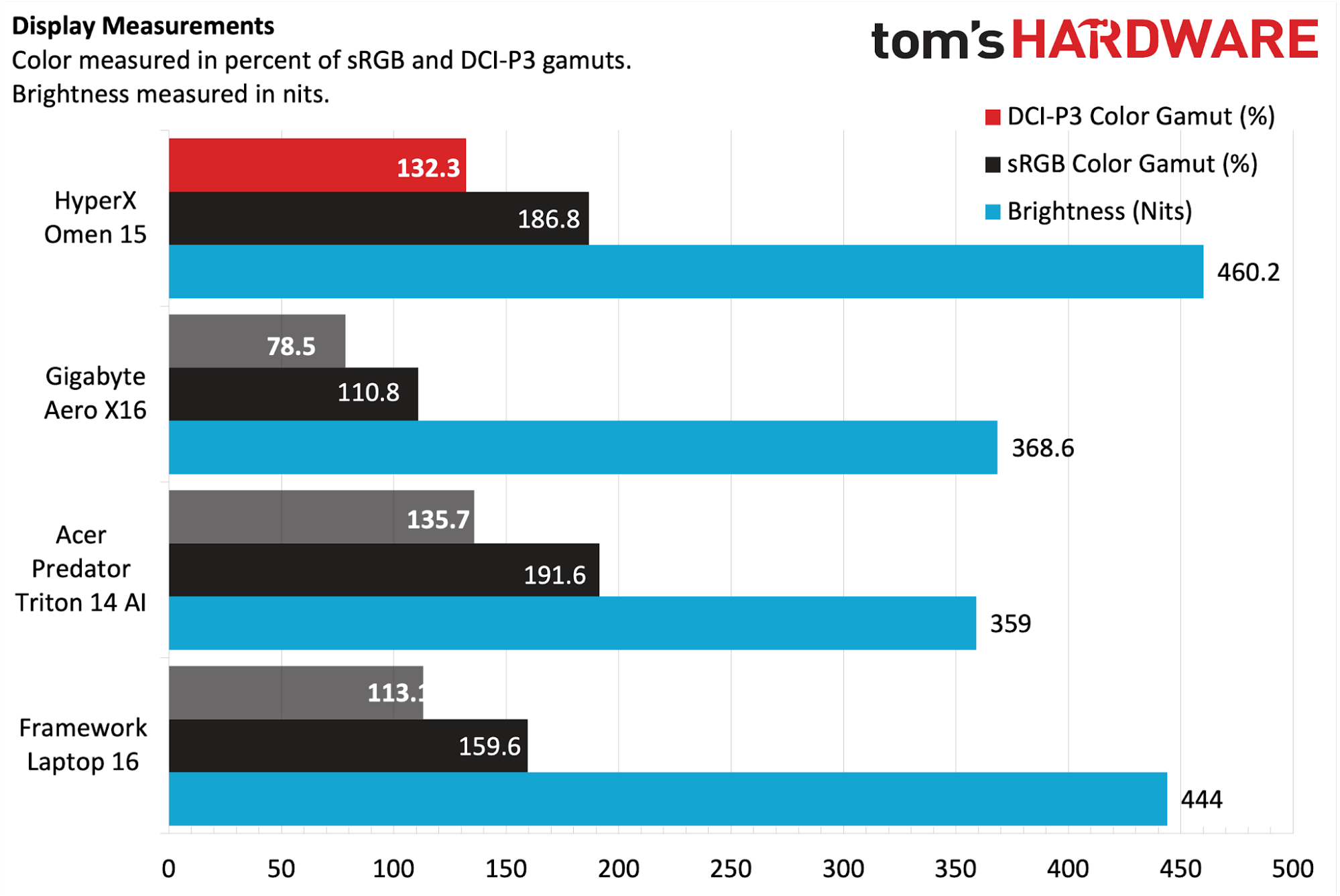
The Omen 15’s OLED panel performed roughly on par with the rest of the laptops in this segment, as it covered 132.3 percent of the DCI-P3 color space and 186.8 percent of sRGB. It even managed to take the top spot in the brightness category, hitting 460.2 nits compared to 444 nits for the Laptop 16.
(Image credit: Tom's Hardware)
I love OLED panels, and the 1800p unit on the Omen 15 just proves that that love shows no sign of abating. Colors looked rich, blacks were jet black, and brightness levels in my home office setting (with an abundance of overhead lighting) were more than adequate.
I played quite a bit of Forza Horizon 6 using the Omen 15, and marveled at the bright, colorful, and reflective car bodies as I competed in various events.
Keyboard and Touchpad on the HyperX Omen 15
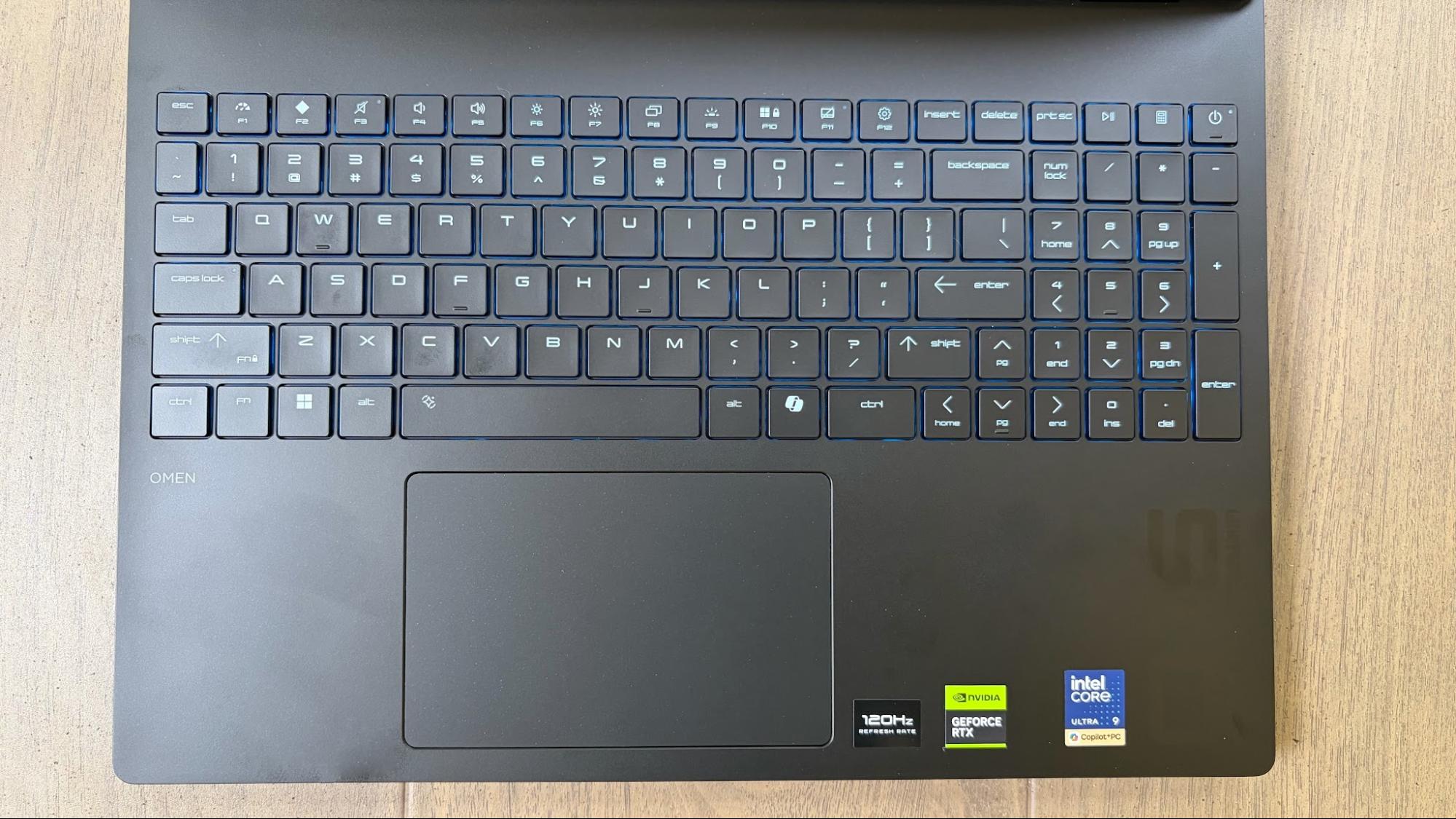
There have been noticeable improvements made to the Omen 15’s keyboard, at least compared to the previous Victus 15. The biggest change is the move from half-height arrow keys to full-size. The tiny, half-height function keys have also been enlarged.
HP also boasts of an 8K polling rate for the Omen 15’s keyboard (equating to a response time of 0.125 ms). I wouldn’t consider myself to be a highly competitive gamer, so any upgrades in this area are lost on me. The keyboard also features 4-zone RGB backlighting.
(Image credit: Tom's Hardware)
Using the Keyhero.com typing test, I averaged around 87 words per minute with 95% accuracy, which is on par with my typical typing speed. I found the keyboard comfortable for typing and gaming.
There’s nothing particularly noteworthy about the touchpad, which features a top-hinged design. Its surface allowed my finger to glide smoothly, although it is a bit loud and clanky when clicked.
Audio on the HyperX Omen 15
The Omen 15 features stereo speakers supporting DTS:X Ultra and HyperX Audio Control. I was pleasantly surprised by the sound emanating from the speaker, which was rich in volume and clarity. While lacking any real semblance of bass, the underlying output was clean.
I took the opportunity to fire up “Mujahadin and Opium,” which is a horn- and string-filled track by John Barry from The Living Daylights soundtrack. There is just something very chilling about the interplay of the strings and horns; the former of which starts the track, while the latter beautifully fills in classic James Bond tradition.
The speakers also did well to mimic engine sounds as I went corner carving in Forza Horizon 6, be it a high-strung flat-6 or a burbling V8.
Upgradeability of the HyperX Omen 15
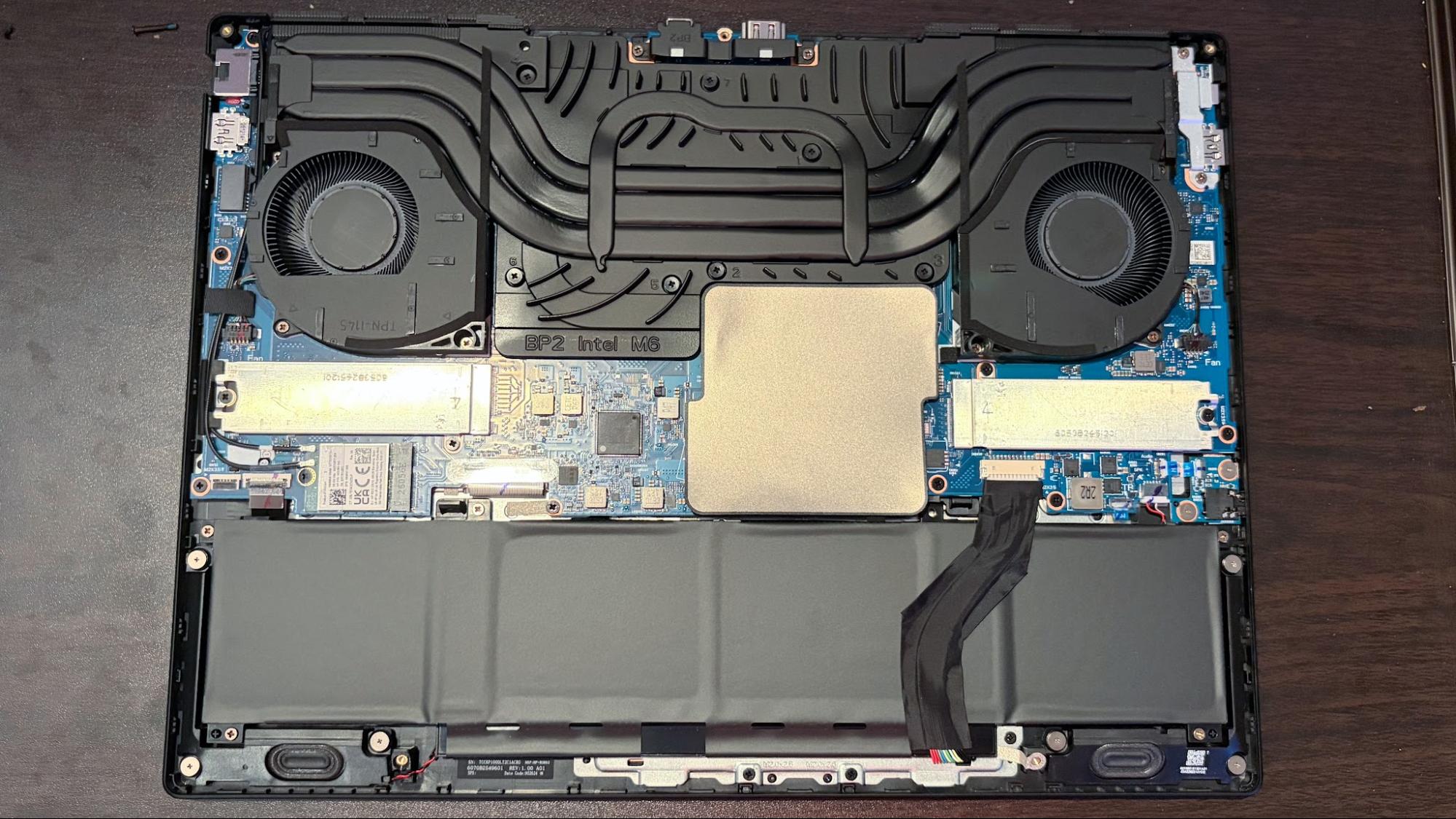
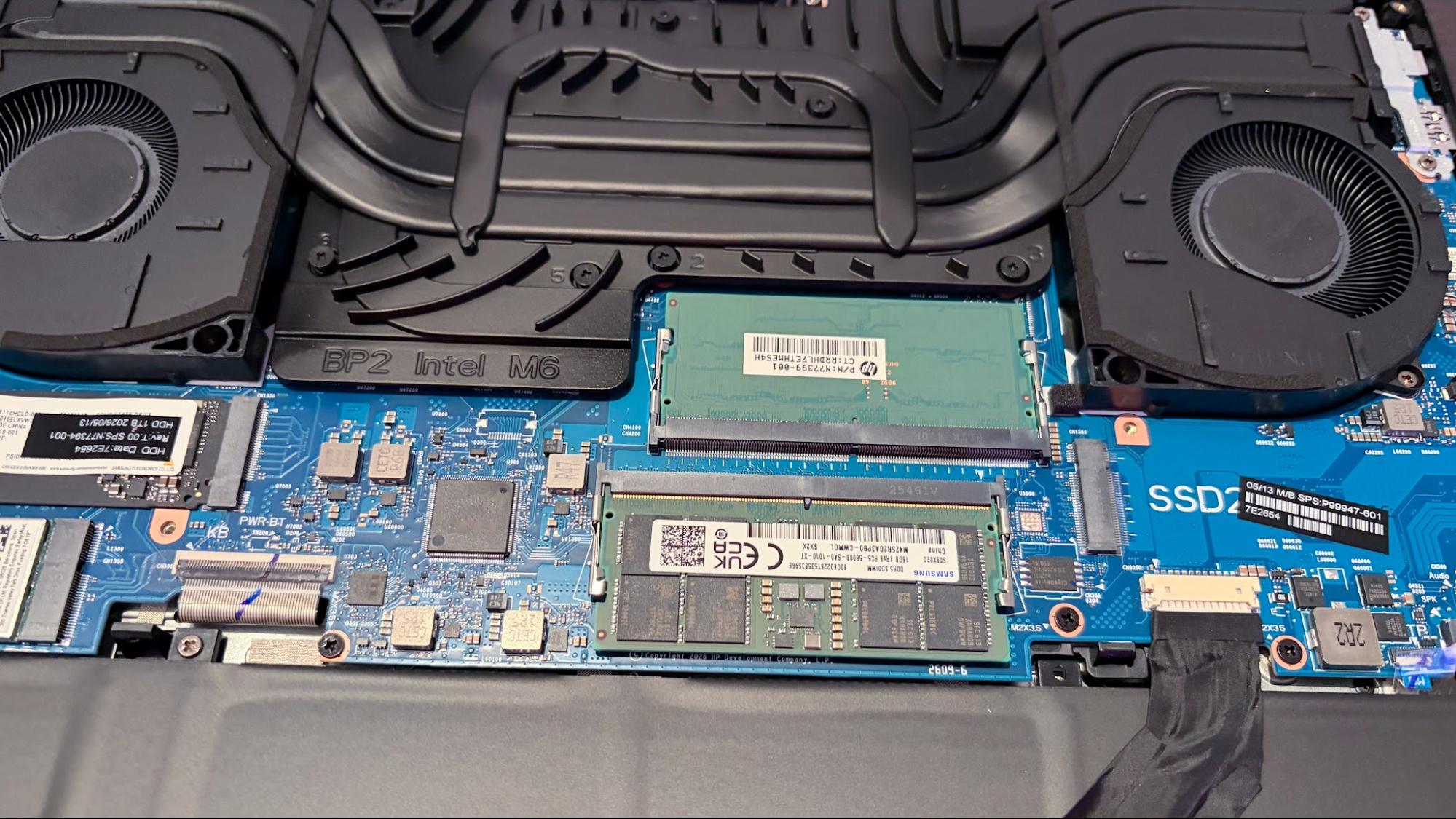
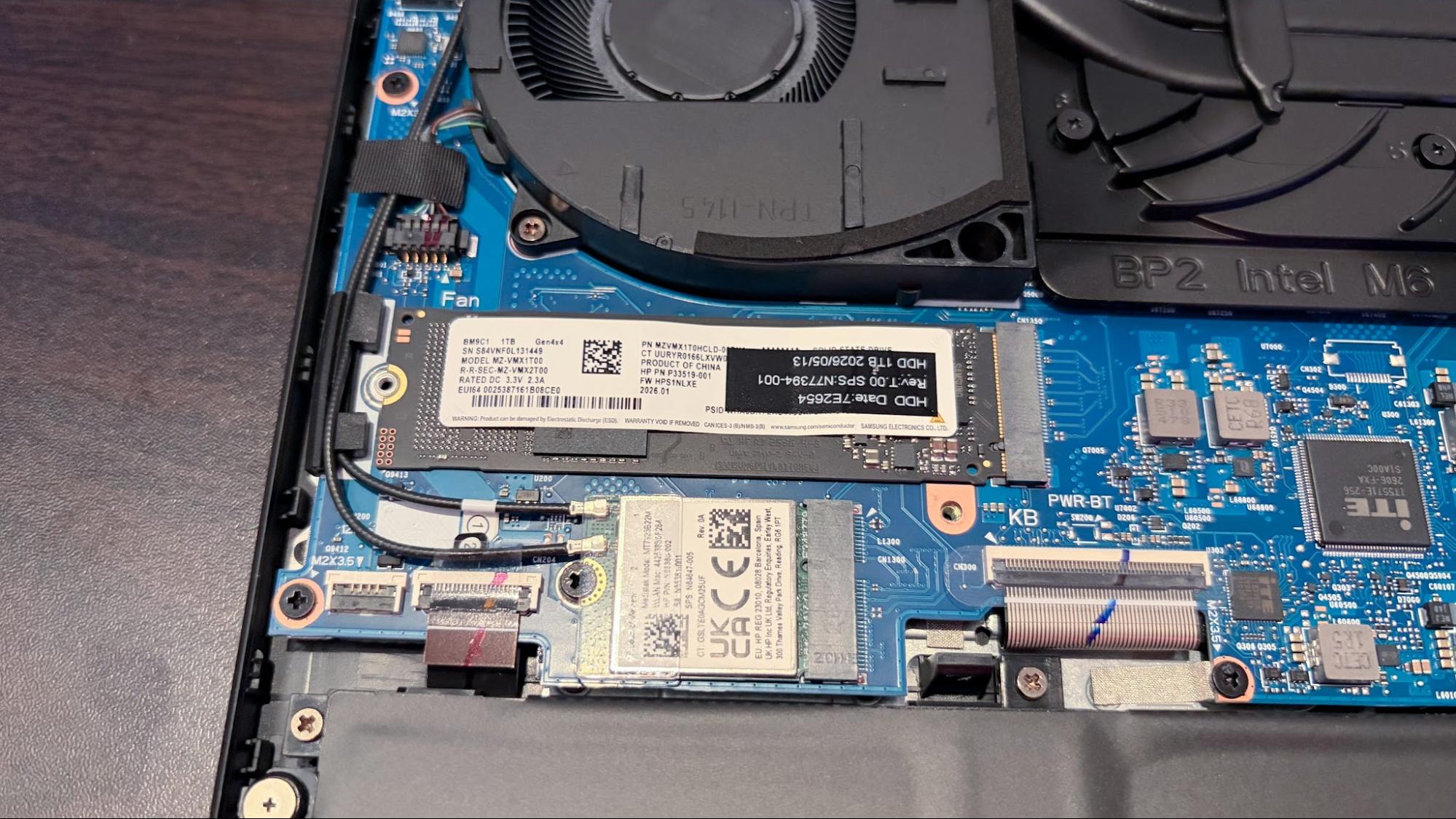
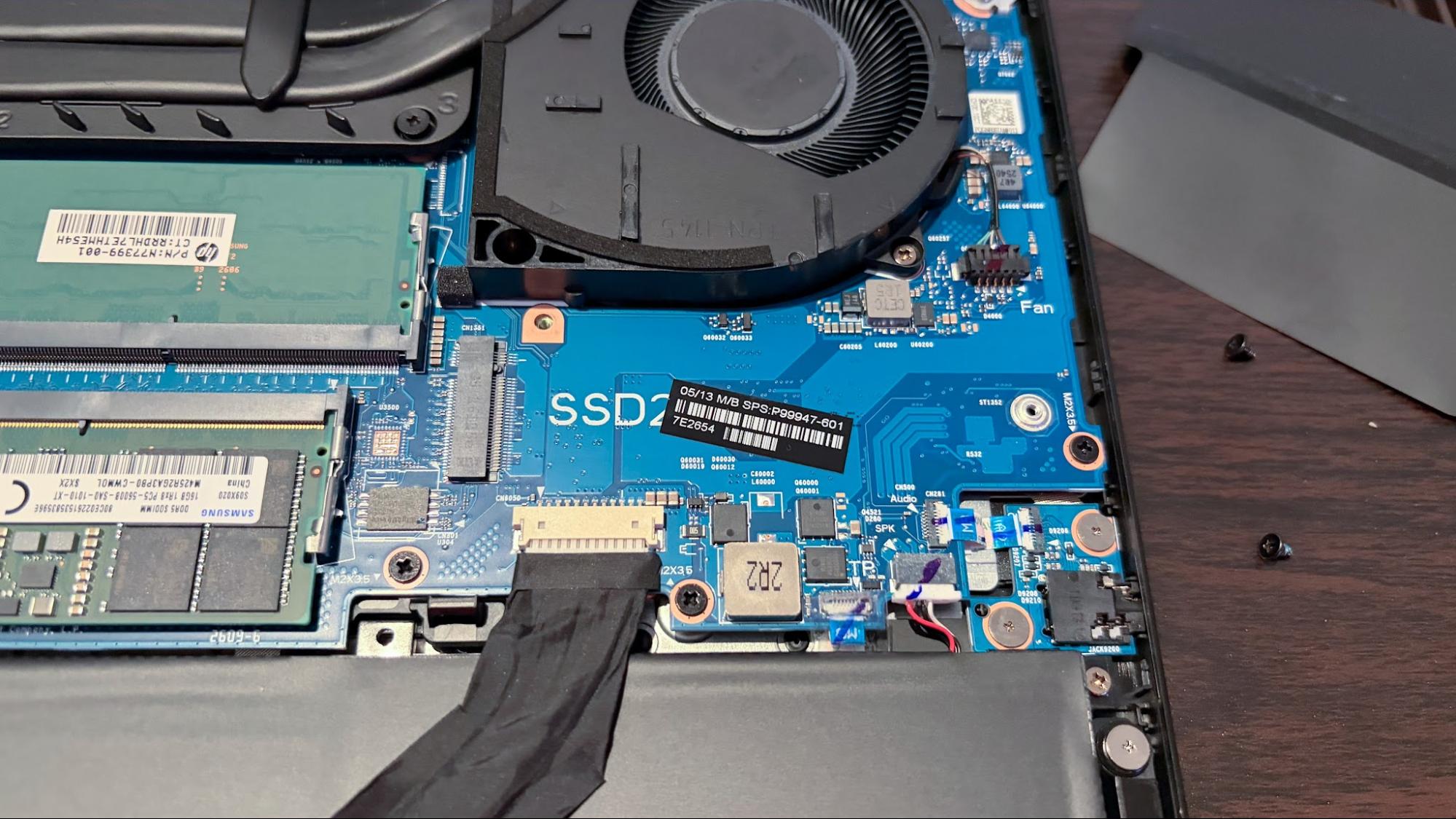
Flipping the Omen 15 over to reveal its bottom panel, you’ll find five screws holding it in place. Three of the screws are exposed, while the two corner screws at the back are hidden beneath tiny rubber plugs. I needed to use a safety pin to pry them out, which was annoying.
With the panel removed, you’ll find easy access to the battery, both M.2 SSD bays, the Wi-Fi card, and the two SO-DIMM slots (which are covered by a flexible I/O shield).
Battery Life on the HyperX Omen 15
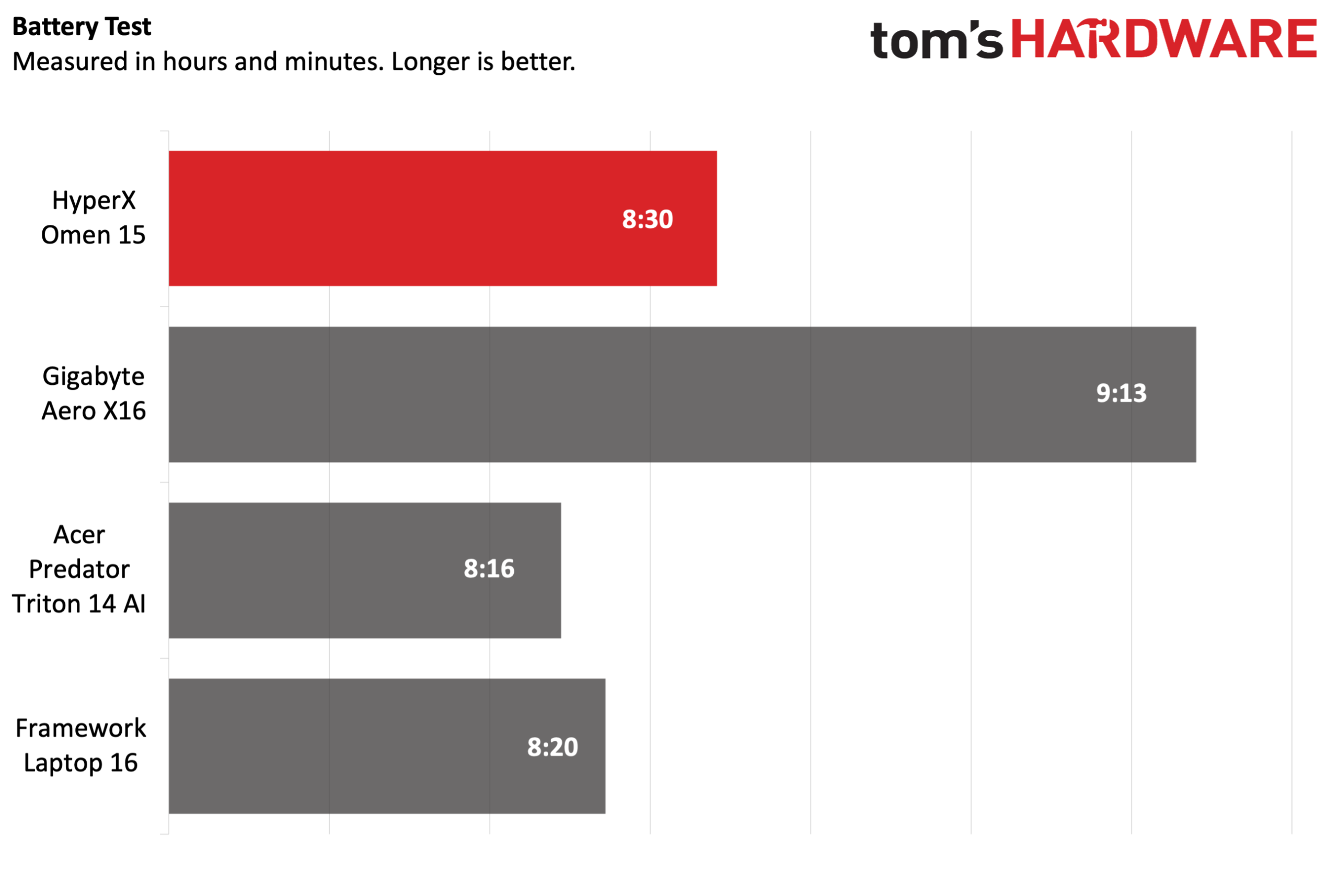
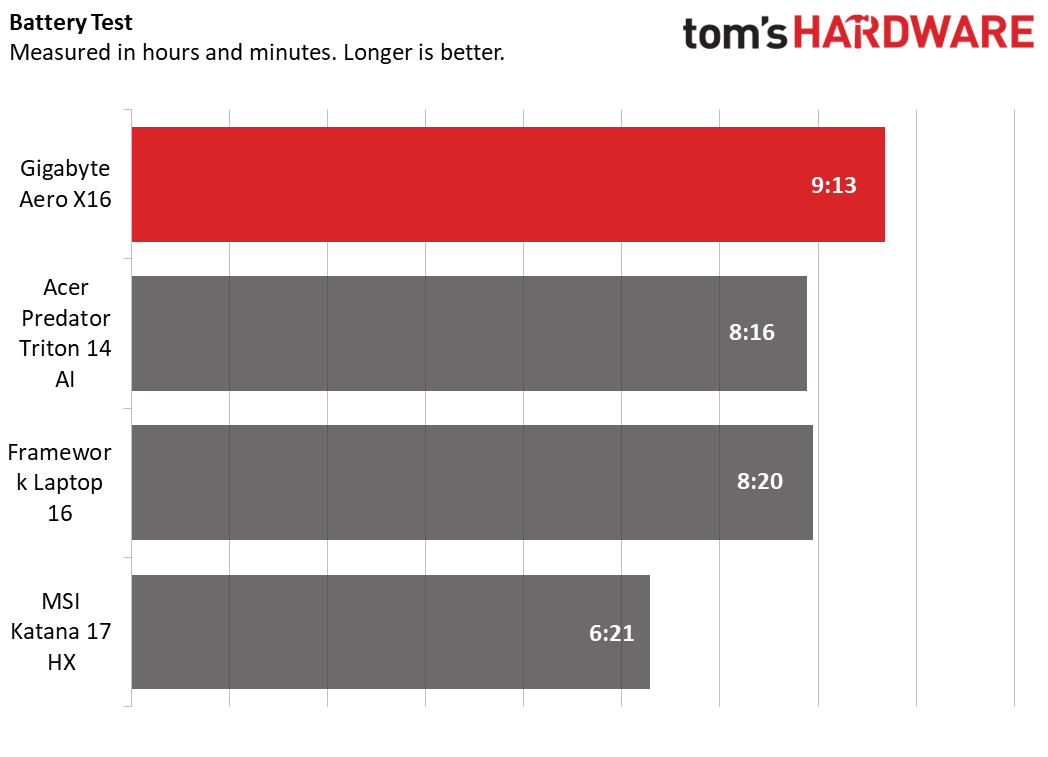
The Omen 15 is powered by a 70 WHr battery, and it performed well against its peers. Our battery test leverages web browsing, video streaming over Wi-Fi, and OpenGL testing with the screen brightness set at 150 nits.
(Image credit: Tom's Hardware)
The HyperX laptop endured for 8 hours and 30 minutes, which was 10 minutes longer than the Laptop 16 and 14 minutes longer than the Predator Triton 14 AI. However, it was no match for the Aero X16, which lasted 9 hours and 13 minutes.
Heat on the HyperX Omen 15
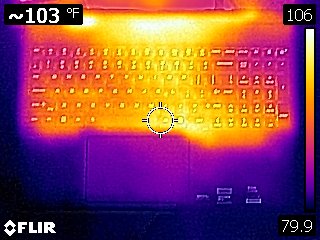
During the Metro Exodus stress test, we measured the Omen 15's keyboard at 95.4 degrees Fahrenheit (F) between the G and H keys, while the touchpad was 85.1 F.
Tom's HardwareTom's Hardware
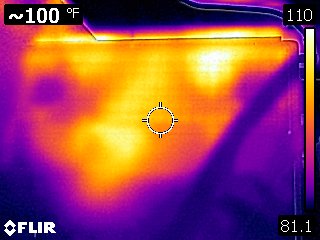
The hottest part of the laptop was near the bottom-rear of the chassis, measuring 110 F.
While running the Metro Exodus stress test, the CPU measured 63.4 degrees Celsius (C). Meanwhile, the RTX 5070 came in at 63.2 C.
Webcam on the HyperX Omen 15
The Omen 15 uses a standard 1080p webcam with IR capabilities, meaning it can be used with Windows Hello biometric authentication in Windows 11.
The camera is fine, and by no means a standout in any particular area. It covers the basics, offering decent color reproduction, and did a passable job of picking out my facial hair. However, I did notice a fair amount of noise in the image. However, if you mainly use the camera to hop on a few Zoom calls here and there, it’s more than adequate.
HyperX Omen 15 Software and Warranty
HP has no qualms about loading up its systems with a copious amount of apps, as you'll find a variety of software including HP, HP Documentation, HP PC Hardware Diagnostics, HP Smart, HP Privacy Settings, and HP TV+ (and that's not even all of them).
However, the HP utility that you'll probably interact with the most is the Omen Gaming Hub. Here you'll find controls for tweaking nearly every aspect of the system, from power modes to RGB lighting for the keyboard.
The Omen 15 comes with a one-year manufacturer warranty.
HyperX Omen 15 Configurations
Our Omen 15 review unit came configured with an Intel Core Ultra 9 386H processor, 32GB of DDR5-5600 memory, a 1TB PCIe 4.0 SSD, GeForce RTX 5070 GPU, and a 2880 x 1800 OLED 120 Hz display. It’s listed on HP’s website with an MSRP of $2,799, but is currently available for $2,099 with a 25% off coupon.
There are various configurations available with slightly different specs, but the 15-ga0762nr SKU features a Core i7-14650HX processor, 16GB of DDR5-5600 RAM, a 1TB PCIe 4.0 SSD, an RTX 5060 GPU, and a 2560 x 1600 OLED with a 180 Hz refresh rate. This system is priced at $1,999, or just a $100 discount compared to our review unit’s sale price. However, the price disparity makes more sense when you consider our review unit’s MSRP.
Bottom Line
On the one hand, the HyperX Omen 15 has solid gaming performance across the board, and its CPU performance in productivity tasks is top-of-the-class. In addition, the 15.3-inch OLED display looks great and offers an expansive 2880 x 1800 resolution.
On the other hand, the chassis is constructed of cheap and flexy plastic, while SSD performance lags behind its competitors. In addition, the display is limited to a 120 Hz refresh rate, and you don’t get any Thunderbolt ports (if that’s something that’s important to you at this price point).
Where things get even more complicated is with pricing. Our review unit carries an MSRP of $2,799, but HP is currently selling it for $2,099 after discounts. At MSRP, our review unit is an absolute non-starter, while the sale price makes it a much more palatable option. But even at its sale price, we feel that the Gigabyte Aero X16 makes a far more compelling buy at just $1,799.
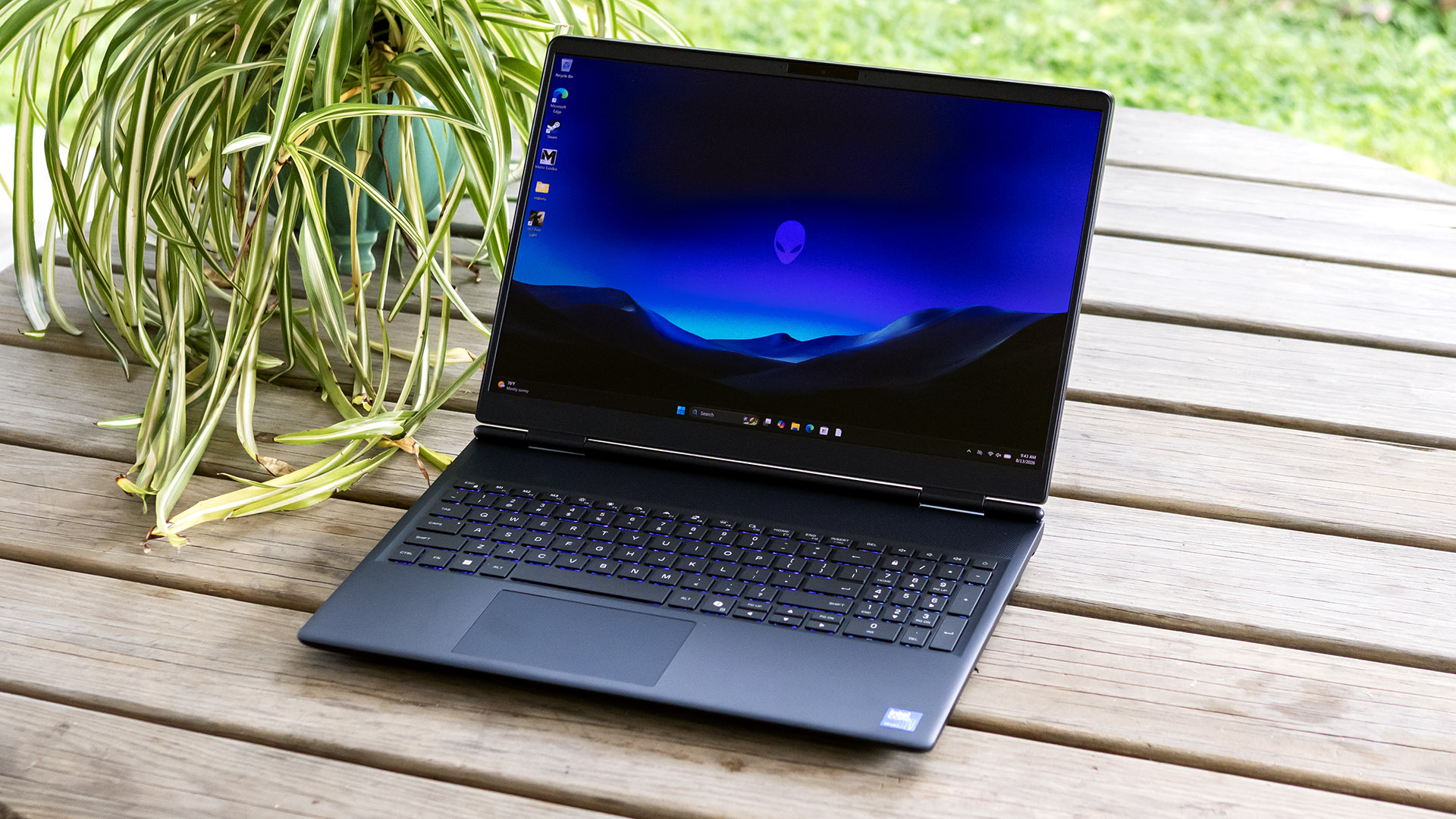
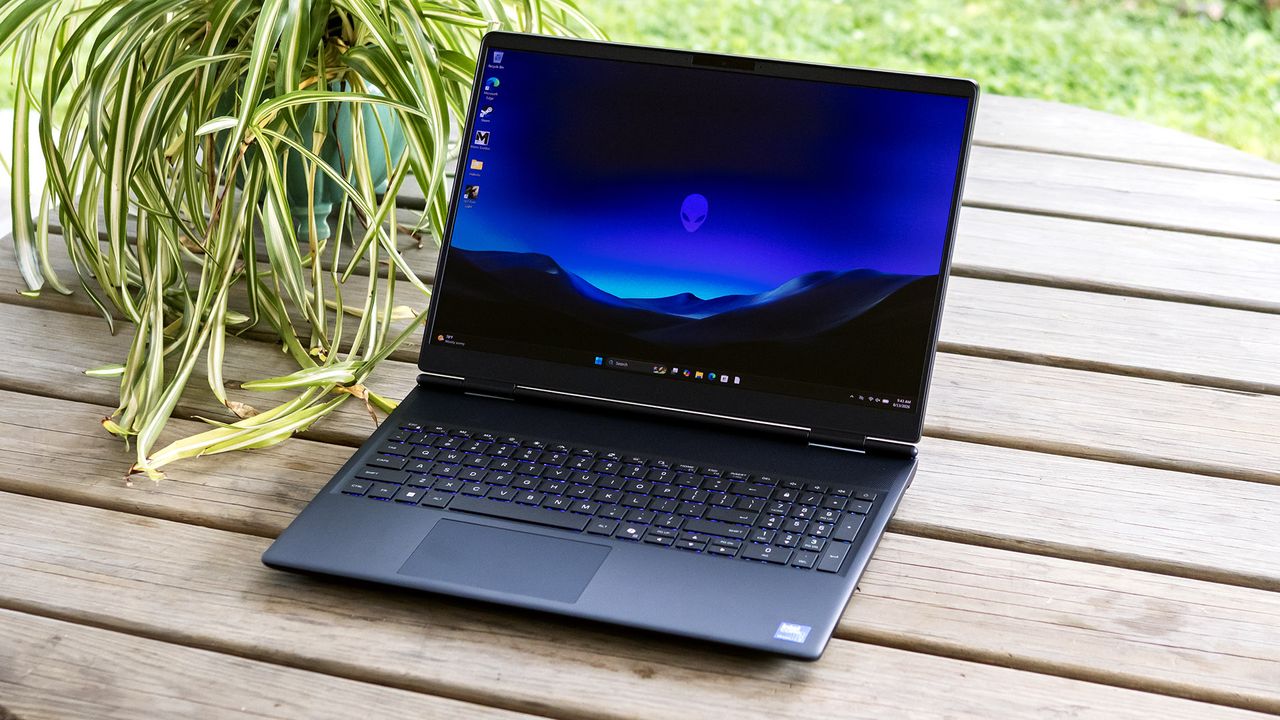
Alienware’s 16X Aurora (starts at $1,979.99) isn’t just another spec-sheet powerhouse – it’s a statement in restraint. Alienware has shifted toward performance-first minimalism with a cleaner, RGB-free chassis, but it doesn’t compromise on the specs: a 16-inch OLED display running at a blistering 240 Hz, Intel’s Core Ultra HX-series CPU, and Nvidia’s latest RTX 50-series graphics. While its bulk and limited battery life prevents it from being a great travel companion, the Aurora’s overall competence make it worth your attention.
Design of the Alienware 16X Aurora
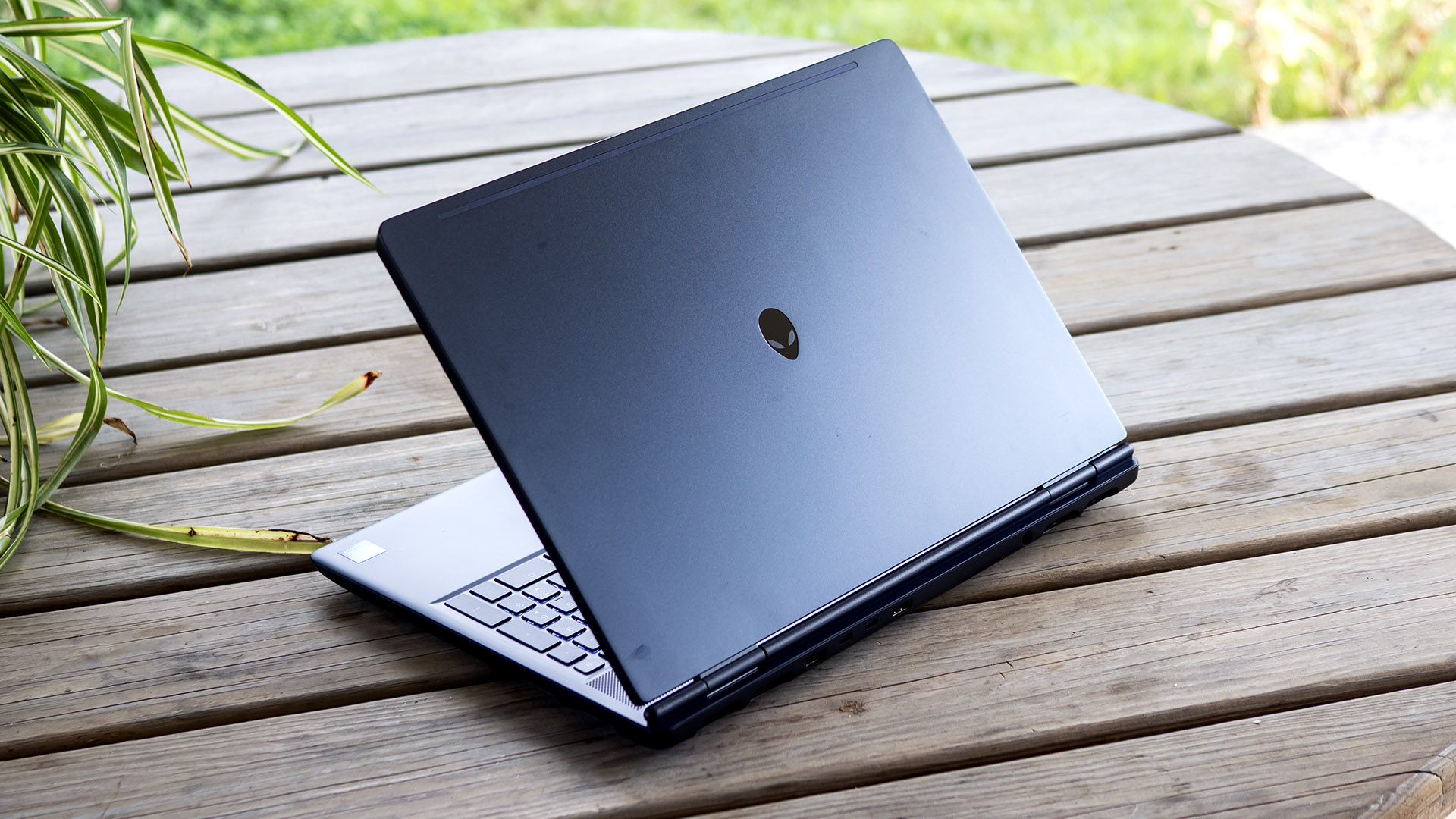
The Aurora is a discreet gaming laptop. Aside from its nearly inch-thick profile, it does little to distinguish itself. Alienware’s “interstellar indigo” chassis is plain, and the iconic Alien head on the lid is hard to see against it. Unlike many previous-generation Alienware laptops, this one has no external lighting.
Tom's HardwareTom's Hardware
Alienware’s build quality is substantial, with aluminum top and bottom panels. A magnesium internal frame keeps the laptop rigid, though the lid can still be opened one-handed. Rounded edges on the bottom of the chassis make the Aurora comfortable to transport, though at 5.66 pounds, it’s a handful. Acer’s Nitro V 16S AI (4.55 pounds) and Gigabyte’s Aero X16 (4.2 pounds) are much lighter.
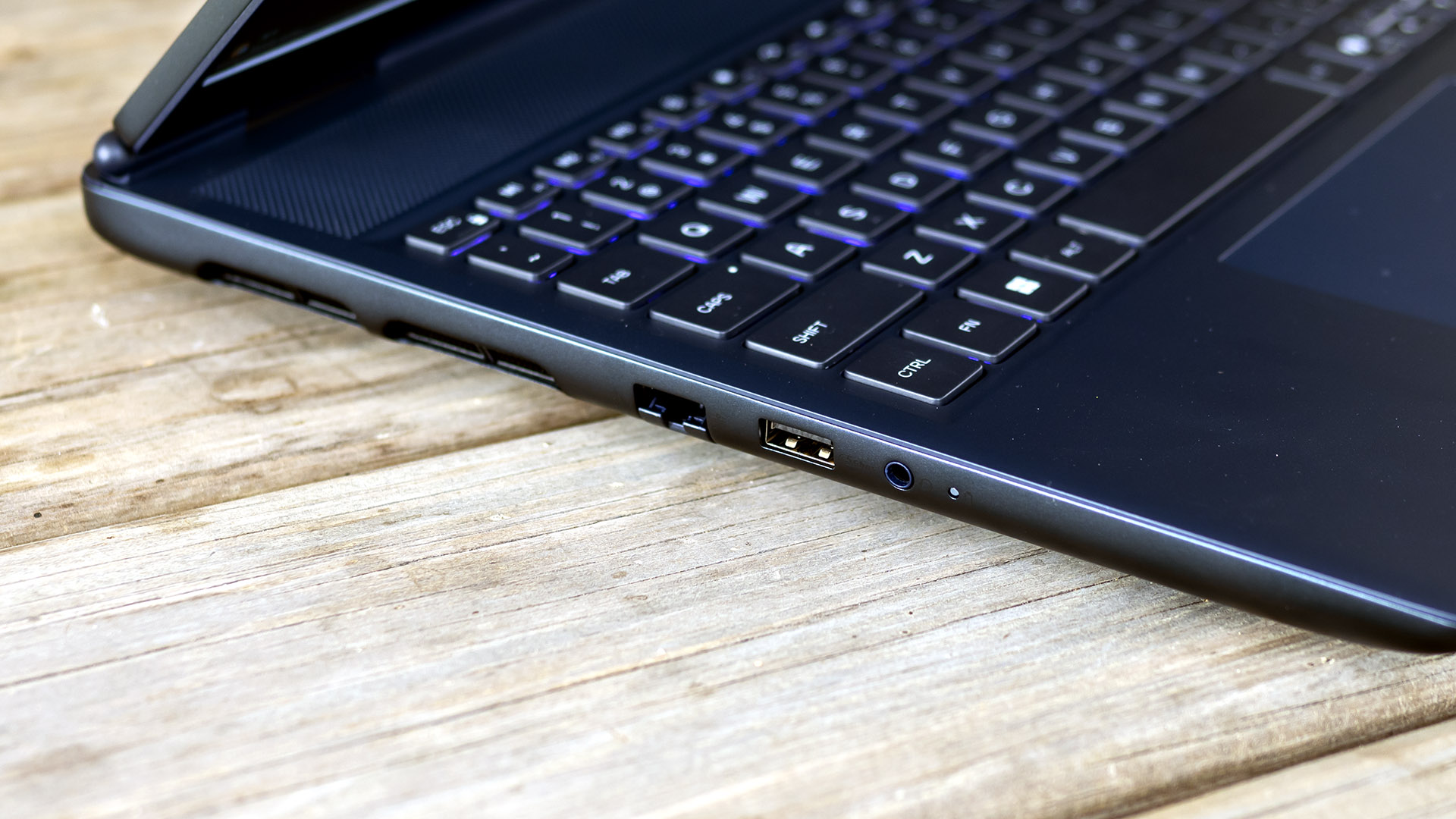
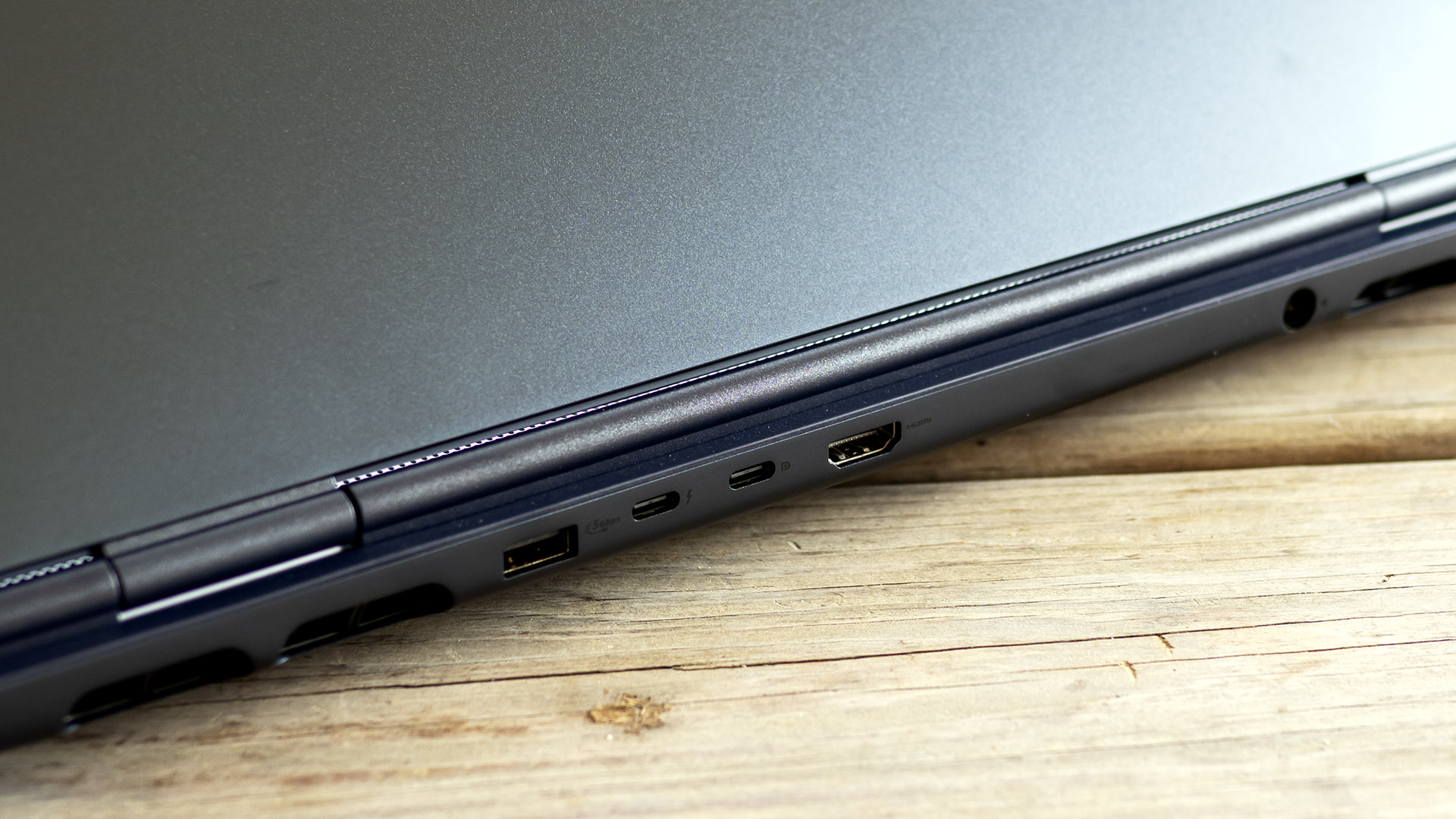
Alienware’s port selection spreads across the left and rear edges: Thunderbolt 4, USB-C (10 Gbps), two USB-A (5 Gbps), HDMI 2.1, Ethernet, and an audio jack. Having some connections on the back, particularly the barrel-style power connector, preserves mouse space. Internally, the Aurora includes Wi-Fi 7 courtesy of a MediaTek MT7925 card.
We tested the 16X Aurora in its entry-level configuration, featuring a Core Ultra 7 270HX Plus processor, a GeForce RTX 5060 GPU, and 16GB of dual-channel DDR5-5600 RAM.
I saw between 60 and 70 frames per second (fps) playing 007 First Light at 2560 x 1600 with medium settings and DLSS (but not frame generation). The game ran smoothly and didn’t stutter.
For performance comparisons, the Aurora faced the Acer Nitro V 16S AI (Ryzen 7 260, RTX 5060 85 W, $1,299.99 when tested), the Asus TUF Gaming F16 (Core i7-14650HX, RTX 5050 115 W, $1,199.99), and the Gigabyte Aero X16 (Ryzen AI 7 350, RTX 5070 85 W, $1,899.99).
Our comparisons will focus on the 1920 x 1080 resolution. We also included results at each laptop's native resolution: 2560 x 1600 for our Aurora as well as the Gigabyte Aero X16, and 1920 x 1200 for the Acer Nitro and Asus TUF units.
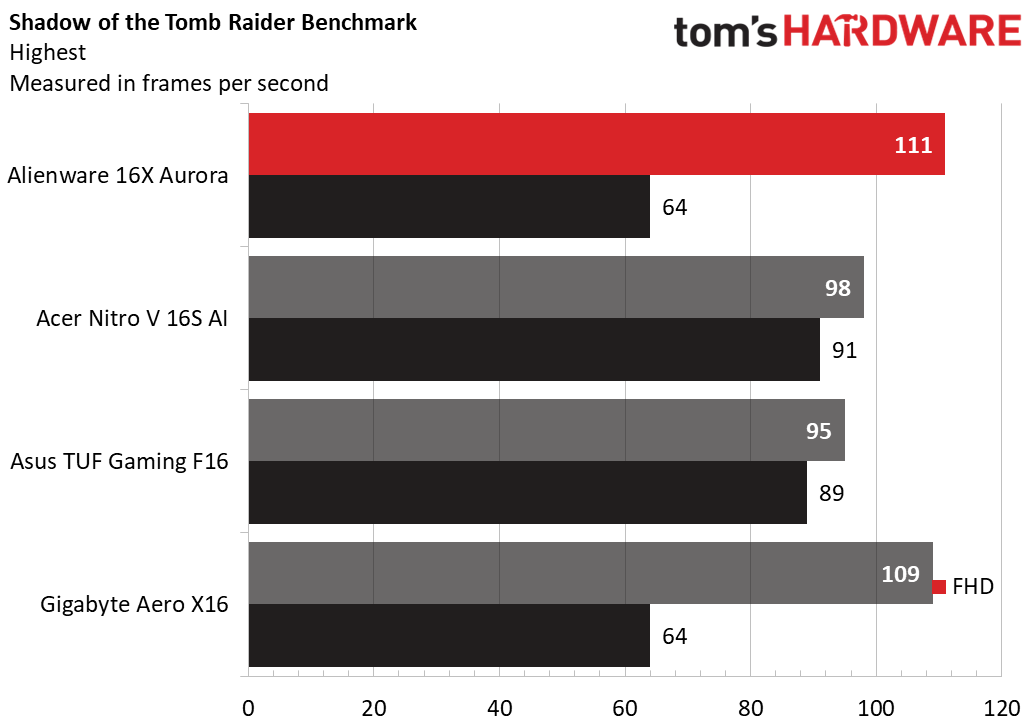
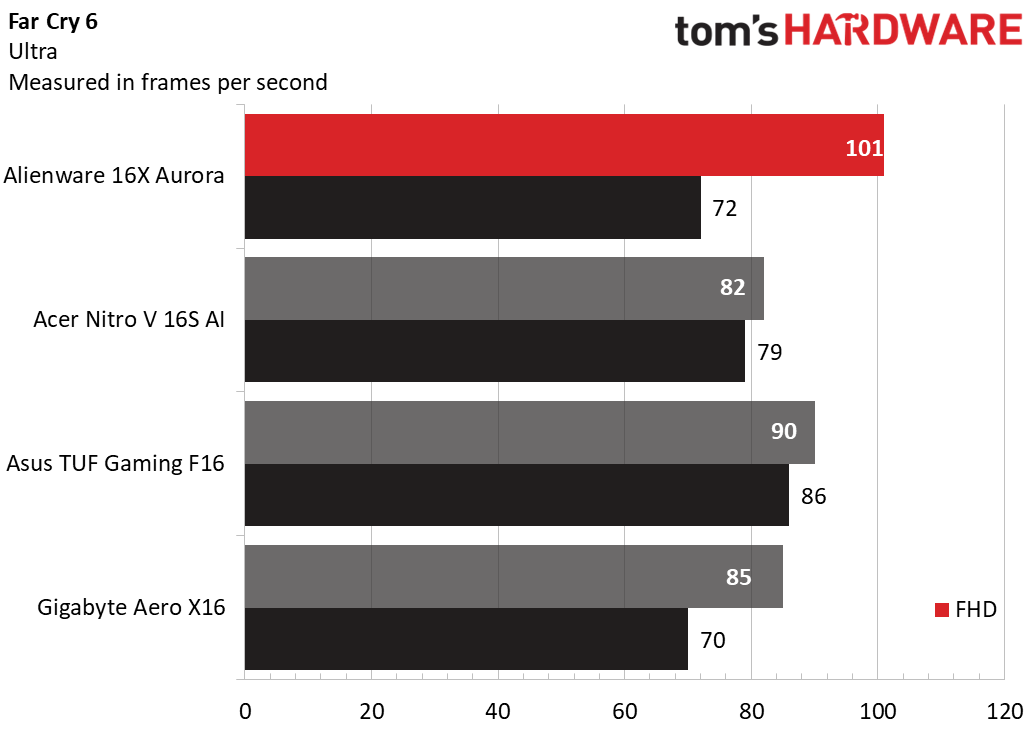
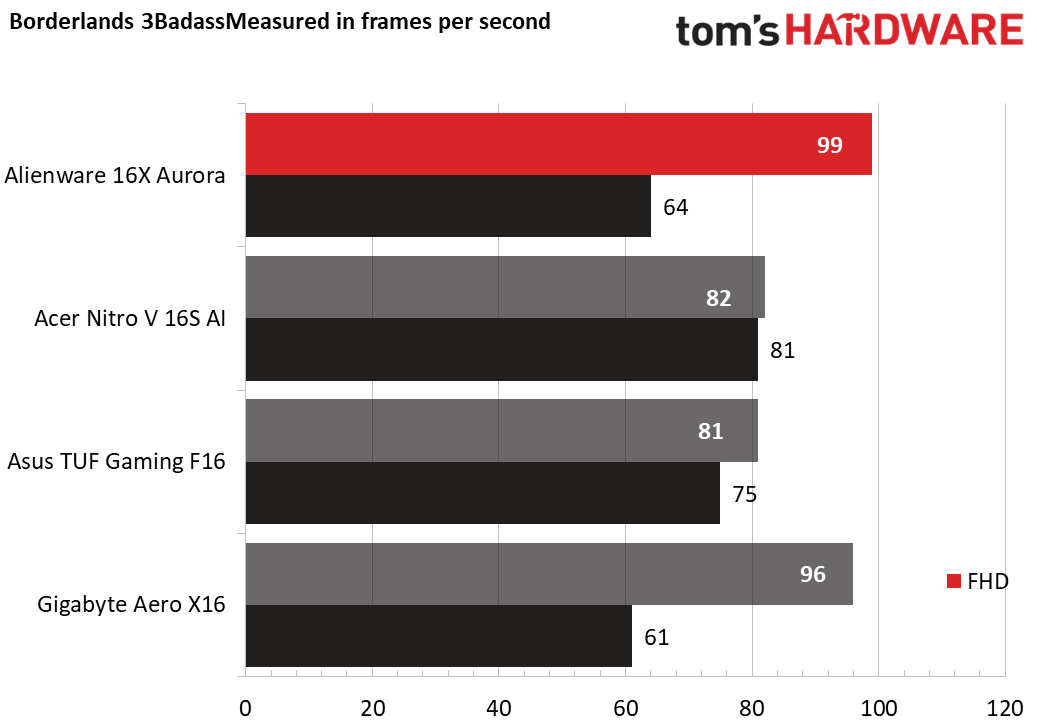
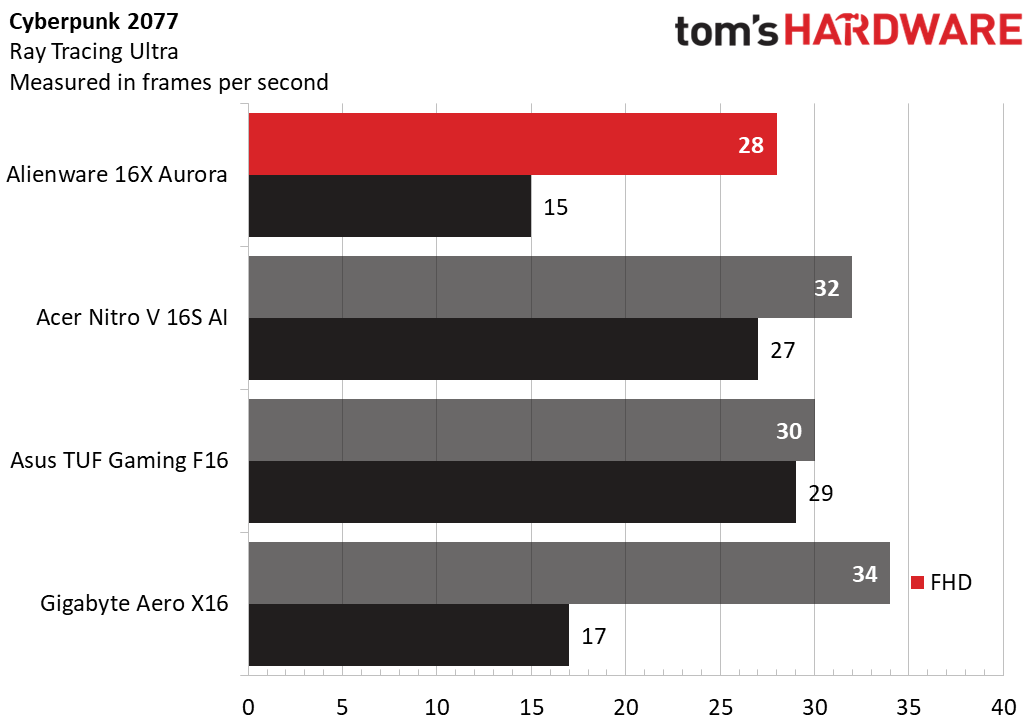
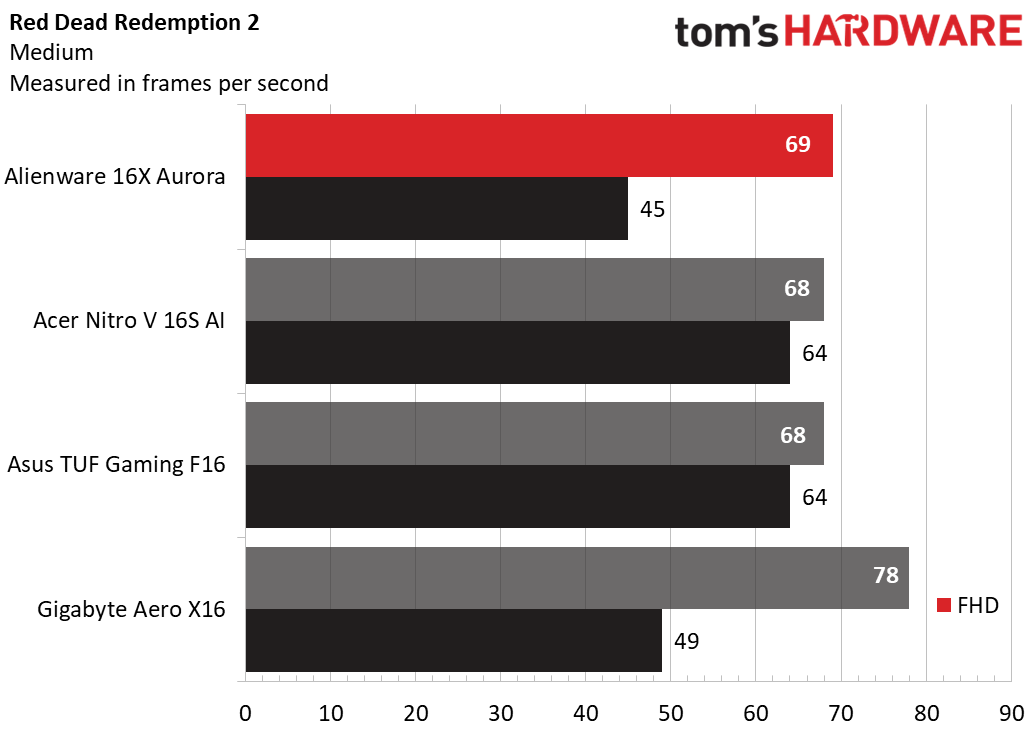
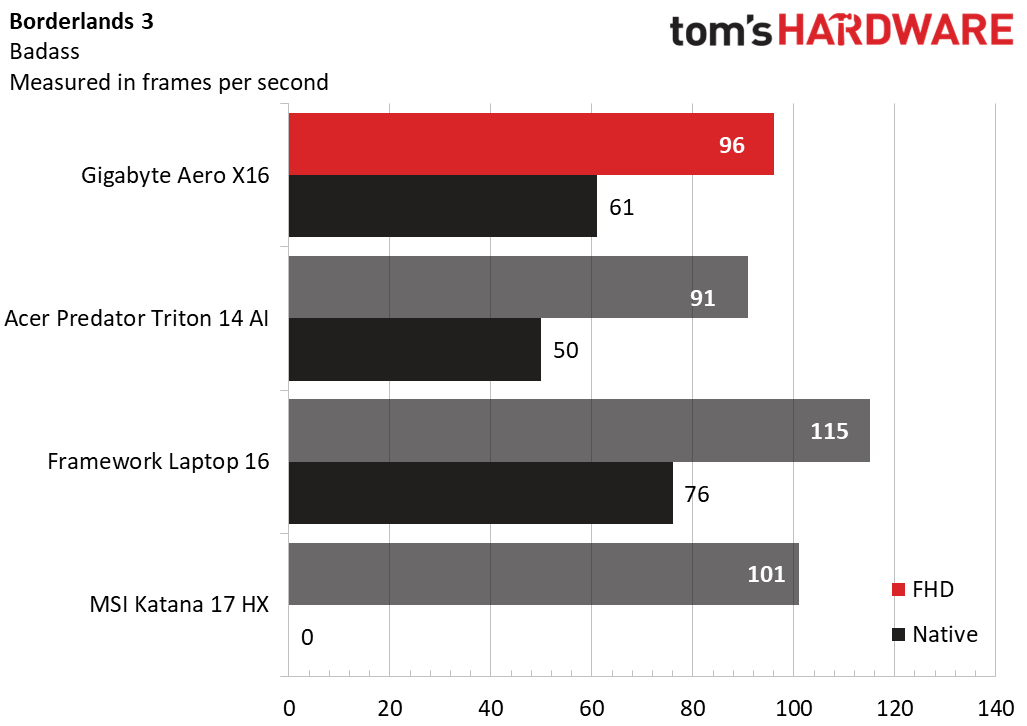
The Aurora 16X is competitive but doesn't stand out in this group. In Shadow of the Tomb Raider, Far Cry 6, and Borderlands 3, it performed 20 to 25% better than the RTX 5060-powered Acer and RTX 5050-powered Asus, but those two surprisingly did better in Cyberpunk 2077 and matched the Aurora in Red Dead Redemption 2.
The Aurora produced varied results against the RTX 5070-powered Gigabyte; While the Aurora took a sizable lead in Far Cry 6 and matched it in Shadow of the Tomb Raider and Borderlands 3, it fell behind in Cyberpunk 2077 and Borderlands 3.
At its 2560 x 1600 native resolution, the Aurora took a drastic performance hit of around 50% from 1080p – from 111 to 64 fps in Shadow of the Tomb Raider, 101 to 72 fps in Far Cry 6, 99 to 64 fps in Borderlands 3, 28 to 15 fps in Cyberpunk 2077, and 69 to 45 fps in Red Dead Redemption 2 – but, excepting Cyberpunk 2077, its performance remained playable.
To stress-test gaming laptops, we run 15 loops of the Metro Exodus benchmark at RTX settings, simulating about half an hour of gaming. The Aurora averaged 76 fps across all runs with no more than a fraction of one frame between runs. During the test, the Core Ultra 7 270HX Plus ran at 3.1 GHz on its P-cores and 2.5 GHz on its E-cores while the RTX 5060 ran at 2.48 GHz.
Productivity Performance on the Alienware 16X Aurora
Our Aurora 16X arrives with a Core Ultra 7 270HX Plus, 16GB of RAM, and 1TB PCIe 4.0 SSD.
Tom's HardwareTom's HardwareTom's Hardware
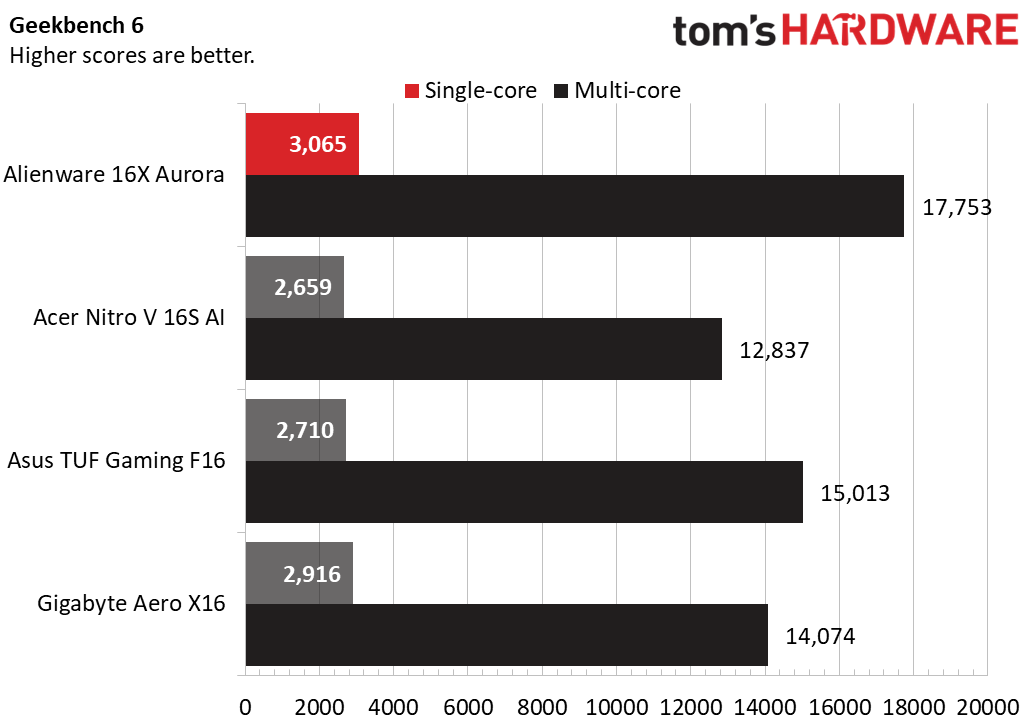
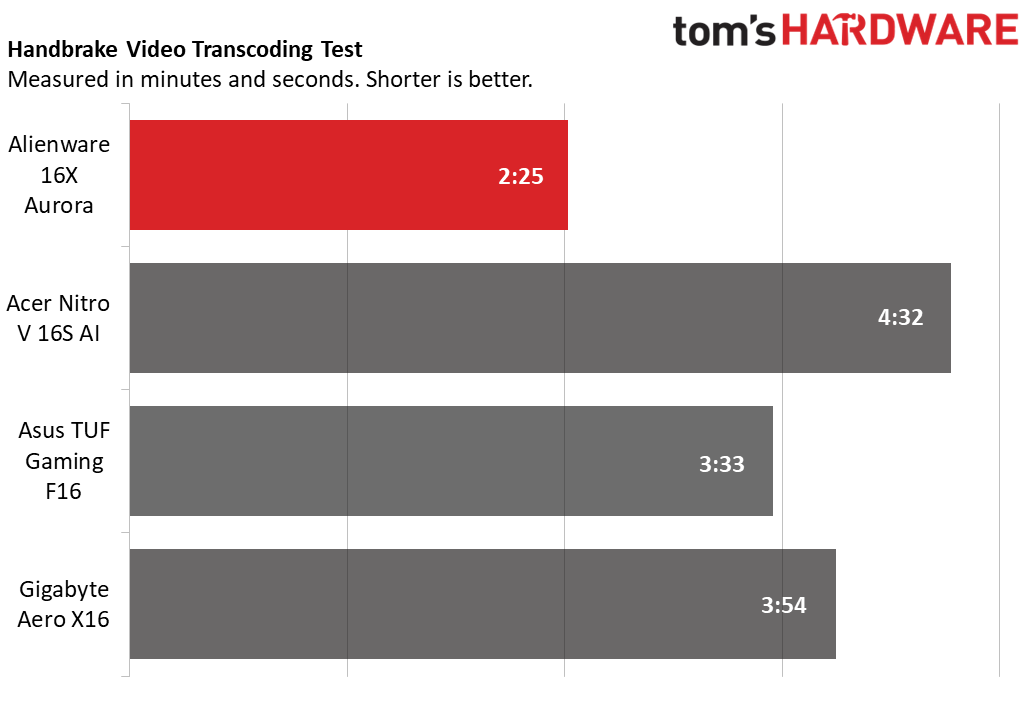
Powered by the Core Ultra 7 270HX Plus, the Aurora predictably outclassed these competitors, which all use previous-generation processors and/or lower-tier chips. In Geekbench 6, it took the top single-core (3,065) and multi-core (17,753) scores, distantly trailed by the Core i7-14650HX-powered Asus (2,710 and 15,013) and Ryzen AI 7 350-powered Gigabyte (2,916 and 14,074). It also clinched the leading time of 2 minutes and 25 seconds in our 4K-to-1080p Handbrake transcoding test, easily outdoing the Asus (3:33), Gigabyte (3:54), and Acer (4:32).
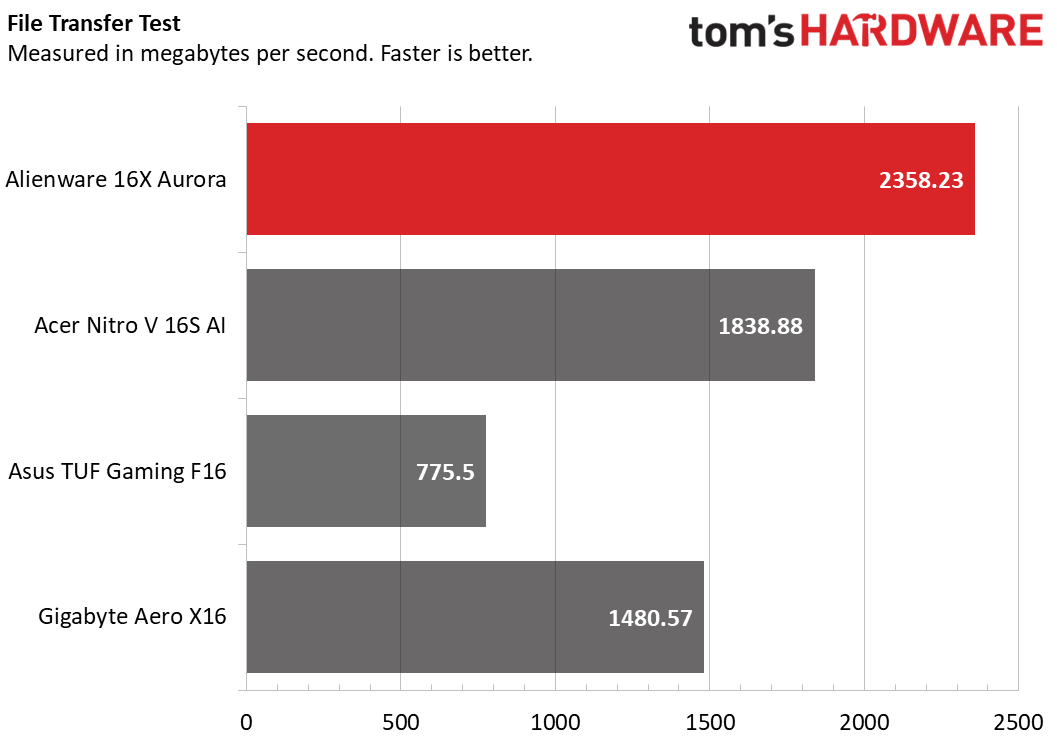
The Aurora also took top honors in our 25GB file transfer test, averaging 2,358.23 MBps. Acer’s Nitro V 16S AI (1,838.88 MBps), the next fastest unit, wasn’t even close.
Display on the Alienware 16X Aurora
All Aurora configurations include the same 16-inch OLED panel with a 2560 x 1600 resolution, 240 Hz refresh rate, and Nvidia G-Sync support. It’s the laptop’s standout feature, pairing the inky contrast expected from OLED with vivid color and unusually strong brightness for this panel type.
In 007 First Light, OLED added a level of depth that a lesser display wouldn’t match, giving shadow-heavy night scenes a richer, moodier look while keeping Malta’s sunlit desert environments bright and crisp. The panel’s sharpness and color also stood out while watching Avengers: Endgame, where fine details such as the nano-texture pattern on Iron Man’s suit were easy to pick out. There’s little to criticize here: the Aurora’s display is excellent.
(Image credit: Tom's Hardware)
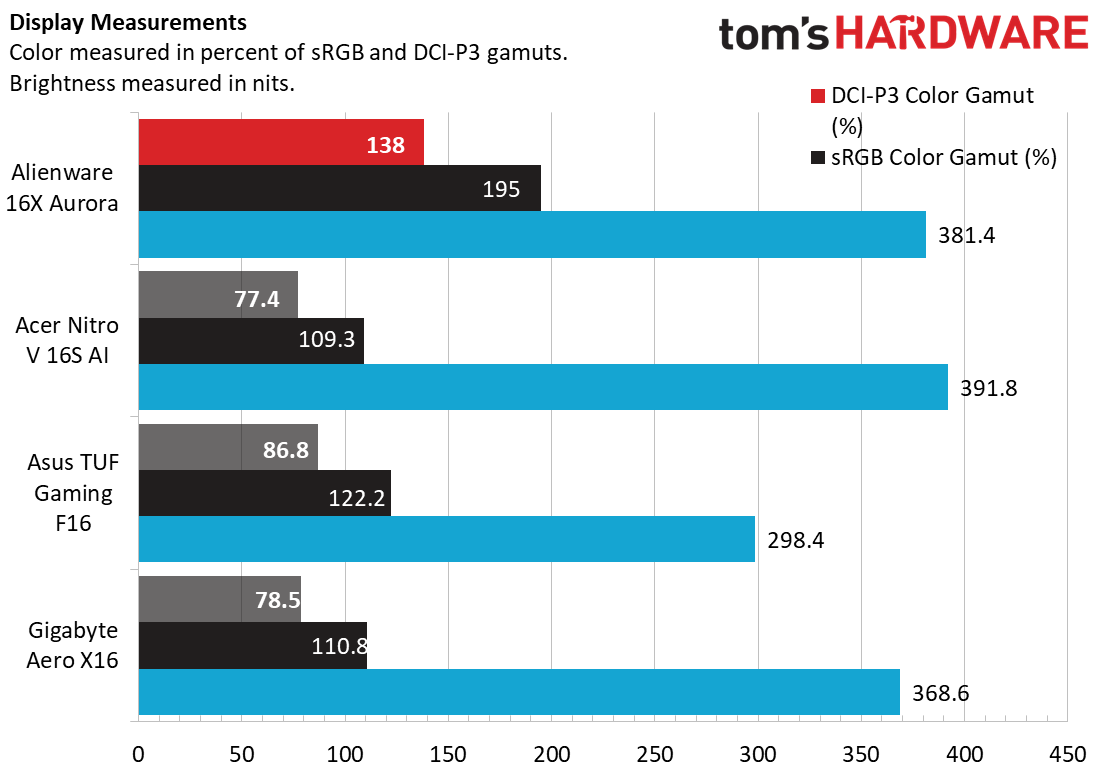
Our lab results back that up. The Aurora peaked at 381.4 nits, which is bright for OLED and nearly tied the IPS-equipped Acer Nitro V 16S AI at 391.8 nits while nudging past the Gigabyte Aero X16’s 368.6 nits. Color coverage was also impressive, reaching 138% of DCI-P3 and topping both the Asus TUF Gaming F16 at 122.2% and the Gigabyte at 110.8%.
Keyboard and Touchpad on the Alienware 16X Aurora
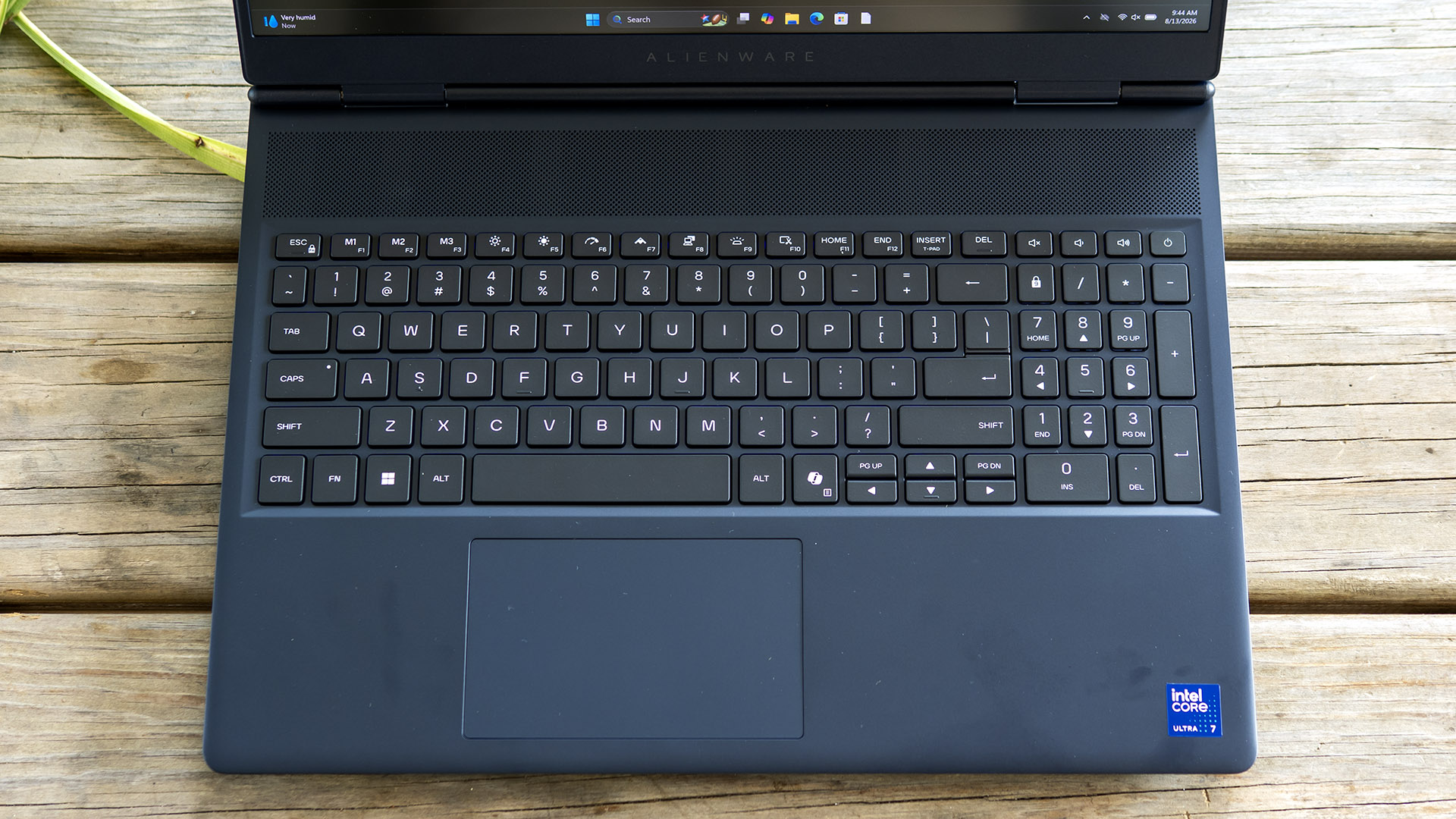
I nearly matched my personal best typing speed on the 16X Aurora, hitting 123 words per minute with 99% accuracy in the MonkeyType typing test. The keys have enough travel and a precise feel, but the overall typing experience is competent rather than memorable. The RGB backlighting only has one zone, and while Alienware Command Center offers effects such as breathing, morph, pulse, spectrum, and rainbow wave, the excitement is undermined by the lighting being too dim to stand out in a well-lit room.
The touchpad is similarly ordinary. It’s average-sized, with a smooth tracking surface and predictable top-hinged mechanical clicks, though those clicks are louder than I prefer.
(Image credit: Tom's Hardware)
Audio on the Alienware 16X Aurora
The Aurora’s speakers are serviceable but unremarkable. Their placement on the sides of the palm rest creates a decent stereo effect, and output is clean enough, with no obvious tinniness and adequate volume for personal listening. In Phil Collins’ “Don’t Lose My Number,” however, drum hits lacked low-end impact, even though vocals came through clearly and instrument separation was strong.
Movies and games fare better with the Dolby app’s Movie and Gaming modes since they boost the sense of surround sound and help the sound feel fuller, but the weak bass still holds back the overall experience.
Upgradeability of the Alienware 16X Aurora
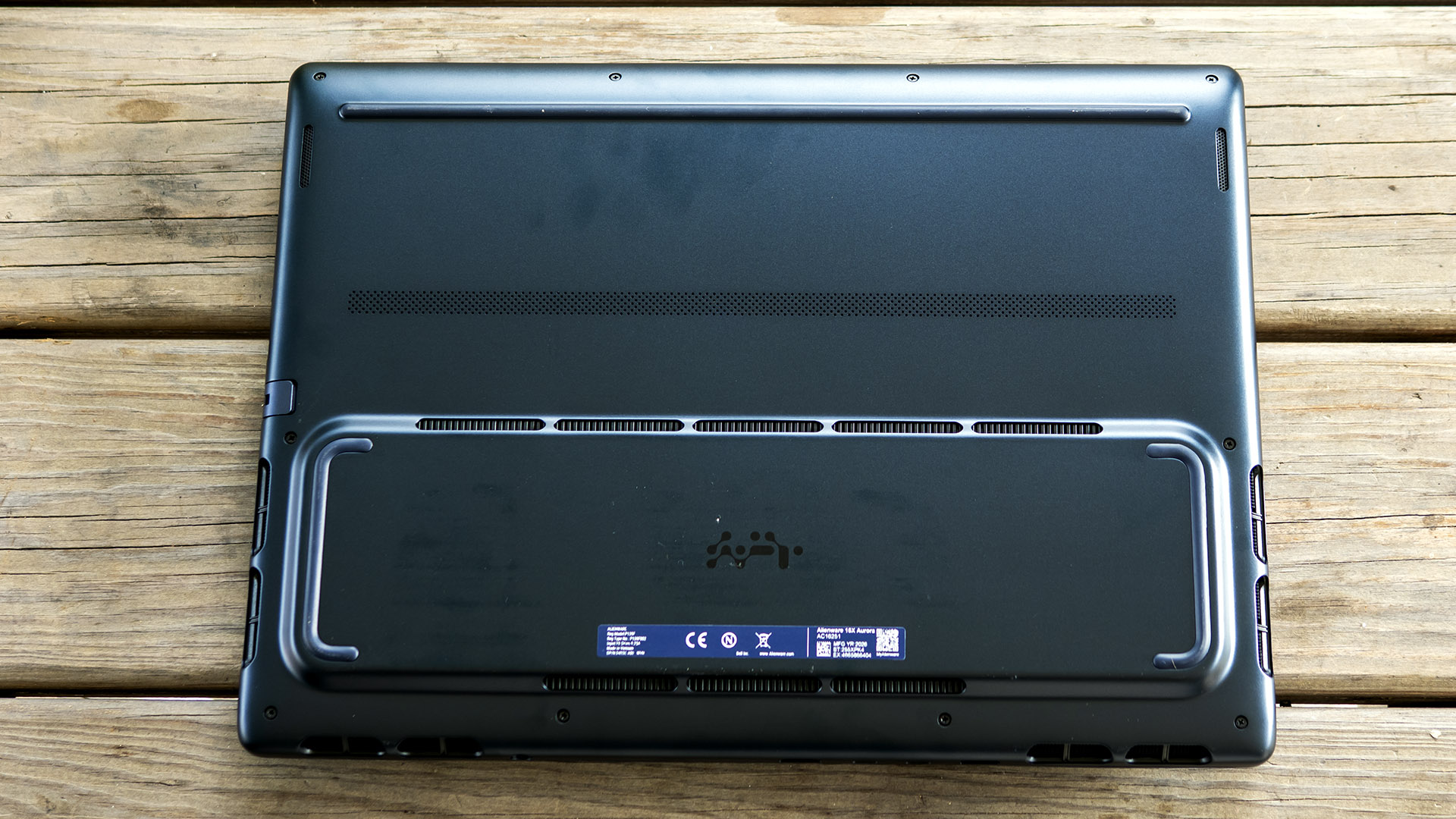
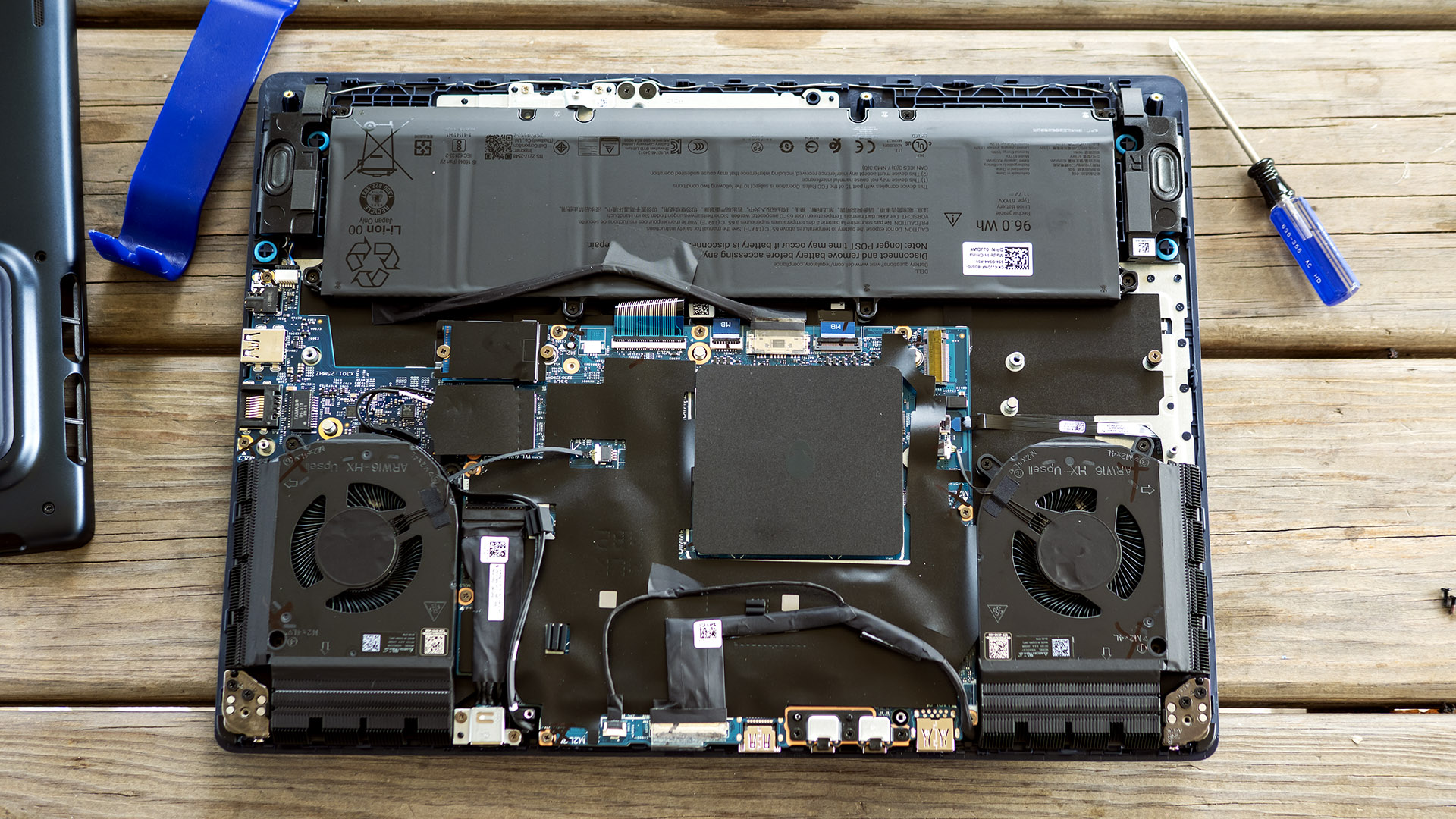
The Aurora is about as upgradeable as laptops get. Opening it up is mostly straightforward - undo the Philips-head screws in the bottom cover, then use a plastic pry tool to pop the clips around the edges. Not all the screws are the same size, and the rear corners are captive and don’t come out.
Upgrades include two DDR5 SO-DIMM slots under the square black shield between the cooling fans, two M.2 2280 drive slots, an M.2 2230 wireless card, and the 96 Whr battery.
Tom's HardwareTom's Hardware
Battery Life on the Alienware 16X Aurora
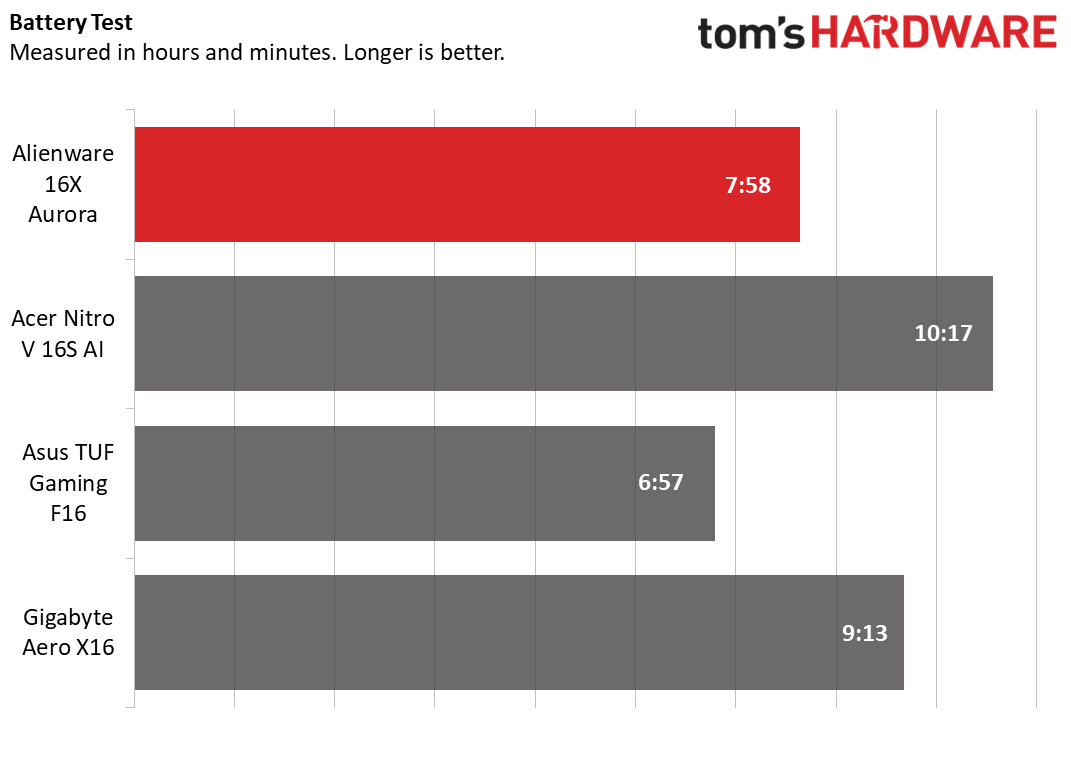
Our battery testing consists of web browsing, running OpenGL tests, and streaming videos with the screen at 150 nits while connected to Wi-Fi. The Aurora’s time of 7 hours and 58 minutes is middling, outlasting only the Asus (6:57). The Gigabyte (9:13) and the Acer (10:17) both lasted several hours longer.
(Image credit: Tom's Hardware)
Heat on the Alienware 16X Aurora
During our 15-loop Metro Exodus stress test, surface temperatures on the Aurora were 101 degrees Fahrenheit (F) between the G and H keys, 83 F on the touchpad, and 101 F on the underside around the exhaust vents.
Internally, the Core Ultra 7 270HX plus averaged 67 Celsius (C) while the RTX 5060 ran at 73 C.
Webcam on the Alienware 16X Aurora
Alienware’s 1080p webcam shows slight grain and the image looks slightly over-sharpened, but the picture is well-exposed, colorful, and doesn’t blow out highlights. It’s missing a privacy shutter, but that’s not unusual for a gaming laptop. It does, however, include an IR sensor for facial recognition logins via Windows Hello.
Software and Warranty on the Alienware 16X Aurora
The Aurora’s main app is Alienware Command Center, which brings system monitoring, power profiles, keyboard lighting, and game library management into one place. Its power presets cover battery, quiet, balanced, and performance modes, while AlienFX handles the single-zone RGB keyboard effects. The app also links out to Dolby for audio tuning. Dell SupportAssist is also included for support access and system updates.
The laptop is backed by a one-year warranty.
Alienware 16X Aurora Configurations
We tested the 16X Aurora in a mildly upgraded configuration, which pairs a Core Ultra 7 270HX processor with an RTX 5060 GPU, 16GB of RAM, and a 1TB SSD. It retails for $2,279.99 from Dell, though I saw it as low as $1,679.99 during our review period. The base model drops to a 512GB SSD and retails for $1,529.99.
Available upgrades include a Core Ultra 9 290HX CPU and RTX 5070 or RTX 5070 Ti graphics. Adding both the Ultra 9 and the 5070 Ti pushes the price to $3,029.99. The memory tops out at 64GB (two 32GB modules) and storage drives are available up to 4TB (two 2TB drives in RAID 0).
Standard features across all models include the 16-inch 2560 x 1600 OLED display, 96 Whr battery, single-zone keyboard backlighting, and Wi-Fi 7.
Dell’s pricing seems to align with the market – I found various other gaming laptops featuring a Core HX-class CPU, a premium screen, and an RTX 5060 or RTX 5070 for within about $100 of what the Aurora commanded.
Bottom Line
The Alienware 16X Aurora is a highly competent gaming laptop with a clear highlight: its superb 16-inch OLED display. It pairs solid gaming performance with reassuring build quality, practical connectivity, and strong upgradeability, while avoiding any major pitfalls. Portability is the main tradeoff, as its weight, size, and middling battery life make it feel more like a desktop replacement than an everyday carry than something like the Razer Blade 16. But if you want a sturdy, capable 16-inch gaming system with a gorgeous screen and few real compromises, the Aurora is easy to recommend.
A great deal on an OLED gaming laptop could be yours, if you're quick. This Acer Predator Helios Neo 16S AI machine has dropped to just $1,899.99 right now, giving you a machine capable of X, thanks to the Nvidia GeForce RTX 5070 Ti included within. Powerful GPU aside, this 16-inch laptop also ships with 32GB of DDR5 RAM and a 1TB SSD, with this deal saving you $300 on its usual price thanks to Best Buy's Labor Day sale.
The Acer Predator Helios Neo 16S AI features an Intel Core Ultra 9 275HX processor, an Nvidia GeForce RTX 5070 Ti laptop GPU with 12GB of fast GDDR7 VRAM, 32GB of RAM, and a 1TB PCIe Gen 4 SSD. This is a high-end spec sheet built with gaming in mind. The 16-inch display is one of the big MVP's here, though, with an insanely fast 240Hz refresh rate on a gorgeous-looking OLED panel that'll make games look stunningly vibrant.
You simply won't find a better alternative for gaming on a laptop than an OLED panel like this one, either. OLED's are fast, with near-instantaneous response times and infinite contrast ratios that give a depth and clarity to the colors on your screen that a traditional LCD can't really match.
For gaming, the mobile version of the Nvidia GeForce RTX 5070 Ti is still powerful, even if it doesn't quite match the desktop version. It still has 12GB of VRAM, however, which will mean you can easily hit high frame rates at the OLED display's native 2,560 x 1,600 resolution, along with a pared-down count of 5,888 CUDA cores. You'll be able to manage high and ultra graphics presets in the most intensive games, with Nvidia DLSS support helping in a crunch, thanks to multi-frame generation.
32GB of DDR5 RAM and a 1TB SSD means you're not compromising on storage or memory with this Acer gaming laptop, despite the AI price boom affecting the entire market this year. Both are more than enough to handle the demands of modern gaming, along with any productivity work you might need to complete. You're also getting the Intel Core Ultra 9 275HX CPU, which has 24 cores, eight of which are the best-for-gaming performance cores.
You're getting a mix of plastic and metal with this laptop's chassis, all-black with RGB lighting, with customizable zones all over. You've got longevity with this build, too, with two DDR5 RAM slots that support up to 64GB, along with two M.2 slots. It's thin and lightweight, weighing just 5lbs with a thickness of just 19mm. You get a good amount of ports, too, including USB-C, and USB-A, along with Ethernet and HDMI. Wireless connectivity is included with Wi-Fi 6E and Bluetooth 5.4, with a 76Wh battery that Acer claims will last almost all day long.
The $1,899.99 sale price for this 16-inch Acer Predator Helios Neo 16S AI gaming laptop is a seriously good one in the current market. Less than $2,000 for an OLED gaming laptop, especially with these specs, is a deal that you'll struggle to match elsewhere. This Best Buy Labor Day sale discount is set to run out by September 7, but with a deal this good, expect it to sell out before then.
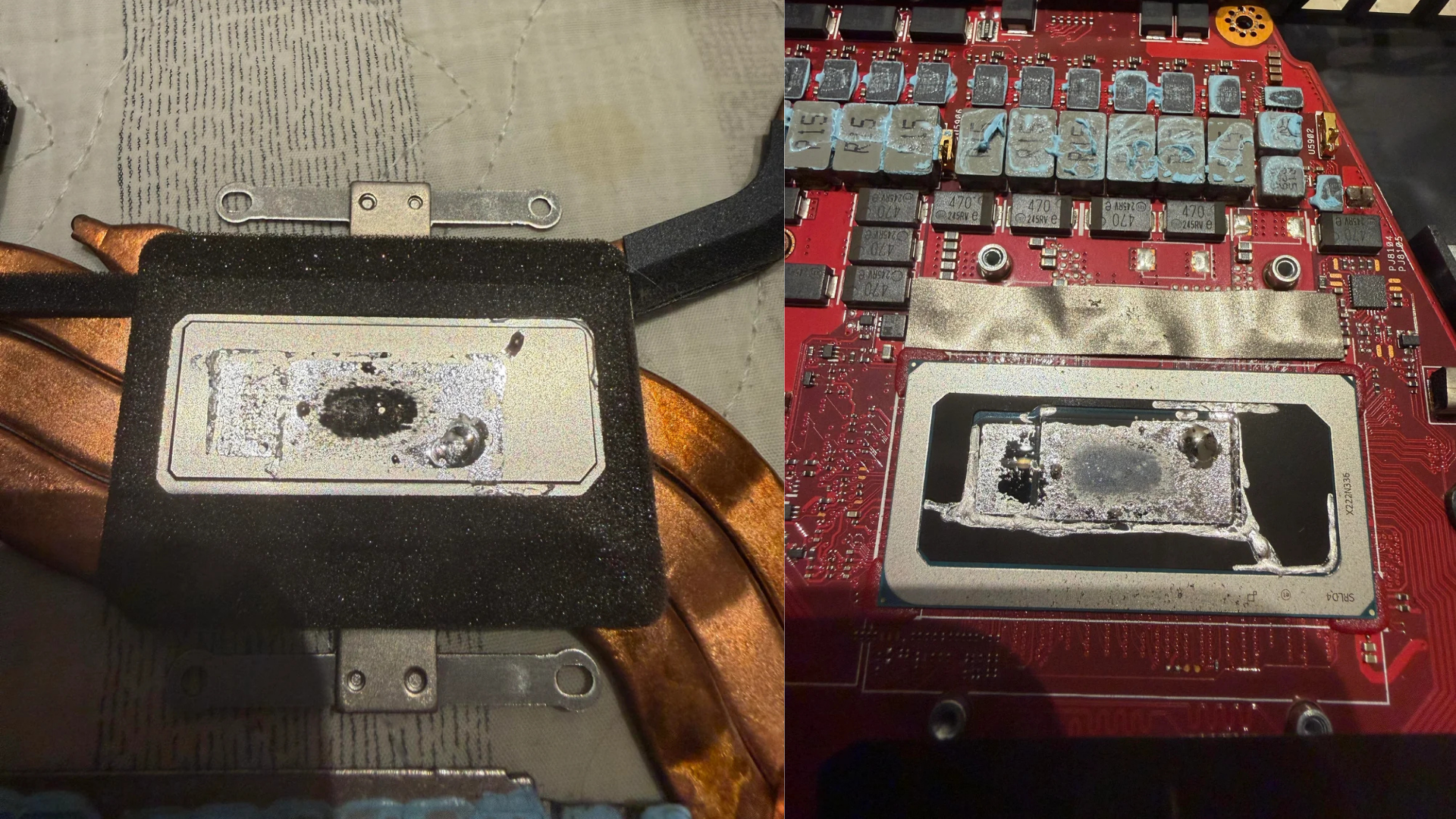
Asus has been putting liquid metal on mobile dies used in its laptops for a few years at this point. Liquid metal as a TIM has its place, but it's a highly inconsistent solution to a problem that can be solved by other materials. Such was the case with u/nicknickmeetnick, whose Zephyrus M16 gaming laptop was overheating and restarting on its own. Turns out, the instability came from an issue born from the factory — the liquid metal applied on the CPU had slowly eaten away at the heatsink and almost reached the silicon itself.
The post above explains the ordeal in detail and how the user ultimately fixed their problems. The laptop in question is a Zephyrus M16 model from 2022 with an Intel Core i9-12900H processor that was bought just over three years ago. During this period, the laptop was mostly used for lightweight tasks instead of gaming or anything that'd stress it. However, as of late, Nick started to run into various issues where his laptop would overheat and thermal throttle to the point of hard-crashing. Before it'd crash, performance in games would already be degraded.
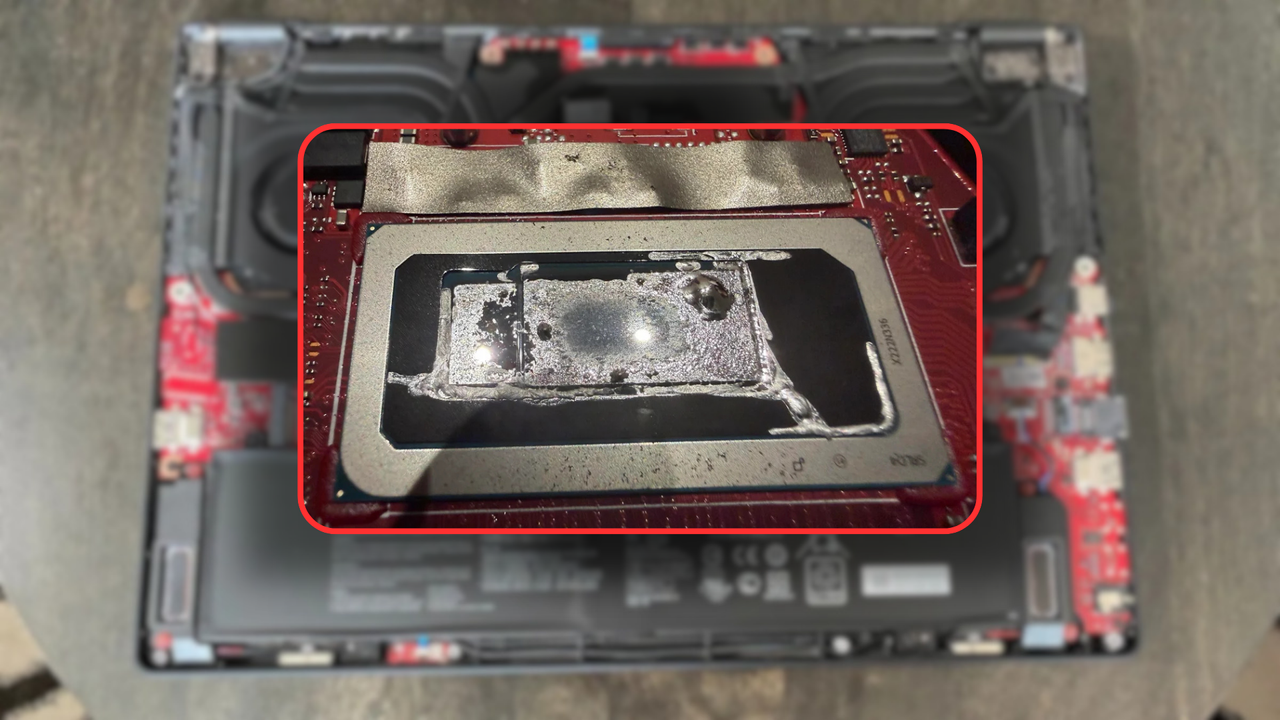
Nick felt his machine was getting warmer than usual, so he ordered some PTM7950 phase change material to repaste the aging hardware. He was ready to use GD900 thermal paste, but upon opening the laptop, he discovered something shocking. The liquid metal on the CPU was so poorly applied that the overheating processor made some of the liquid metal burn onto the heatsink. Underneath, there's only a thin lid that protects the silicon, and Asus applies liquid metal on top of that as well. The metal here had also spilled out of its dedicated cavity.
We don't need to tell you why that would be a devastating and instantaneous catastrophe. Liquid metal is electrically conductive, which means if it comes into contact with surrounding componentry, it can create microbridges that will short anything in the way. Asus, however, seems to be mixing some abrasive chemicals into the liquid metal to make it more adhesive, such that it sticks to the die better. Unfortunately, these chemicals eat away at the metal over time and cause corrosion.
The heatsink (left) and the CPU (right) (Image credit: u/nicknickmeetnick on Reddit)
That's ostensibly what wore out the heatsink and almost the lid underneath as well. Had the user waited for just a while longer, the liquid metal could've seeped onto the die itself. Thankfully, the rogue TIM was removed just in time, but even that process was quite interesting. The OP explained how he used dried cotton to manipulate the existing liquid metal into sanding away the corrosion before taking everything out. For that, he used lots of isopropyl alcohol with cotton sticks to form the liquid metal into a blob that was easy to pluck away with painter's tape.
Once the CPU was nice and clean (well, as clean as possible), OP re-applied GD900 thermal paste and closed everything back up. Right away, the temperatures improved tenfold, and the laptop ran much cooler. Remember, the PTM7950 hasn't even arrived yet, so it will only get better from here. The random reboots stopped, and the only game Nick plays with his kids is now running three times as smoothly. Removing the liquid metal tripled his FPS and restored the Zephyrus M16 to its full glory.
He advised others to do the same. In fact, he suggests banning liquid metal entirely from electronics. It shouldn't be used in laptops to begin with since they're portable devices that move a lot, but even discrete GPUs that sit still for years face problems. This wasn't an isolated case either. A simple Google search returned a dozen different posts on Reddit about liquid metal woes on Asus laptops, which just goes to show that automated, assembly-line liquid metal application is still not perfect.
The Asus ROG Flow Z13 comes with a 13.4-inch IPS display, offering an 180Hz refresh rate and a max resolution of 2,560 x 1,600. The display is also a touchscreen and comes with Gorilla Glass protection to help avoid damage. The laptop's design means you can switch from an ordinary laptop to a tablet orientation using the built-in kickstand.
The specs in this portable rig are pretty formidable. You're getting a 16-core AMD Ryzen AI Max+ 395 processor with integrated Radeon 8060S graphics, along with 64GB of LPDDR5X unified memory running at 8,000 MT/s and a 1TB SSD for storage. This Strix Halo CPU is a good option for gaming at 1080p, but you might need to compromise on your graphics presets to reach 1440p to keep those frame rates high.
ROG Flow Z13: was $2999.99 now $2099.99 An AMDRyzen AI Max+ 395 gaming laptop with a 16-core processor and integrated Radeon 8060S graphics, plus a hefty 64GB of 8000MT/s LPDDR5X unified memory. There's also a 1TB SSD for storage and the 2 in ability to transform from a laptop to a touchscreen tablet. View Deal
The build quality of this Asus ROG Flow Z13 is high, too. It's constructed from a CNC-cut aluminum block for a completely solid structure, and features a lightweight stainless steel vapor chamber to efficiently dissipate heat while giving the laptop extra physical strength. Liquid metal thermal cooling helps to keep the CPU nice and cool under heavy loads while also keeping it as quiet as possible, even during heavy gaming or while using AI apps.
This 2-in-1 convertible laptop is a great option for those who are always on the go. The $2,099.99 sale price for this Asus ROG Flow Z13 laptop is a decent one in the current market, especially with RAM costs skyrocketing. Pick it up while the current discount lasts.
This laptop features Intel's Core Ultra 9 275HX processor, with 24 cores, eight performance and 16 efficiency, 5.4 GHz boost clock speeds, and 40MB Total L2 Cache. With the heavy lifting for gaming done by the GPU and its 24GB of VRAM, this is a superb laptop for both work and play.
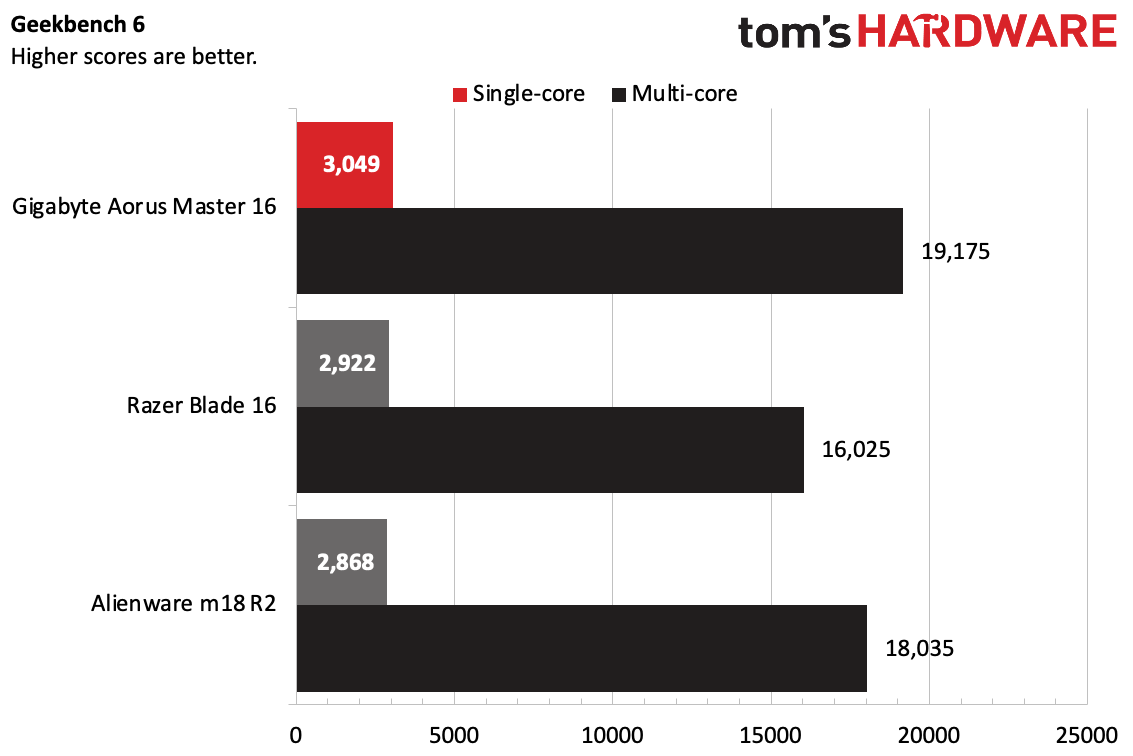
For the price, this is a serious bit of mobile gaming hardware. The GPU and CPU will combine to give you the very best gaming performance you can expect from a mobile graphics unit, all while offering decent efficiency and speeds in productivity workloads. We've reviewed the RTX 5080 version of this laptop with the same CPU, beating out rivals in Geekbench 6 testing for CPU performance.
Tom's HardwareTom's HardwareTom's Hardware
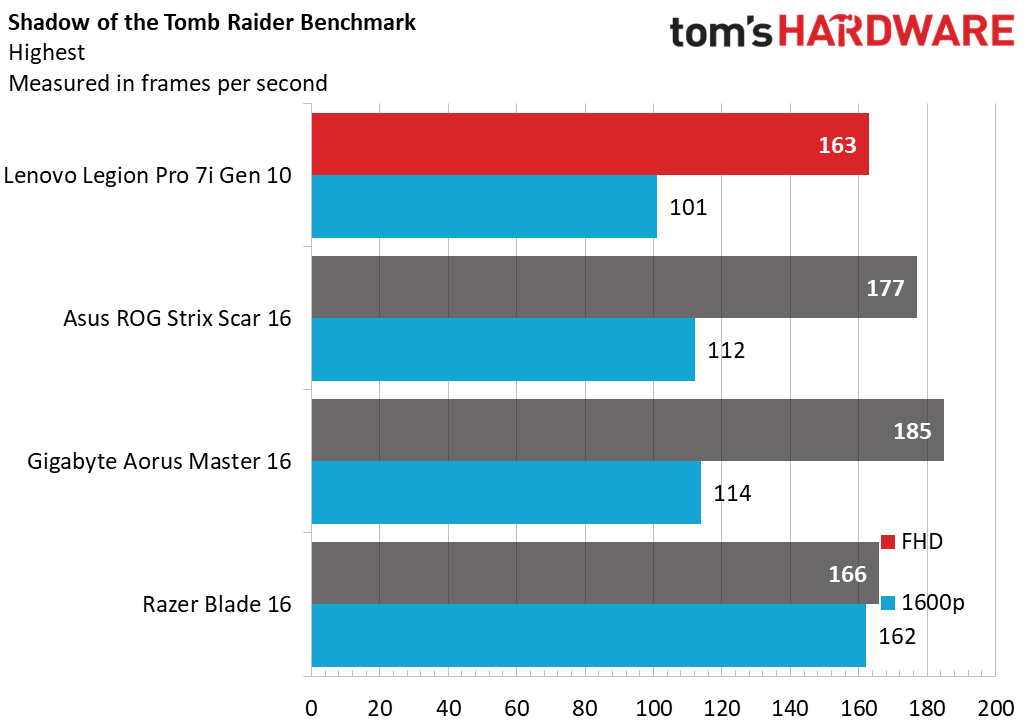
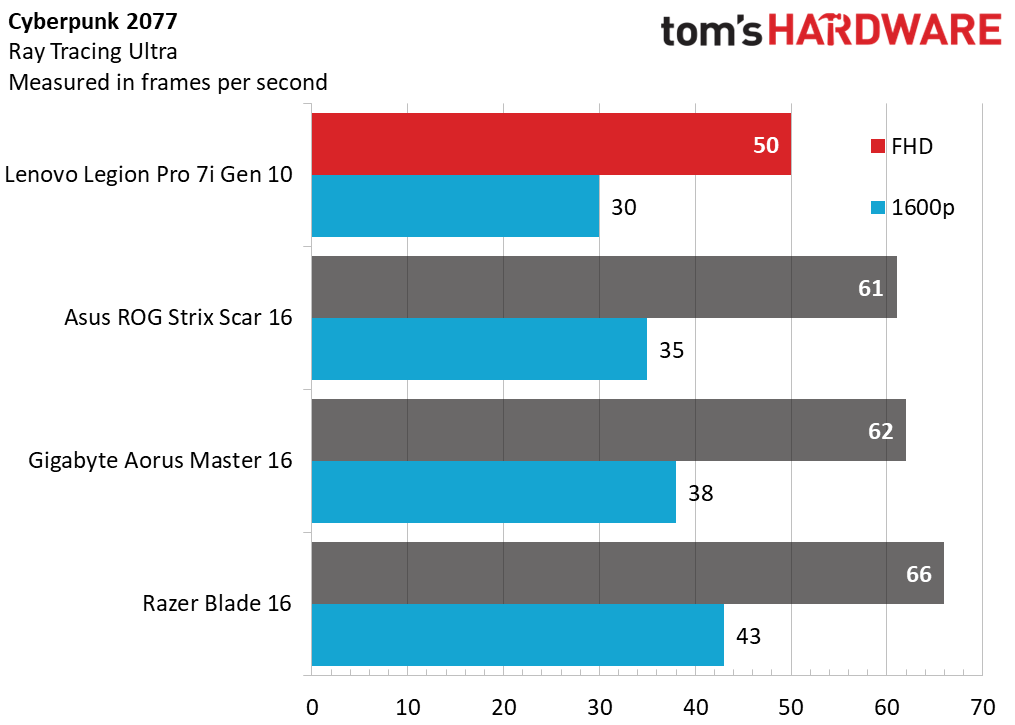
Even the RTX 5080 version of this laptop can run Shadow of the Tomb Raider at its highest settings at 185 frames per second in 1080p, or 114 frames per second at its native resolution. As such, you can expect a big leap in performance from the more potent 5090, with titles like Cyberpunk 2077 easily playable at the native 2560 x 1600 resolution this laptop offers. The OLED display of this laptop also impressed us, beating rivals in our display measurement testing thanks to its 240Hz OLED screen.
(Image credit: Tom's Hardware)
Aside from the headline specs, this laptop also offers ample RAM and storage, 32GB of DDR5 (one spec page says 16GB, but the listing and marketing images clearly state 32GB) and a 2TB Gen 4 SSD respectively.
Connectivity is supplied by way of Wi-Fi 7 and Bluetooth 5.4, and ports include USB-C with Thunderbolt 5, USB 3.2 Type-A, MicroSD card slot, HDMI 2.1, Ethernet, and a 3.5mm headphone jack. If you want a no-nonsense laptop that offers the most mobile graphics power of any machine on the market, this could be a fantastic laptop for heading back to school or campus.
This premium laptop combines a hefty mobile GPU for gaming with an impressive 240Hz, 2560 x 1600 screen, plenty of RAM for multitasking, lots of storage, and great networking and connectivity options. We absolutely loved it in our review and this $1,350 discount makes it all the more enticing.
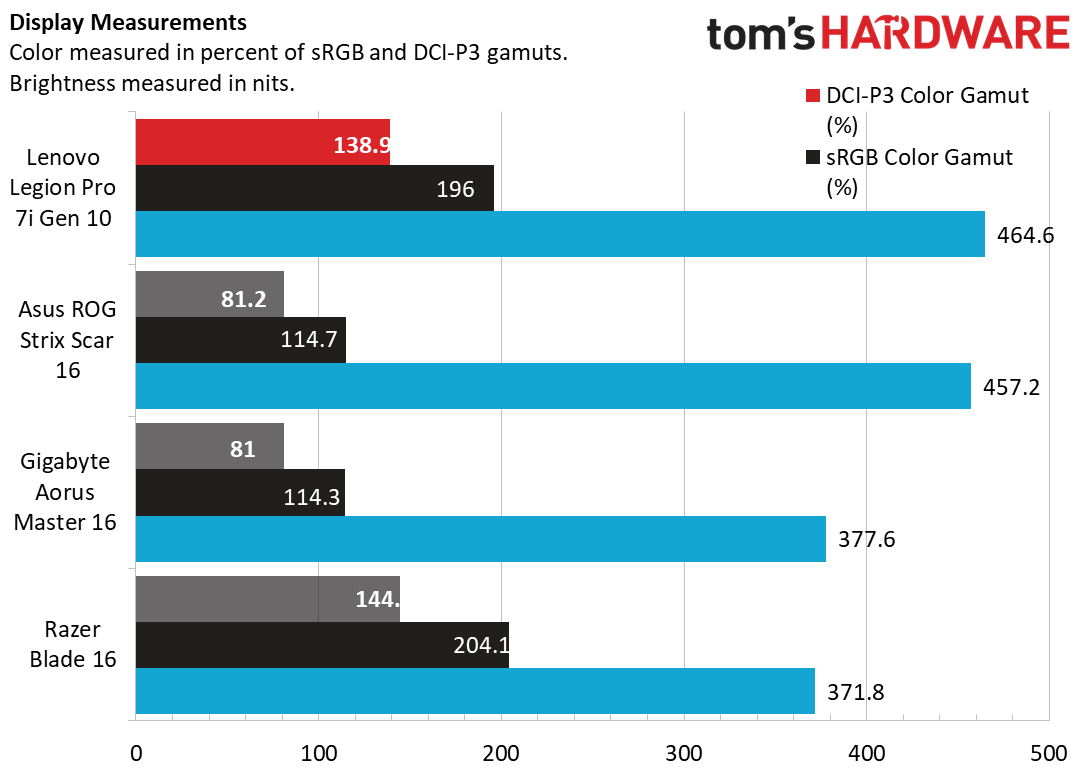
This is a premium gaming laptop that scored well in our Tom's Hardware review. The display in particular is outstanding, as is the sleek aluminum design, customizable RGB lighting, and sharp webcam. As you can see below, the laptop performs extremely well in our display measurements testing thanks to that impressive OLED panel.
(Image credit: Tom's Hardware)
We actually tested the 5080, 32GB RAM, 275HX variant of this laptop, which means we can tell you exactly how the device performs when gaming. In our gaming benchmarks, the Legion Pro 7i pumps out 163 frames per second in Shadow of the Tom Raider at 1080p, or 101 frames per second at the laptop's native resolution of 2560 x 1600. We also clocked Crysis Remastered at Very High, running in the mid-90s, with the 16 VRAM pool and 175W power draw putting in plenty of work.
This is a laptop that will handle anything you throw at it, work or play. Other noteworthy features include 32GB of DDR5 6400 RAM, 1TB SSD, HDMI, USB-C, and USB-A ports, as well as a headphone jack, Wi-Fi 7, and Bluetooth 5.4. It also has an impressive 1440p webcam and scope for upgradeability thanks to its two M.2 drives. As per our review, this is an "outstanding" laptop that easily passes muster in terms of performance, while blowing us away with its OLED screen.
Walmart isn't the first choice you think of for computers and components, but it, of course, does stock them and is guilty of being a bit of a sleeper when it comes to hosting some great tech deals if you can find them. One of the main deals I spot at Walmart is on their gaming laptop selections, and today, we have a $350 saving on a little 15-inch gaming powerhouse for under a grand. MSI's Cyborg 15 with RTX 5060 graphics is just $949. That's a pretty good price for an entire gaming laptop in the current economic climate, and at a price that many can afford.
The Cyborg has a 15.6-inch 1080p display with a 144Hz refresh rate, more than ample resolution for a small screen. Images will appear crisp thanks to the pixel density on the 15.6-inch IPS panel. Powering the display is an Nvidia RTX 5060 laptop GPU with 8GB of VRAM, plenty of memory for 1080p gaming. Rounding out the rest of the internal specs for the MSI Cyborg is an 8-core Intel Core 5 210H CPU, 16 GB of DDR5-5600 RAM, and a 512 GB PCIe 4.0 SSD.
RTX 5060
Enjoy buttery-smooth gaming with the RTX 5060-powered Cyborg 15, coupled with the 8-core Intel Core 5 210H CPU and 16 GB RAM. Featuring a sleek design, plenty of battery life, and a 144 Hz 1080p IPS display, this is a solid machine for any task on the go — made even better at its discounted price. View Deal
The Cyborg 15 has a distinct aesthetic, with a slate gray coloring to its outer shell and a somewhat symmetrical pattern on the keyboard, with some transparent plastic cutouts. There's 4-zone RGB lighting on the keyboard, a fingerprint reader, a webcam shutter, and a healthily large 55.2Wh battery.
Connectivity options include Wi-Fi 6E and Bluetooth 5.3 for wireless networking, and an Ethernet port for a stronger cabled network. For your peripherals, there are fast USB ports that include USB-A and USB-C (DisplayPort and Power Delivery 3.0) ports, and an HDMI 2.1 (4k 60) port for hooking up to an external display.
The MSI Cyborg 15 in this deal is a 2026 model selling for just $949 at Walmart right now, making it one of the cheapest up-to-date RTX 5060 gaming laptops we've seen in a while, and a great counter to the ever-rising price barriers to jumping into PC gaming.
We've been highlighting the benefits of going down the pre-built gaming PC and laptop route a lot recently, thanks to the ever-rising prices of PC components. Today is another example of a price cut on a ready-made gaming computer that might be the saviour of those looking to buy into PC gaming in the current climate. Hitting a new all-time low price at Amazon is the Acer Predator Helios Neo 18 AI, falling to $2,199.99. That's a saving of $600 from its most recent sale price of $2799.99, which we've confirmed via price comparison sites.
The Acer Predator Helios Neo 18 AI features an Intel Core Ultra 9 275HX processor, an Nvidia GeForce RTX 5070 Ti laptop GPU with 12GB of fast GDDR7 VRAM, 32GB of RAM, and a 2TB PCIe Gen 4 SSD. These components power your gaming on the huge 18-inch IPS display with an insanely fast 240Hz refresh rate and 3ms overdrive response time.
The chassis of the Predator Helios Neo 18 AI is a mix of metal and plastic, with an abyssal black finish. There is room to upgrade parts in the future if RAM and SSDs don't become unaffordable, with two DDR5 RAM slots that support a maximum of 64GB and two M.2 slots. For that gamer aesthetic, there's plenty of bright RGB zones all over the laptop, so you can dial it up to 11 if you want to go for the full light show.
RTX 5070 Ti / 32GB of RAM
This large 18-inch gaming laptop packs an Intel Core Ultra 9 275HX CPU and Nvidia RTX 5070 Ti GPU, along with 32GB of DDR5 RAM and 2TB of Gen 4 SSD storage capacity. View Deal
The RTX 5070 Ti is one of the more powerful laptop graphics chips, and although not comparable to a desktop version, it still has 12GB of VRAM and will be able to run games smoothly on the 18-inch 2560x1600 WQXGA+ screen. Being an Nvidia GPU, the laptop will be able to access Nvidia's DLSS software to increase or smooth out frame rates on more taxing titles. This is a large laptop at 18 inches, and quite expensive due to its size and amount of memory and storage used. So it's good to see it hit a new all-time low price at Amazon of $2,199.99.
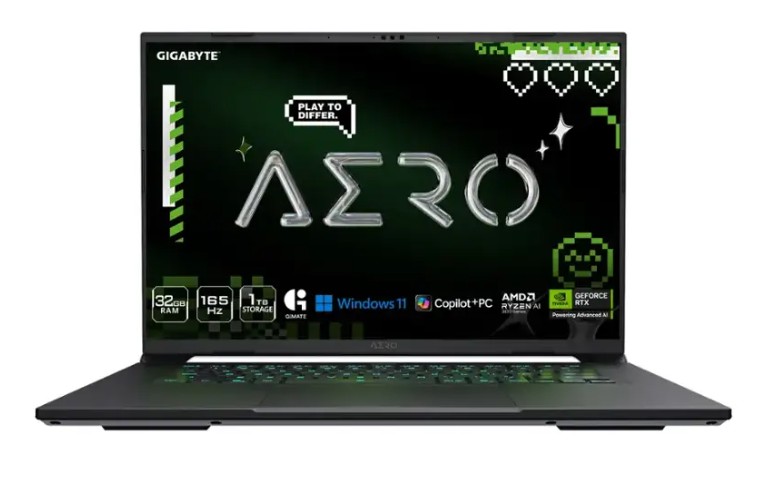
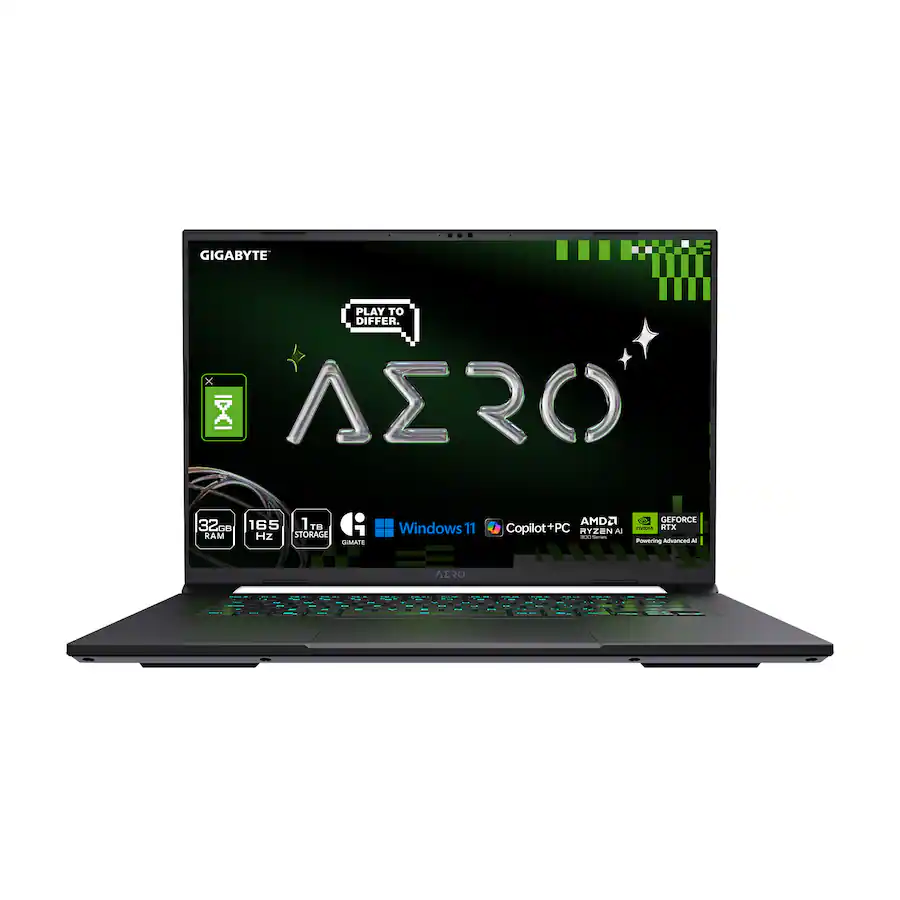
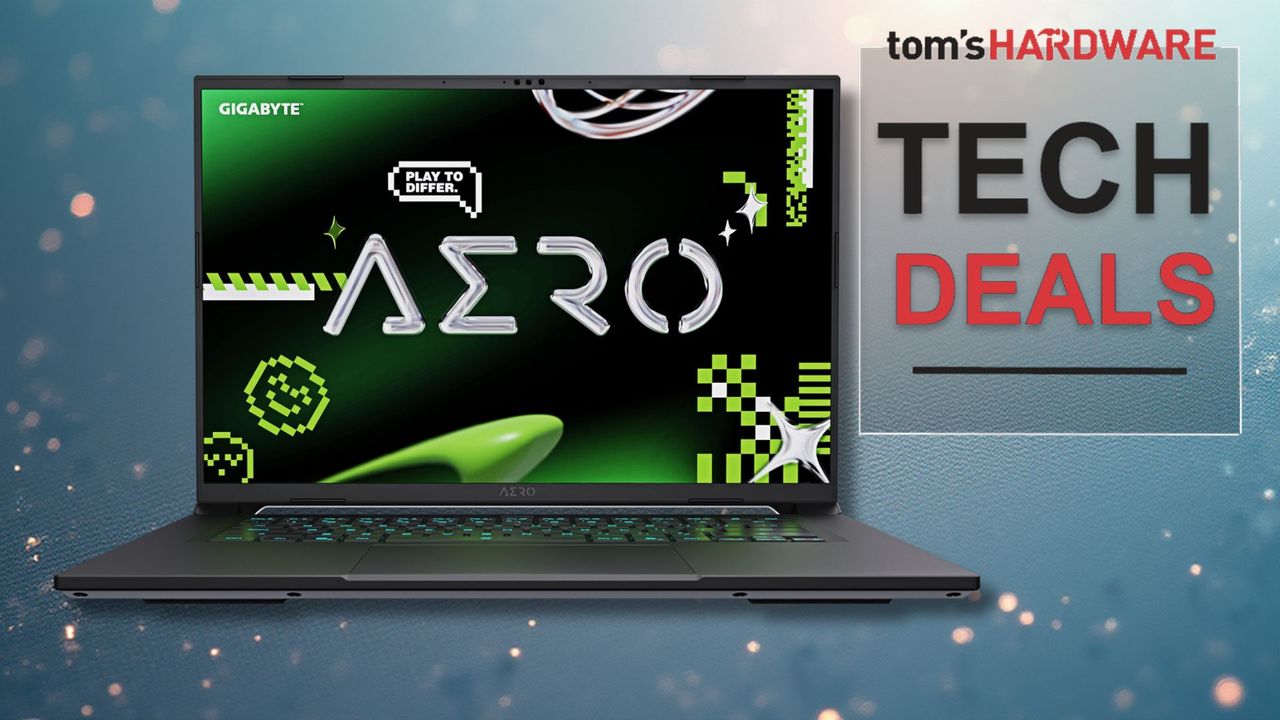
We all know that prices of memory, storage, and graphics cards have all shot up in price this year due to the insane AI-boom sucking up all the production resources, and the outlook for PC component upgrades is pretty grim, but luckily there are still a few ways to nab a gaming computer without emptying your bank account. Gigabyte's Aero X16 gaming laptop is down to $ 1,099.99 at Walmart, a $600 discount off the $1,699.99 list price. A gaming laptop or a pre-built gaming desktop is turning out to be the best value-for-money way to keep playing in the current climate.
The Gigabyte Aero X16 features an AMD Ryzen AI 7 350, an 8-core, 16-thread processor that can boost up to 5 GHz, paired with an Nvidia RTX 5060 with 8GB of VRAM, 16GB of DDR5 RAM, and a 1TB PCIe Gen 4.0 SSD for storage.
The Aero X16 laptop sports a 16-inch IPS screen with a resolution of 2560 x 1600 pixels, offering 100% sRGB color gamut coverage and up to 400 nits of brightness. The IPS panel supports a refresh rate of 165Hz with a 3ms gray-to-gray response time for a smooth gaming experience.
There's no unified soldered RAM or storage in this laptop either. There are dual memory and M.2 slots for upgrades, so that when the prices of RAM or SSDs hopefully subside a little, you can add some more capacity.
Featuring an AMD Ryzen AI 7 350 processor, Nvidia RTX 5060 graphics with 8GB of VRAM, 16GB of DDR5 RAM, a 165 Hz 16-inch IPS panel, and dual storage expansion support, the Gigabyte Aero X16 stands out as a versatile gaming and productivity machine at an affordable price.View Deal
Other features of the Aero X16 include a single-zone RGB-backlit keyboard, a 1080p webcam with Windows Hello support, Wi-Fi 6E, and Bluetooth 5.2. For connectivity to peripherals and external displays, there are two USB 3.2 Gen 1 Type A ports, a USB 4.0 Type-C port, a USB 2.0 Type-A port, and a 3.5mm headphone and mic combo jack, plus a network Ethernet port.
If you’re looking for the absolute best performance in a gaming laptop, then you’ll likely want to consider a desktop replacement. If you’re in the market, the HyperX Omen Max 16 makes a strong case with a 16-inch form factor and a thick chassis that accommodates some beefy hardware.
Our review unit carries a sticker price of $4,699, packs a Core Ultra 9 290HX Plus processor, and includes an RTX 5090 GPU. It also tips the scales at 6.56 pounds, making it a more suitable companion for your desk than for lugging around while traveling.
Despite its imposing dimensions and beefy hardware, the Omen Max 16 doesn’t quite pass muster in performance against its slimmer competitors among the best gaming laptops.
Design of the HyperX Omen Max 16
“Solid, solid as a rock,” is the phrase that comes to mind when describing the Omen Max 16. The laptop feels like it was forged from a solid piece of granite, but in actuality, it’s aluminum. It’s also thick, measuring 1.13 inches at its thickest point (at the rear).
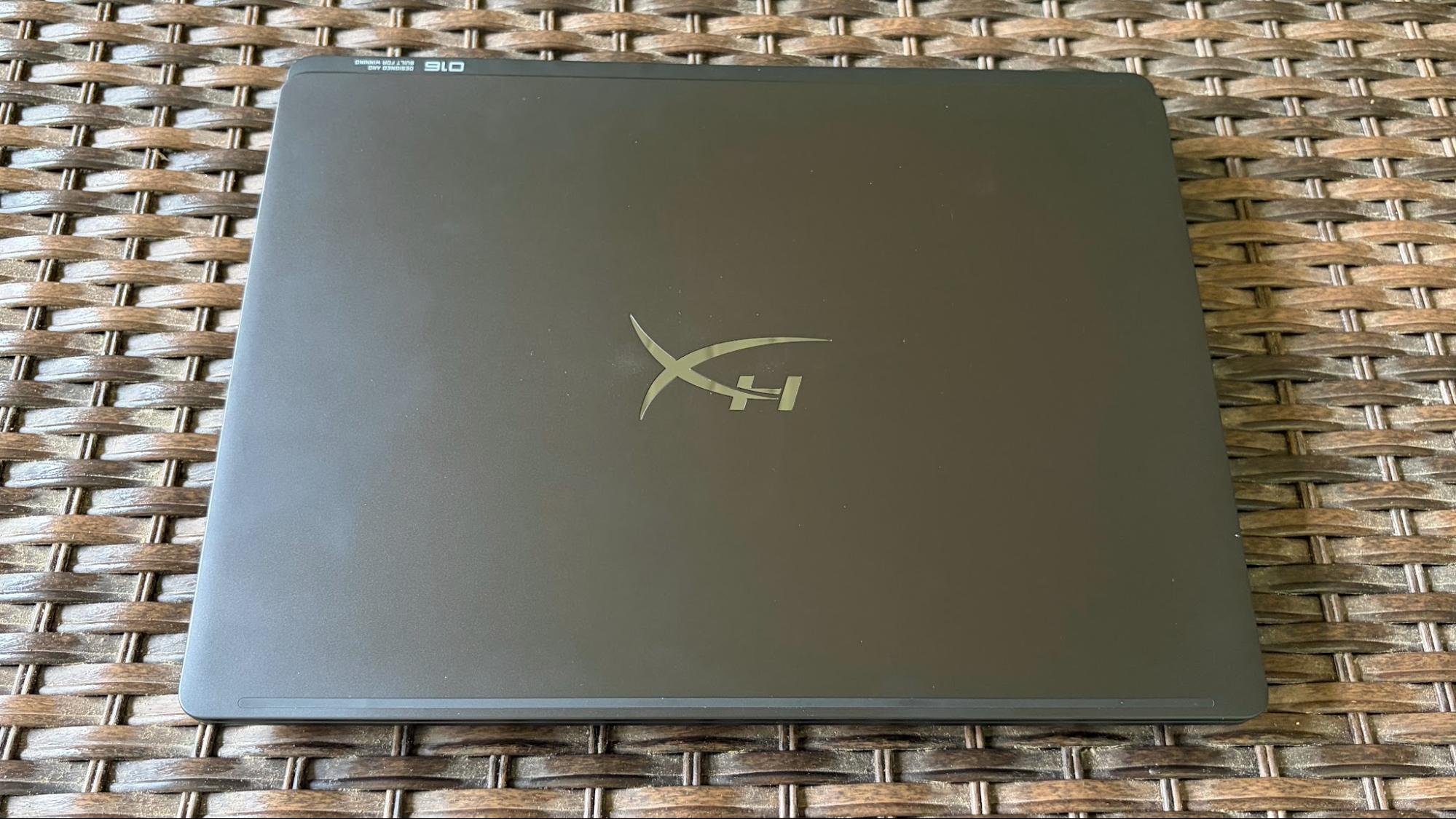
To my eyes, the Omen Max 16 is attractively designed with no outrageous styling gimmicks. The aluminum is coated in a matte black finish, and design flourishes (like the O16 printed vertically along the deck and the HyperX logo on the lid) are subdued and don't draw significant attention. There’s also a laser-etched grille that runs nearly the width of the chassis that sits above the keyboard.
Tom's HardwareTom's HardwareTom's Hardware
The only thing that really clues you into the gaming nature of the laptop (other than its sheer size) is the per-key RGB lighting for the keyboard, and a single LED strip on the bottom front edge of the chassis that you can configure with the Omen software.
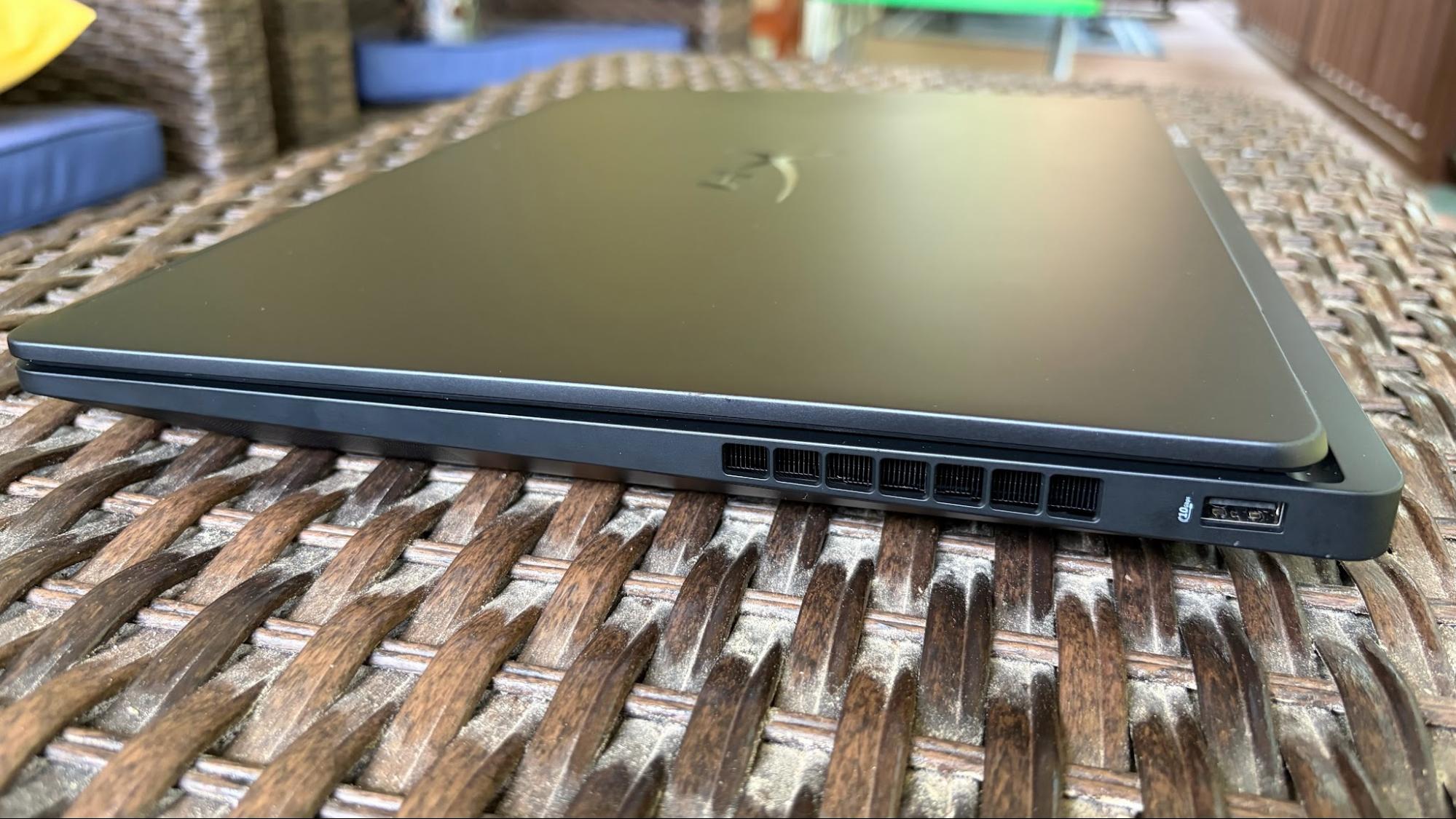
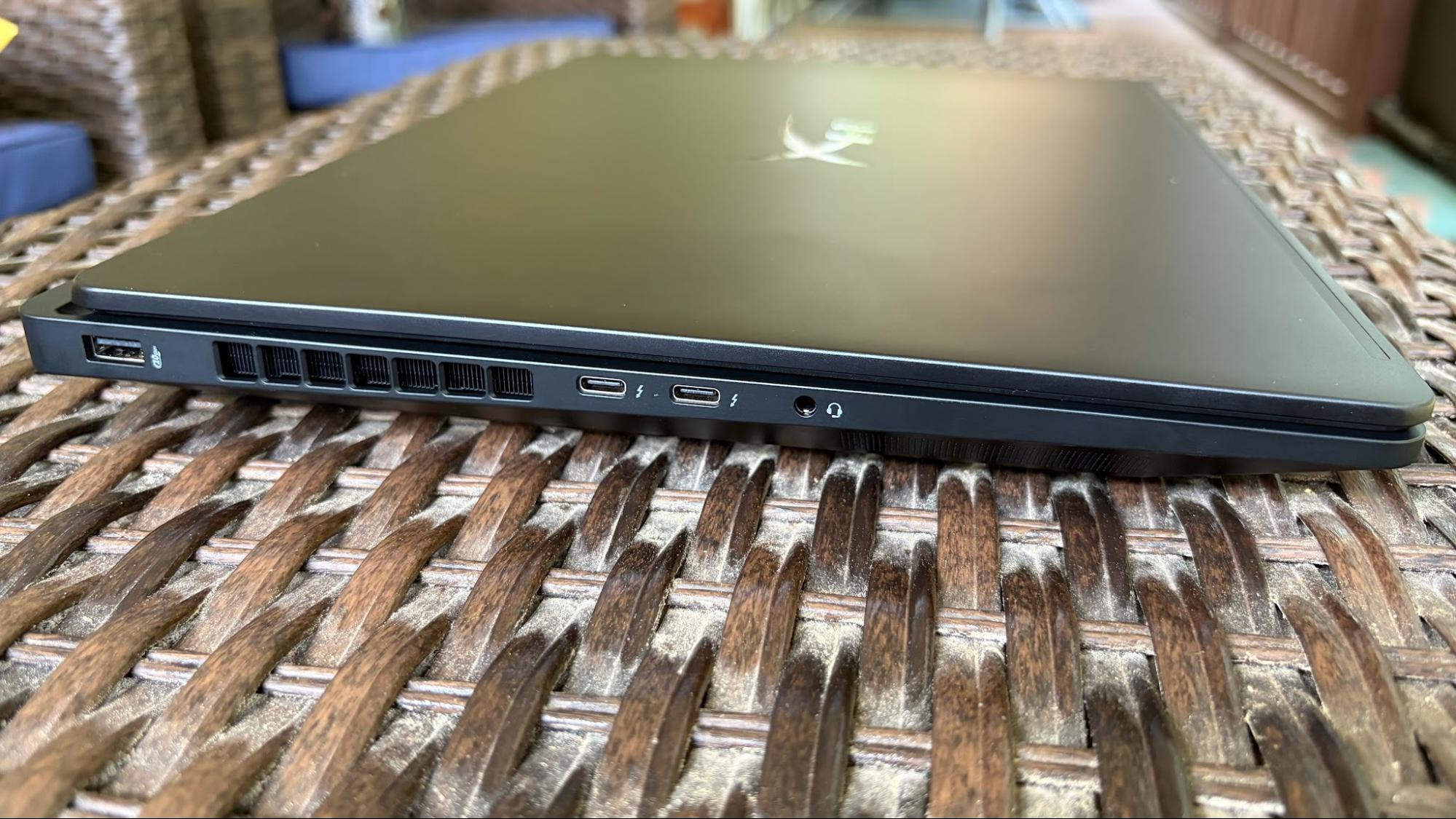
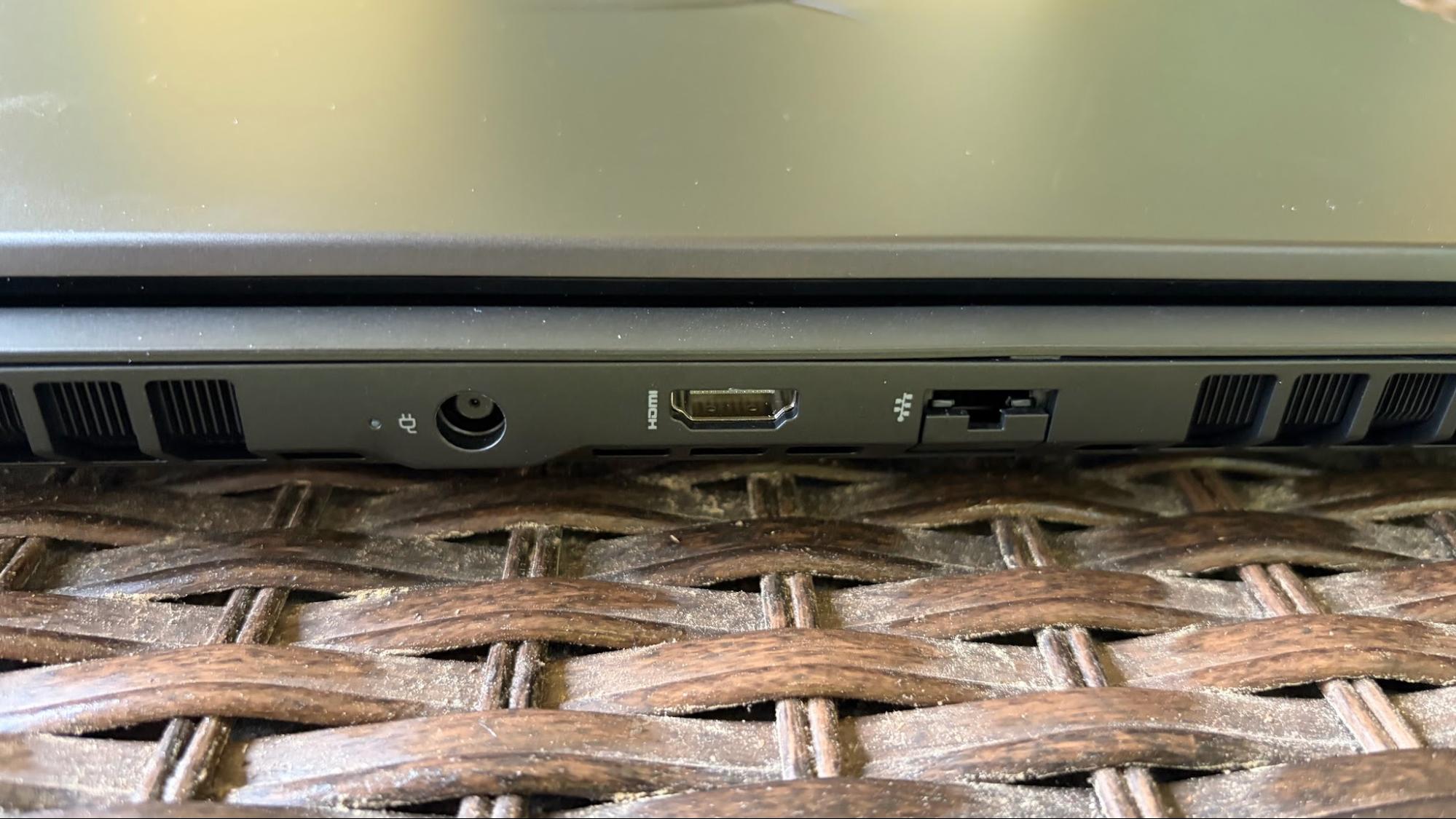
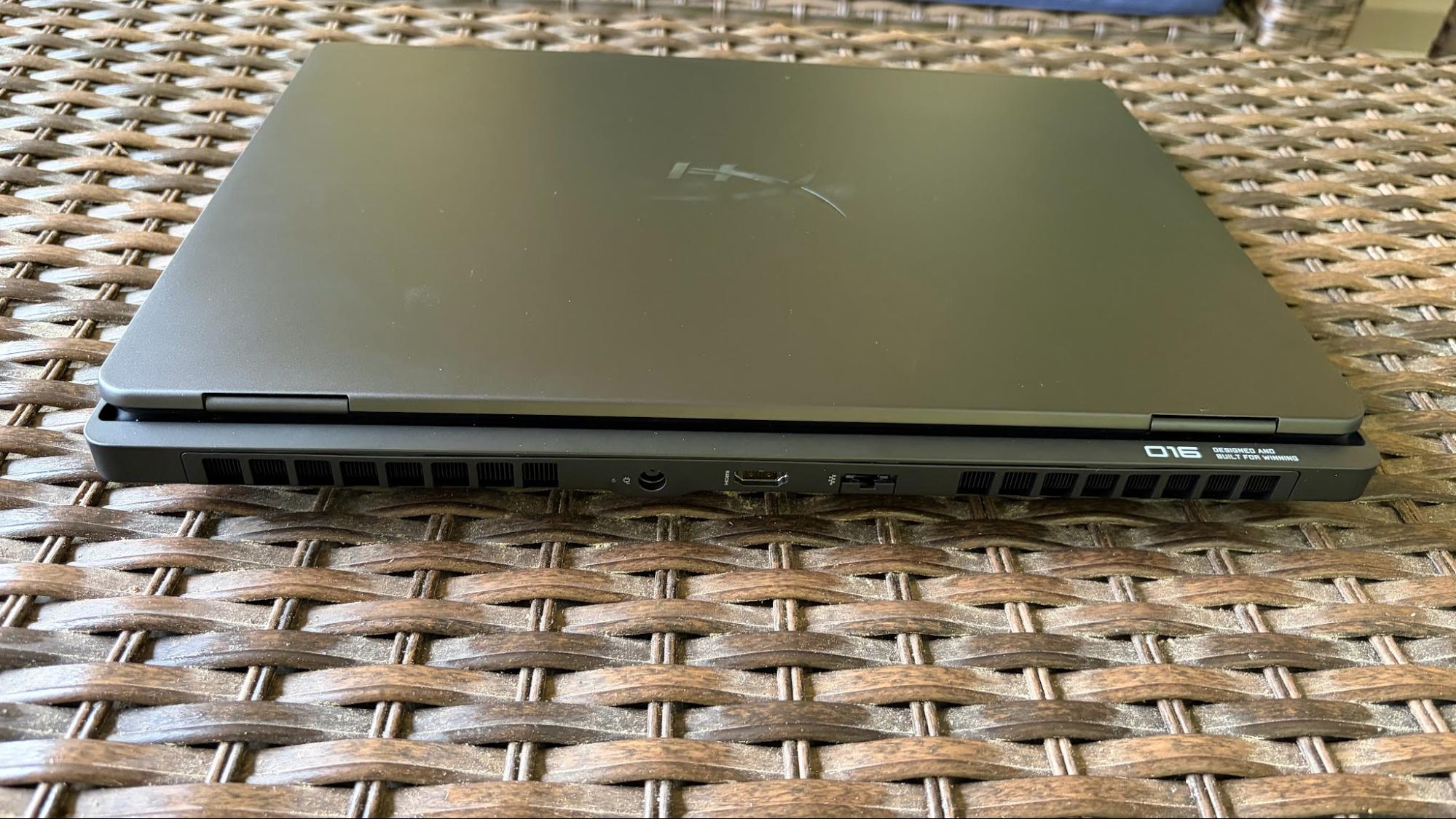
When it comes to external ports, the Omen Max 16 has a USB-A (10 Gbps) port, two Thunderbolt 4 ports, and a 3.5 mm audio jack on the left. On the right side of the chassis, you'll find another USB-A port. The back panel of the laptop is home to an HDMI 2.1 port, a 2.5 GbE port, and a proprietary power port (a 460W GaN power adapter is included).
The Omen Max 16 measures 14.04 x 10.59 x 1.03 inches and weighs 6.56 pounds. For comparison's sake, the Razer Blade 16 is 13.98 x 9.86 x 0.69 inches and weighs 4.71 pounds. The MSI Raider 16 HX comes in at 14.29 x 10.62 x 1.14 inches and weighs 5.73 pounds. The Alienware 16 Area-51 weighs 7.49 pounds and measures 14.37 x 11.41 x 1.12 inches.
HyperX Omen Max 16 Specifications
CPU
Intel Core Ultra 9 290HX Plus
Graphics
Nvidia GeForce RTX 5090 Laptop GPU (24GB GDDR7, 1,597 MHz Boost Clock, 175 W Max TGP)
Memory
32GB DDR5-6400 (2x 16GB)
Storage
2TB PCIe 5.0 NVMe M.2 SSD
Display
16-inch, 2560x1600, 240 Hz, 16:10, OLED
Networking
Wi-Fi 7, Bluetooth 5.4
Ports
2x Thunderbolt 4, 2x USB 3.2 Type-A Gen 2, 1x HDMI 2.1, 3.5 mm headphone jack, 2.5 GbE
Camera
1080p IR webcam
Battery
83 Whr
Power Adapter
460 W
Operating System
Windows 11 Home
Dimensions (WxDxH)
14.04 x 10.59 x 1.03 inches
Weight
6.56 pounds
Price (as configured)
$4,699.99
Gaming and Graphics on the HyperX Omen Max 16
The Omen Max 16 is equipped with an Intel Core Ultra 9 290HX Plus processor, 32GB of RAM, and an RTX 5090 GPU (175W TGP). Given these specs and a sizable chassis to aid cooling (300W total system power), I was expecting strong numbers from the Omen 16 Max. Instead, the laptop was relegated to the back of the pack, except for one game benchmark: Far Cry 6.
My game of choice these days is Battlefield 6, running at native resolution in Overkill detail mode, with DLSS Quality and frame generation enabled. Using these settings, I was able to average between 100 and 110 frames per second.
For the competitive set, we have the Blade 16 (Core Ultra 9 386H at 25W, RTX 5090 at 175W TGP), MSI Raider 16 Max HX (Core Ultra 9 290HX Plus at 55W, RTX 5090 at 175W TGP), and the Alienware 16 Area-51 (Core Ultra 9 290HX Plus at 55W, RTX 5080 at 175W TGP). It should be noted that the Omen Max 16 uses slower DDR5-6400, whereas systems like the Blade 16 use faster LPDDR5X-9600.
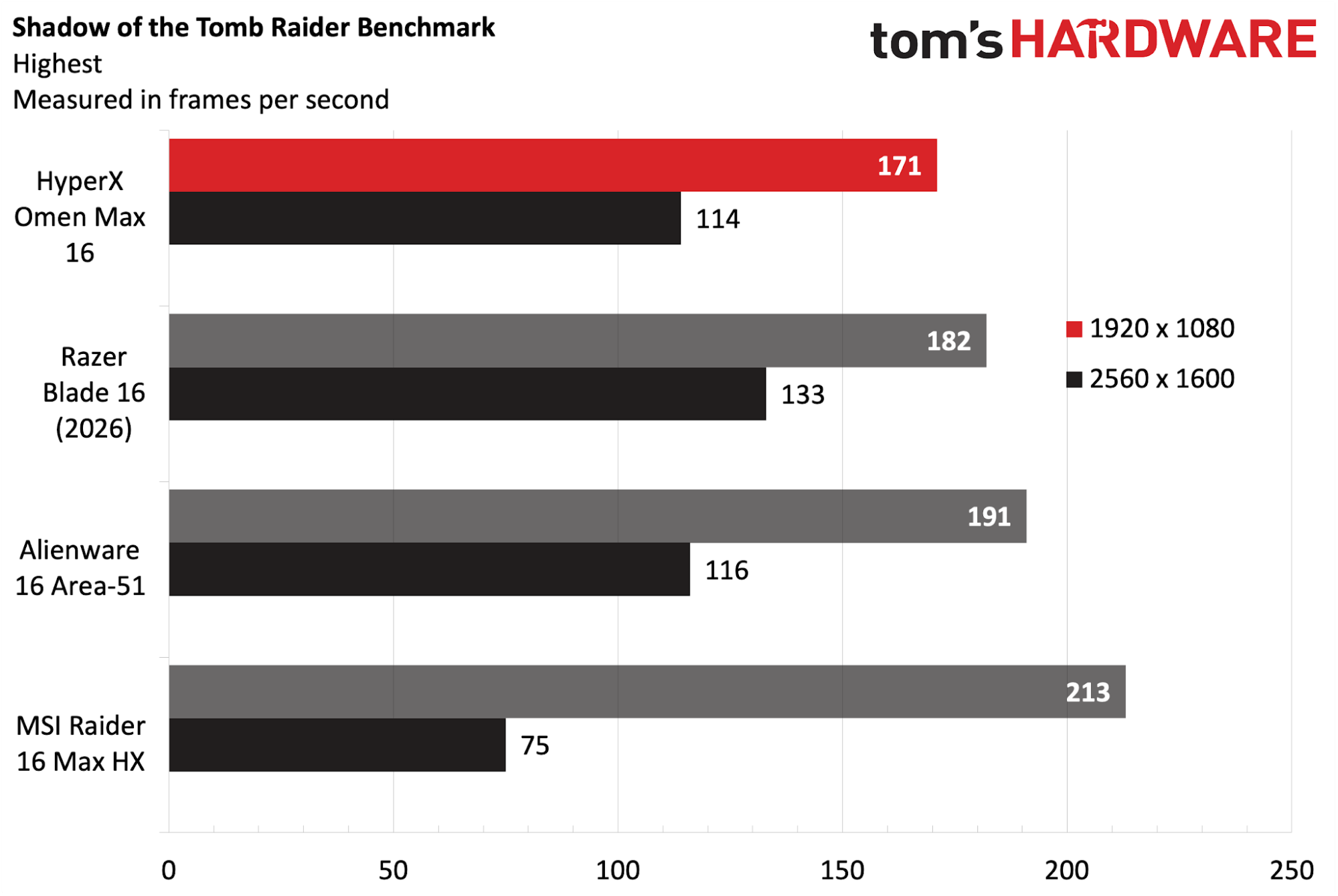
We started our benchmarking spree with Shadow of the Tomb Raider (Highest setting), and here the Omen Max 16 achieved 171 FPS at 1080p, putting it in last place behind the Razer Blade 16 (182 FPS). At 1600p, it landed in a comfortable third place (114 FPS) behind the Alienware 16 Area-51.
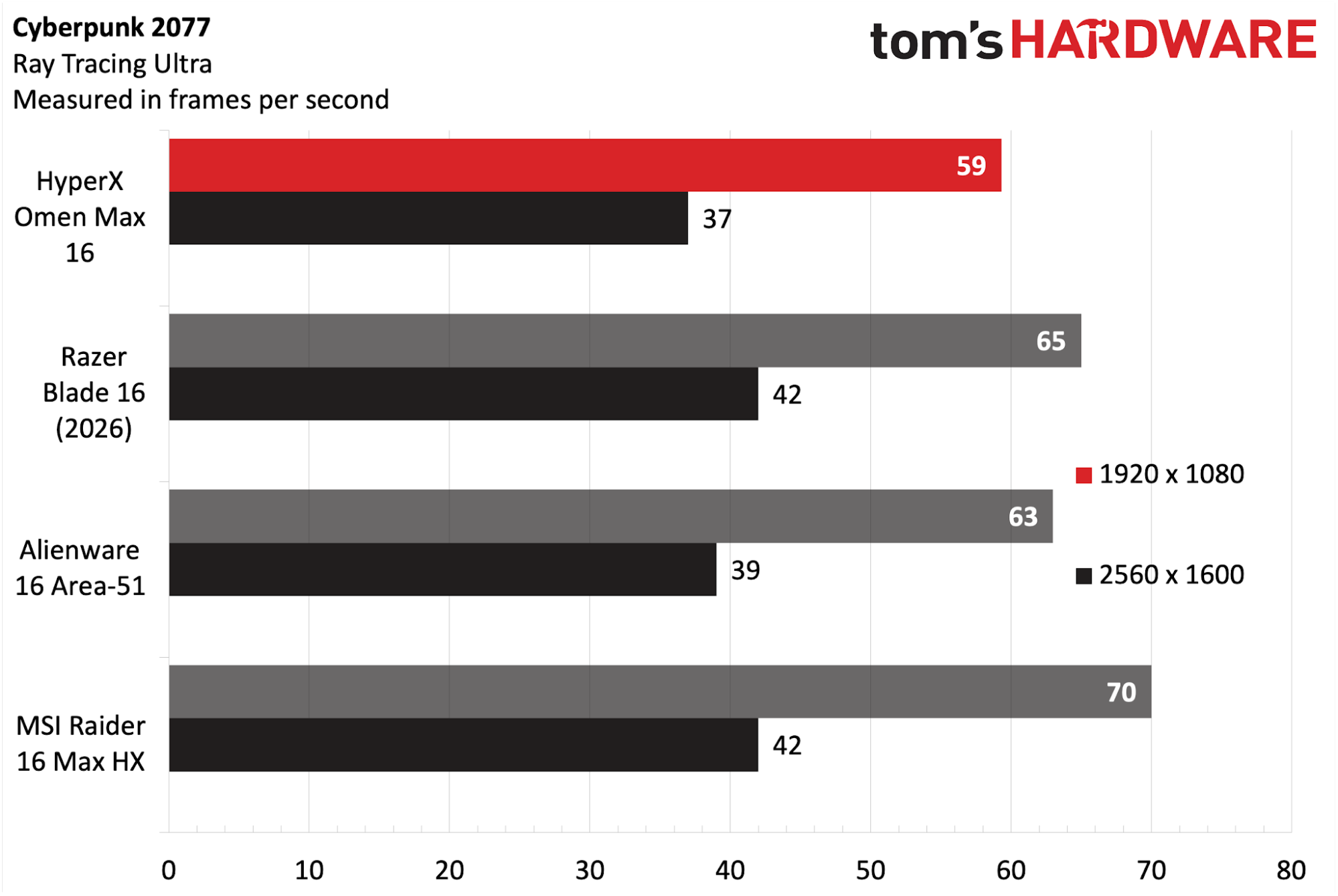
Cyberpunk 2077 (Ray Tracing Ultra settings) wasn't a strong showing for the Omen Max 16, either. It brought up last place at 1080p (59 FPS) and 1600p (37 FPS).
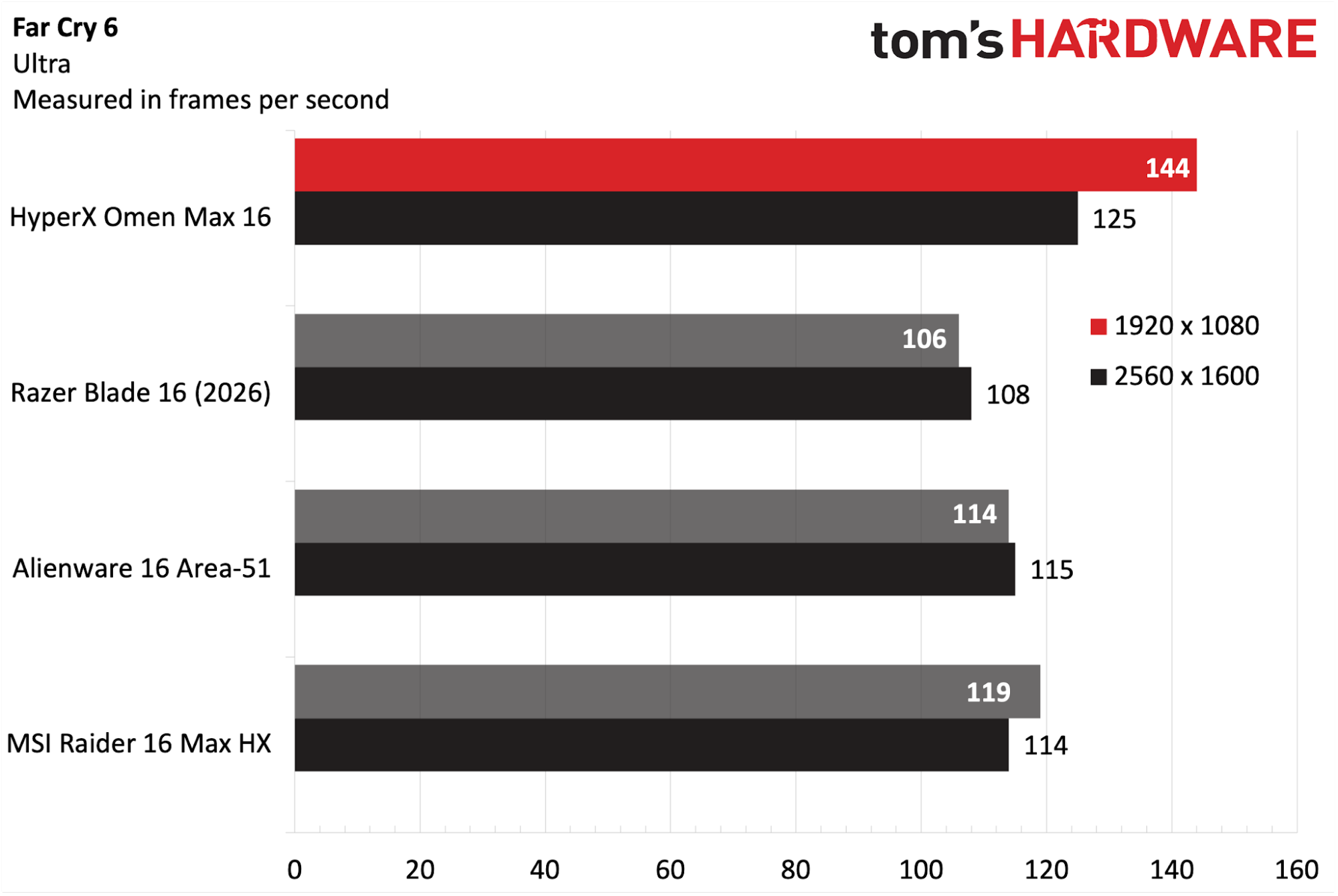
Far Cry 6 (Ultra settings) was the lone bright spot for the Omen Max 16, as it garnered 144 FPS at 1080p and 125 FPS at 1600p, easily putting it in first place. Both of these results far outpaced the rest of the field, with the next closest competitor being the MSI Raider 16 Max HX at 119 FPS and 114 FPS, respectively.
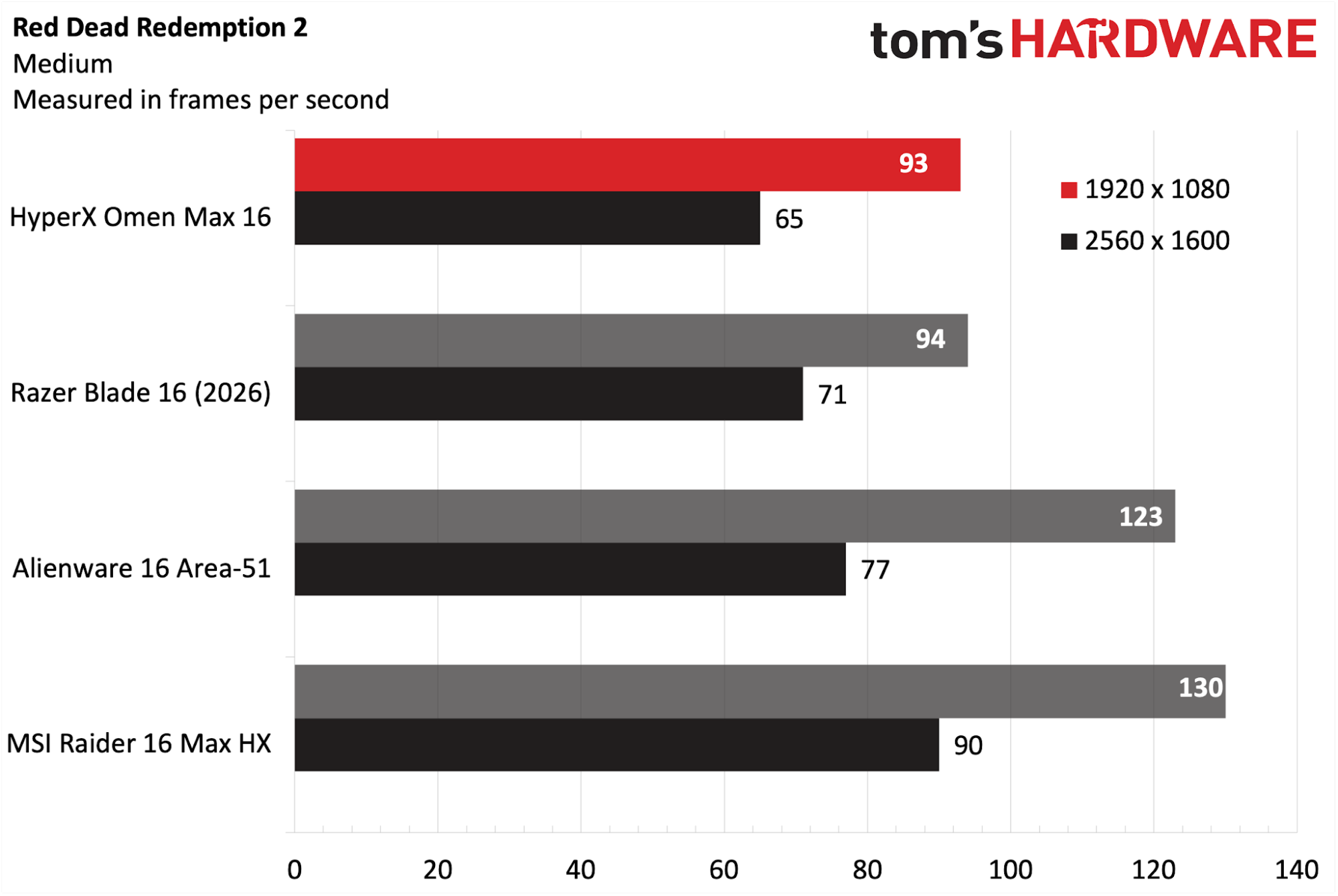
Moving to the Red Dead Redemption 2 (Medium settings) benchmark, the Omen Max 16 again wound up in last place, hitting 93 FPS at 1080p and 65 FPS at 1600p. However, in this instance, the margin between the Omen Max 16 and The Blade 16 at 1080p was just 1 FPS.
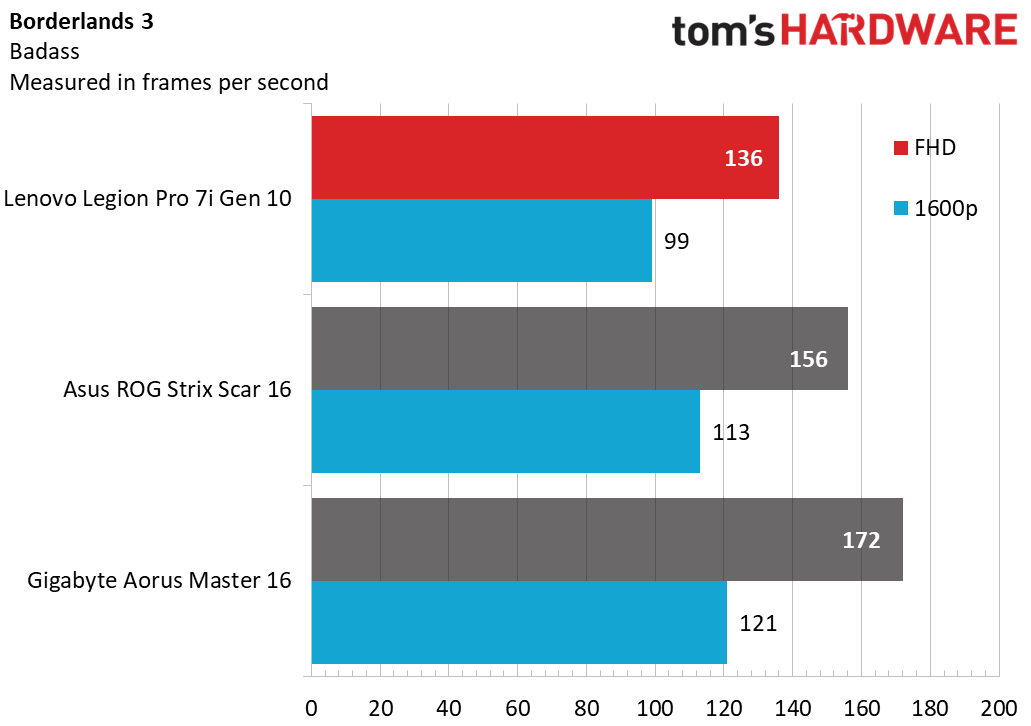
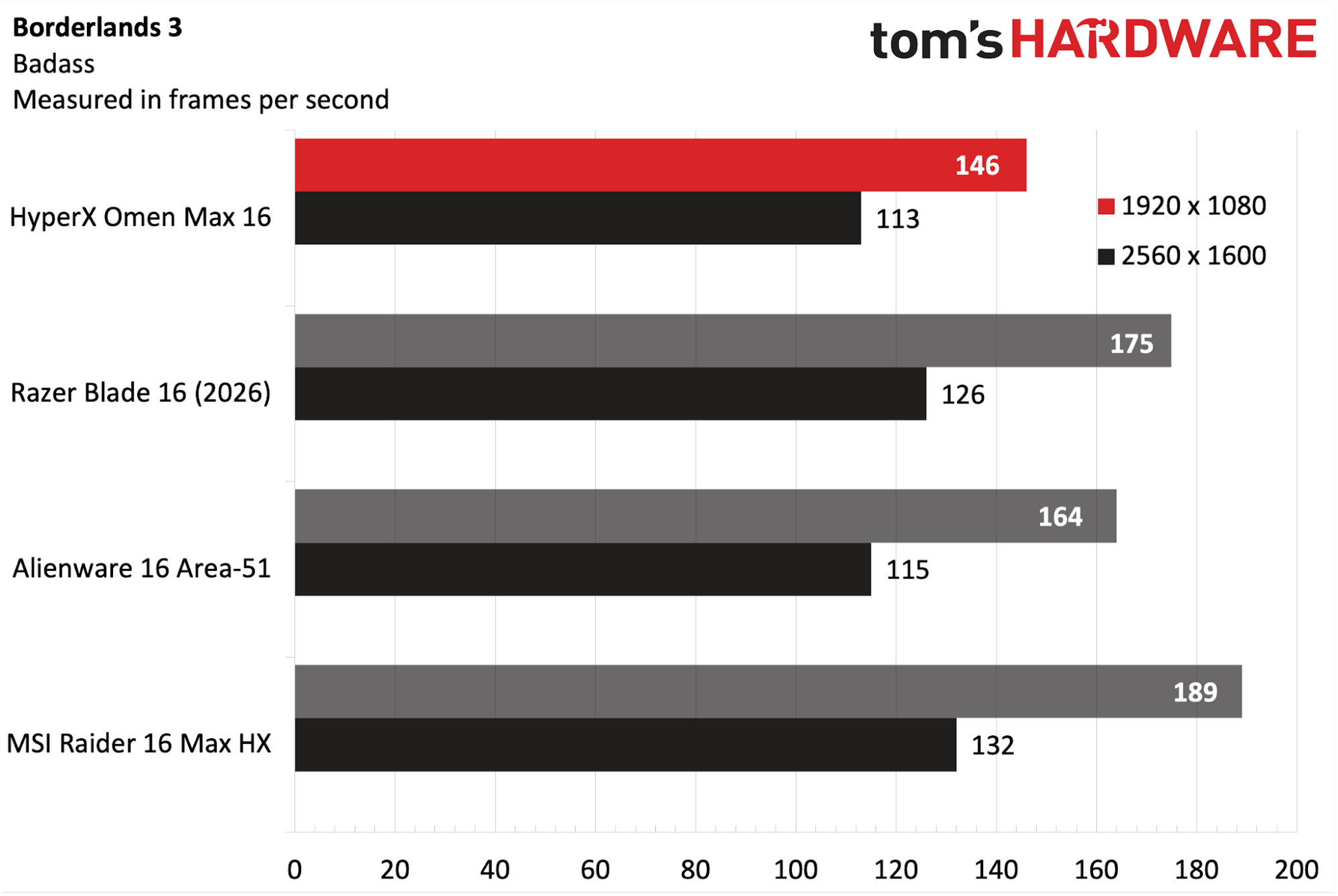
The Omen Max 16 again had trouble during the Borderlands 3 (Badass settings) benchmark, falling well off the pace set by its three competitors. The laptop hit 146 FPS at 1080p, nearly 20 FPS off the pace of the third-place Alienware 16 Area-51. At 1600p, it mustered just 113 FPS.
Metro Exodus is our go-to benchmark for laptop stress testing. Our review unit averaged 141.62 FPS at 1080p across 15 loops using the RTX benchmark preset. The CPU performance cores averaged 4.91 GHz, and the efficiency cores averaged 3.95 GHz. The RTX 5090 GPU ran at 1.81 GHz.
Productivity Performance on HyperX Omen Max 16
With its Core Ultra 9 290HX Plus processor, 32GB of RAM, and 2TB PCIe 5.0 SSD, the Omen Max 16 fared better in the productivity tests than it did with gaming.
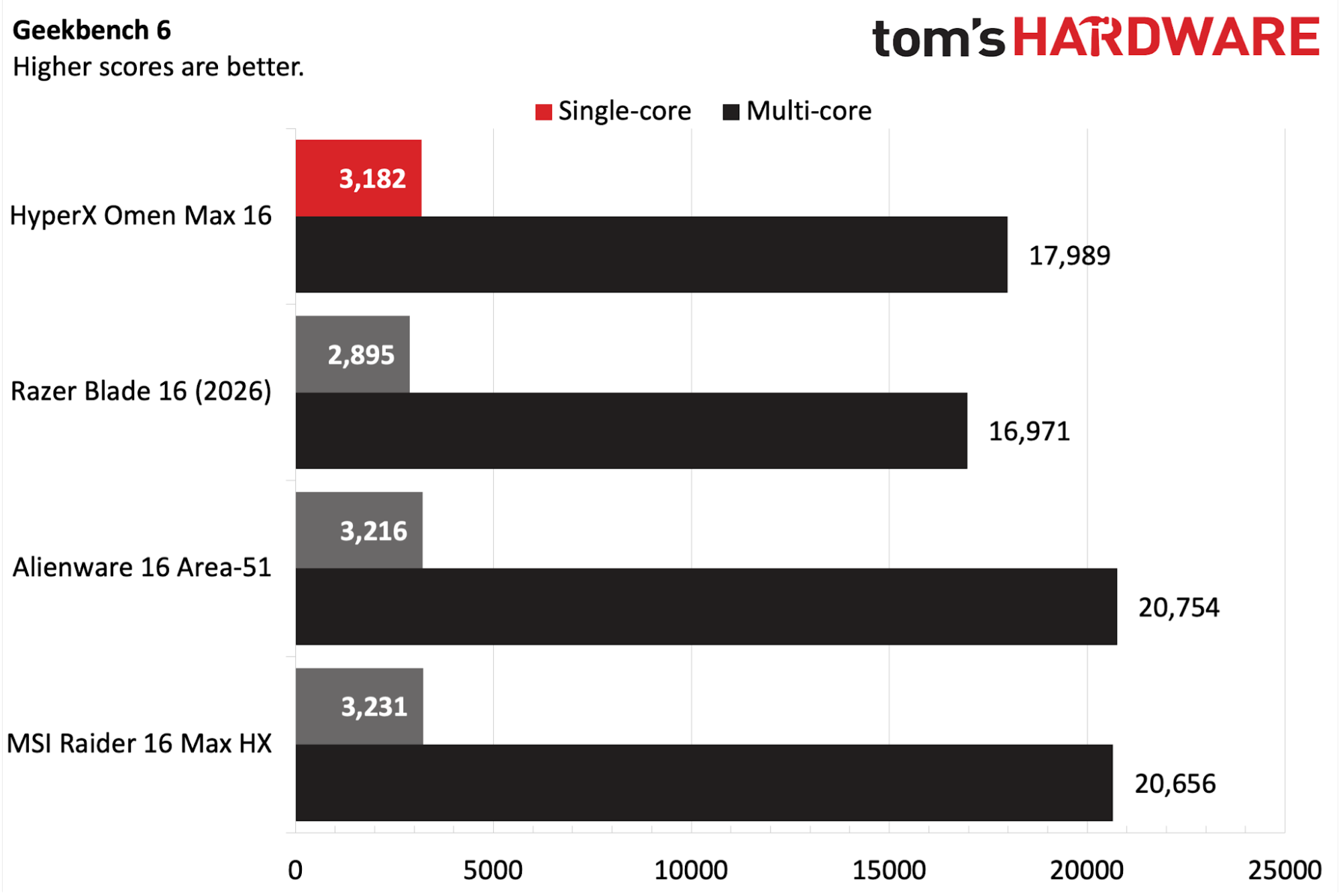
On Geekbench 6, the Omen Max 16 with the Core Ultra 9 290HX was able to muscle past the Blade 16 with its Core Ultra 9 386H on both the single-core (3,182) and multi-core (17,989) benchmarks. However, the Alienware 16 Area-51 and Raider 16 Max HX, which use the same Core Ultra 9 290HX processor, achieved much higher multi-core numbers (each surpassed 20,000).
Tom's HardwareTom's HardwareTom's Hardware
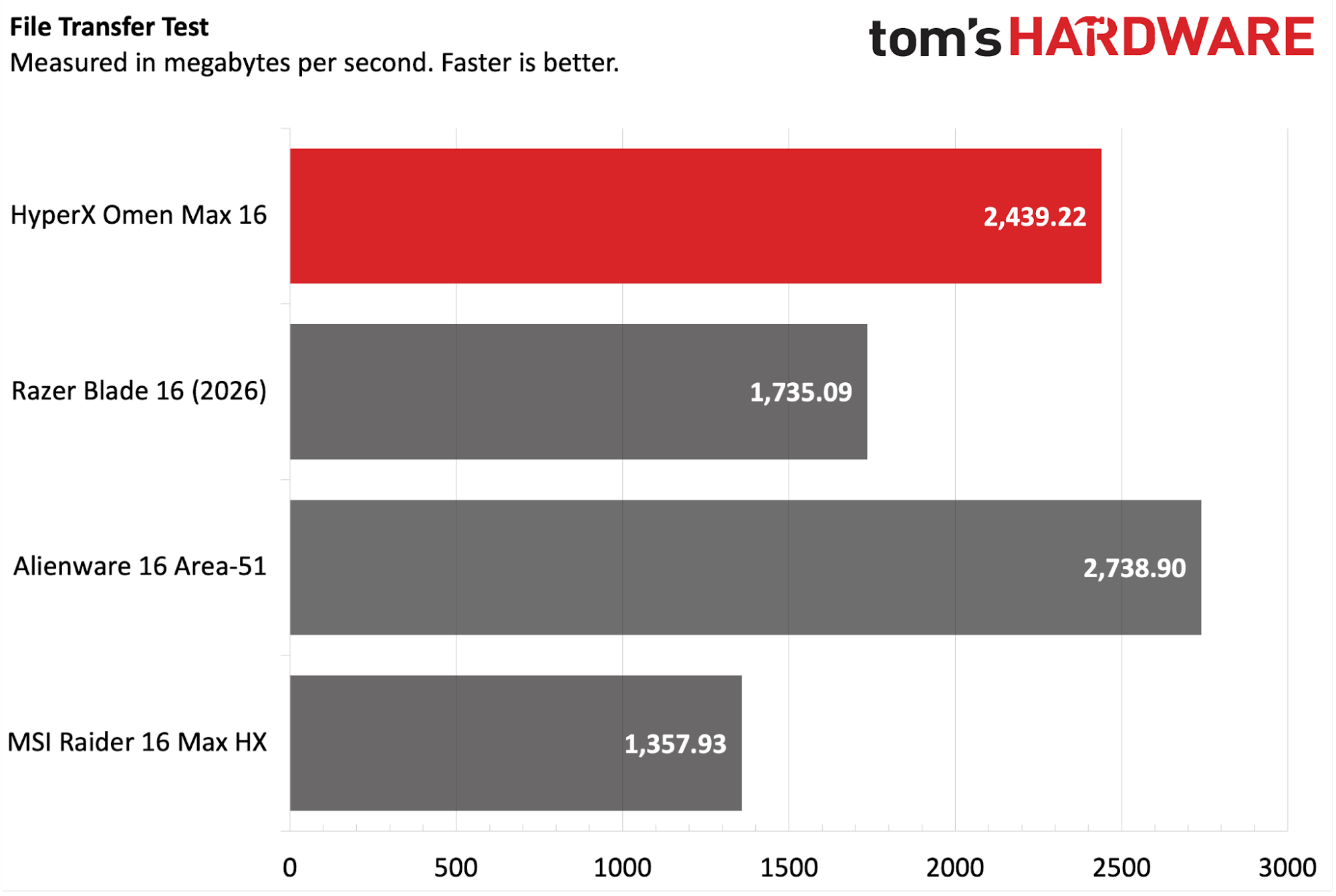
The PCIe 5.0 SSD used in the Omen Max 16 performed quite well in our 25GB file transfer test, coming in second place at 2,439.22 MBps. The Alienware 16 Area-51 was a few ticks ahead at 2,738.90 MBps.
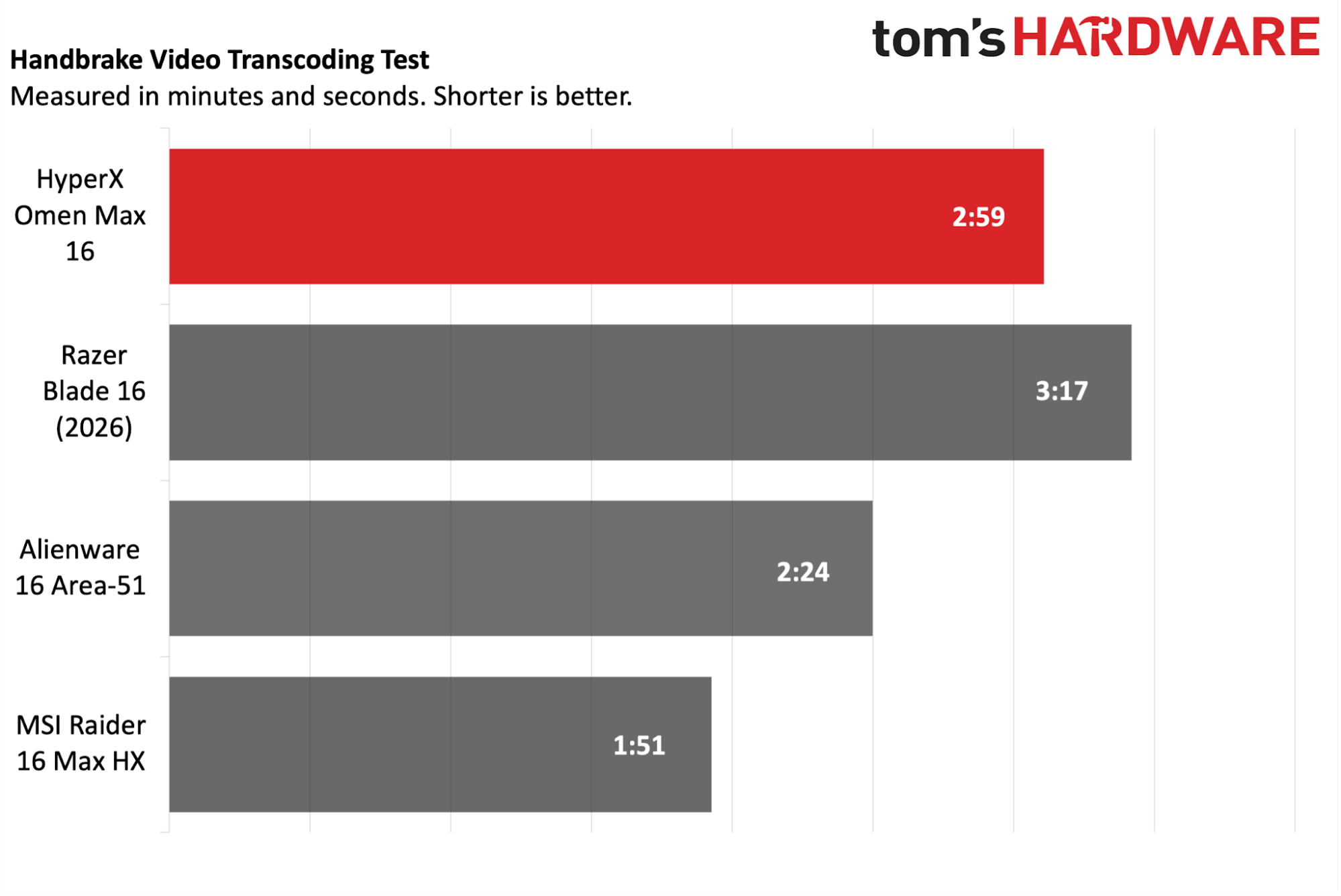
The soft performance of the Omen Max 16 continued with our Handbrake test, which involves transcoding a 4K video file to 1080p. Here the laptop performed the task in 2 minutes and 59 seconds. However, at least one other laptop with the same Core Ultra 9 290HX did the deed in less than two minutes.
Display on the HyperX Omen Max 16
The Omen Max 16 uses a 16-inch 2560 x 1600 OLED panel with a 240 Hz refresh rate. As is the case with most OLED displays that we test, this one had a glossy finish.
Instrumented testing on the OLED panel showed it excelling against the competition, covering 131.2 percent of the DCI-P3 color space and 185.2 percent of sRGB. Even better, the Omen Max 16 nudged past the Raider 16 Max HX to also take the crown for panel brightness (464.6 nits versus 455.6 nits).
(Image credit: Tom's Hardware)
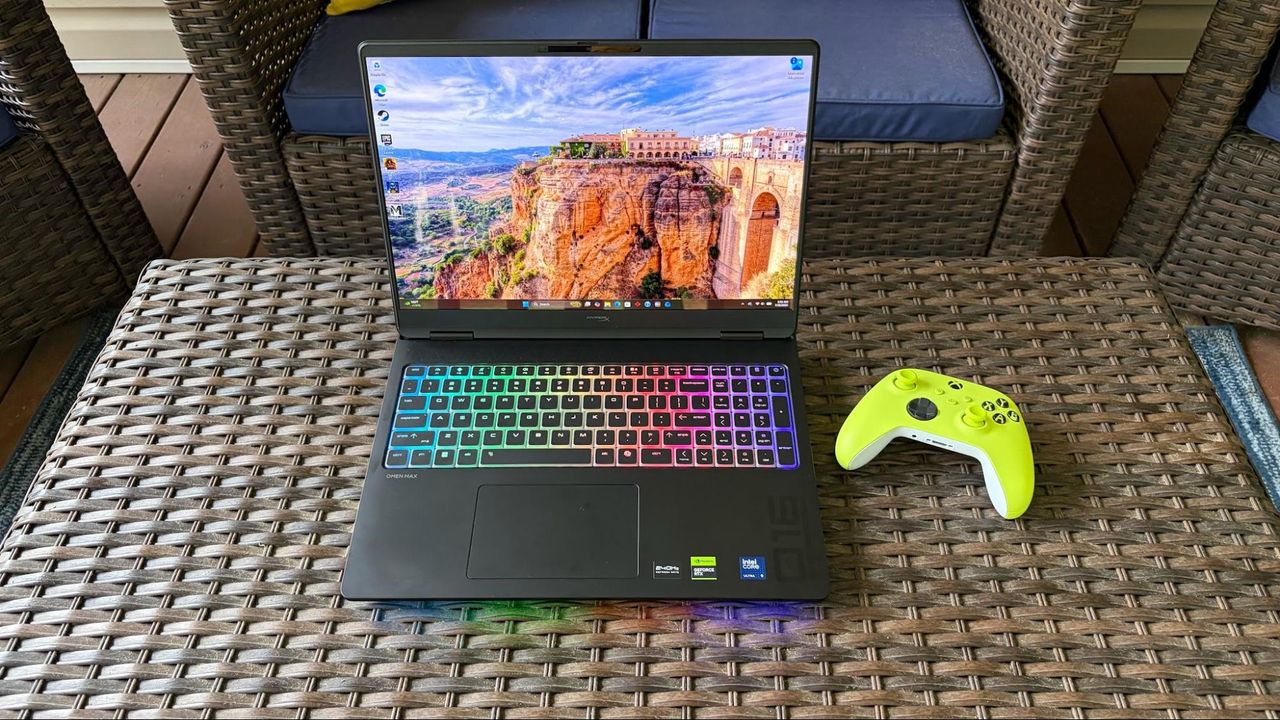
OLED panels rarely disappoint, and I was more than impressed with the overall quality and brightness. The brightness was high enough that I was able to game while on my back porch during a partly cloudy day with minimal interference from reflections on the glossy panel.
I also viewed the first Avengers: Doomsday trailer using the display, and besides getting a tiny bit emotional while watching it, was delighted with the color reproduction, particularly in the short battle between Gambit and Shang-Chi, with flashes of purple playing cards and orange rings.
Keyboard and Touchpad on the HyperX Omen Max 16
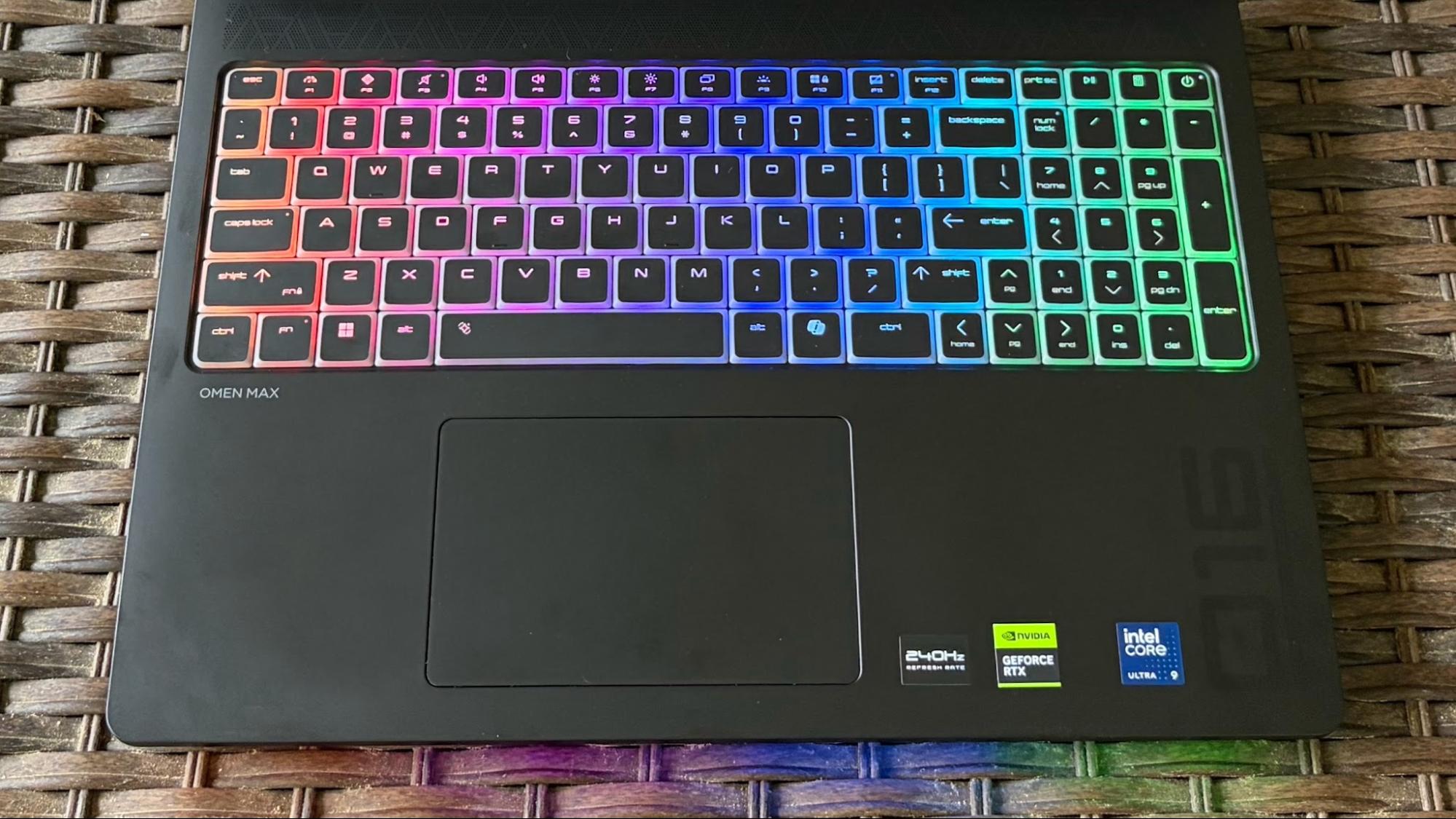
The Omen Max 16 features a full-size RGB backlit keyboard (with per-key lighting) and NKRO anti-ghosting technology. RGB effects are customizable using HP's Omen app or directly from within Windows 11.
The keys felt quite springy when typing, and I found it incredibly comfortable to rest my fingers and click away. And while some keyboards audibly make their presence known as you type at a furious pace, the key actuation on the Omen Max 16 was whisper-quiet.
(Image credit: Tom's Hardware)
Turning my attention to the Keyhero.com typing test, I plugged away at 95 words per minute with 97% accuracy, which is definitely on the high side for me (I’m usually in the mid-80s realm).
Given the Omen Max 16 price tag of over $4,500, I was disappointed that HP didn’t go with a haptic touchpad. Instead, we get a top-hinged trackpad that is just OK. It gets the job done, but for this much money, I’d prefer to be able to click anywhere on the touchpad surface without hitting a dead zone. At least while gaming, you probably use a mouse or controller.
Audio on the HyperX Omen Max 16
Audio quality is another area where I think HP missed the mark. To beat a dead horse, but this is a laptop that retails for $4,699, and it only comes with stereo speakers. Would it have killed HP to add another pair of speakers in this tank of a chassis?
While the speakers had good overall volume levels, I felt the sound lacked some depth compared to similarly priced laptops with four (Raider 16 Max HX) or even six speakers (Blade 16). While I was more than happy listening to Keane’s “Fly to Me” from the album Hopes and Fears, I was disappointed in the sound while playing Battlefield 6.
When it came to gunfire, vehicle sounds, and background explosions while gaming, I wasn't impressed. I prefer throwing on a pair of the best gaming headsets, but there’s still no excuse to drop the ball at this price point.
Upgradeability of the HyperX Omen Max 16
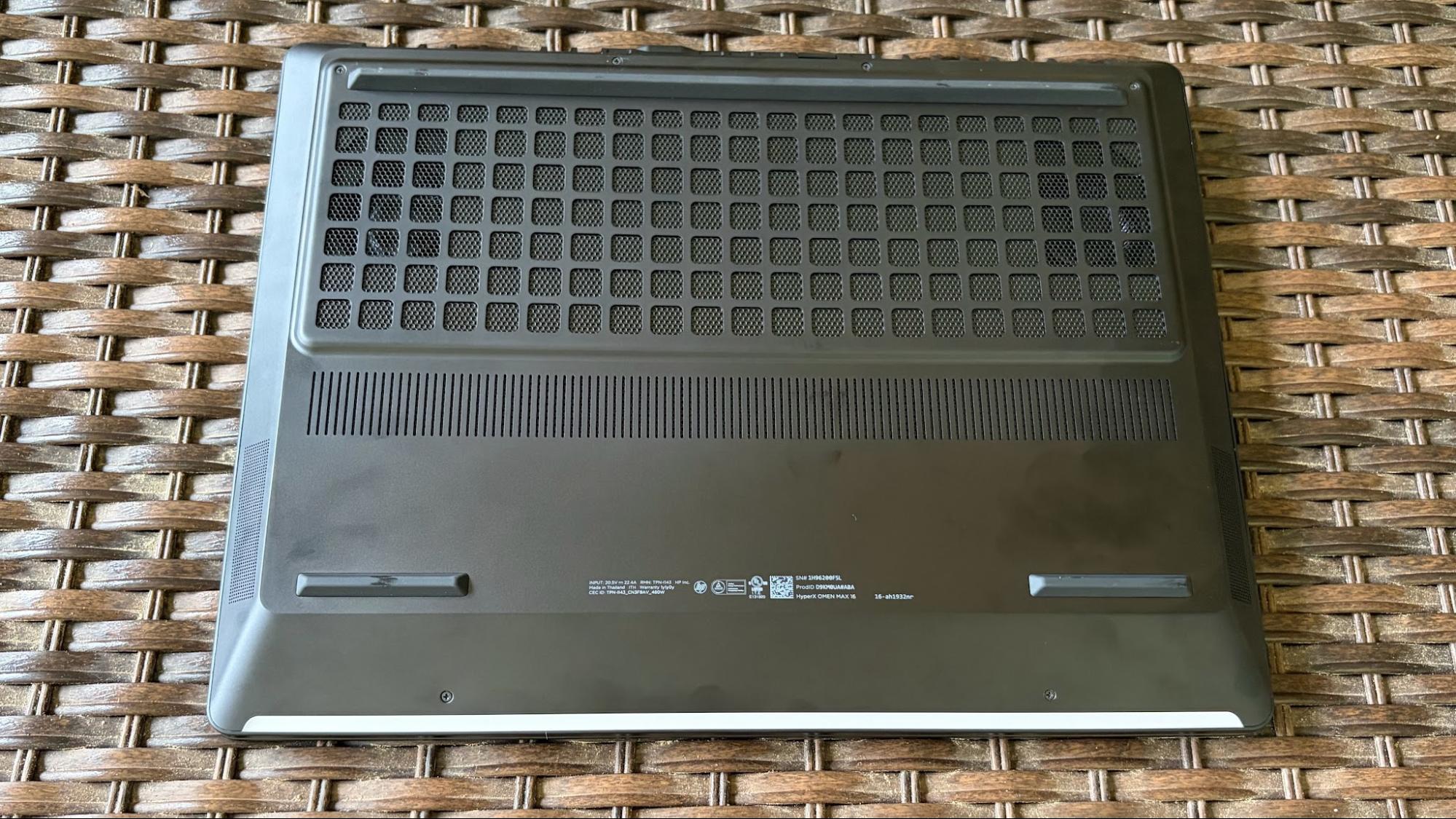
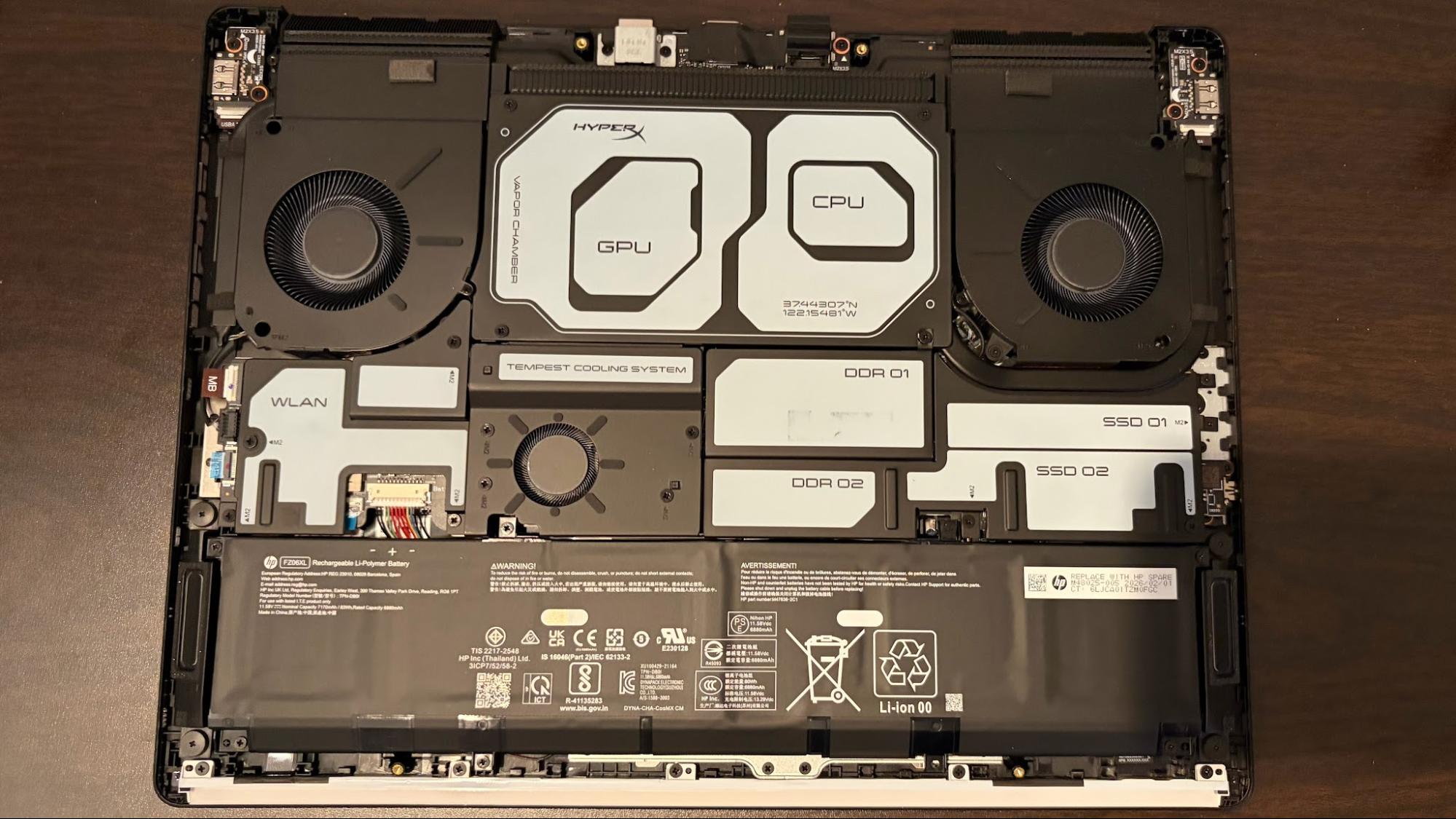
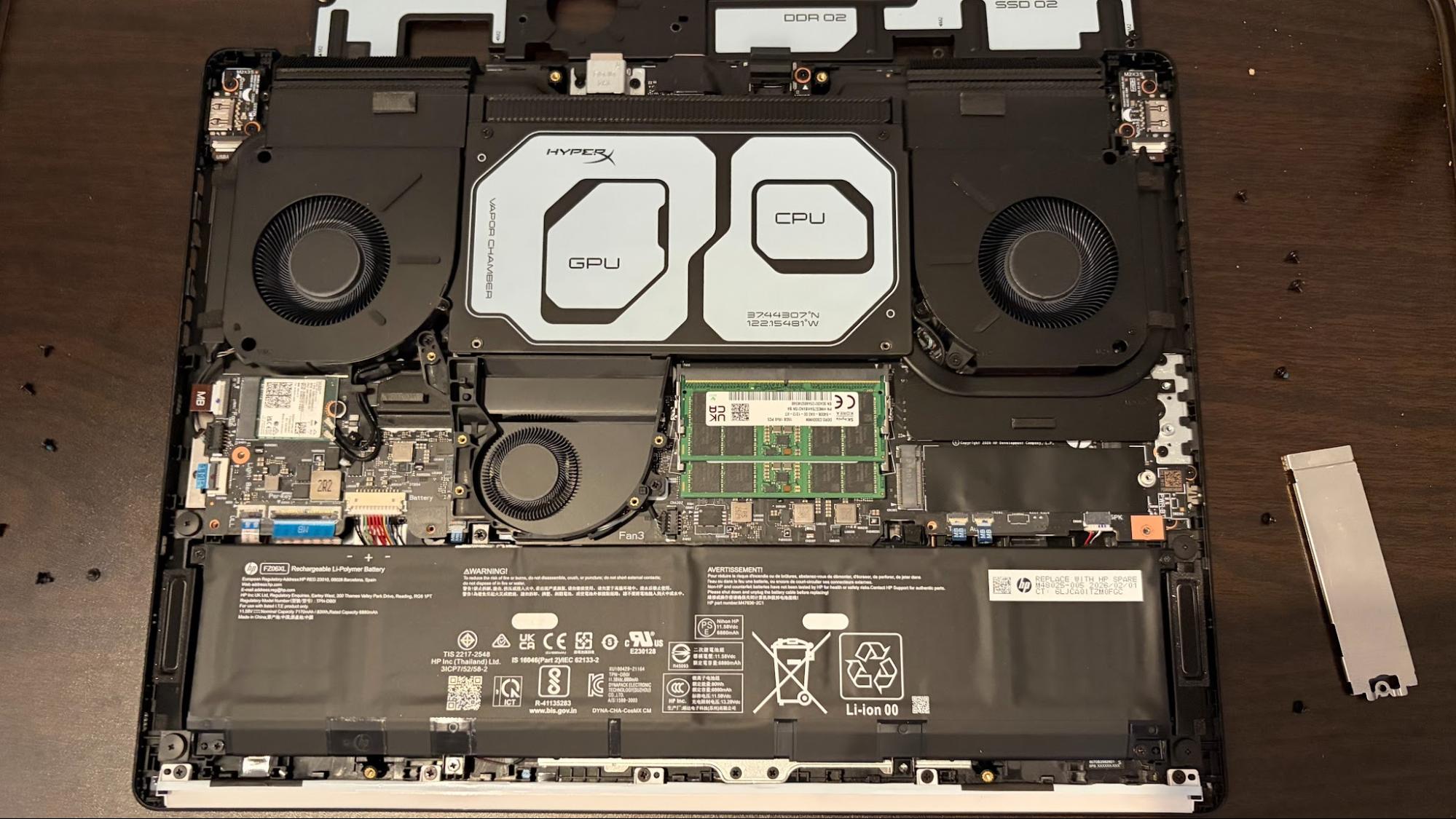
Six screws need to be extracted to remove the bottom aluminum panel. While that was easy enough, it’s only half the battle. All of the serviceable components (save for the readily accessible battery) are underneath an extensive metal shield. That shield is held in place by roughly a dozen screws, making upgrades a bit tedious.
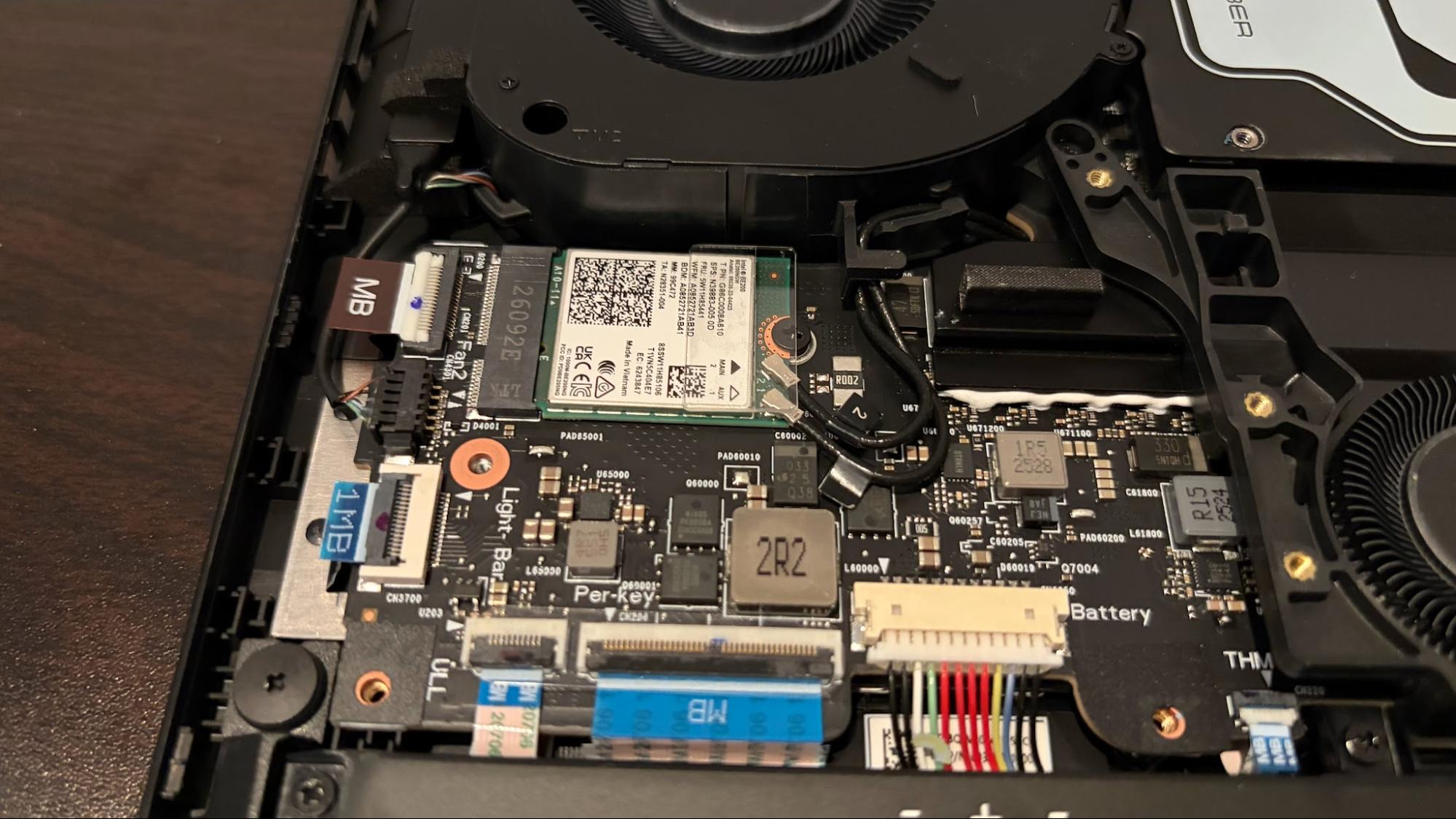
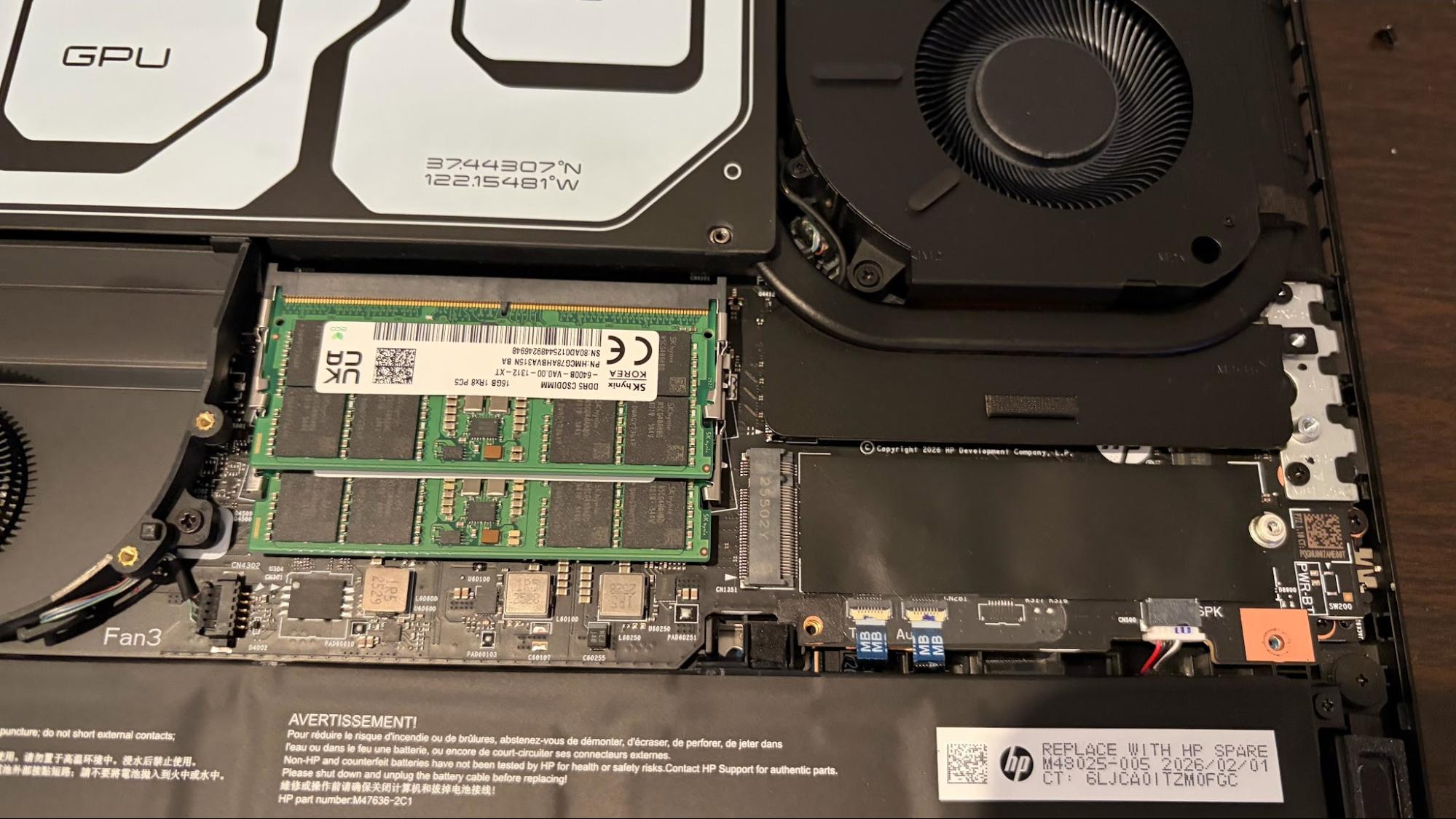
Once the shield is removed, you’ll find access to the M.2 slot for the Wi-Fi/Bluetooth module, two SO-DIMM slots (both of which were filled on our review unit), and an additional M.2 slot for a second SSD. Yet another metal shield covers the first M.2 SSD slot, although I didn’t go through the process of removing another dozen screws to uncover it.
Battery Life on the HyperX Omen Max 16
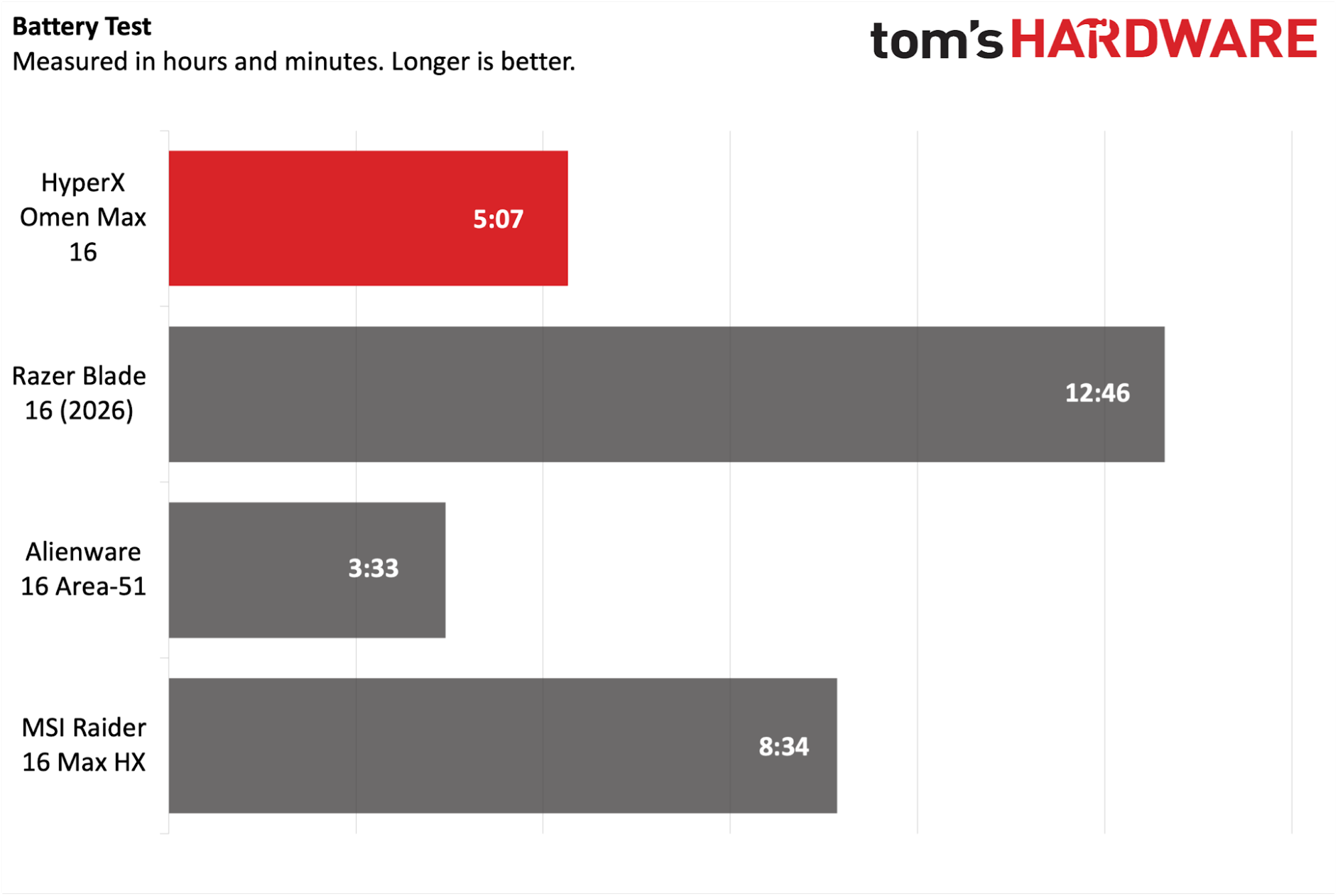
Despite its considerable girth, the Omen Max 16 is equipped with just an 83 WHr battery. For comparison, the thinner and lighter Blade 16 manages to squeeze in a 90 WHr battery.
(Image credit: Tom's Hardware)
The Omen Max 16 lasted 5 hours and 7 minutes on our battery test, which consists of web browsing, video streaming over Wi-Fi, and OpenGL testing with the screen brightness set at 150 nits. This was over three hours shorter than the Raider 16 Max HX, while the Blade 16 lasted over twice as long on a charge (12:46).
Heat on the HyperX Omen Max 16
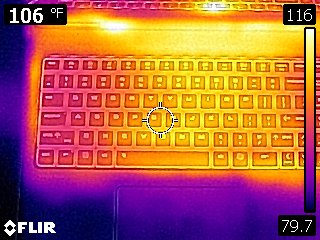
During the Metro Exodus stress test, we measured the Omen Max 16's keyboard at 106 degrees Fahrenheit (F) between the G and H keys, while the touchpad was 84.9 F.
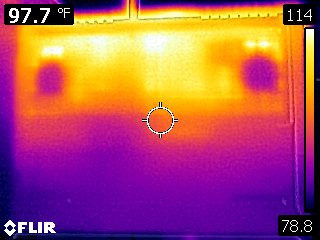
The hottest part of the laptop was near the rear center of the bottom of the chassis, which measured 114 F.
Tom's HardwareTom's Hardware
While running the Metro Exodus stress test, the CPU measured 87 degrees Celsius (C). Meanwhile, the RTX 5090 was cooler at 75 C.
Webcam on the HyperX Omen Max 16
Another area where it feels like HP skimped is with the webcam. Rather than going with a higher resolution unit, the Omen Max 16 features a bog-standard 1080p unit that looks about as good as one you’d find in a $1,000 entry-level gaming laptop.
The camera didn’t do particularly well with a nearby window where light was shining through, and there were a lot of noise artifacts in less-than-ideal light conditions. In addition, the camera didn’t really pick up fine details well, which is disappointing considering the price.
Software and Warranty on the HyperX Omen Max 16
Like many HP laptops, the HyperX Omen Max 16 comes loaded with additional software bloat that you can mostly ignore or simply delete. Scrolling down the list of “H” apps in the Start Menu, HP basically set up camp with no less than eight apps/shortcuts—everything from HP Documentation to HP Privacy Settings to HP TV+. In addition, you’ll find the usual third-party add-ons like McAfee and promotional links for Dropbox, Adobe, and Booking.com.
Tom's HardwareTom's HardwareTom's Hardware
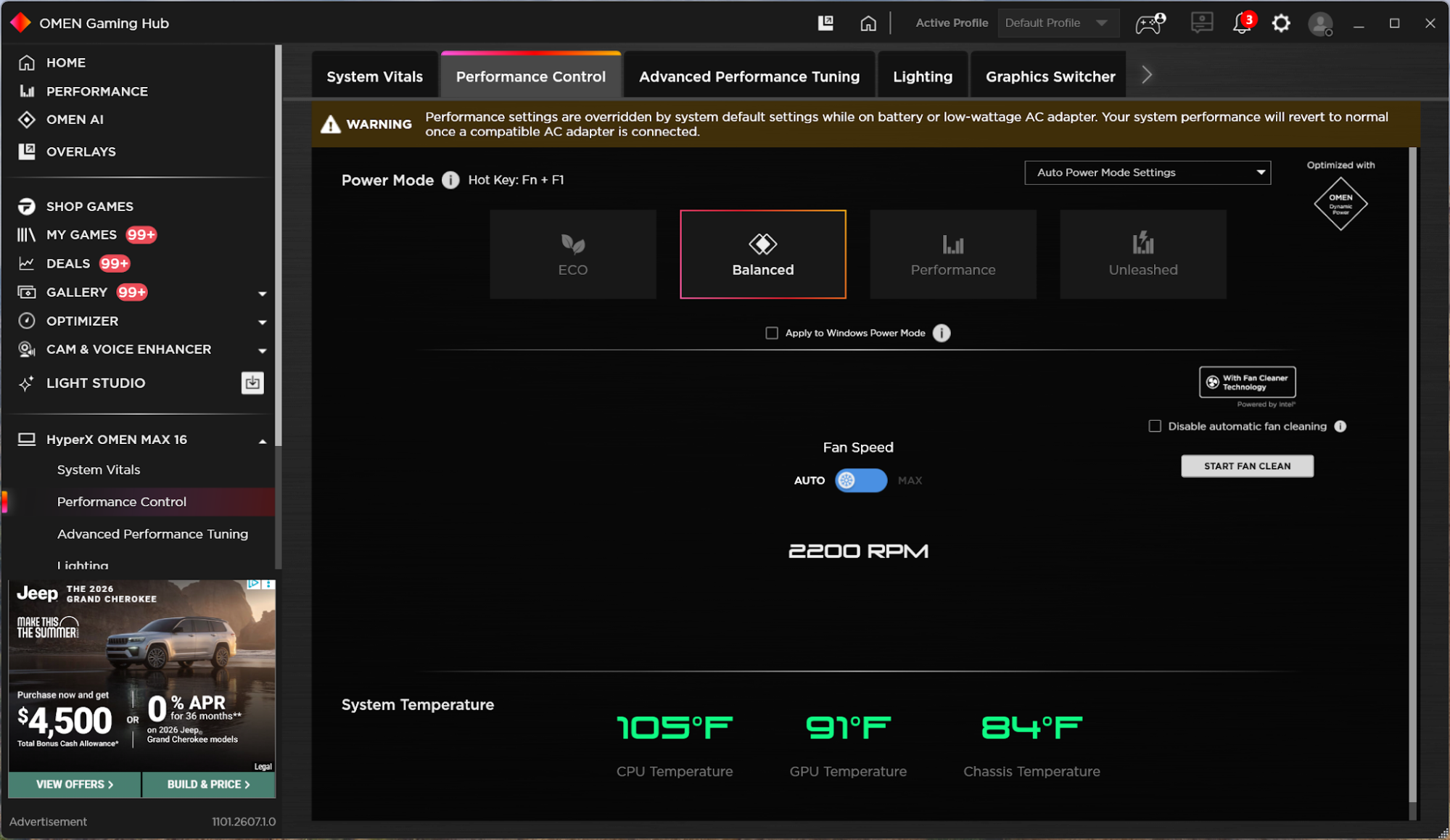
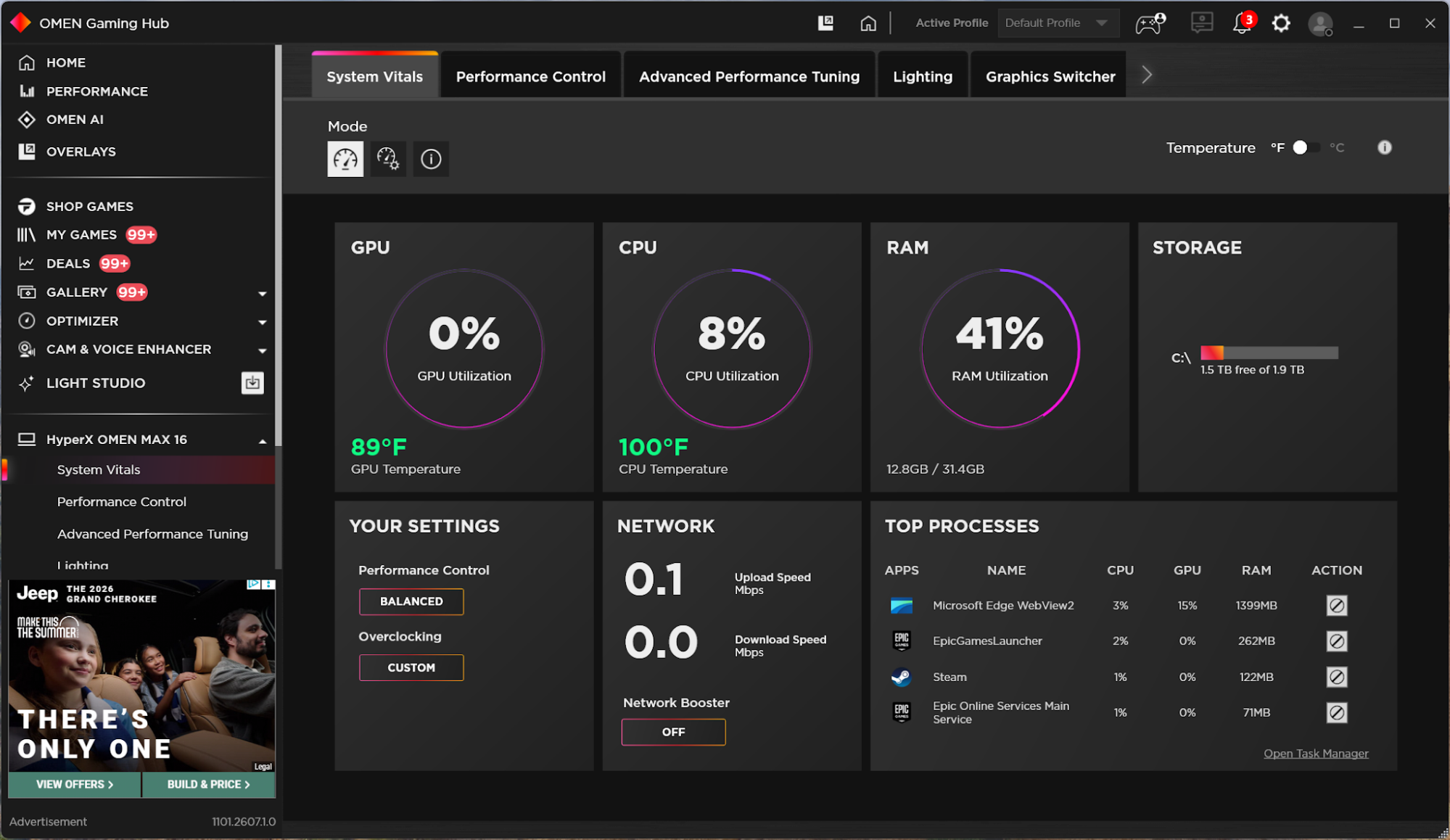
The only really useful preinstalled app is the Omen Gaming Hub. It gives you control over power modes, lets you see CPU/GPU/RAM utilization, and provides plenty of configuration options for the onboard RGB lighting.
The Omen Max 16 comes with a one-year manufacturer warranty.
HyperX Omen Max 16 Configurations
Our Omen Max 16 came configured with an Intel Core Ultra 9 290HX Plus processor, 32GB of DDR5-6400 memory, a 2TB PCIe 5.0 SSD, RTX 5090 GPU, and a 16-inch 1600p 240 Hz OLED display. The MSRP on our review unit was a staggering $4,699.99.
There are also several less expensive options, with the cheapest being a $2,699 SKU with a Core Ultra 7 270HX processor, 32GB of RAM, a 1TB SSD, and an RTX 5080. For $3,099, you can swap the Core Ultra 7 270HX for an AMD Ryzen AI 9 HX 475 and double the SSD capacity to 2TB.
Bottom Line
The HyperX Omen Max 16 represents a swing and a miss. When I first saw the enormity of the chassis, I was looking forward to some impressive gaming performance given the 55W processor and 175W RTX 5090 onboard. Instead, what I was left with was a $4,699 gaming laptop that lingered in last place for most of the gaming benchmarks, and often by a large margin. Even the Razer Blade 16 with its 25W processor managed to get the upper hand in most benchmarks.
But the gaming wasn’t the only disappointment. Given the price tag, I would have expected a better-equipped machine. Where’s the haptic trackpad, and why do we only get two speakers? And on a minor annoyance angle, while I appreciate the two M.2 slots for storage and replaceable memory, why do I need to remove another dozen screws just to access those components?
In the end, the Omen Max 16 could have been so much more. Quite frankly, it would make sense to spend the extra $200 and grab a Razer Blade 16. Not only is it thinner and lighter (by two pounds), but it offers double the battery life.
There are two features that make this laptop a serious option for gamers, especially at this price, and it's the display and the GPU. The 16-inch OLED panel included here is a stunner, offering a top resolution of 2,560 x 1,600 for gaming, with an ultra-fast 240Hz refresh rate. It has a top brightness of 500 nits, with full 100% coverage of the DCI-P3 color space, meaning you'll see vibrant colors with true-to-life accuracy, with games and movies looking fantastic on this display.
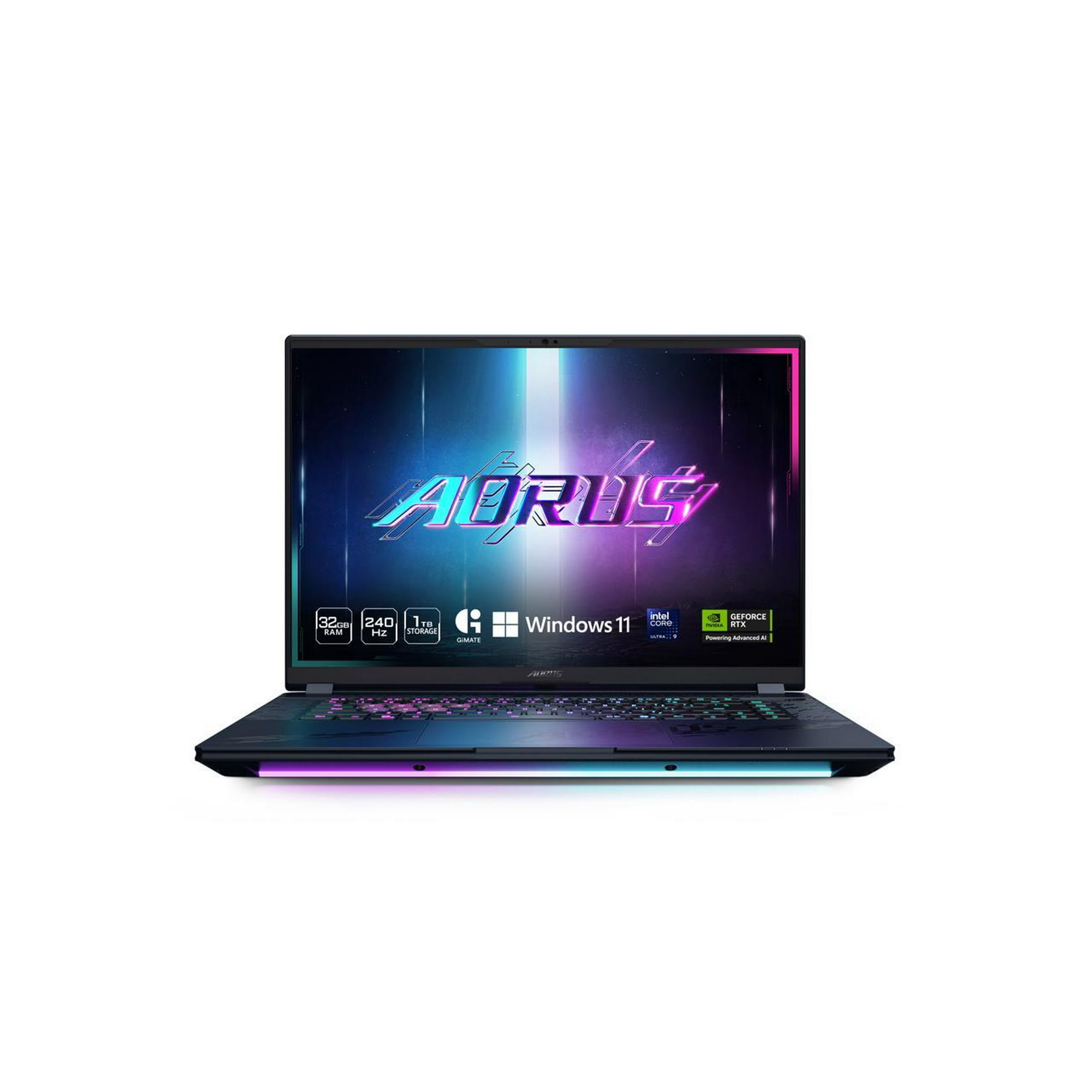
This 16-inch Gigabyte Aorus Master gaming laptop is a steal at this price. It has a 16-inch OLED display with a 240Hz refresh rate, along with an Nvidia GeForce RTX 5070 Ti, 32GB DDR5, a 1TB SSD, and a 24-core Intel Core Ultra 9 275HX CPU.View Deal
The Nvidia GeForce RTX 5070 Ti, meanwhile, won't be troubled to hit the high frame rates at this display's native 1600p resolution. This mobile GPU ships with 5,888 CUDA cores and 12GB of GDDR7 VRAM, along with a total TDP of 175W. At 1600p, expect to be able to play games with Ultra graphics presets enabled. This is an Nvidia Blackwell GPU, so you've also got DLSS 4 to fall back on, including multi-frame generation. If you use a second monitor with this laptop, that'll be a useful feature for the higher resolutions, with AI able to fill in the gaps to boost your frame rates.
This Gigabyte laptop also ships with an Intel Core Ultra 9 275HX CPU. It has 24 cores, eight of which are performance cores, which are best for gaming, along with 16 efficiency cores for multi-threaded work. You're also getting 32GB of DDR5 RAM in this laptop build, so no need to compromise there, along with a 1TB SSD for storage, which should be enough for a few big game installations.
Other specs include four 2W speakers with Dolby Atmos support, a three-zone RGB backlit keyboard, along with several USB-C and USB-A ports to choose from. It also includes Wi-Fi 7 and Bluetooth 5.4 support for wireless connectivity.
The $1,999 sale price for this 16-inch Gigabyte Aorus Master OLED gaming laptop is an absolute steal in the current market and one that'll save you over $750. You'll struggle to find specs this powerful in a rival laptop at this price point so if you're looking for an upgrade, grab this deal fast before the price or stock runs out.
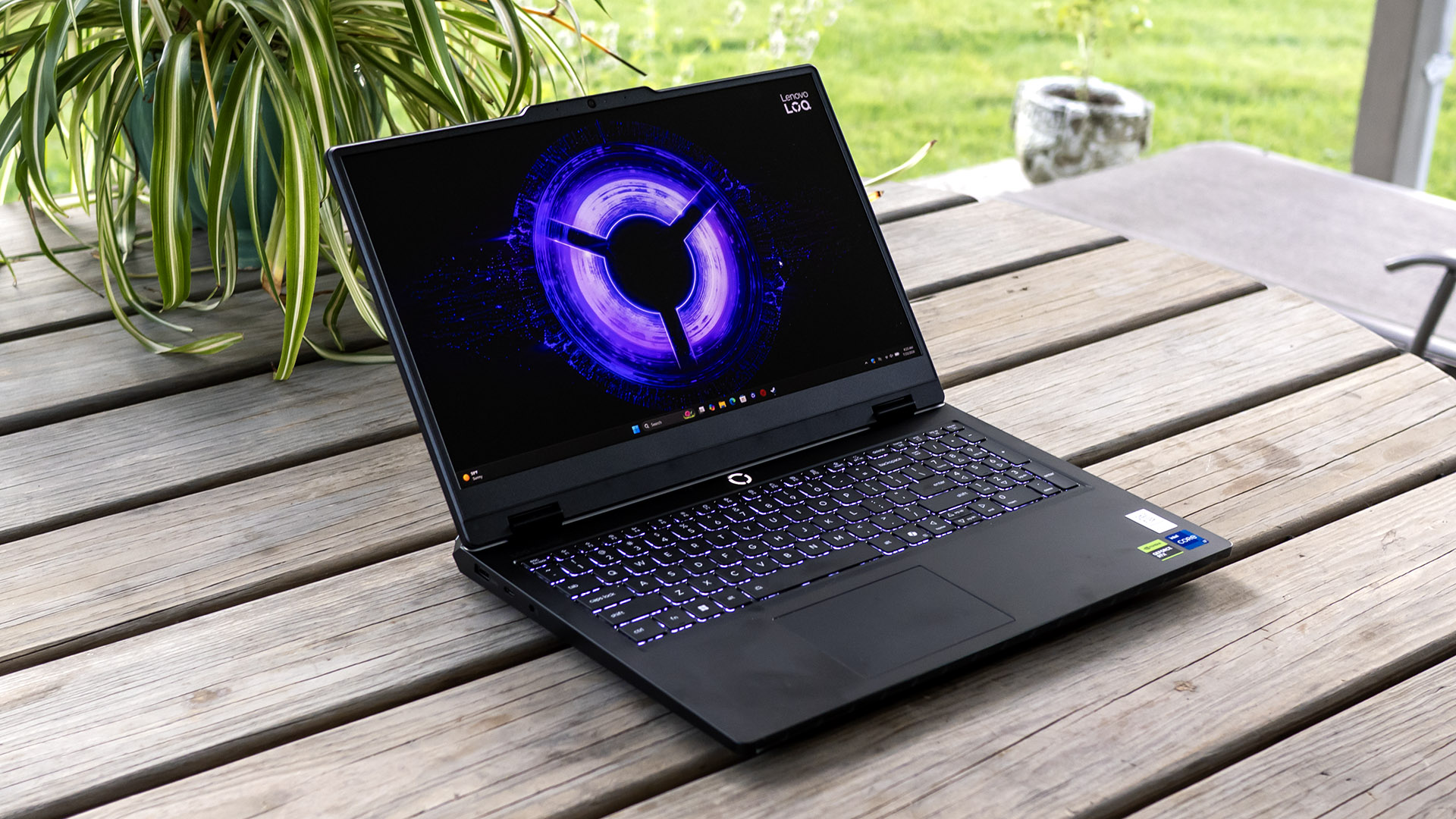
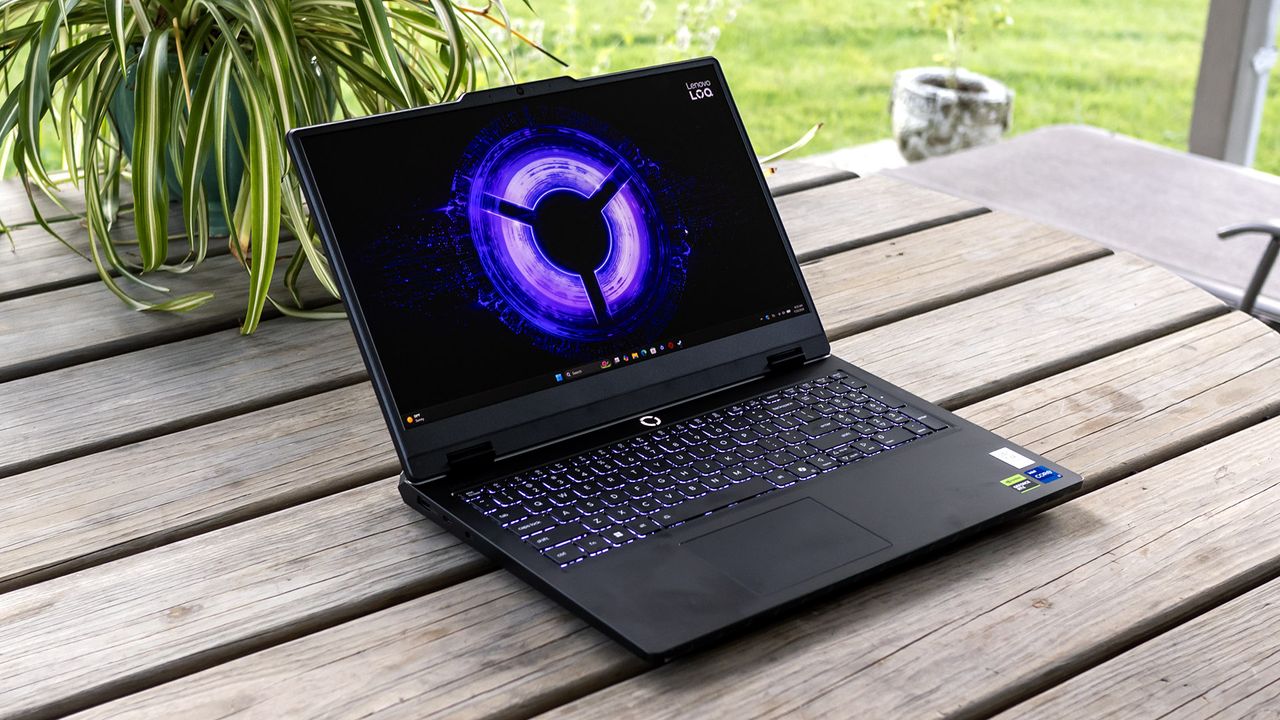
The Lenovo LOQ Essentials 15 Gen 11 has the right idea to compete with the best budget gaming laptops: skip the flashy design extras and focus on the hardware that matters. Its RTX 5060 graphics, 144 Hz IPS display, solid keyboard, and generous internal upgrade options give budget-strapped gamers plenty to like on paper. The reality is that this configuration is compromised in the area that matters most: gaming performance. Its RTX 5060 is held back by a 65W power limit and the CPU is several generations old, allowing rival machines in the same price range to post stronger results. The LOQ is usable and practical, but at this price, it needs stronger performance to stand out.
Design of the Lenovo LOQ Essentials 15 Gen 11
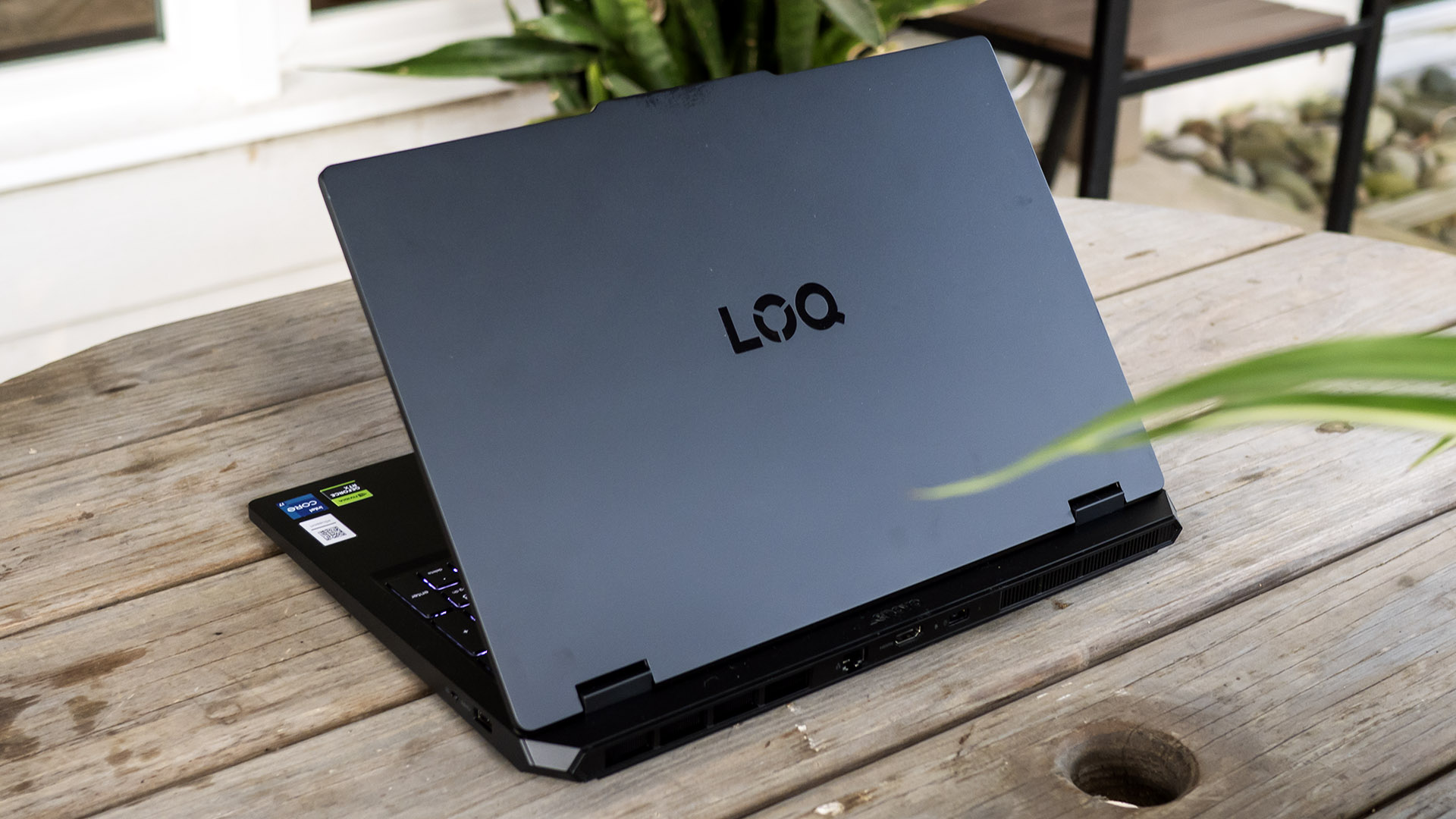
Aptly named, the LOQ Essentials 15 embraces a no-frills design. Aside from LOQ branding on the lid, there’s little here meant to catch the eye, which is fitting for a laptop that’s intended to deliver performance at the lowest possible cost. Lenovo reserves premium materials and styling for its Legion gaming laptops.
Fortunately, the budget considerations are mostly aesthetic, as the LOQ’s plastic chassis feels solid and has the durability you’d expect for daily home or school use. Its 0.97-inch thick profile and 5.07-pound weight don’t make it a great traveling companion are in line with competing laptops like Acer's Nitro V 16S AI, Asus’ TUF Gaming F16, and MSI's Cyborg 15. The latter is the lightest in the group, at 4.36 pounds.
Tom's HardwareTom's Hardware
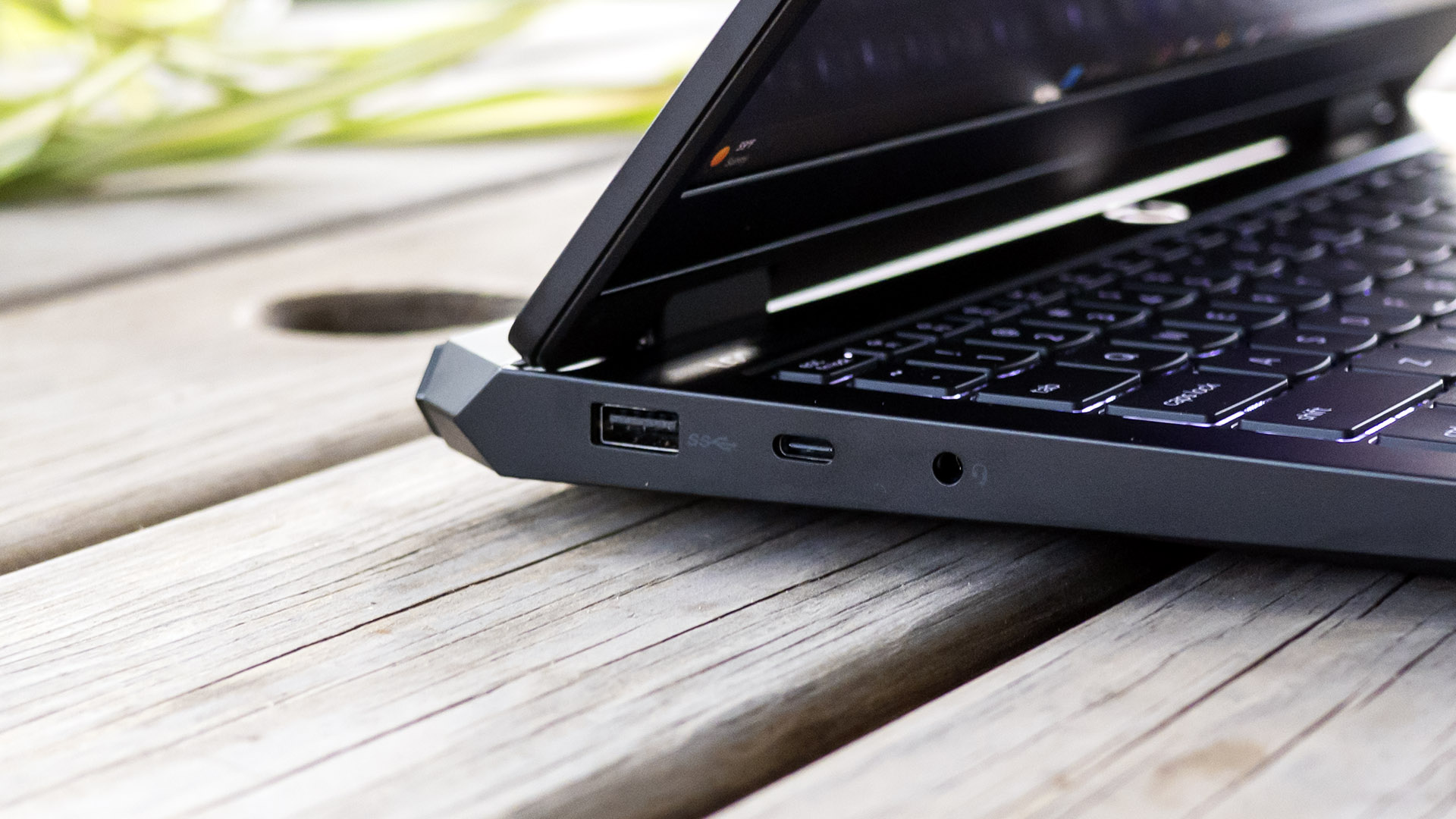
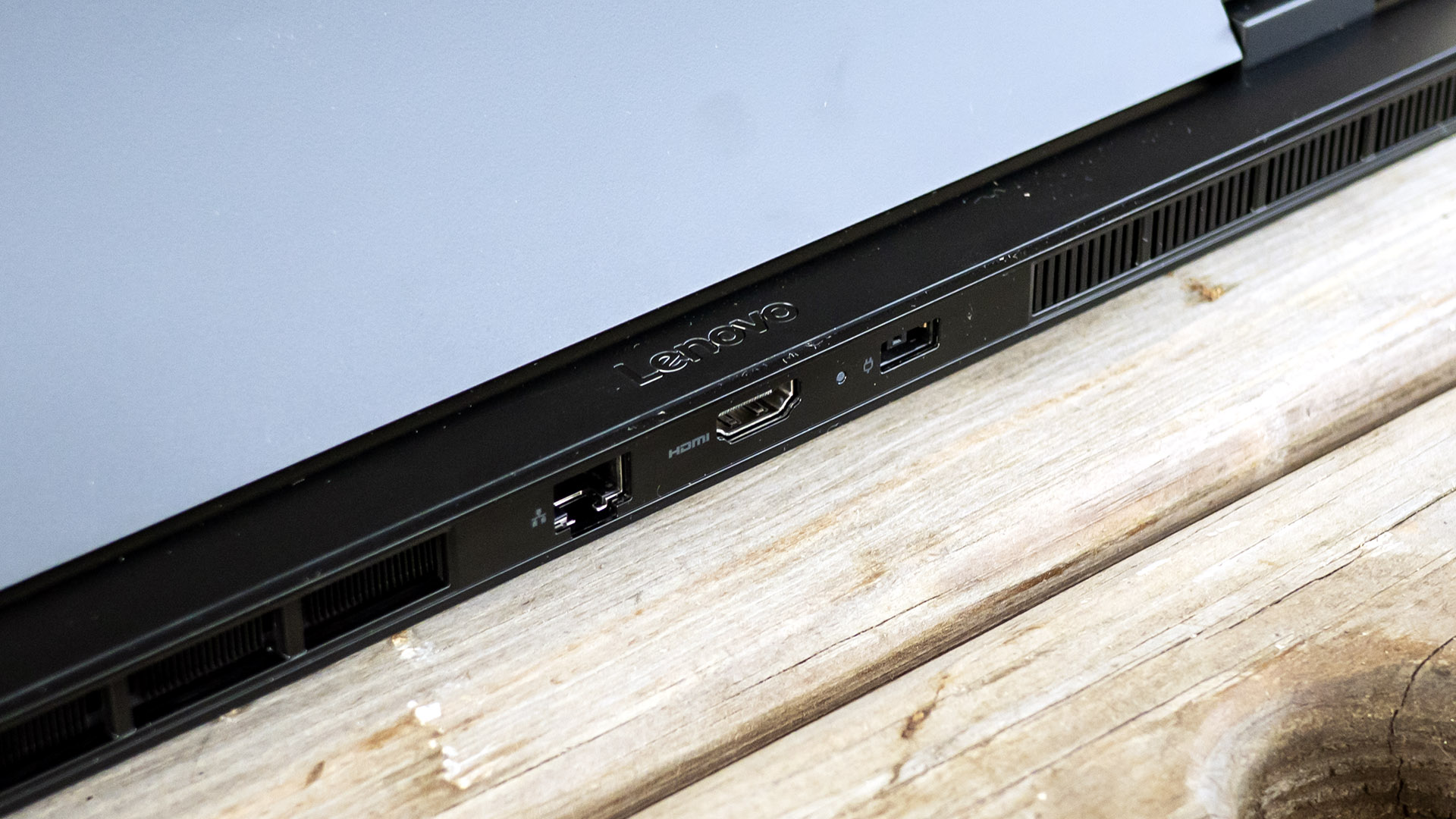
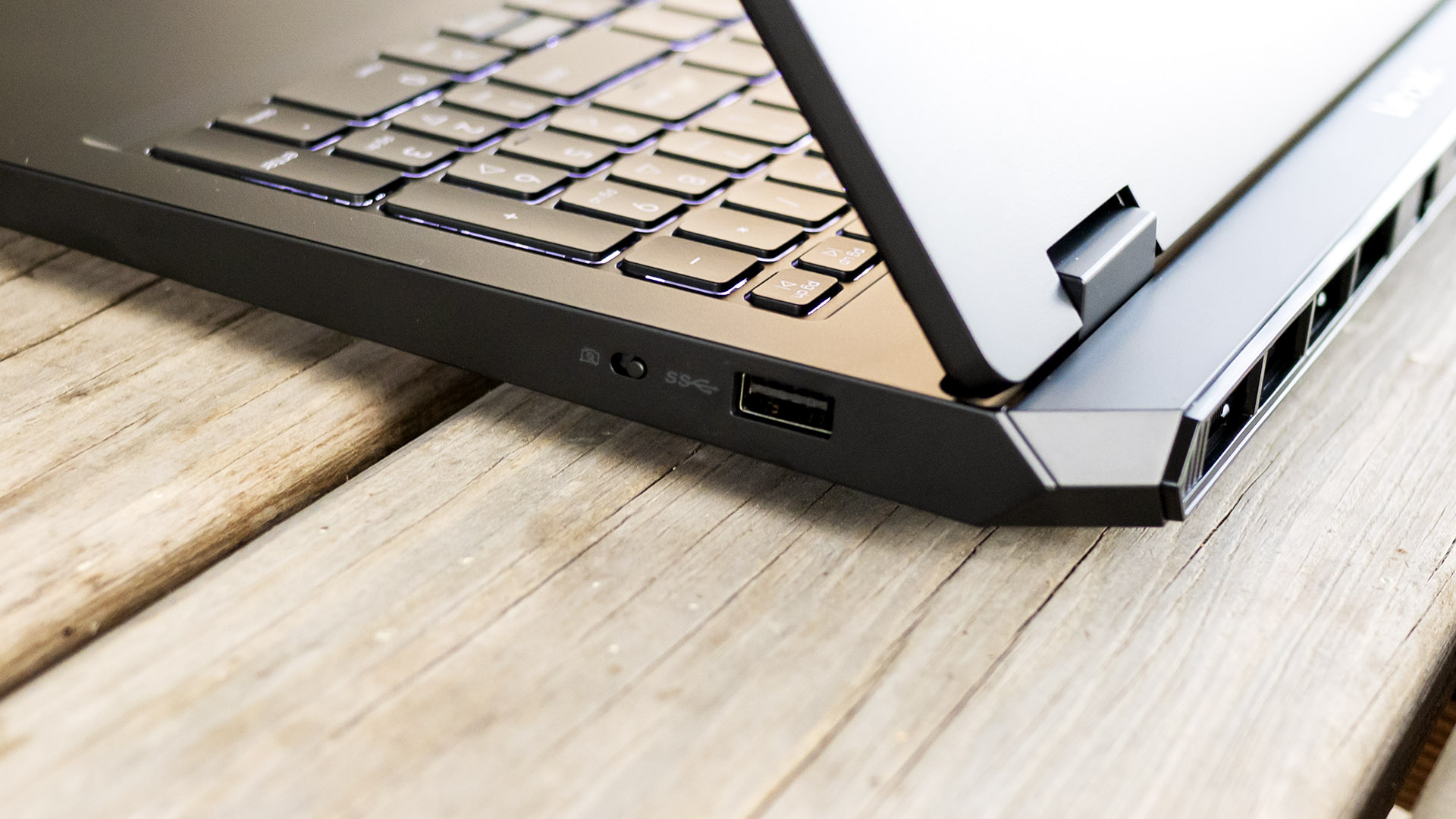
Lenovo’s port selection is practical: one USB-C port (10 Gbps), two USB-A ports (5 Gbps), an audio jack, Ethernet, and HDMI. You won't get truly high-speed ports like USB4/Thunderbolt 4 at this price. The Intel AX203 Wi-Fi 6 card is another example of this laptop's economical focus, though it shouldn't hold users back.
Tom's HardwareTom's HardwareTom's Hardware
Lenovo LOQ Essentials 15 Gen 11 Specifications
CPU
Intel Core i7-13650HX
Graphics
Nvidia RTX 5060 (8GB GDDR7, 1,455 MHz boost, 65 W maximum graphics power)
Gaming and Graphics on the Lenovo LOQ Essentials 15 Gen 11
We evaluated the LOQ Essentials 15 Gen 11 with a Core i7-13650HX processor, RTX 5060 graphics (65W), and 16GB of single-channel DDR5-4800 RAM. The processor is several years old though still packs a punch, with six Performance cores.
Playing 007 First Light at 1080p with medium lighting settings, post effects on, and DLSS set to balanced, the LOQ produced playable frame rates, ranging from the mid-50s to low-70s FPS depending on the scene. The experience was never poor, but it lacked the fluidity I expected from a laptop carrying Nvidia's latest midrange GPU.
Our benchmark comparison lineup consists of Acer's Nitro V 16S AI (Ryzen 7 260, RTX 5060 85W, $1,299.99 when tested), Asus' TUF Gaming F16 (Core i7-14650HX, RTX 5050 115W, $1,199.99), and MSI's Cyborg 15 C13WE (Core i5-13420H, RTX 5050 70W, $1,219.99).
Overall, the LOQ’s results were disappointing. With a 65W power limit, its RTX 5060 simply doesn't deliver the level of performance buyers might expect from the badge. It was routinely outperformed by the TUF Gaming F16 using an RTX 5050, while Acer's higher-powered RTX 5060 laptop also finished comfortably ahead. The result is a gaming laptop that works well enough but struggles to justify its price when similarly priced alternatives make better use of comparable hardware.
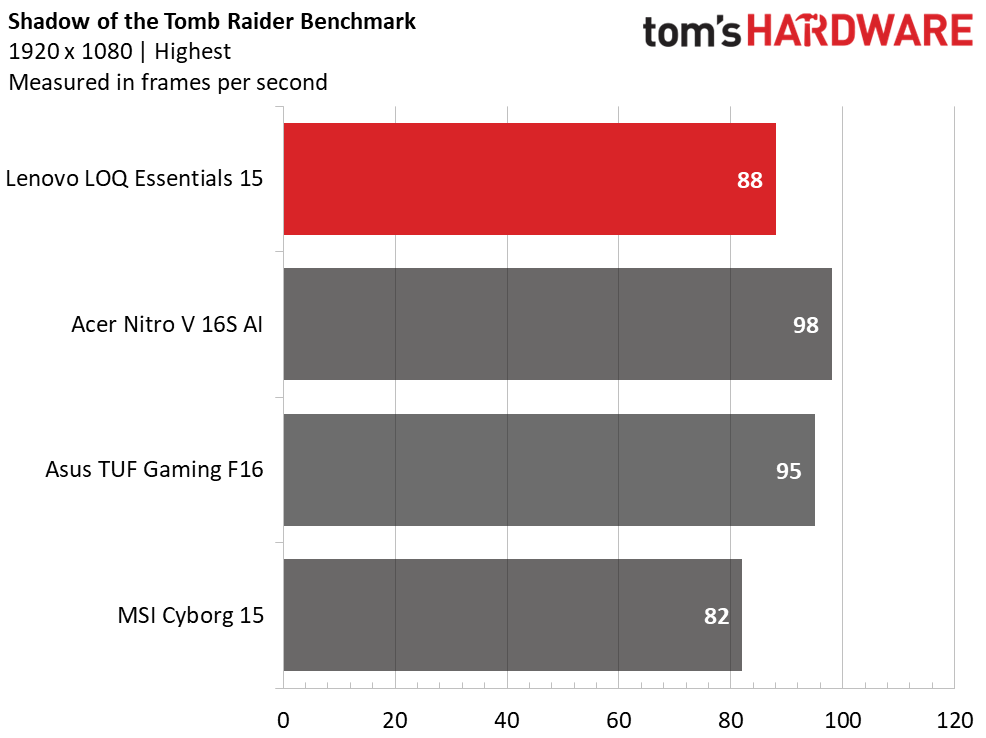
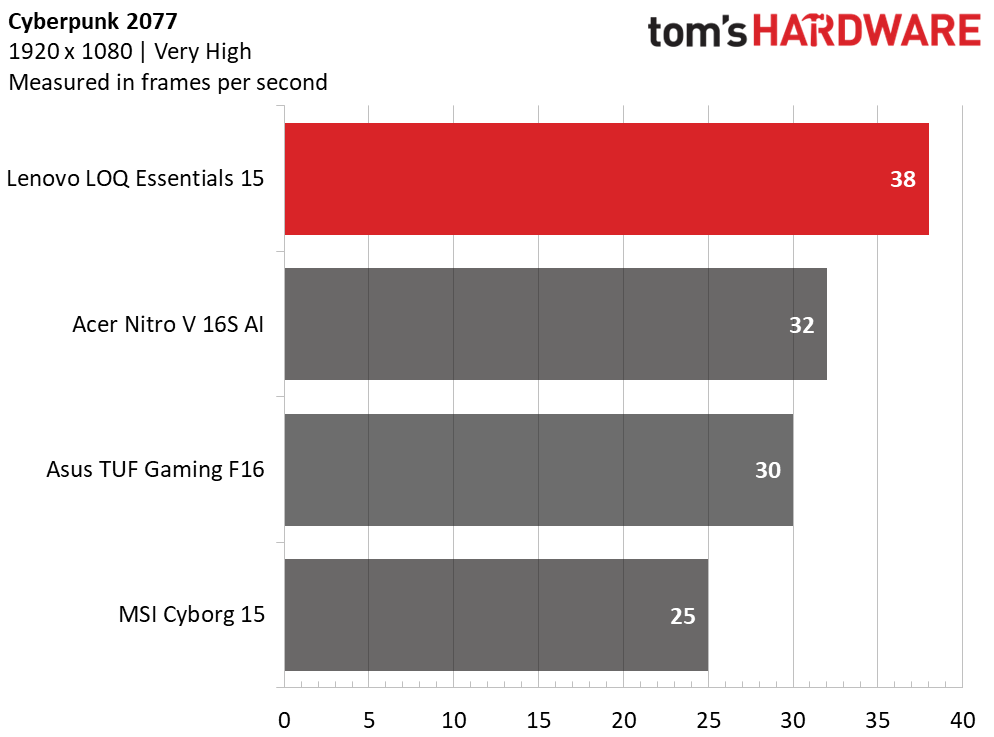
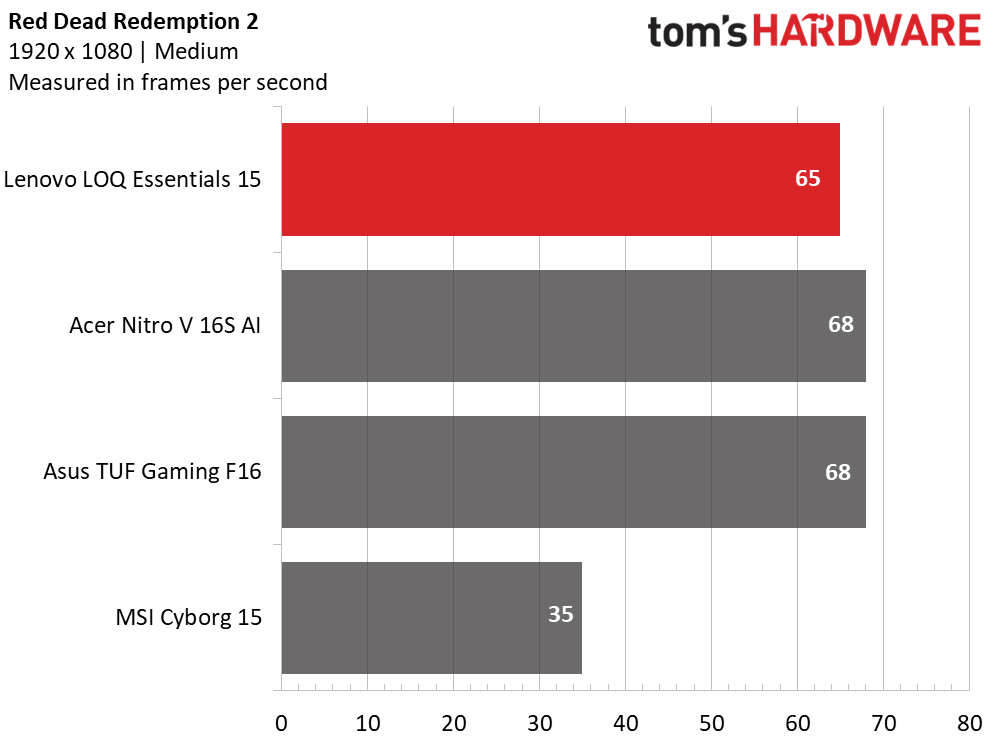
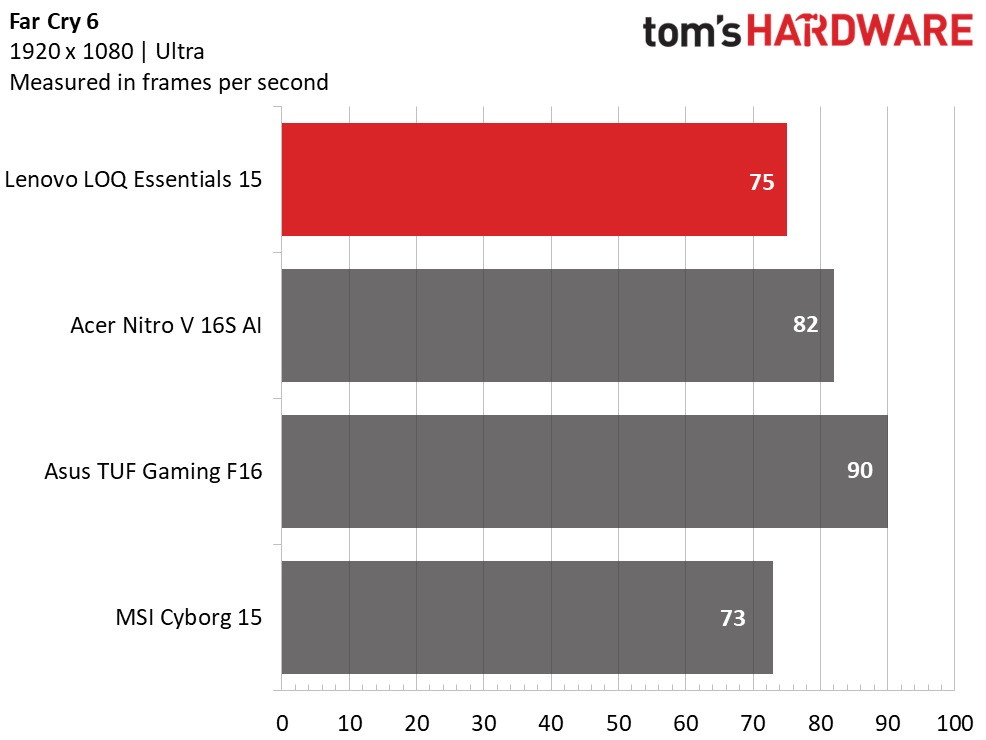
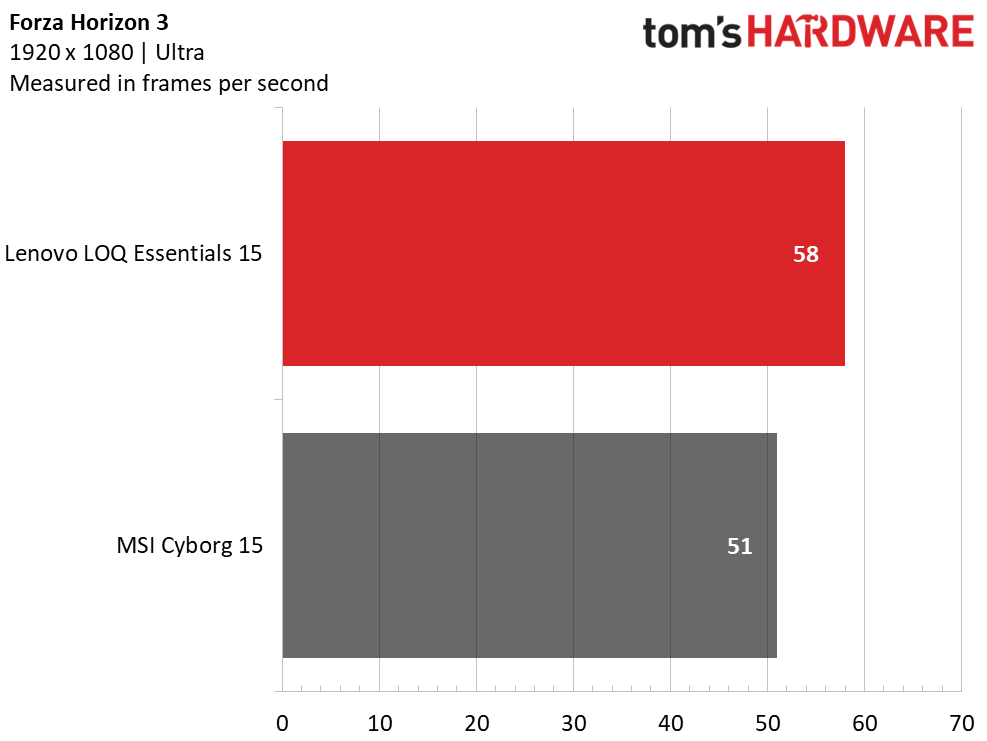
In Shadow of the Tomb Raider at the Highest detail preset, the LOQ’s 88 FPS only outpaced the Cyborg (82 FPS), while the Asus (95 FPS) and Acer (98 FPS) both pulled ahead. This story repeated in Far Cry 6 – with 75 FPS, the LOQ trailed Acer (82 FPS) and Asus (90 FPS), though it was within a few FPS of those units in Red Dead Redemption 2. The LOQ’s only real victory was Cyberpunk 2077, where it achieved 38 FPS, with the Acer (32 FPS) trailing. The LOQ was one of two laptops tested with Forza Horizon 3, where it predictably had no trouble outgunning the Cyborg, 58 FPS to 51 FPS.
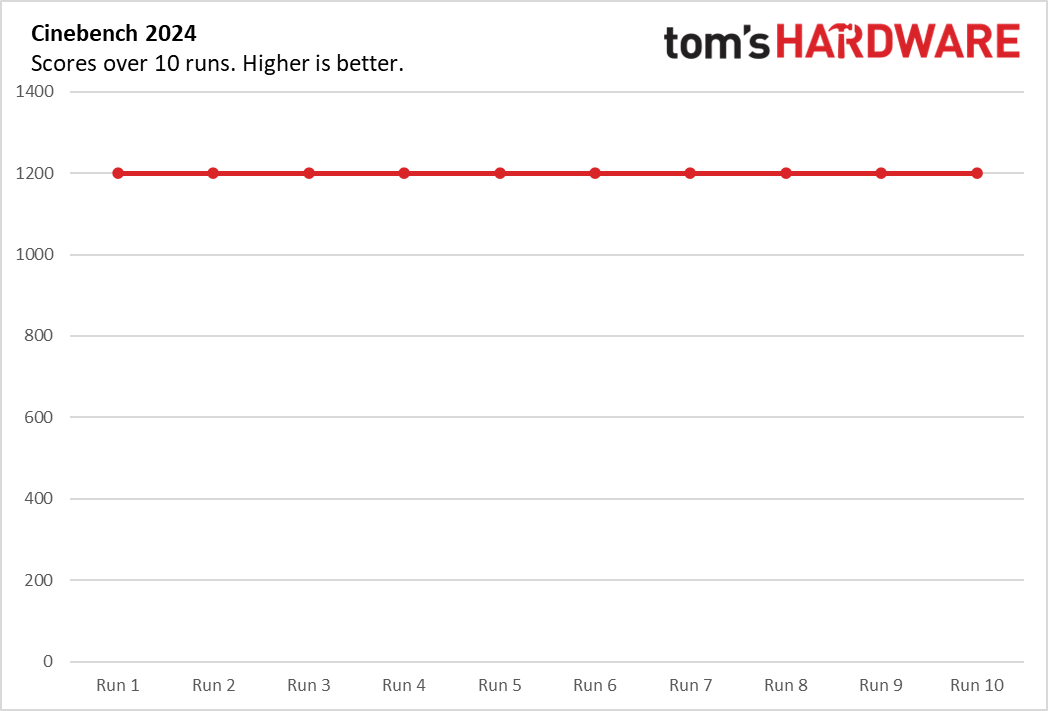
To stress-test gaming laptops, we run 15 loops of the Metro Exodus stress test at RTX settings to simulate half an hour of gaming. The LOQ demonstrated stable performance throughout the test, averaging 59.79 FPS without a variance of more than one FPS across runs. During the test, the Core i7-13650HX ran at an average frequency of 2.73 GHz while the RTX 5060 averaged 1,919 MHz.
Productivity Performance on the Lenovo LOQ Essentials 15 Gen 11
Our LOQ Essentials 15 Gen 11 is built around a Core i7-13650HX, 16GB of RAM, and a 512GB SSD.
Tom's HardwareTom's HardwareTom's Hardware
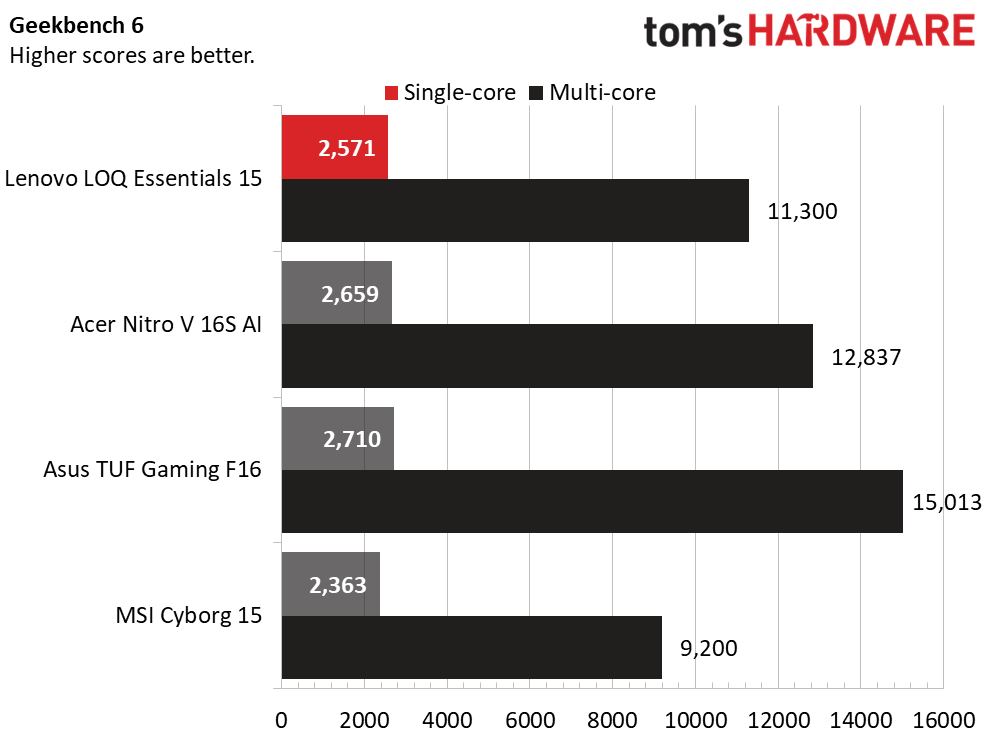
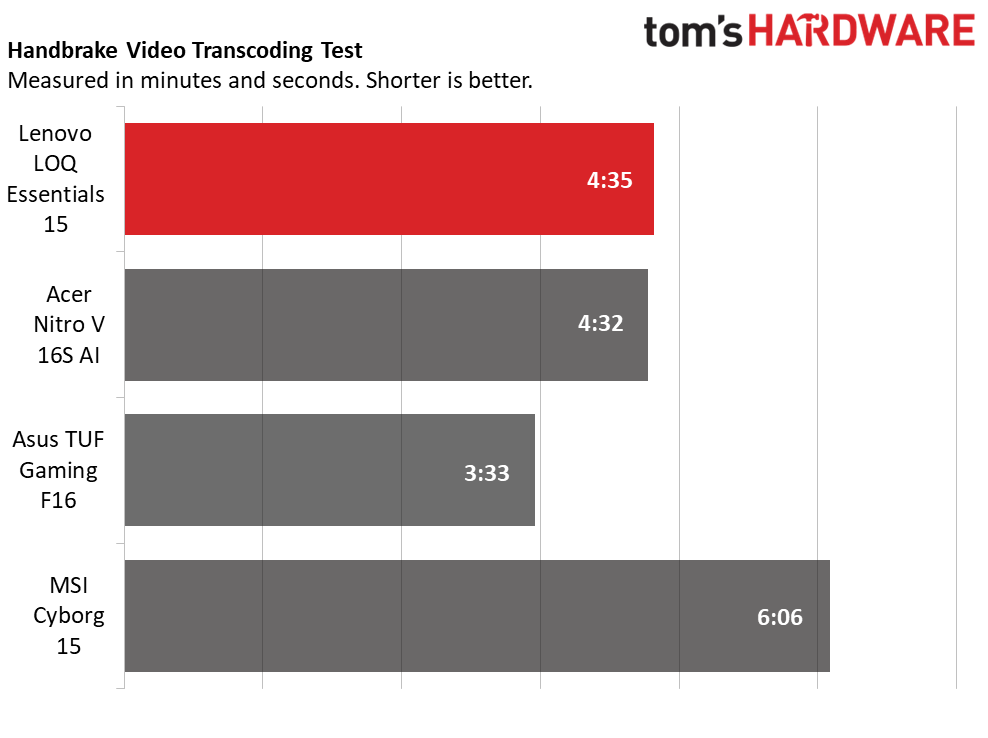
Throughout our testing, the LOQ's outdated CPU struggled against the newer silicon in the competition, only consistently outpacing the Cyborg with its equally dated Core i5-13420H. In the multi-core portion of Geekbench, the LOQ's score of 11,300 was well behind the Ryzen 7 260-powered Acer (12,837) and couldn't touch the Core i7-14650HX-powered Asus (15,013). The Asus also dominated Handbrake, completing that test in 3 minutes and 33 seconds compared to the LOQ's 4:35.
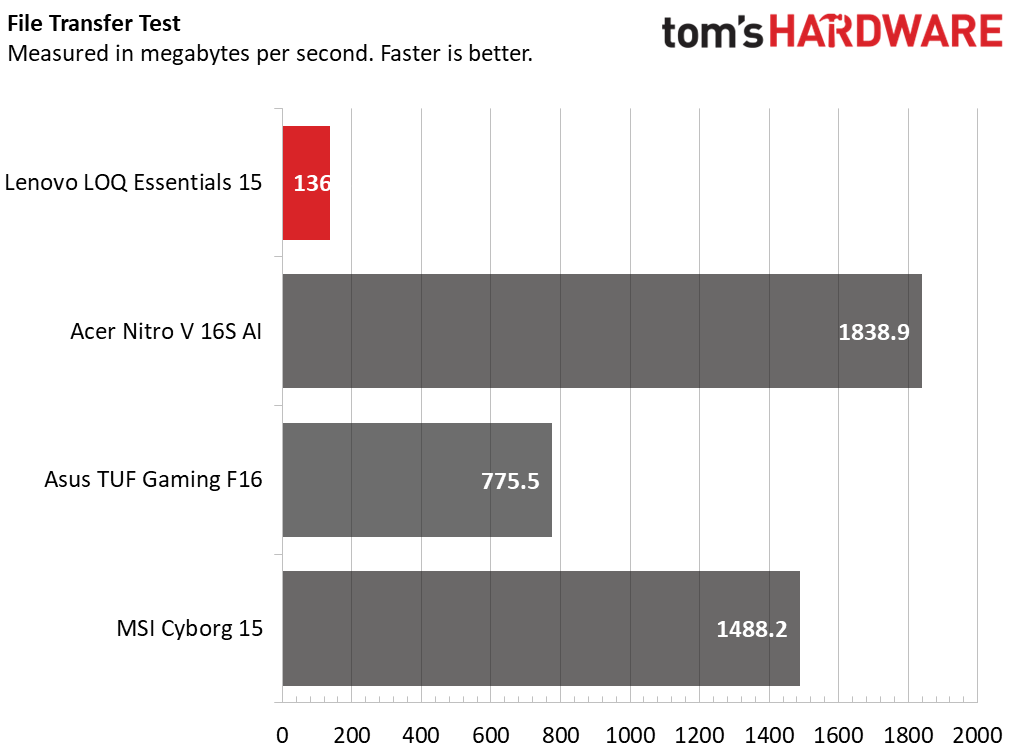
The LOQ's average speed of 136 MBps in our 25GB file transfer is abnormal, but it also occurred on other drive benchmarks, though I never noticed any issues in loading games. The drive is a WD PC SN5000S using QLC.
Display on the Lenovo LOQ Essentials 15 Gen 11
Lenovo didn't cut too many corners with the LOQ's display. The 15.6-inch IPS panel pairs a smooth 144 Hz refresh rate with an anti-glare finish that minimizes reflections. While the 1920 x 1080 resolution isn't especially sharp by 2026 standards, it isn’t too hard for the RTX 5060 to drive in today’s games.
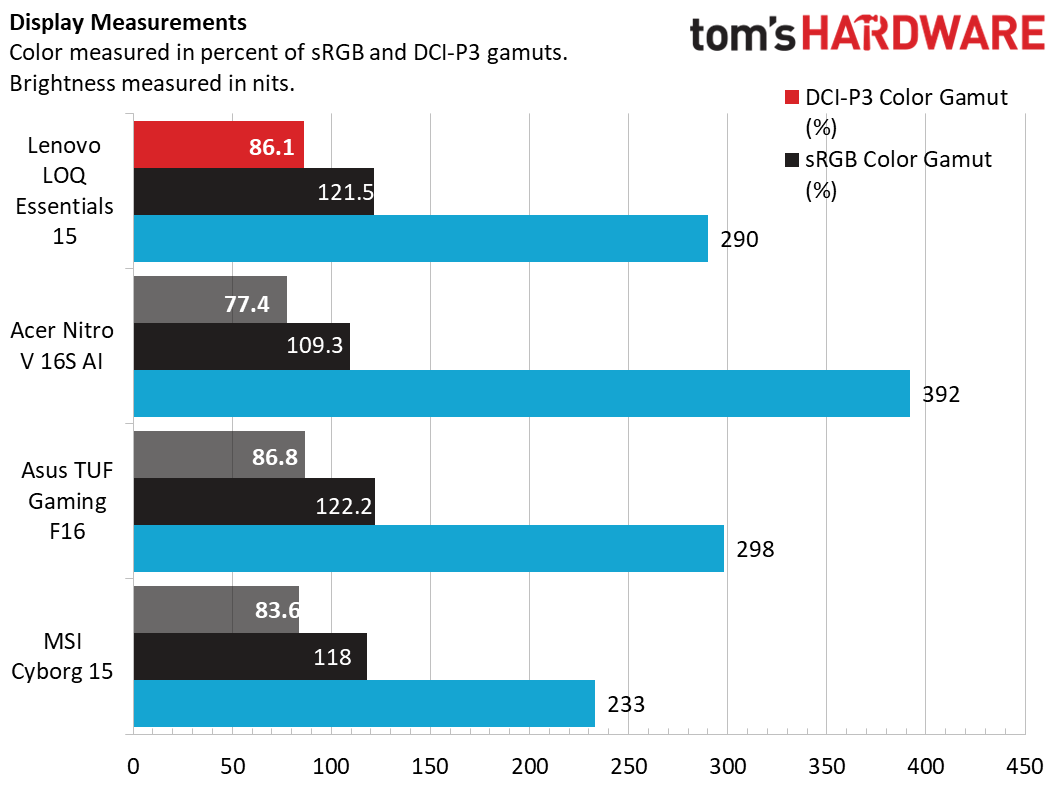
Watching X2: X-Men United and playing 007 First Light, the LOQ’s display stood out as one that’s better than typical budget laptop fare. Colors have enough punch to make game environments feel lively, and enough contrast to give darker scenes reasonable depth. Brightness is just adequate – the panel is best suited for indoor use and can't compete with the significantly brighter screen in Acer's Nitro V 16S AI. Still, for gaming, streaming, and everyday use, the LOQ's display is one of its better attributes.
(Image credit: Tom's Hardware)
Covering 86.1% of DCI-P3, the LOQ’s display proved more colorful than the Acer (77.4%) and effectively tied the others. Its 290-nit peak brightness was on par with the Asus (298 nits) and brighter than the MSI (233 nits) but not nearly as bright as the Acer (392 nits).
Keyboard and Touchpad on the Lenovo LOQ Essentials 15 Gen 11
Lenovo’s keyboard offers an ample 1.3 mm of travel for comfortable typing sessions. Its two-level white backlighting provides excellent visibility in low light. The number pad isn’t quite full-size but offers the expected layout. In MonkeyType, I reached 122 words per minute with 99% accuracy on the first try.
The touchpad is also well-designed, with a comfortably-sized surface and quiet physical clicks.
(Image credit: Tom's Hardware)
Audio on the Lenovo LOQ Essentials 15 Gen 11
The LOQ's twin 2W speakers produce acceptable sound for a laptop. Bass is lacking, but the sound is clear enough to pick out footsteps and shell cases dropping in games. Overall, the setup works for casual gaming.
The included Nahimic app is essential for sound quality – without it, the speakers are tinny and dull. The Music preset with bass and treble boost works well all around. The Smart preset also gets the job done; my ears didn't detect much of a difference versus the Music preset. The Movie preset's virtual surround adds a hollowness that I find unnatural.
Upgradeability of the Lenovo LOQ Essentials 15 Gen 11
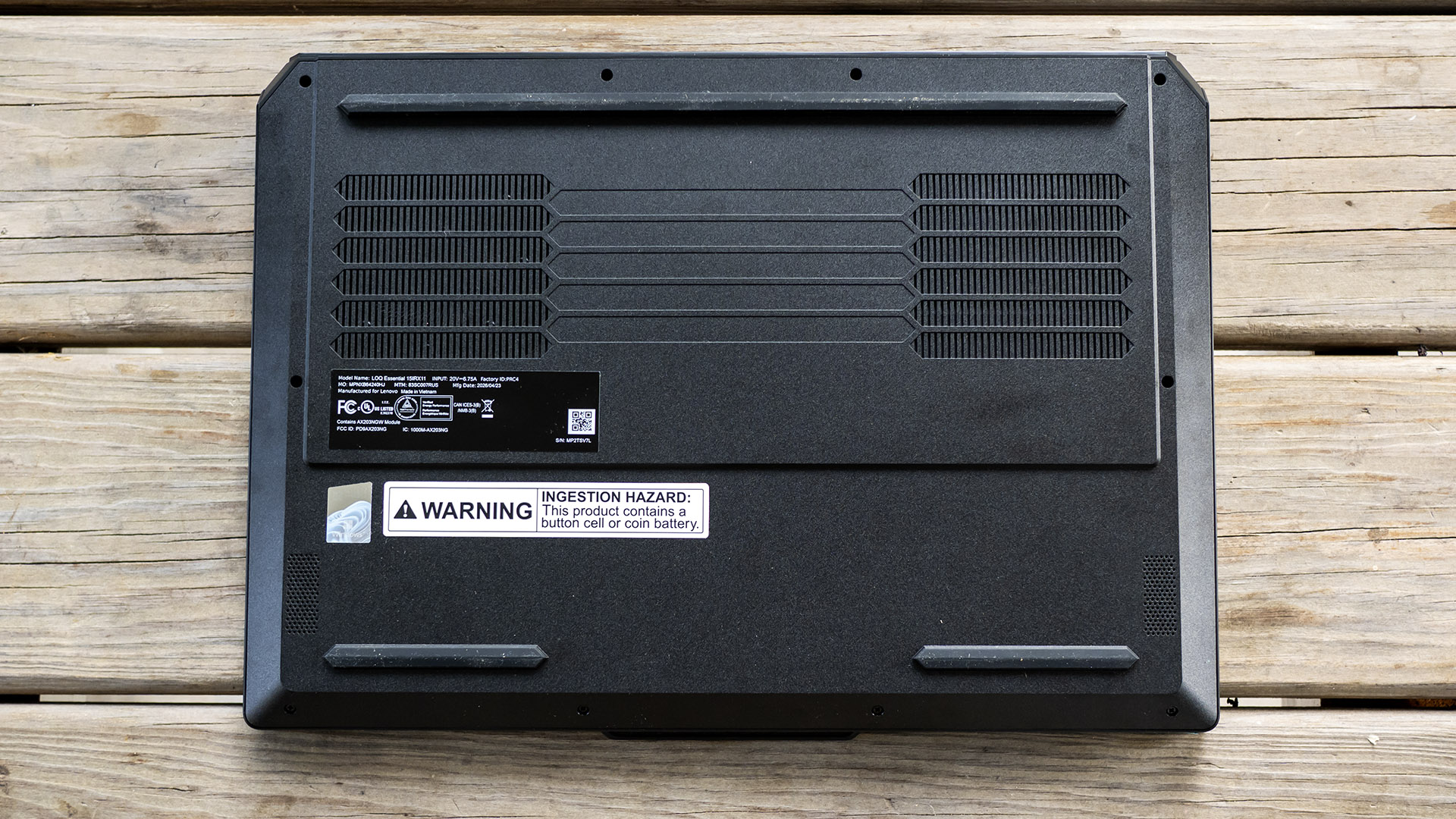
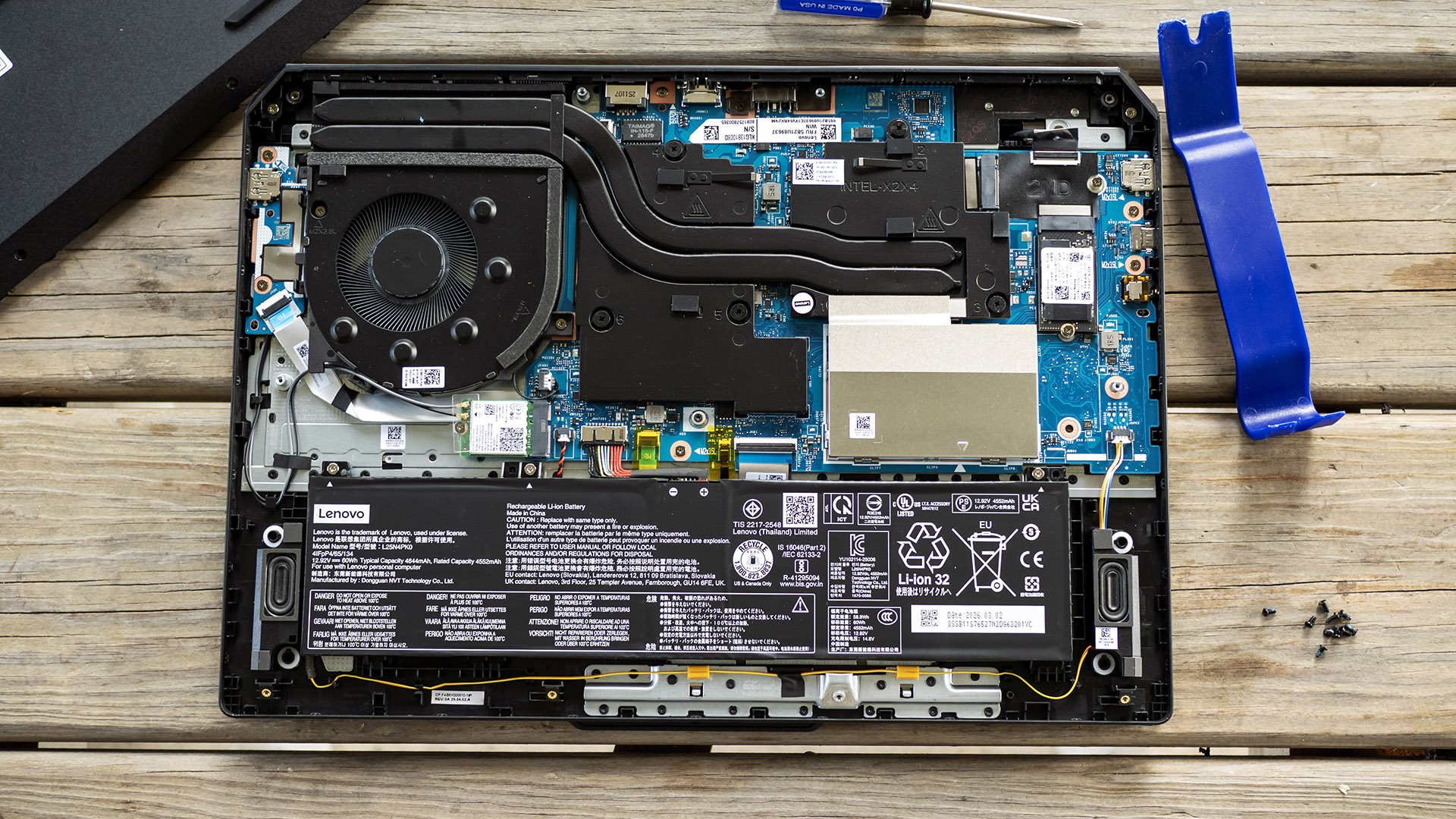
Getting inside the LOQ is somewhat tricky. Removing the Philips-head screws is straightforward – they’re fortunately all the same size – but the bottom panel sits flush with the chassis edges, with no obvious entry points. I created one using my thumb to push in one of the rear chassis corners, which created a gap for my plastic pry tool.
Upgrade prospects are excellent, with two DDR5 SODIMM slots and two SSD slots, one M.2 2280 and one M.2 2242. The 512GB SSD in our model is M.2 2242 format and installed in the M.2 2280 slot. The M.2 2230 wireless card and the battery are also replaceable.
Tom's HardwareTom's Hardware
Battery Life on the Lenovo LOQ Essentials 15 Gen 11
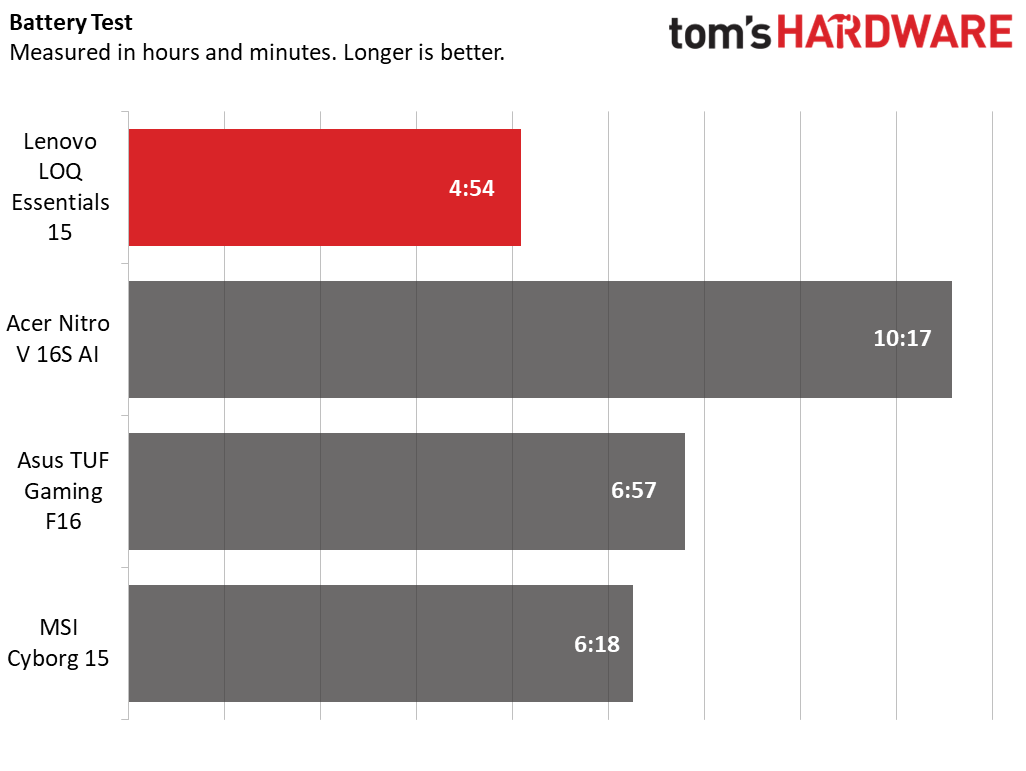
Our battery testing consists of web browsing, running OpenGL tests, and streaming videos with the screen at 150 nits while connected to Wi-Fi. The LOQ's runtime of 4 hours and 54 minutes is short even for a gaming laptop, with the Asus lasting about two hours longer. Acer's Nitro completely outclassed it, lasting 10 hours and 17 minutes.
(Image credit: Tom's Hardware)
Heat on the Lenovo LOQ Essentials 15 Gen 11
We measure laptop surface temperatures while running the Metro Exodus stress test. The LOQ's peak temperatures were 108 degrees Fahrenheit (F) between the G and H keys while the touchpad was 79 F. The highest temperature was 112 F on the bottom near the cooling fan exhaust. Internally, the Core i7-13650HX measured 70 degrees Celsius (C) while the RTX 5060 was 66 C.
The LOQ’s fan noise is noticeable while gaming, but is no louder than other entry-level gaming laptops I’ve tested. Its speakers are easily loud enough to be heard over the fans.
Webcam on the Lenovo LOQ Essentials 15 Gen 11
Lenovo's webcam is a basic 720p model with a soft focus. It handles lighting reasonably well – a lamp behind me wasn't blown out – but detail is lacking and there's considerable grain. There's no physical shutter, but you'll find an e-shutter switch on the right edge.
Software and Warranty on the Lenovo LOQ Essentials 15 Gen 11
The LOQ includes two main apps. Legion Space shows component readouts like CPU speed and temperature, plus power profile toggles between Performance, Quiet, Balanced, and Custom. The app can also auto-disable the Windows key and auto-close specified apps when games are launched, and prioritize network traffic to apps you specify. An aim assist feature puts a crosshair in the center of the screen. The app also provides access to the Lenovo community and can be a game library.
The Vantage app is familiar across Lenovo laptops for support services, troubleshooting utilities, and system updates. System settings include battery smart charging (limits charge to 80% to extend battery lifespan). The app also has a security advisor that verifies anti-virus and firewalls are active and tells you if a Wi-Fi network is safe. The app contains upsells for Lenovo’s identity protection, system recovery, and performance tuneup subscription services.
Lenovo backs the LOQ with a one-year warranty.
Lenovo LOQ Essentials 15 Gen 11 Configurations
We tested the LOQ equipped with a Core i7-13650HX processor, RTX 5060 graphics card, 16GB of DDR5-4800 single-channel RAM, and a 512GB SSD, retailing for $1,269.99 at Best Buy. It was not yet available directly from Lenovo at the time of this review.
An even more basic spec with a Core i5-13450HX and RTX 5050 is listed on Lenovo's site as "coming soon" but wasn’t at the time of publishing. All configurations include a 1920 x 1080 IPS display with a 144 Hz refresh rate and Windows 11 Home.
Bottom Line
Lenovo’s LOQ Essentials 15 Gen 11 is a reminder that spec sheets don’t tell the whole story. While it delivers an RTX 5060 and a 144 Hz display for a competitive price, its conservative GPU power limits and older platform leave it trailing rivals in real-world performance. Though it gets many fundamentals right -- its display, keyboard, and upgradeability are all solid – it’s ultimately a serviceable gaming laptop rather than a competitive one. At this price, Acer’s Nitro V 16S AI is a stronger value.
It can seem a little doom-and-gloom when shopping for computers in the current climate. Trying to find a laptop that has your desired hardware specifications and doesn't require selling your firstborn is getting harder and harder. Prices have been creeping up thanks to massive spikes in RAM and storage costs, with the AI boom sucking up all the manufacturing and stock resources. The future is uncertain, but what is currently available can sometimes be found with a decent discount. Best Buy is currently running a limited-time deal on Gigabyte's Aero X16 gaming laptop with RTX 5060 graphics, and asking $1,199. This is a quick $100 saving off the usual $1,299 asking price.
The Aero X16 is powered by a Ryzen AI 7 350 processor, which is based on AMD’s Zen 5 architecture. It has four Zen 5 cores and four Zen 5c cores, with a max boost of 5 GHz (3.5 GHz for the Zen 5c cores). Not only does it come with the powerful AMD processor, but it's also packing dedicated graphics processing power, with Nvidia's RTX 5060 laptop GPU with 8GB of GDDR7 VRAM. A solid combination for chomping through the latest games and giving respectable frame rates on sensible settings.
Another boon to this budget laptop deal is the inclusion of a healthy amount of memory. This model of the Aero X16 comes with 32GB of precious DDR5 RAM installed. This alone gives this deal an advantage, as upgrading memory capacity has now become an extremely expensive affair.
The Gigabyte Aero 16X packs a Ryzen AI 7 350 CPU, 32GB of RAM, and an RTX 5060 GPU. The 16-inch screen has a crisp 2560 x 1600px resolution and 100% sRGB color space coverage.View Deal
The laptop’s native resolution on the 16-inch IPS panel is 2560 x 1600px. A very crisp resolution for a small screen that offers tight pixel density. The display has a max refresh rate of 165 Hz, with a 3 ms gray-to-gray response time, and 100% sRGB color space coverage. The screen also outputs a reasonable 400 nits of brightness, so the games and media can be easily viewed in both darkened and overly light environments.
As for physical ports, the laptop features plenty of connectivity with three USB 3.2 Gen 1 Type-A ports, a USB-C port (USB4), an HDMI 2.1 port, a GbE port, and a 3.5 mm headphone jack. For wireless connectivity, there’s Wi-Fi 6E and Bluetooth 5.2.
You can save $1,000 on a truly high-end gaming laptop that, for many, is way over the top for the average user in both hardware and price. But if you want the most powerful laptop gaming setup, or a portable desktop replacement, then this Lenovo Legion 9i gaming laptop from B&H Photo, priced at $5,799, is something you should check out. It's certainly not your average gaming laptop, as it comes with the top-tier halo components from Intel and Nvidia, and is absolutely massive at 18 inches.
Gaming laptops have always been more expensive than desktop gaming PCs with comparable components, even with the comparable components not being as powerful as their desktop counterparts due to the size, power, and heat limitations of stuffing hardware components into a smaller laptop chassis.
This model of the Lenovo Legion 9i contains the most powerful laptop graphics card available, Nvidia's RTX 5090 with 24GB of GDDR7 VRAM, and Intel's Core Ultra 9 290HX Plus 24-core processor, plus a massive 64GB of DDR5 RAM (2 x 32) with four RAM slots available, able to support up to 192GB of total RAM. For storage, there is a 2TB SSD, with Windows 11 Home edition pre-installed.
The luxurious 18-inch display features a detailed 3840 x 2400 resolution with a 3ms gray-to-gray response time. The display can reach up to 240Hz at native resolution and up to 440Hz when set to an FHD resolution. The display uses an IPS panel with 520 nits of brightness and a color gamut of 100% DCI-P3
Play your favorite PC games with high frame rates and smooth gameplay with an Intel Core Ultra 9 24-Core processor, RTX 5090 laptop graphics card, 64GB of DDR5 RAM, and a 2TB SSD.View Deal
The Lenovo Legion 9i also uses the latest Thunderbolt 5, WiFi 7, Bluetooth 5.4, and 2.5GbE Ethernet. The keyboard is fully RGB backlit with chiclet-style keys. This is a very powerful gaming laptop that you can also use for some serious creative work and go hard on some smaller local LLM models if you want to dabble with some AI workloads.
It is a very expensive laptop, made more costly by the price of RAM and NAND in the current economy. Still, it's also $1,000 cheaper than the usual price, so if this kind of laptop is something you're interested in, then head to B&H Photo and check out the RTX 5090-powered Legion 9i available for $5,799.
It's that time of year when you need to start thinking about prepping for starting a new semester or heading off to college. One of the handiest items to get a hold of is a competent laptop computer for doing lots of your coursework on. If that same laptop also happens to be able to play games, well, that's a big bonus. Shaving a massive $900 off the list price, HP's HyperX Omen 16 gaming laptop is now just $1,099.99. That's a superb price for a laptop that packs an RTX 5060 mobile GPU and a crisp 16-inch 2K display.
The HyperX Omen 16 packs some seriously good components for the price tag, as finding a capable RTX 5060 gaming laptop for near $1000 is a rarity in today's computer market. Inside the chassis of this model of the Omen 16 is an AMD Ryzen 7 8745HX processor, an Nvidia GeForce RTX 5060 laptop GPU with 8GB of dedicated GDDR7 VRAM, 16GB of RAM, and a small 512GB SSD. The display measures 16 inches diagonally and has a crisp 2K (1920 x 1200) resolution with a max refresh rate of 165Hz and a 3ms gray-to-gray response time. The IPS panel has a micro-edge display, anti-glare, low blue light emissions, a brightness of 400 nits, and 100% sRGB for the color gamut.
HP's HyperX Omen 16 features an AMD Ryzen 7 8745HX processor, an Nvidia GeForce RTX 5060 laptop GPU with 8GB of dedicated GDDR7 VRAM, 16GB of RAM, and a 512GB SSD. It's a capable gaming laptop with a crisp 16-inch IPS display and a fast 165Hz refresh rate. View Deal
We haven't had the opportunity to review this particular model of the HyperX Omen 16, so we can't fully use our Omen 16 review as a fair comparison. Our review unit used the much more powerful RTX 5080 GPU and Intel Core Ultra 9 275HX CPU. The components that are included in this model, though, are very familiar, so we do have a good idea how they will run, and the chassis, screen, and features of the Omen 16 will overlap.
The RTX 5060 will be able to run games smoothly on the 16-inch 1920 x 1200 display, and will be able to make use of Nvidia's DLSS software to increase framerates for a smoother experience on more taxing titles.
So if you're looking for a competent laptop for heading back to school, you can't go far wrong with this $1,099 deal on the HyperX Omen 16 for both work and play.
For that, you get Nvidia's punchy mobile RTX 5070 GPU, 32GB of RAM for gaming and multitasking, 1TB of storage, and a nifty 2560 x 1600 WQXGA display. Given the current prices of RAM and storage, getting a laptop of this spec at this price is pretty much unheard of these days. We actually covered the HX 350 version of this laptop at $1,389 earlier this month. This deal gets you a snappier HX 370 CPU for just $10 more.
Get the Gigabyte Aero X16 with RTX 5070, 32GB of RAM, 1TB SSD, and AMD's Ryzen AI 9 HX 370, a 12-core CPU. View Deal
We've actually reviewed the aforementioned 350 version of this laptop, where we praised the Aero's excellent productivity performance, good battery life, and scope for upgradeability. However, it was let down by its display and performance given the price. At the $1,399 discount, however, it becomes a much more enticing prospect. As you can see, it sails past rivals in our battery test, scoring nearly an hour longer usage compared to its next-closest rival.
(Image credit: Tom's Hardware)
As you can see from our gaming benchmarks, the Aero X16 can easily deliver over 100 fps in Shadow of the Tomb Raider at 1080p, or 64 fps at its native 2560 x 1600. It's not the most potent gaming laptop on the market by any means, but it's one of the best-value options given the sub-$1,400 price point on offer here.
Our productivity testing is based on AMD's Ryzen AI 7 350 processor. This 8-core CPU delivered decent Geekbench 6 scores, so expect the 12-core 370 in this model to offer better performance still and also give gaming a much-needed boost, with 24 threads and boost clocks of up to 5.1 GHz.
The other specs of this laptop, notably the 32GB of RAM and 1TB SSD, are also impressive. 32GB of DDR5 is worth nearly $400 these days, and that'll get you all the multitasking and performance you need for work and play. While this isn't an OLED laptop, the 2560 x 1600 display offers a refresh rate of up to 165Hz.
As the 'Aero' moniker suggests, the X16 is also thin and light. It measures just 0.65 inches in thickness and weighs 4.18 lbs, making it a very portable option. You'll also be pleased to know that the laptop can be upgraded in the future, with two SODIMM memory slots and two M.2 drive slots offering you headroom to add RAM or storage later in life.
 登录
登录